"If a community, or a section, or a race, or an age, is groaning under industrialism, and well aware that it is an evil dispensation, it must find a way to throw it off. To think that this cannot be done is pusillanimous. And if the whole community, section, race, or age thinks it cannot be done, then... it has doomed itself to impotence." —Twelve Southerners

Four-Wheelin’ Stone Pickers

Those of you who have read my Christian-agrarian memoir, Writings of a Deliberate Agrarian may recall Chapter 30: “My Son and His Journal.” In the beginning of that chapter I explain that my son Robert really wanted a 4-wheeler of his own. The neighbor boys had 4-wheelers that their parents had bought them, but I would not buy one for my boys. They would have to work and save the money. I wrote about that back in 2005.

Here’s an updated report: Late last summer Robert did buy his own 4-wheeler. He worked and saved and looked long and hard for something halfway decent that he could afford. He ended ended up buying a used Yamaha Blaster from a friend of a friend. Robert and his two brothers blasted all over the countryside with that thing until it finally broke down in the fall.

We moved the 4-wheeler into Marlene’s mother’s garage for the winter and Robert set up shop. He studied the repair manual at length, took much of the vehicle apart, and replaced some basic parts that were worn. He bought the parts he needed on Ebay. But Robert was hesitant about getting into the engine, where the main problem was.

Earlier this spring, he took the 4-wheeler to a guy up the road who is an auto mechanic for a garage by day and does some part-time mechanic work on the side at his home. The guy did a great job of explaining and showing Robert what the problem was and the work that was needed, and he did the work for a reasonable fee. So, first thing this spring, Robert and his brothers are back riding the 4-wheeler.

I have to admit that getting the little vehicle has been a very good thing. Robert and James can now drive themselves to the nearby farm where they sometimes work. And Robert has learned a lot about small engines. He is always doing some maintenance task and is intimately familiar with every screw and part on the machine.

Last week Robert and his younger brother, James, picked stones for a diary farmer every afternoon for around four hours. They have done this for the past couple of years for three different farmers. They are experienced rock pickers. It was hot and dry here all last week and the rock pickers came home dirty but well-satisfied with themselves. Here’s a picture of James & Robert after picking rocks:

Photobucket

At 13-years-old James is going through a phase where he does not like to smile for the camera. Or, if he does, it is only for a split second. So we got the serious look. By the way, he’s drinking a root beer (personally, I never touch the stuff).

What do you suppose two hard-working country boys would want to do after a few hours of picking rocks in the hot sun?

Photobucket

Oh look.... there’s a little bit of a smile. What could be more fun that digging a few worms and going fishin' with your brother at a nearby farm pond? You can get there lickety split on your 4-wheeler. They went fishing every evening last week. The neighbor’s pond has some nice largemouth bass, as you can see.

James didn’t have a tape to measure the fish, so he held the critter along his arm to gauge the length before throwing it back in the pond.

Photobucket

We measured later and the fish was around 16” long. You can see a portion of the Blaster in the background.

I don’t know if they fully realize it, but my sons are blessed. To be boys, living in the country, in a Christian home, with farm work to do, a 4-wheeler to drive through the woods and fields, and fish to catch in a well-stocked pond, is about as good as it gets.

And I, for one, am very thankful to God for such blessings.

Confessions of a Wheat “Hoarder”

I’ve read numerous internet reports in recent days of people around the world hoarding food, particularly rice. My family doesn’t eat much rice. But if we did, I’d have hoarded a supply of it before now. That’s because I’ve been a food hoarder for years.

We hoard all kinds of food. We hoard wheat in plastic pails. We hoard crates of potatoes and net bags of onions. We hoard canning jars of applesauce, green beans, and dried beans. We hoard a freezer full of chickens and beef. If we eat much of something, we probably hoard it to some degree.

But we don’t call it hoarding. And we don’t condider it hoarding. We call it stocking up. It’s nothing new. It’s what rural folk have done for centuries. Traditionally speaking, stocking up just makes sense.

I’ve been thinking about this a lot lately. It has occurred to me that I may be a food “hoarder” because of a childhood experience. When I was maybe eleven years old, my stepfather went into the hospital for surgery. He was in his middle 30s. The industrial laundromat where he had worked for several years, promptly fired him when he got sick. He came home from the hospital after a week and I was shocked to see how feeble he was. He recuperated at home and was out of work for a long time. My mother did not work outside the home. Finances were tight.

During that time, my parents came home one day with rice, powdered milk, cheese, and some other foods that thay had gotten for free from the government. They did this several times until my father got healthy and found work.

I didn’t like the government food. I didn’t like it that we were poor and needed “welfare.” I worried about it then. I worried about my parents finances for years after that.

Later, when I was in high school and had a part time job, I actually bought a supply of canned foods and stored the hoard in boxes under my bed, just in case. I guess I was traumatized for life when I was eleven years old. Maybe I should see a psychiatrist. :-)

When Marlene and I were married, we got involved in a co-op group. Bulk foods would be delivered to a local church and everyone in the co-op got together to divide it up. It was a “community thing” and a fun time. We bought all kinds of food in bulk and stored it in our two-room apartment in town. Some of it we stored in freezers at our parent’s homes. Buying in bulk was cheaper, and it was a good feeling to know we were stocked up, just in case.

When I started a chimney cleaning business, I remember cleaning the chimney of an older man who was a Mormon. He had a small home business making and selling electric grain grinders. I was fascinated. He explained to me that Mormons store grain and other food, just in case. This resonated with me. I knew enough about Mormonism that I felt it was unbiblical and wrong. But the food storage thing struck me as a very practical and wise thing to do.

And so it is that Marlene and I have always stocked up to some degree or another over the years.

Then came Y2k. Do you think we stocked up extra for Y2k? You better believe it! We got real serious about stocking up back then. A lot of people did. It was a practical and wise thing to do, just in case.

One of the things we really stocked up on back then was hard red winter wheat. I think we had over half a ton of it packed away in 5-gallon pails. The pails were stacked to the ceiling in our basement. We did that in 1998.

What does a family do with that much red wheat in the basement? Well, if you have a grain grinder, you can grind the grain into flour and make bread. That’s what Marlene has done for the past ten years. The stack of buckets has dwindled substantially. It is now more than 3/4 gone. Of course, if you have a little home bread baking business (as my wife does) that can use a lot of wheat too.

We haul the wheat, a bucket at a time, up from the basement and Marlene grinds it in an old, electric, Marathon grain mill. The mill was given to my mother by a friend and eventually handed on to us. The Marathon mill looks a lot like the grain mills that old Mormon guy made in his home. It employs stone burrs to do the grinding. The appliance gets a lot of use, has never given any problem, and does a great job. We have a hand-operated grinder for backup.

I’ve been saying to Marlene for over a year that I think we should restock some wheat in the basement. Now we’re finally getting to it. If I had restocked a year ago, I could have saved a lot of money. The current price for a 50 lb bag of “certified chemical free” hard wheat “berries” is $37. Six weeks ago, the same wheat was $26. I don’t recall how much a bag of wheat was in 1989. Probably around $13.

You might wonder about the quality of 10-year-old wheat that has been stored in my basement. Well, we took some pains to properly store the grain, and it is perfectly preserved.

What we did (and what we plan to do again very shortly) is utilize used plastic buckets (with lids) that we bought for a dollar each from a local dairy (they held ingredients for ice cream). We put a large mylar bag (20” by 30”) in each bucket, filled the bag with wheat, put in an oxygen absorber packet (500cc size), sealed the bag with a household iron, tucked it in, and put the lid on. Nothing could be easier. The oxygen absorber packet will remove the oxygen inside the bag, creating a vacuum. Stored thusly, wheat (and other grains) will keep very well for decades.

Pictures and more detail about the procedure I just explained can be found at this link: Walton Feed Mylar Food Storage Tutorial.

You can purchase mylar bags and oxygen absorbers from Walton Feed in Idaho. But, sorry to say, they have a terrible procedure for ordering. I recently tried ordering some mylar bags and O2 absorbers from them and it was frustrating.

I think Walton Feed might be a Mormon-owned company and Marlene suggested to me that maybe they don’t give good service unless you are a Mormon. I told her that they don’t know if I’m a Mormon or not. All they know is my name and address. But then it occurred to me that maybe they can tap into the massive, underground, nuclear-bomb-proof, Mormon genealogical database, and they actually did find out I’m not one of them...... Nah, on second thought, they probably have a lousy ordering system for everybody. Too bad.

Whatever the case, I’ve found another company. Sorbent Systems looks like it has everything needed and their online ordering system looks like it should be a lot faster and easier (I’ll know for sure very shortly). If someone reading this knows of another source for these items, please post a response here with the information.

Well, there you have the Confessions of a Wheat “Hoarder.” I know I'm not the only one doing this. Like I said, it's something all Mormons do and it's something that most rural people traditionally do. I'll bet most people reading this are food "hoarders."

But maybe you aren't a hoarder. And maybe what I've written here is resonating with you right now. If so, I sure do hope you will stock up, just in case. Aside from going to the store and buying extra food, I hope you’ll put a garden in. Most of what we stock up here is actually food we’ve raised in the growing season. Potatoes, squash, and onions are easy to grow, easy to store, and good food for winter eating. Marlene makes a LOT of meals around potatoes.

=====================

A further thought.....

I had some reservations about publishing this essay. I wondered if it was wise to tell the whole world that we have buckets of wheat in our basement. But, in the end, I concluded that writing this may encourage others to stock up. And if that happens, that's a good thing. At least I think it is. (Then again,, as you all know now, I was mentally "damaged" in my youth.)

Besides that, 99% of those who read this blog do not live anywhere near me. Those that do, and that I know of, are country folks who I suspect are stocked up themselves. And regardless, I’m more than willing to share what I have, as I can, with my neighbors if they are ever in need.

Beyond that, there are, of course, the worst case scenarios. You can read those on some survivalist web sites. I’m not going to entertain such hypotheticals here. That would not be productive.

=========================

And speaking of productive things, in an upcoming essay I will tell you about a couple of easy, tasty ways to prepare and eat stored whole grains (without grinding them into flour). Stay tuned.....

Hope For A Troubled America

This is a blog about faith, family, and livin’ the good life. My faith is Christian. I view the world through the lens of my Biblical worldview. That means I see things differently than most.

As I see it, a properly lived life is one in which Jesus Christ is acknowledged as sovereign Lord, wisdom and righteousness are pursued with humility, love and forgiveness are manifested, and the Bible is looked to as the first and final authority on all matters.

In “theory” such a statement would probably be accepted by most modern Christians. But, in practice, many who consider themselves Christians do not really believe all of that.

People who actually do believe what I stated in my second paragraph, and then act on their beliefs, are looked upon by other so-called Christians, and the predominant antichrist culture, as simpletons and fools at best, or dangerous threats to “freedom” at worst.

I know this from casual conversations about current events and religious subjects that I’ve been a part of with small groups of co-workers over the past eight years. When I voice my opinions in such groups, based on my Biblical worldview, the response ranges from dead silence, to laughter, to outright anger. People are astonished that I am so narrow-minded.

Though there are other men in the room who would categorize themselves as Christian (based, I suppose on a childhood church experience or occasional adult church attendance), not one of them actually accepts God’s word as total authority.

To speak up as a committed Christian believer in a group of worldly unbelievers about matters of morality (i.e., abortion) or religion (i.e., the inerrancy of the Bible), or any number of social issues, is an invitation to be verbally stoned by the crowd. Or maybe it is akin to Daniel in the lion’s den. Whatever the case, if you have been there, you know what I mean. It can be a real eye-opener. There is a lot of hostility in this nation towards any kind of Christianity that truly believes what Christianity teaches.

I am, by God’s grace, secure enough in my faith that I can handle the verbal slings and arrows. It is, after all, to be expected. But, frankly, there are times when I am astonished at what some people believe and defend. After numerous instances where I have been the lone crazy Christian, totally out of step with the mainstream opinion, I started to consider the biblical admonition about throwing pearls before swine.

Such confrontations of theological antithesis—man-centered theology vs Christ-centered theology—underscore something I do not like to think about, but which I nevertheless do think about...

My country is not at all what it once was.

Any honest examination of early American history will clearly reveal that America was founded on Biblical principles by people who held a Christian worldview. In other words, we were a Christian nation. That’s one of those statements that will get a group of unbelievers agitated (I know this from experience). But it is true. The preponderance of evidence is overwhelming.

Not all people who lived here in the founding years were Christians. But within the culture at large, the Bible was accepted and honored as a reliable standard of truth. And God’s law was accepted as a just foundation for American jurisprudence, even by the few founders who were not devoted Christians.

We were not a Baptist, or Methodist, or Episcopal, or Unitarian, or Presbyterian nation (though Presbyterianism was a powerful force). We were a monotheistic Christian nation. We were not a Muslim, or Hindu, or Buddhist, or Jewish, or Wiccan, or even a secular humanist nation. We were a Christian nation.

But that is no longer the case. Now we are a post-Christian nation. Christianity is acceptable as long as it doesn’t get in the way. Christians are okay as long as they conform, as long as they fall into step with the new polytheistic, secularized America.

And, thus, we who call ourselves Christians and live out our beliefs, have become strangers in a foreign land.

It is worth noting that he decline of Biblical worldview and of effective Christian witness, along with the rise of Christ-denying secularization, has paralleled the decline of agrarianism and the rise of corporate-industrial urbanization. Christian America is a thing of the past. Agrarian America is a thing of the past. This is no coincidence.

Christianity has always blossomed within the agrarian paradigm

”Where Christianity has existed in an agrarian culture, it has thrived and produced ample fruit. Where it has existed nominally in a non-agrarian culture it has proved to produce no fruit at all except apostasy. Examples abound. Christianity was born “outside the camp” in the rural areas of Israel and it found its greatest movement and growth once it scattered out of urban Jerusalem after the stoning of Stephen. It has been hunted down and persecuted by the great harlot city of Rome, while it thrived in the valleys and mountains of the Alps. It found Reformation in Germany, Switzerland, England, and Scotland only to suffocate again when it became the state religion in the great cities of those lands. It fled Europe for the wilds of Puritan America and thrived in the fertile soils of the New World, only to be choked out once again by the stony ground of northern industrialism and the growing urban state. Christianity is not just theology, and the sooner we realize and accept that, the faster we will grow into maturity.”

(excerpted from the essay, Towards a Biblical/Agrarian Culture by Michael Bunker)

As America has “freed” itself from the influences of Christianity and God’s Laws, we have become more and more like a ship with no anchor and no rudder. The map by which we can judge where we are and where we need to go has been discarded. We are adrift.

But those who run the ship assure us everything will be okay. After all, we are technologically advanced, and our scientific experts will solve the most pressing problems—just in time. Our financial experts will intervene and prevent any serious problems. Prosperity is our birthright. Our military is superior to any other. We are unbeatable. Our bloated and “benevolent” government will not only protect us from all enemies, foreign and domestic, it will also provide for We its subjects in our times of need. After all, that is part of what government is supposed to do, or so Americans have come to believe.

The “benevolence” of America extends to the entire world. We “bless” the nations of the world with our largesse. Yet we stick our noses into the affairs of other countries and we position our military forces in so many nations of the world. Most of the world hates us for it, and I don’t blame them.

We “The Haughty Empire” are a shining example of what every other nation can be if they embrace our ungodly way of life...

If the rest of the world would follow our example, they could be well-educated and materially successful heathens too. They could have WalMarts and McDonalds too. They would be able to buy more and more unnecessary stuff too. They could have big screen televisions and fancy cars too. They could have all the feculent trappings of an “advanced” civilization that has lost its bearings.

Like Esau, who squandered his birthright for a mess of pottage, America has squandered its rich and wise Christian heritage for a warped understanding of what freedom is, and what prosperity should be.

Let there be no mistake: the great ship of The Haughty Empire is doomed. Even now, deep in the bowels of the vessel, the engineers are worried. The engines are faltering. Cracks are forming in the hull. A storm is on the horizon.

No nation can turn its back on God, ignore His laws, and continue to enjoy His blessings of prosperity, safety, and peace. No nation can exalt itself against Him and survive. None. When a once-godly people depart from paths of righteousness, God will judge. And His judgment is not coming someday. It is happening now. America is in decline. The handwriting is on the wall.

But, thankfully, there is hope.

The hope isn’t that America as it is will survive and thrive for centuries to come. That option is out of the question for anyone who sees and understands the reality of who God is and how He has dealt with rebellious nations throughout history.

Rather, hope lies, first, within individuals—within those people who fear God, who understand that He is holy and they are not. Hope lies within people who understand they can never on their own meet God’s standards of righteousness and who understand that they are sinners, and who, then, by faith, embrace God’s gift of redemption and salvation through the shed blood of Jesus Christ. Hope lies within those who repent (turn away) from their sins.

The holiness of God, the sinfulness of mankind, the shed blood of Christ, and repentance are unpopular topics with the masses of modern heathen Americans. And, sadly, such things are unpopular with many who call themselves Christians. They are more concerned with reality television programs, or Hollywood stars, or politics, or the stock market, or sports, or _________ (fill in the blank).

But when an individual seeks righteousness and finds it in Christ, then there is peace. There is also an eternal hope that, regardless of outward circumstances, can not be taken away. That has been my experience. That is what I know. And let me be perfectly clear here: this unearned grace, this unwarranted mercy, this unmerited salvation is available to all.

That is the beginning of hope. Even in the midst of God’s judgment, such hope can and will sustain those who trust in it. But there is another possibility for hope in the midst of judgment. It is a fresh cultural hope for the future. It is a vision for restoration of Christian culture in America.

This vision, this hope, begins first with the awareness that modern Christianity and modern Christians are too much like the ungodly culture they live in.

Far too many modern Christians have the same career-oriented, mammon-grubbing focus as the ungodly. Far too many modern Christian men are as self-absorbed and irresponsible as the ungodly. Far too many modern Christians willingly enslave themselves to the ungodly bondage of monetary debt. Far too many modern Christians immerse themselves in ungodly forms of entertainment and amusements. Far too many modern Christians give their children to the secular education system for indoctrination. Far too many Christian women willingly choose a secular job—choose to be the helpmeet of men other than their husbands—choose to put their children in daycare. I could go on. In short, there is precious little difference between modern Christians and modern heathens.

And to make matters worse, far too many modern Christians are almost totally dependent on a world system that acts contrary to God’s laws and that hates what Christianity believes.

Christianity in the midst of secular, industrialized civilization has compromised and blended with the materialistic aspirations and vain imaginings of the ungodly culture to such an extent that it has emasculated itself. Modern Christians are not a peculiar people. The salt of modern Christianity has lost its savor.

Scripture makes it perfectly clear that Christians are not to be partakers of the ungodly world system:

Wherefore come out from among them, and be ye separate, saith the Lord, and touch not the unclean thing;..."
II Corinthians 6:17

For a new hope to rise in the midst of judgment, this awareness I speak of must permeate the thinking of all Christians who take their faith seriously. And when the awareness becomes clear, the question arises: How then should God’s people live in the midst of the “foreign land” they now find themselves in?

Well, the simple answer to that question might well be to look at how the secular world lives, and do the exact opposite. Look at what the ungodly value most, and reject it.

As I see it, the only way for this to happen is to return to the old path of Christian agrarianism.

Christian agrarianism is a vibrant and radical antithesis.

I have written of the Christian agrarian worldview here before. I invite you to read some past essays in the archive section of this blog. I have written of Christian agrarianism in the book, Writings of a Deliberate Agrarian. There are other Christian men who are blogging about this quiet but profound movement of the Lord (links to some are on the sidebar at right).

Many Christians will not agree with my conclusions here. Some may not totally understand what I’m saying. Some are comfortable with the status quo. A few will want to argue. That is to be expected.

My objective is not to say you must think as I do, or to declare that all Christians should act a certain way or go to a certain church. And my desire is not to argue.

My only intention with this essay, and others like it, is to declare that wisdom and hope for the future can be found in the old paths of righteousness and the old paradigms for living the Christian life.

The vision is long term. But the time is short.

A Christian-Agrarian Creed

Photobucket

Almost exactly three years ago, when I first discovered blogs on the internet, I posted a comment over on Scott Terry’s Homesteader Life blog. I don’t recall the context. But I do recall the story....

In my younger days, I started a chimney cleaning business. A Mr. Letchworth called me and wanted the fireplace in his camp cleaned. The camp was on Owasco Lake, which is one of Central New York’s beautiful Finger Lakes.

I turned off the main road where Mr. Letchworth had told me to, and I drove down a long, winding, private road, through hardwood forest land, towards the lake. At the bottom of the road I came to a large, level expanse of lakeside lawn and buildings. The largest of the buildings was, evidently, the camp. It was old and grand. The morning was foggy and damp. No people were in sight. The only evidence that anyone was around was a single, ordinary station wagon parked on the lawn.

I got out of my truck and walked around to the front of the camp. There I found the front stairs, which matched the grandeur of the structure. Two exceptionally large statues of winged lions stood guard on either side of the staircase. They were impressive creatures.

The combination of quiet, foggy morning, the old and large building, and the winged lions left me feeling like I was in the opening scene of an Alfred Hitchcock movie.

Standing on the broad porch, I knocked on the front door, and waited. A short while later I could hear footsteps coming and the door opened. A slight, grey-haired older gentleman greeted me. It was Mr. Letchworth.

He invited me in and introduced me to his wife, then showed me to a fireplace in one room. I commented about the size of the camp and Mrs. Letchworth related to me that their visiting grandchildren would sometimes get lost in the place.

If you are familiar with New York State, you may have heard of Letchworth State Park. The land for the park was given to the State by William Pryor Letchworth, a wealthy industrialist who died in 1910. W.P started his career as a clerk in a saddalry and hardware business in Auburn, N.Y., which is at one end of Owasco Lake. I suspect the lakeside compound was a remnant of that family’s former greatness, and the Mr. Letchworth I met was, no doubt, a descendent, and heir.

The fireplace chimney wasn’t dirty enough to warrant cleaning. Before leaving, Mr. Letchworth wanted to show me a stove chimney in the kitchen. The room was in the back of the house. Like everything else, the kitchen was big with lots of windows and counter space. I imagined that it was once the center of activity for a bustling crew of domestic servants.

The kitchen was far from modern. Its walls, woodwork and built in cabinets were all painted a monochrome buttermilk color. Though clean and neat and bright, the kitchen was cold and sparse. There was no decoration or ornamentation except a single, plain black picture frame. But it had no picture in it. There was, instead, some printed words. I read the words and remembered them.

Use it up.
Wear it out.
Make it do.
Or do without.


Were those words an admonition to the domestic help? I suspect so. Were they the Letchworth family motto? Probably not—at least not in their heyday of wealth and fame. Would someone with such a motto live so grandly? It would certainly be a paradox.

But it appeared that the Mr. Letchworth I had just met was a conservative man—careful with his money. The small station wagon on the lawn was one indication of this.

Whatever the case, I like that little creed. I have always wanted to put it in writing and frame it in my home. Last weekend I finally did just that.

Photobucket

The framed phrase is in my kitchen. My whole family can now see the words, and learn them, and remember them, and, hopefully, take them to heart.

Inherent within the creed are some very notable virtues for living one’s life. In fact, as a Christian I see the creed as a deep theological statement. The Bible tells us that Christians are supposed to be a type of “domestic servant” to the The Most High God. We are to be caretakers of creation and stewards of the many material blessings our King has entrusted to us.

The whole idea of thrift—of not wasting the blessings—is found in the creed. Conservation of natural resources and using the earth’s bounty responsibly is there. Personal resourcefulness, as well as creativity can be read into the words. Contentment is certainly found within the creed. Simplicity, and doing without ostentation are also in the creed. In fact, the creed is a clear rejection of prideful materialism.

These concepts are inherent in the agrarian way of life, and they mesh perfectly with my Christian-agrarian worldview. That is because the Bible and agrarianism mesh perfectly with each other.

Of course, if everyone in America adopted this creed tomorrow, and actually acted upon it, our economy would collapse in no time flat. So what does that say about our economic system?

The industrial way of life, and the economic system it has spawned, is built upon discontentment, materialism, destruction of the earth’s natural resources, and waste. It is not a system that honor’s the King. It rejects Him and His wisdom.

All of which explains why the world finds itself in such troubles these days. Economic troubles. Environmental troubles. All kinds of troubles. We have departed from the simplicity and wisdom of God’s admonitions for living a responsible life.

So I present this Christian-agrarian creed for your consideration. It is something to think about. Perhaps you would want to frame it and put it on the wall of your home as a reminder to you and your family.

April 15: Two Steps Forward. One Step Back.

It has been almost three years since I established The Deliberate Agrarian and started writing here about “Faith, Family & Livin’ The Good Life.” It was many months before I said anything about my Whizbang Chicken Plucker plan book. That’s because I did not begin these writings with the intention of promoting my books.

But, as the story of that book (and the others I’ve self published) came out, I discovered something remarkable about blogging… it’s a great way to spread the word about your home business. The Google search engines have been good to me. People stop by every day to read the past essays about how my family raises and processes chickens in our backyard with the Whizbang Plucking machine, and the Whizbang Automatic Chicken Scalder. As a result, I have sold quite a few books. Better yet, I have sold quite a few parts to people who decided to make their own chicken plucker.

In fact, many of you who are reading this now have purchased one or more products from me in the past three years. For that, I am very grateful. Thank you.

If you are a regular reader of this blog, you know I have a dream. I have even referred to it as a vision. It is certainly my daily prayer….. Lord, my heart’s desire is to own some rural acreage—40 to 100 acres—a mix of woods and some field.

I desire a section of land greater than the 1.5 acre lot I now own so I can husband it. I want to care for the woods in a sustainable way. I want to plant trees and blueberry bushes, and have a raspberry patch, and a garlic patch, and a strawberry patch, and a big vegetable patch, and a small vineyard, and maybe I’ll even try my hand at growing apples again. In other words, I want to make the land productive. I have a strong yearning to do this. I feel it is a calling.

But more than that, I feel a desire to establish this acreage as some sort of a family trust. It would be a place that my children and grandchildren could visit and enjoy and use it for their own down-to-earth “dominion” projects. Perhaps we could all live on the land. I don’t know. But it would be a homestead base with a lot of possibilities for the generations. And, not incidentally, I see this land as a base of hospitality and Christian outreach.

It is with this dream, this vision, in my mind and heart that I am working to write books and make project parts to sell to people. My full time job as a state government employee supports my family. My part-time home business supports itself and gives me money to put towards the land I hope to get one day.

I am under the conviction that I should not go into debt for the land. I am also under the conviction that I should not strive too hard for the dream. I should work hard. I should save money for the purpose. But I should not strive so hard that I neglect my responsibilities as a father and husband. I could easily do that (I have done so in the past). And I am under the conviction that the Lord will provide according to His will, in His time. So I need to be patient. I need to be content with what I have (and I am).

I'm fully cognizant of the possibility that I may never own a section of land, as is my hope and dream. Or, it may be that, by the time I do own it, I’ll be too old to carry out the projects I have in mind. It may be a dream that my son’s see to fruition. But I will play my part in the story. I have planted the seed of the dream in their hearts and minds. And I will continue to save with the goal before me.

That said, last year was a good year for my home business. It was, in fact, good enough that I had trouble keeping up with orders. My little part-time job has turned into a bigger, full-time job. I pretty much have two full-time jobs now. But the one is a home-based business, and I can involve my family in it. This is part of my vision too—to establish a family economy of some sort. And, of course, with land, the idea of a family economy can take on a whole new dimension.

I have related these things to you because they are on my mind. I feel the Lord is blessing me in the area of creativity and entrepreneurship, and I desire to acknowledge that I see and believe such blessings are entirely from Him. And I am very thankful.

Now I want to tell you what happened two days ago. It was Saturday and I was working around the house. Marlene went to town to take care of some errands. One of those errands was to pick up our 2007 taxes from the accountant. They are due tomorrow, April 15. He waited until the end to get the finished paperwork to us.

When Marlene got home she told me I was not going to be pleased with the bottom line. I figured I would owe some money. Like I said, it had been a good year. But I was not prepared for the reality of my tax bill. I was stunned.

I had to sit down.

Seated in a chair in the living room, I stared blankly into space and thought for some time about my taxes and all the money the government wanted from me. All that hard-earned money. The government was going to take my gain from all those hours and hours of making parts in my shop and filling orders.

It was about 1:00 in the afternoon and the thought actually crossed my mind that I just wanted to go to bed, pull the covers over my head, and go to sleep.

A spirit of depression was knocking on the door of my heart. I’ve been there before. I’ve been through financial problems in the past. It is not a good memory.

And then I came to my senses. Two things entered my mind: First, “Render therefore unto Caesar the things which are Caesar’s; and unto God the things that are God’s.” (Matthew 22:21). Second, “Watch ye, stand fast in the faith, quit you like men, be strong.” (I Corinthians 16:13).

“Quit you like men” is King-James language for “Don’t be a baby about it. Suck it up. Act like a man.”

The true bottom line is that money and land and my dreams are of secondary importance. What is most important is that I keep my focus. Not a focus on my bank account. Not a focus on what money can buy or do for me, or even what it can “do for God.” But a focus on the things that money can’t buy.

What is important is that I focus on my personal responsibilities as a father and husband and child of God. What is important is that I focus on who Jesus Christ is and what He has done for me. What is important is that I give Him thanks for His grace, His mercy, and His many blessings. What is important is that I think and act more like Jesus Christ every day. What is important is that I trust Him completely.

In short, what is important is that I bring glory to the Lord in the life I live. And more often than not, money (the desire for more of it, an excess of it, or the love of it) gets in the way of that.

So, money and the things money can buy are secondary. Either I believe that, or I don’t. Either I act on that belief, or I don’t.

In the end, I am thankful for this situation. It has helped bring a degree of perspective that I needed.

For the Lord is great, and greatly to be praised.
Psalm 96:4

=====

P.S. It is not like I made a LOT of money with my little home business. I really didn’t (if I did, I’d quit the state job). But I made enough that I felt like I was on the verge of really “getting ahead.” I felt like if it kept up, I might, Lord willing, have enough to seriously consider buying land in maybe another five years.

If you have ever had a business of your own, and it started making some money, and you got socked with a surprisingly big tax payment (most of which is the 15% social security “contribution”), you know what a shock it can be to think you made a certain amount, only to find you made a whole lot less.

Oh, and I realize my story of tax woe is not unique. We’re all in the same boat. The reality of it just hits some of us harder at times.

Backyard Sugarin’ Part 5: Finishing

My previous essay in this series explained how we boil maple tree sap down to syrup in a jerrybuilt, wood-fired evaporator. When the syrup is close to done we stop the boil, drain the evaporator pan into a big stock pot and finish it off on the kitchen stove. The advantage to finishing on the kitchen stove is that we have better control of the heat.

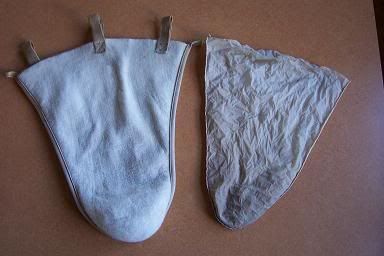
Hot syrup needs to be filtered. We do this outdoors, as we are draining the syrup from the evaporator pan. We use a heavy felt filter that is made for this purpose. The filter is made like a pouch, with a wide, open top. And we use a similarly shaped pre-filter inside the felt. The pre-filter is a thinner material and easier to wash out. Here is a picture of the washed out filters (felt filter on left and pre-filter on right). If washed and dried, both filters will last for many years, though they may become somewhat stained (as is the one on the right in the picture).

Photobucket

To do the filtering we simply hold the two filters open over the stock pot and drain from the evaporator down into and through the filters. The person holding the filter wears gloves because the syrup and steam are extremely hot. A few clothespins are useful for holding the felt and prefilter together around the top.

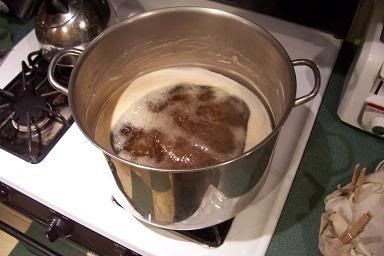
Here’s a picture of the stock pot of suryp boiling on the kitchen stove:

Photobucket

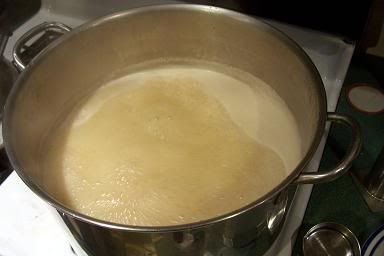
A unique characteristic of boiling maple syrup is that, when it is close to done, a boiling foam of the syrup will rise up in the pan. If you reduce the heat, the foam will subside. A whole pan of frothing sap can also be miraculously sent into instant retreat by simply touching it with some butter. I’ve heard that the old-timers suspended a piece of salt pork over their evaporator pan to halt the sudden rise of maple bubbles. Here is a picture of tiny, hot, frothy, maple bubbles rising in the stock pot:

Photobucket

The trick to finishing maple syrup is knowing when to stop boiling. There is an optimum range for sugar content wherein the syrup is nicely sweet and thick (once it cools), but no sugar crystals form upon cooling.

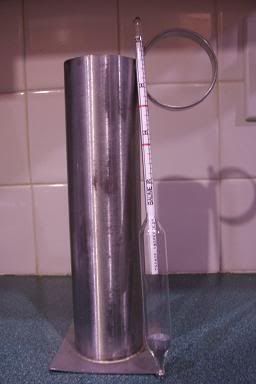
Rink Mann tells in his book, Backyard Sugarin’, how to gauge this optimum range for sugar content by using a candy thermometer to measure the temperature of the syrup at a boil. When it is seven degrees hotter than boiling water, the syrup is done (see the book for more specific details). We used a candy thermometer the first couple of years that we made syrup. Then we decided to buy a maple syrup hydrometer and test cup.

Photobucket

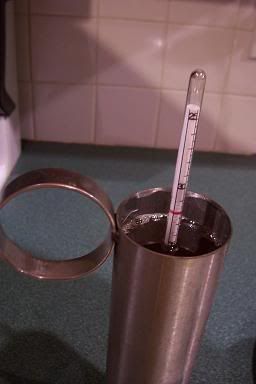
The hydrometer is a sealed glass tube with a weighted bottom. A calibrated strip of paper has been sealed into the tube. To use the hydrometer, you first dip the stainless steel test cup into the boiling syrup to fill it. Then you slowly lower the hydrometer into the liquid. If there is too much water in the syrup, the hydrometer will come to rest on the bottom of the test cup, and stay there. That means more boiling is needed.

But if the hydrometer bobs up and floats, the syrup is ready. The higher the sugar content of the liquid, the higher up the hydrometer floats. There are two red guide lines on the hydrometer scale that indicate the acceptable range for finished syrup. We’ve found that when the hydrometer just starts to float, the syrup is nicely done. I suspect there are slight differences between hydrometers and you need to find the “sweet spot” on your particular instrument.

You can also utilize the hydrometer when boiling sap in the evaporator outside, and we do that. But be prepared to immediately stop the boil and drain the syrup off as soon as the hydrometer shows any indication that it is about to start to float up. You can tell when it’s close to floating by how it acts in the syrup.

Here’s a picture of the hydrometer in the test cup:

Photobucket

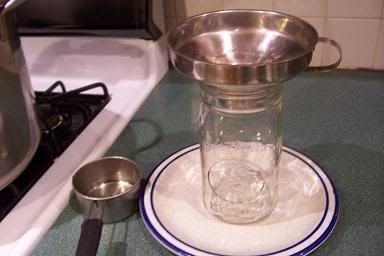
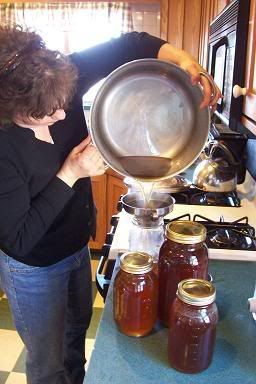
When we’ve determined that the syrup is done, we turn the stove burner down to a simmer—just enough to keep it hot. Then we ladle the syrup into canning jars for storage. Here’s a picture of a quart jar with a funnel and a measuring cup for ladling:

Photobucket

We once bought plastic, quart-size maple syrup jugs to put our syrup in. That was a stupid thing to do. There are plenty of canning jars in our pantry, they don’t cost anything, they are reusable, they are sanitary, and we get to actually see the entire contents of the container (which is kind of nice).

We pre-heat the jars in the oven to prevent thermal shock and possible jar breakage when filling. Then we dip the syrup out of the stock pot and pour it into the canning jar. We fill to about 1/4” below the rim. Put a canning jar lid on, followed by a ring, and tighten it down. Then the hot jar needs to be tipped so the syrup can sterilize the air space. Set the jars upright to cool and they will seal just fine. They will keep for years.

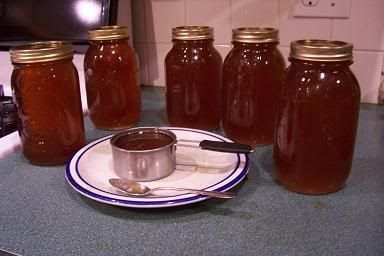
Here’s a picture of the yield from one day’s boil: five quarts and a cup.

Photobucket

As the jars of syrup cool and over time, a thin layer of sediment will settle to the bottom. It is known as “sugar sand” or niter. It is too fine for the felt filter to stop. The niter is no problem with homemade syrup (you just pour out of the jar, leaving the very bottom layer, and it washes right out), but it is probably not acceptable for syrup that is sold to the public. I understand commercial syrup producers have special filtering equipment that will remove the niter.

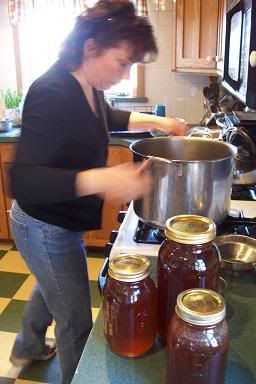
A tutorial about how my family does Backyard Sugarin’ would not be complete without a picture of The Lovely Marlene, my sugarin’ helpmate. Here she is tending the stock pot of syrup.

Photobucket

The blurry picture is indicative of how industrious my wife is—it's tough getting her to stop for a still picture. But I did manage to get one...

Photobucket

So there you have it. That’s how my family makes maple syrup on a very small scale, using very basic equipment, in our backyard. It was a productive season. Eight gallons of homemade syrup are in the pantry.

As I write this, it is April 11th. Our last boil was five days ago. Maple season is over for another year. We have pulled the taps. The buckets and other equipment are washed and put away. The maple trees are now budding. Spring is at hand. The garden beckons....

======================
CLICK HERE to go back to Part 1 of this Backyard Sugarin' series

Backyard Sugarin’ Part 4: Boiling Sap

As I mentioned in a previous essay of this series, one of the great things about Backyard Sugarin’ is that we utilize inexpensive, homemade, low-tech equipment to make maple syrup. Nowhere is this truer than with the evaporator.

The evaporator is a pan that you put maple sap in and boil off the water. You boil until the sugar content is concentrated to maximum liquid sweetness, and the clear tree sap will turn some shade of maple syrup color.

You can purchase ready-made evaporator pans from maple syrup equipment suppliers. I think they are made of tin with soldered joints. They can be amazingly expensive.

In the book, Backyard Sugarin’ by Rink Mann, he suggests using a big, 18” by 24” “hotel lasagna pan” for an evaporator. Restaurant auctions might be a good source for getting such pans at a reasonable price. He also provides directions for making an evaporator pan out of a 30” by 32” piece of galvanized sheet metal. The sheet can be folded and hammered into shape without any soldering needed.

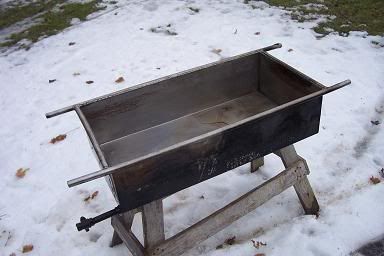
Using galvanized metal for a boiling pan doesn’t appeal to me. I opted to have a friend who is a welder make me a pan. It measures 16-1/2” wide by 33” long by 8” deep. It is made of stainless steel and has a drain on one end. Here is a picture:

Photobucket

The metal in that pan came from a stainless steel plate that was screwed to one side of a swinging door inside a factory. I was doing some remodeling there and salvaged the metal before throwing out the door. I had no use for it at the time but knew it would come in handy someday.

My friend the welder happens to be a Backyard Sugarer too. He fabricated my evaporator pan, added the handles using some salvaged metal he had, welded in a threaded insert for the drain pipe, and charged me 40 bucks for the job.

The pan is pretty much indestructible. On one occasion I boiled too far and ended up with a tough, fired-on black residue in the bottom of the pan. Such an event would have totally ruined a fancy tin-and-solder evaporator pan. But not a stainless steel pan with welded corners. I took an electric disc sander to it and ground off the charred gunk. It took some doing but I did it. In between boiling batches of sap, I clean the pan with water and a sheet of 400-grit wet/dry sandpaper. You can’t beat stainless steel for durability and longevity

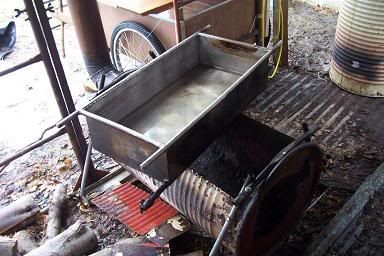
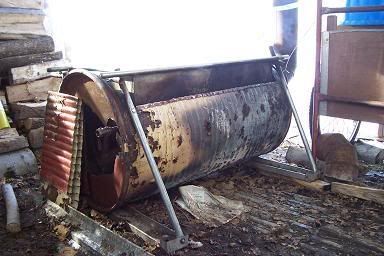
My pan sets on top of, and partly into, a firebox that I fabricated out of an old metal barrel, as shown in the picture below. By the way, in the picture you can see some charred sap inside the pan on the end. It is normal to get some of that after a boil and that's where the wet/dry sandpaper comes in real handy.

Photobucket

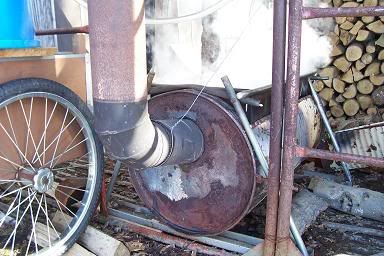
That fire-barrel is actually a new one made this year. The old one (just like it) rusted out after several seasons. My son, Robert made the new one using the old one as a pattern. The stabilizing framework of bolted-together metal conduit was still sound and he reused that. The chimney is 6” diameter stove pipe. It friction fits into a hole in the back of the barrel and is wired up as shown in this next picture:

Photobucket

Here’s another view of the evaporator and firebox:

Photobucket

Those scrap pieces of metal in front of the firebox opening are used like a door to restrict airflow into the fire chamber as needed in order to maintain the hottest possible fire.

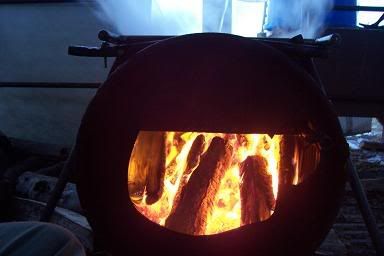
To use the evaporator we fill the pan with sap and build a fire in the firebox. We keep the sap a couple inches below the rim to allow for a rolling boil. It takes some time to get a fire hot enough to boil the pan’s contents. Once it starts to boil, we keep feeding the wood to it all day, and sometimes into the night. Here’s a picture of the firebox in action:

Photobucket

Boiling the sap down is a lot of fun (as long as you don’t boil it too far). The evaporator is located just outside a window in our house, so Marlene (who, with the kids, tends the fire when I’m at work) can periodically look out to see how the boil is going. She enjoys stoking the fire with wood and “babysitting” the boil. There is a very appealing rustic ambiance to Backyard Sugarin’ like this.

Once the pan gets to boiling, we adjust the valve on the sap barrel to allow a steady trickle of fresh sap into the pan, as shown in this picture:

Photobucket

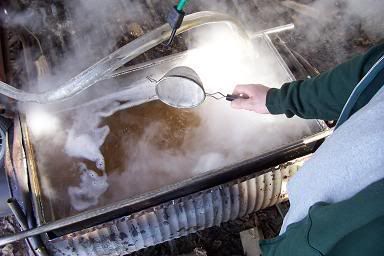
As the sap boils, dirty foam will collect on the surface. We skim it off with a wire mesh strainer, as shown in this next picture:

Photobucket

The sap will bubble and boil down for many hours as we keep the fire fed and fresh sap running in. We can typically boil down a whole barrel in a day. If the sap is “running” and we are refilling the barrel as we boil, we will sometimes leave the full pan with a fire underneath it and go to bed. In the morning the fire will be down to coals and ashes and the sap level will have steamed down two or three inches. Then we re-stoke the fire, top off the pan and boil for another day, or as long as needed to use up our sap supply. But we have never boiled a pan of syrup for more than two days because, the longer it boils, the darker it gets.

As the sap boils off and the sugar content concentrates, the boiling bubbles get smaller and smaller. When the syrup is almost done, the little bubbles will come together in foamy masses over the hottest part of the pan. A wood fire does not offer the control needed to precisely finish the syrup, so we draw it off just before it is completely done, and take it in the house to finish on the kitchen stove.

There is a certain knack to knowing when you’ve boiled far enough. Rink Mann’s book gives some pointers. The more we’ve made maple syrup, the better we’ve gotten at knowing the right time to draw off the evaporator’s contents. We will discuss when the time is right between ourselves: "It's not ready yet!" "Yes it is!" "No it's not!"

The problem is that the syrup can go from close-to-ready to overdone pretty fast. Overdone means that when the syrup cools down, the sugar will crystalize (not the desired outcome). Really overdone means you completely forgot about the evaporator pan long enough for the liquid to all boil off. It's a memorable experience.

There is, fortunately, a simple instrument that you can use to tell exactly when the syrup is close to done and just right. I'll show and tell about that in my next essay.

For our pan, and the amount of sap we process, we usually end up with a half inch of close-to-done syrup in the bottom, and it usually amounts to a couple gallons of liquid.

To draw the syrup off, we have three methods. One is to lift the pan off the firebox, set it over a sawhorse and open the ballvalve to let it flow into a big stockpot. It takes two people to do this and we are extremely careful about it because hot syrup is dangerous. I have a friend who spilled a pan of maple syrup on himself. The burns were bad enough to put him in the hospital and he was out of work for several weeks.

If I am by myself and have to draw off the syrup, I shovel out the hot coals and drain the pan. Or, on a couple of occasions, I’ve shoveled snow into the firebox to quench the fire before drawing off the syrup.

Sorry but I don’t have a picture of drawing off the syrup. But I have pictures of finishing it off on the stove in our kitchen and I will write about that next.

Stay tuned.....
Click Here to go on to Backyard Sugarin' Part 5: Finishing
or
CLICK HERE to go back to Part 1 of this Backyard Sugarin' series

Backyard Sugarin’ Part 3: Collecting Sap

In the previous essay of this series I showed and explained how my family taps sugar maple trees to collect sap for making maple syrup. Now I’m going to explain how we collect the sap and store it.

It takes approximately 40 gallons of sugar maple tree sap to make a gallon of finished maple syrup. The exact amount varies because sugar content of sap varies. It varies between different trees, and even within the same tree throughout the season.

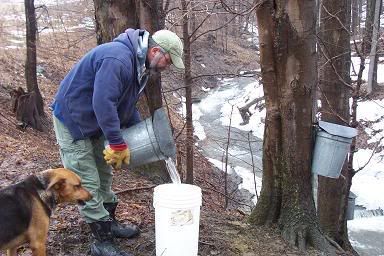
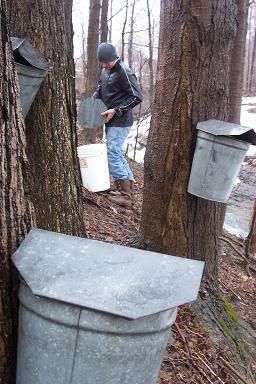
Our “sugar bush” is right out the back door of our house, just across the lawn. With only 25 taps to collect, we simply walk from tree to tree with a couple of five-gallon plastic pails. We unhook the galvanized sap pail from the hook on the sap spile (see previous essay for details) and dump the contents into our collecting buckets. Here’s a picture of me doing just that.

Photobucket

And here’s a picture of my son, Robert, filling a pail.

Photobucket

As you can see, collecting sap is a simple process. But that isn’t to say it is easy. Sap weighs around 8 pounds a gallon. The buckets are heavy to carry. The difficulty of the task is compounded by the steep terrain we have to traverse. Keep in mind too that maple season is also mud and ice season. So collecting sap in buckets and carrying them uphill to our collecting tank is a real workout.

There are days throughout the maple season when the sap doesn’t flow at all, and there are days when it really “runs” (which isn’t to say it is actually running out of the tree like a faucet—it’s just dripping fast and a lot of sap accumulates in the pails). On a good day we will collect sap a couple of times. But usually we collect once in the late afternoon. Here is a picture of me carrying some full buckets.

Photobucket

We carry the buckets of sap out of the woods to our makeshift “sugar shack” which is right next to our house, in our wood shed. Before I show you the wood shed and the west side of my house, I need to warn you—this is not a pretty picture. The west side of our house has no siding beyond weathered plywood and some tarpaper. When you are a one-income family and you build your house on a budget, without borrowing money, things like siding can wait....and wait. That’s part of My Christian Agrarian Reality. Here’s the picture:

Photobucket

What you’re looking at is a “temporary” wood shed that has been in place for eight years—far longer than I originally intended. I built it cheap with lumberyard culls and salvaged barn roofing. It does the job. We hand wood through the window in the background and put it in my Yeoman Furniture Wood Box. By the way, CLICK HERE to see the remarkable contrast between the above west side of my house, and the east side.

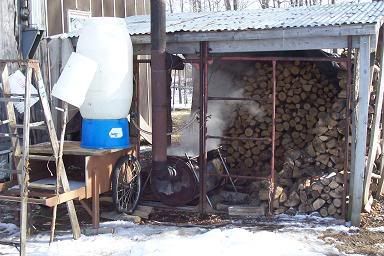
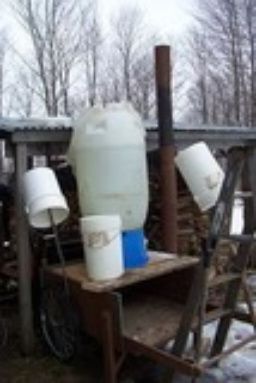
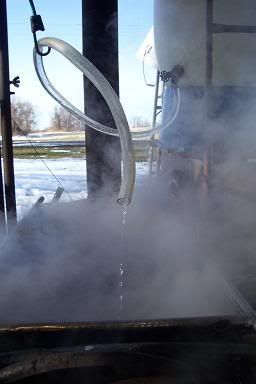
Underneath the woodshed is a steaming evaporator, which I’ll discuss in more detail in the next essay of this series. For now, I’d like to draw your attention to the big white 55-gallon plastic barrel. That is our sap collection tank. Here is another view:

Photobucket

The 55-gallon barrel is up off the ground so we can gravity-feed sap down into the evaporator. Please note that the barrel is up on top of a homemade Whizbang Garden Cart (an essential homestead tool if there ever was one).

You will also notice in the picture that our collecting buckets are upended over upright poles. That is how we store them to keep them off the ground and clean until the next time we need them.

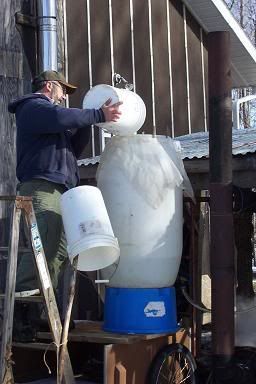
We fill the barrel by dumping buckets of sap into the top, as shown in this next picture.

Photobucket

We don’t use any electric pumps to get the sap up into the barrel. Man and boy power does the job.

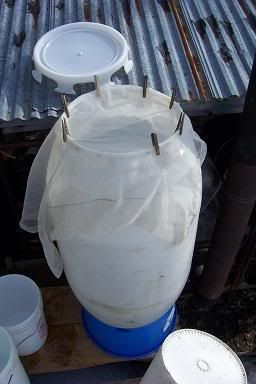
You can see a cloth is over the top of the barrel. That is a piece of sheer nylon curtain material that Marlene bought at a garage sale. It makes a very strong and effective filter and has multiple uses around the homestead. A filter is needed to separate bits of bark and bugs and such from the sap. Here’s another view showing the makeshift filter:

Photobucket

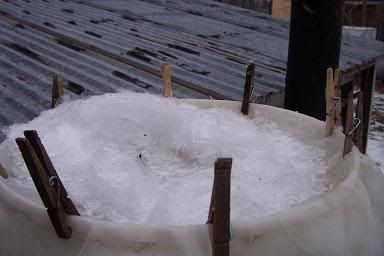
The filter is held in place with clothespins. After dumping our collected sap in the top, I take the clothespins and fabric off and put the lid on. I then clip the material to the roof of the wood shed and let is air dry until next time. In addition to filtering out bugs and bark, the filter will separate any slushy ice that was collected...

Photobucket

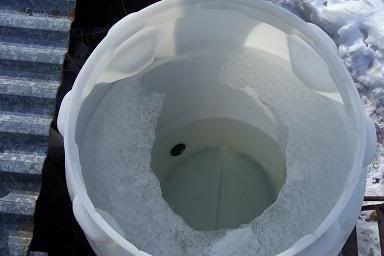
When sap partially freezes, the ice has almost no sugar content. So the ice is thrown away and the remaining sap has a higher concentration of sugar. A little icing is good because it results in less boiling time. Ice can form in the holding tank too, as seen in this next picture.

Photobucket

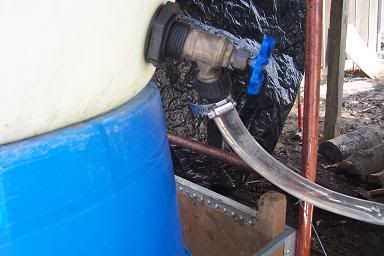
When the barrel ices up like that, it clogs the outlet drain in the bottom, and we have to dip the sap out of the top to get the boil started. As the evaporator heats up, it will thaw the bottom drain. Icing in the barrel makes more work, but I don’t mind because all that ice is water that doesn’t have to be boiled away. When the barrel is empty, I just tip it upside down and knock out the ice.

This next picture shows the water valve that I put on the bottom of the sap barrel.

Photobucket

We store sap until we get most of a barrel. If the weather is cold, the sap will keep for several days. In warmer weather it can go bad after a couple days. It is best to keep the collection tank out of the sun so the sap keeps a well as possible.

That’s the story on collecting maple sap.

In my next essay I will discuss our evaporator and how we boil the maple sap down into syrup.

Stay tuned.....
Click here to go on to Backyard Sugarin' Part 4: Boiling Sap
or
CLICK HERE to go back to Part 1 of this Backyard Sugarin' series.

Backyard Sugarin’ Part 2: Tapping Trees

In Part 1 of this how-to series of blog essays I explained that my family makes maple syrup on a small scale in our back yard, and I explained our reasons for doing so—reasons beyond just maple syrup. Now I’m going to launch into the details of our particular little operation by telling (and showing) you how we tap trees....

This year we tapped our maple trees on Saturday, March 15. It was foggy and overcast all day but the temperature was in the 40s and the sap was “running.” Cold nights and above freezing days will get the sap flowing.

I was up at daybreak. The rest of my family was still sleeping. Not a problem. I tapped 24 trees by myself and I took my time. Later, I got my son, Robert, to help with the pictures that follow.

Tapping maple trees by oneself on a foggy morning in March is the antithesis of working in a factory in the city, which is what I do five days a week. It was quiet and peaceful in the woods. The air was fresh. I could clearly hear the water rushing through the stream that runs through our woods. But a rushing stream does not make noise; it is a quiet, natural, therapeutic sound. So, yes, I took my time. I savored the experience.

We tap only 25 sugar maple trees because that’s pretty much all the properly sized trees we have available to tap on our small acreage. Our sap storage and boiling operation (as I’ll be showing and explaining later in this series) is sized for that number of taps. If we tapped more trees, we would need to re-engineer our whole small-scale system.

Our woods are directly behind our house, along a gully, and on the west side in an overgrown old family cemetery. So our trees are all within walking distance of our yard.

According to Rink Mann’s book Backyard Sugarin', every tap you put in will translate to about a quart of finished maple syrup per season. we ended up with a better yield than that this year. But it is a good rule-of-thumb.

The following picture shows some basic tapping equipment: a galvanized steel sap bucket with a galvanized cover (in the background), a hammer, and hand brace with drill bit.

Photobucket

The first couple of years we made maple syrup we utilized recycled plastic milk jugs to collect the sap, as Rick Mann’s book explains. The jugs are free, and they work fine to collect sap. But they need emptying more frequently than a sap bucket. And if it gets cold, some of the sap will freeze. When this happens in a sap pail, you just take the ice off the top, throw it away, and pour your maple sap into your collecting bucket. But you can’t do that with a partially frozen jug of sap. I’ll tell you why we throw the ice away later in this series.

As you may know, a lot of maple syrup makers now utilize lengths of plastic tubing instead of old fashioned sap buckets to collect sap. They string the tubing from tree to tree and the sap flows along into a central collection tank. We don’t do that because I like sap buckets. They are simple and effective and, if properly cared for, should last a lifetime. Besides that, I hate plastic, or vinyl, or whatever that tubing is made of. The less plastic in my life, the better.

The buckets also clean out nicely. I’ve heard that the tubing is difficult and complicated to clean. We bought the buckets from a local maple equipment place used for something like three dollars each. The covers were a buck more. It was money well spent.

Trees are tapped by drilling a 7/16” hole into the tree with a brace and bit. 7/16” is the universally accepted proper size for a tap hole. And using a hand brace is the traditional method for drilling the hole. You could, of course, use a battery-powered electric drill to drill the holes. That would be faster and easier. But for 25 taps, I keep it simple.

Functional hand braces can be bought at flea markets for a few bucks. Don’t ever buy a brand new hand brace. They are way too expensive. If you need a 7/16” bit for the brace, you can get one at Lehman’s for a few bucks. Properly cared for, both brace and bit will last you the rest of your life and give you no problem. You can’t say that about a battery-powered drill.

You can tap a tree in 30 seconds with a brace and bit. This next picture shows Robert tapping tree #25.

Photobucket

The tap hole should be drilled a couple inches deep and angled up just a bit. Robert’s drill bit could probably be angled up slightly more than the picture shows. But that's good enough. We drill the holes just above waist height. A little higher or lower makes no difference.

This next picture shows a sap spile with a pail hanging hook and a spile insertion tool, which is used to pound the spile into the hole.

Photobucket

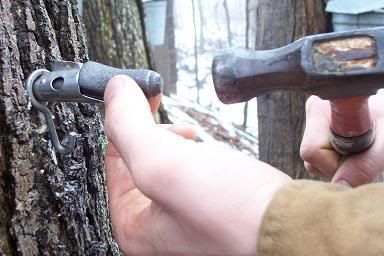
This next picture shows the spile insertion tool in the spile, and the spile being hammered in. The little tool serves to distribute and direct the force of the hammer blows so that the relatively thin metal of the spile is not deformed. A spile insertion tool is not absolutely necessary but it does the job it is designed to do and prolongs the useable lifespan of your spiles. The spile is pounded in until it is snug. Not too tight.

Photobucket

Once the spile is in the tree, the sap will start to drip out, unless the temperature is freezing. I love the sound of sap dripping into the bottom of an empty bucket.

Every maple tree has it's own sap characteristics. Some trees have better sap flow than others, and sugar concentration of sap varies between trees. Seeing as I was in no hurry the morning I tapped, I timed the drips from several trees. Some were producing 40 drips per minute. Most were around 60. My best tree, which also happens to be my biggest, was producing an incredible 120 drips a minute. That tree is always my best sap producer. I call it the “Big Dripper.”

I tried to take a picture of a drip falling off the end of a sap spile. This is the best I could do:

Photobucket

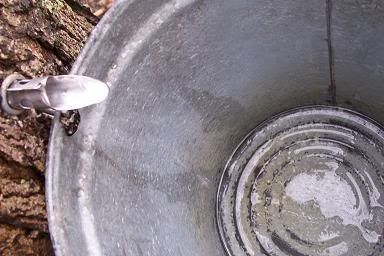
And here’s a drip's-eye view down into an empty bucket

Photobucket

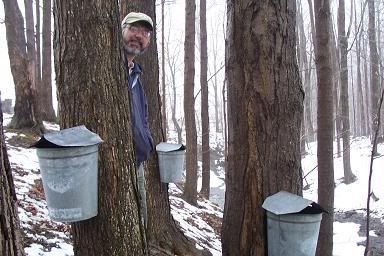
And, finally, Robert took a picture of yours truly amidst a cluster of sap buckets. You can see the steep bank and gully that is behind our house. “Big Dripper” is at the bottom of the gully, which means that collecting sap from that tree is harder than any of the others. In my next essay in this series, I’ll explain (and show) you how we collect and store the maple sap.

Photobucket

To be continued....

CLICK HERE to go on to Backyard Sugarin' Part 3: Collecting Sap
or
CLICK HERE to go back to Part 1 of this Backyard Sugarin' series.

Backyard Sugarin’ Part 1: Why We Do It

Chapter One of my book, "Writings of a Deliberate Agrarian," is titled, The Breakfast of Agrarians (Click here to read chapter One). When you read that short story, you will discover that my family makes our own maple syrup. We do this on a very small scale in our backyard using a relatively simple procedure. Our yearly production of the heavenly-flavored maple sweetness is around five gallons a year. But this year we ended up with a harvest of eight gallons. It was a good year for making "maple."

In this series of essays I will introduce you to the idea of Backyard Sugarin’. Then, in the next four essays, I’ll tell you about how we tap trees, collect sap, boil it down, and finish it off. I’ll also provide lots of pictures along the way.

Some people question why I make maple syrup at all. They see it as a lot of work for a relatively small amount of finished product.

“Wouldn’t it be easier to just buy maple syrup?” That’s the kind of question I get from people who have never done Backyard Sugaring. Folks who have made their own maple syrup don’t ask that question.

And then there is the matter of cost. When my coworkers hear that I’m actually taking a few hours off from work to help make a few gallons of maple syrup, they question the economy of it: “Boy, that’s going to be some expensive maple syrup when you figure your time off into the equation!”

Well, it so happens that making maple syrup with my family isn’t about saving money, and it isn’t about doing what’s easy. It’s all about working together as a family, doing something that is productive and enjoyable, which doesn’t cost much money to do. It’s all about getting outside in the fresh spring air, walking through the woods, feeding a wood fire, and standing over a boiling pan of tree sap, while breathing in the maple steam. In the end, we end up with sweet memories and sweet syrup.

So that’s why we make maple syrup.

People who have done their own Backyard Sugarin’ (even if not as a family tradition) don’t question the economics and work involved. They know there is an intangible something that is very special and downright satisfying about making maple syrup. Rink Mann, in his book, Backyard Sugarin' puts it this way:

”I’ve got to say that there is something magical about sugarin’, and if you talk with people who make maple syrup, either in a big commercial evaporator or out in the backyard, you’ll find out there’s a lot of agreement on that fact.

Maybe it’s the time of year—the warm sun climbing higher into the sky, warming the back after a long winter, turning the snow to piles of white corn, turning the brooks from trickles to torrents, starting the maple sap flowing—a sort of hint of the Spring and Summer lying ahead. Maybe it’s the drip drip of sap falling into the buckets, the telltale aroma of boiling sap, or the hissing sound of sap in a rolling boil. Maybe it’s the magic of converting sweet water, as the Indians used to call it, to delicious golden syrup. But whatever it is, it’s there.


My first experience with making maple syrup came, like so many other first experiences, after high school when I headed off to further my education in Vermont. While there, I spent part of a spring day helping collect sap from buckets hanging on trees, and I spent some time watching the boiling operation in the sugar house. I experienced my first drink of warm maple syrup, right out of the evaporator. One drink, and I was hooked.

It would be a few years before I had land of my own with a few maple trees, and a few more years after that before I finally got around to getting my own sugaring operation going. Part of the delay was that I didn’t really think I had enough trees to justify making syrup, and the sugaring equipment was expensive.

Only after I read the book, Backyard Sugarin’, by Rink Mann did I realize that I didn’t need a lot of trees and I didn’t need all the fancy maple-syrup-making equipment. That book opened my eyes to the whole concept of really-small-scale backyard maple production. It is a very good book that I recommend wholeheartedly. Mr. Mann has this to say of Backyard Sugarin’ in his Introduction:

”The real challenge in backyard sugarin’ is to find ingenious ways to collect and boil down sap without spending any money, and I must say I found a whole breed of like-minded people. Backyard sugarin’ builds interesting friendships, a kind of fraternity, I suppose, born of a mutually parsimonious nature.”

I like to think, too, that most backyard sugarers must have a little of the moonshiner’s blood in them. And there are a surprising number of similarities between boiling maple sap and distilling out the old mountain dew. In both cases you’re separating water from something else. In the case of sugarin’ you want what’s left in the pan after the boiling, while with moonshining it’s what comes off that counts. In both cases, too, you try to set up operations in a nice secluded spot, where you won’t get laughed at for your mechanical eccentricities (in the case of sugarin’) or arrested (in the case of moonshining).


The title of this series of how-to essays is the same as Mr. Mann’s book because his whole philosophy of small-scale, home-scale, on-the-cheap syrup making is summed up nicely in the book’s title; Backyard Sugarin’. His informative little book was the inspiration I needed to make my own maple syrup. Perhaps this series of essays will be the inspiration you need to start making your own maple syrup.

To be continued....

Click Here to go to Backyard Sugarin' (Part 2): Tapping Trees

Peak Grain

I stayed for dinner after church today and, in conversation, the topic of wheat came up. If you didn’t know already, wheat prices have more than doubled from what they were a year ago. My pastor follows the grain market pretty closely. He told me the U.S. grain reserve is gone. There is no reserve. There used to be a surplus reserve of grain in this country. But it’s gone.

If that is true, it is an ominous development.

I decided to look into the subject with a Google search. I discovered a prophetic article written a year and a half ago that talked about the very low reserve of wheat and other grains. The article stated that prices were going to rise. But that will be just the beginning.

It behooves you to read the article. It is not long. It is not difficult to understand. Remember, it was written eighteen months ago. It was written before the price of wheat jumped so dramatically. It was written before your average Joe had a clue any of this was going to happen. Some people can see the handwriting on the wall. We need to take heed. Here is a link to the article:

Grain Drain: Get Ready For Peak Grain

And here is another similar article, written at the same time:

How Long Can The World Feed Itself?

Of Small Houses & Cheap Alternative Housing Options

A friend of mine recently told me that in his town the building code does not allow anyone to build a home that is less than 900 square feet. That got me to thinking about how I really hate it when the government makes such stupid and oppressive laws—especially local governments in areas that are mostly rural.

When Marlene and I built our house—the one we live in now—back in 1985 it measured 16 feet by 24 feet with two floors (no basement). That amounts to 768 square feet. We have since added on to the house so it now amounts to 1,650 square feet. The house is still relatively small, especially with three boys (all in one bedroom). We would love a larger house someday, but what we have is sufficient. Our house is a home. We are content and thankful for what we have.

I can tell you that small houses have their advantages. For one thing, they are cheaper to build. As I explain in my book, Writings of a Deliberate Agrarian, Marlene and I borrowed $10,000 from her father to build our house, and we did the work ourselves. The house is not fancy but it is built very well. There was never a bank loan and the house is now paid for. I’m thankful for that too.

Another advantage to a small house is that it costs comparatively less to heat in the winter, as I have mentioned here a few times in the past. Maintenance costs are also comparatively less. After 23 years, I’m going to need a new roof on the original structure and it won’t break the bank to get that done. Of course, it helps that I’ll be doing the actual roofing work myself.

Looking back, if I had it to do all over again, and I had the same limited financial resources, I’d build a small house just like I did. Perhaps I would incorporate more salvaged materials. I did that with some windows and a staircase, but could have done it to a greater degree. I have an uncle in Ohio who built his house and several outbuildings using almost all salvaged materials, including a slate roof. His house has been featured in Fine Homebuilding magazine.

Or maybe, in retrospect, I would do it just a little bit differently. I now think it would have been wiser to find a good section of land and buy that first. Forty acres would have been nice, with some woods, and some field. The one and a half acres I bought back then, and live on now, is hardly big enough to hold us with all of our homestead projects. What's funny though is that I've gotten e-mails from people who lament that they have only 8 or 10 acres to homestead on.

In any event, with my 40 acres in place, I would have lived in some sort of “alternative” housing to start, while saving to build a more permanent and conventional house. The best alternative housing would be low-cost and not incur any additional property taxes.

One such form of alternative housing would be some sort of camper/trailer. I’ve heard old pull-behind campers can be had surprisingly cheap. And I know people who have lived in them, on their land, for a long time.

Another option is a yurt which is the traditional home of Mongolian herdsmen. I once watched a very unusual documentary movie titled The Story of The Weeping Camel. The best part of the film was seeing the yurt the the Gobi desert herding family lived in. It was roomy and strong and warm in the cold weather. Since yurts are portable structures, I don’t think they would be taxable.

I have long had a hankering to live in a yurt. In fact, I have this idea that someday, when/if I can finally afford to buy a section of woods and field, I will talk The Lovely Marlene into living on our land in a yurt. I have not told her about this yet. She is less adventurous than I when it comes to things like this. Such ideas of mine must be presented with care and wisdom on my part. Hopefully, I’ll be able to persuade her of the many advantages of yurt living and she will agree to try it for one year. And then maybe she would want to live in our yurt for one more year. I don't know which will be harder...saving to purchase the land (debt free) or getting Marlene to try yurt living. Well, one step at a time. :-]

Another possible alternative for housing could be a big, walled tent, like is used on African expeditions. If you think tent living would not be comfortable, check out the pictures at Mary Jane’s Farm Bed & Breakfast. I have written about Mary Jane's Farm HERE. The tent idea would not be much fun in the winter where there is cold and snow. But it would work comfortably for half a year here in upstate New York.

Have you ever been inside a common box trailer that truckers use to haul goods all over the countryside? There is a surprising amount of room in one of those things. I think they measure around 8 foot wide and are something like 60 foot long. Evidentally, the undercarriage wears out and will not pass inspection. Find such a trailer box, with wheels, buy it cheap, park it on your land, and you can set up house in that thing.

My pastor once told me of a nifty tax-free housing idea he had. If your land has a pond on it, build a small floating house on top of empty 55-gallon drums. It would be a house “boat.” The tax assessor around here doesn’t raise your property taxes if you park a boat on your property.

I once knew an old Italian fellow who told me of how, as a young man, he had plans to build a small home for his family out of the lumber in used packing crates. He got the crates free from the factory where he worked. Every day, on his way home (to an apartment) he dropped the crates off at the little section of land he had bought. On weekends, he would take the crates apart and neatly stack the wood under cover. Then World War II came and he went into the military. His plans were put on hold. When he came home from the war, his life had changed course. He never built the house. And he regretted it.

I have a friend who got married last year. He and his wife have been renting a house, and paying utilities. He is very discouraged because it costs so much (especially for fuel through the winter) and they can’t save any money. I could suggest to him that they live in a nice wall tent or a cheap camper for the summer months. Then they could save a lot of money. But I know my idea would not be well thought of.

With the economy the way it is, and people loosing their homes, they need places to live. Most are probably moving into apartments. Marlene and I lived in a two-room apartment for a couple of years when we were first married. I’ll take a wall tent, or an old camper, or even the back of an old tractor trailer box, on a little piece of rural land, over an apartment in town any day, thank you. But a yurt would be preferable.

There are ways to live cheaply, especially in rural areas, where you can get away with “camping out” when you are just starting out, or even starting out all over again. But to live so cheaply requires that you take a socioeconomic step (or two) down from the typical modern lifestyle. It’s a humbling situation that few people are willing to place themselves in. But I think it is easier to do if you see it as a means to an end, not necessarily an end in itself.

Whatever the case, even a shack in the woods can be a beloved home, especially if it is inhabited by a family that loves each other and is thankful to God for the blessings they have. That is what I believe.

=================================
I’m wondering... do you have an example from your own experience of living in some form of cheap, alternative housing (under 900 square feet)? Or do you know of others who have done this. If so, I invite you to tell about it here.

Some Random Thoughts For April 2008

I have a lot of little things on my mind that I’d like to share with you.....
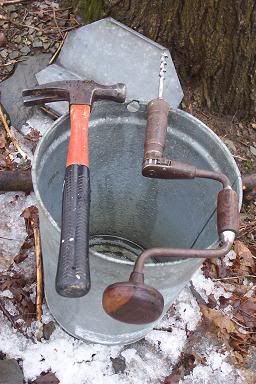
Scott’s Emulsion
As a follow-up to my last blog essay I’d like to tell you about Scott Nearing’s “Emulsion,” which can be found in the book, “Simple Food For The Good Life,” by Helen nearing.
SCOTT’S EMULSION

1 tablespoon honey
2 tablespoons peanut butter

Stir vigorously together into a smooth emulsion in your own bowl. (This is where the guest and eater has to do the work, not the cook.) Then fill your bowl with wheat berries (or kasha or millet). Again give all a good old stir and consume unlimited quantities.


An Organic Apple
For what it’s worth, I bought one organic “Gala” apple at the grocery store one morning this week before going to work. It cost me $1.25.

2008 Whizbang Garden Cart Contest Entry #1
80-year-old John Hudson down in Alabama made himself a Whizbang Garden Cart. It’s a sharp looking unit. Check it out HERE

A Simple, Sustainable Fuel Source
The most recent issue of Small Farm Today magazine has an editorial by publisher, Ron Macher, in which he states:
“One acre of mature forest will supply one cord of firewood per year (cull trees), and the supply will never run out. It is renewable and sustainable.”
As I’ve mentioned in this blog before, I heat my house each winter with a basic woodstove and 10 face cords of wood (which I bought from my neighbor for $450 last fall). I’ve heated my home with with wood in that same stove for 23 years.

In my dreams....someday....I hope and pray I will have a woodlot of my own to husband and harvest sustainably.

Deliberate Agrarian Review
My thanks to Small Farm Today magazine for reviewing my book, Writings of a Deliberative Agrarian. This is what the review says:
”This is a story of the best of rural life as it once was—and as it can be again. It is a wholesome Christian book for those families who want to experience life at its best. I found it an excellent read... It belongs on your bookshelf.”


2.2 Million Less Tomato Plants
According to an article in “Lancaster Farming” newspaper,
“The Mid-Atlantic region’s largest producer of mature green tomatoes is getting out of the business and switching tomato acreage to field corn.”
The reason for the change is the shrinking migrant work force. According to the farmer,
”Let me tell you, there is no local labor that is going to go out and harvest those tomatoes in 90-degree temperatures except our immigrant labor.”
The article reports that it has been years since the former tomato farmer (he planted 2.2 million tomato plants last year) “...has seen local students visit his farm for work. The farm pays a high wage, about $16.59 per hour...”

McDonald’s French Fry Grease
Marlene and I recently attended a wedding reception and sat next to a woman who manages a McDonalds. I asked her how often they change the oil used to make the French fries. The answer.... every 21 days.
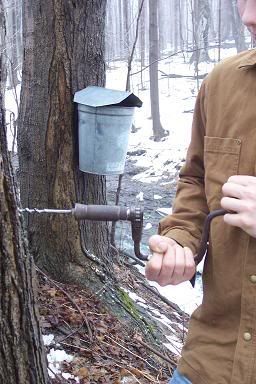
That’s THREE WEEKS!

One of my best friends from high school died of colon cancer at 44 years of age. He loved McDonald’s French fries. In high school, when we went out to eat at McDonald’s, he always ordered two large fries with his burger. When he was diagnosed with cancer, awaiting surgery in the hospital, I went to visit him. We had lost touch over the years. I asked if he still ate a lot of McDonald’s French fries. He said he did. He loved McDonalds French fries.

I never eat McDonald’s French fries.

My first Vegetarian Friend
After High School I went to school in Vermont for a year. There I met a fellow named Randall Blank from Philadelphia. We became pretty good friends. Randall was a vegetarian. The only vegetarian I had ever known of before Randall was the guy who ran a natural foods store I sometimes went to. He was pale and frail and sickly looking. But Randall was robust and healthy.

The amazing thing about my friend Randall was that he had never eaten meat in his life. His parents had raised him and his brother from the beginning as vegetarians. He also would not eat milk or eggs or cheese. He wouldn’t even eat jello. For breakfast he poured orange juice on a bowl of Cheerios. We went to McDonalds once with a group of other students. He ate French fries.

Incidentally, Randall and his brother once hitch-hiked to Maine to visit Scott & Helen Nearing.

Randall’s Legacy to Me
One day, my friend Randall, the vegetarian, stopped by the little library in the town where our school was, and they were throwing out 30 years worth of old Organic Gardening & Farming magazine. He brought them back to his dorm room and called me over to see his find.

I happened to love that magazine, and I practically salivated over the sight of so many old issues, going back to the 1940s. I offered him money. He wasn’t interested. I offered him more money. He wasn’t interested. I asked him if there was anything I could trade him for those magazines. There was nothing. So that’s the way it was.

But, near the end of the year, Randall gave me all the back issues. No charge. It was a gift. I was so grateful. I still have all those great old issues. That magazine is now nothing like it once was. It was a wonderful publication in its day.

Thank you again, Randall!

No More Squash
I wrote awhile back about My Squash Planting Secret. That essay got a lot of attention. Sad to say, we ate our last two Sweet Dumpling squashes on March 29th. They were tasty.

So we were able to eat our own homegrown squash for five months after they were harvested. Squash is easy to grow. Squash is easy to store. Squash is nutritious. Squash is good.

Men Talking
Yesterday, as I was going into my workplace, I stood with several other men in a secure enclosure. A heavy steel door automatically closed and locked behind us. We waited, without talking, for a man inside a room with bulletproof glass to work the controls that would open the door before us. We were about to walk into the main yard of a maximum security state prison. Here is the conversation that took place:

Man #1: “Well, here we are again.”

(momentary silence)

Man #2: “Another day in paradise.”

(momentary silence)

Man #3: “Another day closer to retirement.”

Man #4: “Another day closer to death.”

Everyone laughs.

Except me.

And the door opens.

Advice From Jack
I grew up watching Jack LaLanne on television. He inspired me to do exercises with common household items like a chair, a broom, and a couple cans of beans. He had a white dog named Happy. Jack LaLanne was an inspiration to me.

I recently told my kids about Jack LaLanne. He is still alive. He is in his 90s. He is still healthy. We went to his web site.

In 1956, at age 42, Jack set a world record of 1,033 pushups in 23 minutes on “You Asked for It, a TV Show with Art Baker. In 1979, at age 65, Jack towed 65 boats filled with 6,500-pounds of Lousiana Pacific wood pulp while handcuffed and shackled in Lake Ashinoko, near Tokyo, Japan. He did all kinds of stuff like that.

As you might guess, Jack was and is a "health food" advocate. Guess what he ate a lot of. Yep, that's right... Scott Nearing's Horse Chow!
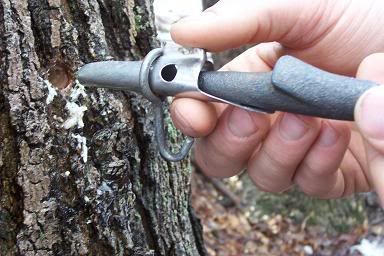
Naw. I'm kidding. You knew I was kidding, didn't you? Well, actually Jack might have eaten Horse Chow. I really don't know. In any event, I want to tell you one of Jack LaLanne's famous Words of Wisdom:
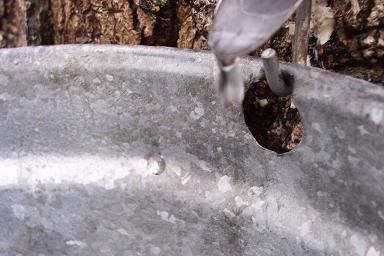
"If it tastes good, spit it out.
Now that's funny. Here's another classic bit of advice from Jack. This is his "Posture Improver" (and it works):
Pretend to try and crack a walnut between your buttocks


It's past my bed time..........