Time & Work & Family & The Struggle

When I went into self-imposed blogging exile several weeks ago, I stated that I would return on this day. And so I have.

I’ve missed blogging. I love to share with you here about the Christian agrarian "good life" my family experiences on our little section of land. But I must confess.... it is a love-hate relationship that I have with this modern means of communication.

Five Hours a Day
There is a dark side to blogging. It is a thief. It takes time away from faith, family, and livin’ the good life. When I blog, I blog alone, while my children and the Lovely Marlene do other things.

It would be different if I were home with them all day, but I am not. For now, I work a regular, non-agrarian job away from home. I wake up (without an alarm clock) at 5:30. I leave for work when everyone is still asleep in bed. I get home around 4:30 in the afternoon. I go to bed around 9:30. That means I am away from home 11 hours each day and I have 5 hours in the evening to do everything that, while I was work, I wish I were home doing. To make matters worse, I’m usually tired when I get home.

Five hours a day.

Choosing Hardship
Agrarian life is full of hard work and responsibility. Ideals are embraced. Plans are made. Creativity is harnessed. Projects are pursued. I’m talking about down-home projects. Projects in the garden. Projects in the woods, Projects in the shop. Projects in the kitchen. Projects that require initiative and effort. Projects that produce sweat and sore muscles.

Agrarian life is a life of home-based activity. As such, it is the antithesis of Modern life, where comfort (and amusement) is the high goal. Moderns slave away at a regular job longing to spend leisure time at a spa, or on the beach, or at some sporting pastime, or on a cruise, or at Disney World, or whatever. Many Moderns dream of a retirement dedicated to the pursuit of leisure, ease, and comfort.

Curiously, none of those things appeal to me.

Instead, I slave away at my industrial job and dream of being home, working on my land, or in my shop. Working until I’m physically exhausted. Until I’m zombie tired. It’s a wonderful feeling to have worked so hard on the land. It brings satisfaction and sleep— sweet sleep. Factory and office work doesn’t do that.

The garden is on my mind. The thought of working hard in the earth is so pleasant to consider in the depths of winter weariness. Soil. Sun. Compost. Cultivating. Planting. Fresh air. Summer rains. Golden sunsets. Fresh green growth. Hope springs with the thought of spring. This is especially true on this cold day in March, with a deep blanket of snow over my land.

The Forgotten Commandment
I have taught my children the Ten Commandments. In the process of teaching my children, I learned them too. Do you know them?

I think it is safe to say that the average Christian in the pew on Sunday morning cannot recite the Ten Commandments. I say that because I was a Christian almost 30 years before I committed them to memory.

Exodus 20:8 says, “Remember the sabbath day, to keep it holy.” That is known as the Fourth Commandment. The Fifth Commandment is to honor your father and mother. But hold on. Between the fourth and fifth there is another commandment: Six days shalt thou labor and do all thy work. (Exodus 20:9)

God specifically commands his people to work for six days. And the Bible says nothing about retirement in the modern sense of the word. Six days shalt thou labor.

What, I wonder, did God’s people labor at? Did mothers and fathers leave their homes each day to work in factories, shopping malls, and office complexes, while their children went off to day care or public school? Of course not. What an absurd thought.

The culture of that time was family and faith centered. The predominant work God’s people labored at was the work of home and subsistence.

When Israel moved into the Promised Land, the culture was family-centered and predominantly agrarian. God’s people were herders, planters, and craftsmen.

Finding Family Quality Time
In a recent internet article by Gary North, he answers a man who asked him how, within the demands of his job and the busyness of modern life, he can spend more quality and quantity time with his family.

Dr. North responds by pointing out that the Bible says nothing about spending quality time with your family. This issue is a modern day concern brought on by the consequences of the Industrial revolution. People in Biblical times did not have such a problem.

In the Biblical (agrarian) model, children grow up within a family where, as previously noted, mothers and fathers are home. As the children grow up, they are taught to do the work of the family. Sons went with their fathers to the fields or the shop to learn a craft. Daughters contributed to the family as they helped their mothers and learned to be keepers of the home.

Gary North states: “Quality time was always mostly work. It was devoted to teaching children how to work.”

North’s advice to the man was, essentially, to have his wife quit her job and stay home with the children. Homeschool the children. Unplug the television. And manage his time better so he can spend more time with the family.

Such advice is good but I’d like to suggest a few more things that would help. Move to a rural location where your family can be closer to the beauty and reality of God’s creation, where every day the entire family can share in the wonders of it.

Pay off debt and live more simply. Work together as a family to provide more of your basic needs. Grow a garden. Raise some animals for food. Work at preserving your own food. Start a home business. Take a hike in the woods. Shoot an animal and cook it for dinner. Do what you can to break away from total dependence on the Industrial Providers.

The shared work of these activities and family learning experiences equates to wonderful quality and quantity time. They add a richness to family life that is hard to beat. And the kind of life I am describing makes childhood memories that will be cherished for a lifetime.

It’s Called The Family Economy
What I’ve been talking about here is known as the Family Economy or the Home Economy.

Only in recent years, as I have begun to understand the wicked cultural consequences of the Industrial Revolution and the redeeming qualities of agrarianism (Christian agrarianism in particular), have I come to know what the family economy is and how absolutely necessary it is to building strong families and restoring Biblical culture.

A family economy is, very simply, when all the members of a family work together as a unit sharing and providing for the needs of the family. Everyone works and contributes, from young children to older grandparents. Each has a role to play. Each is needed. Each is loved.

Homesteading and small-scale farming are ways of life in which the family economy can take root and flourish. Indeed, I know of no other lifestyle that is so perfectly suited to developing and sustaining a family economy.

Restoring The Home Economy Essay Contest
Scott Terry over at Homesteader Life has a contest going for kids, 18 and under. Check it out here: Home Economy Essay Contest

Here’s A Real-Life Example
Two years ago a Mennonite family bought a 300 acre farm about a mile down the road from me. My friend Ken lives across the road and has become friends with them.

Ken says that they homeschool their four boys. They have no television. They have no computer or internet. They don’t even listen to a radio. The family is working to establish an organic dairy. They also have chickens and pigs and a large vegetable garden.

I drive by the farm everyday on my way home from work so I can see what they are up to. They are often working in the field or garden. I see the sons working with the father, and often I see the mother too. If they are out by the road they give a friendly wave.

It is a beautiful thing to see a family work together and bring a neglected farm back to productive life.

Marlene (who has met the family) told me that the oldest son just turned 16 and he is now done with formal homeschooling studies. He will now focus more on working the farm with his father.

This family appears to be a remarkable model of modern cultural separation and home-centered Biblical agrarianism in action. I related the story of this family to a man I work with. His response (and I quote): “Those people are just stupid farmers!”

The Remnant Shall Take Root
History is a record of God’s sovereignty. Nations and cultures have come and gone. Each has had its season in the sun. Some have grown prosperous and powerful. But pride and rebellion against God’s laws eventually leads to moral decline, which is an invitation to divine judgment. And God obliges.

America has a rich Christian heritage, but we are now, sad to say, a post-Christian nation. We think we might be the exception to historical precedent. Maybe, we reason to ourselves, we aren’t that bad. But that depends on your perspective. I imagine it’s what those long lost cultures once thought too.

Whatever the case, this nation will get what it deserves. I dare say we already are. The handwriting is on the wall for those who have mind to see it. Will divine judgment eventually lead to revival and the restoration of a God-honoring and moral republic? Or will God’s judgment lead to utter destruction? I pray for the former scenario.

One thing is certain. God has always preserved a remnant of His people, and He always will.

In 1 Kings 19, Elijah laments to the Lord that “the children of Israel have forsaken thy covenant, thrown down thy altars, and slain thy prophets with the sword and I, even I only, am left and they seek my life to take it away.”

But Elijah was wrong. He wasn’t the only one left. God told him, “I have left me seven thousand in Israel, all the knees which have not bowed unto Baal, and every mouth which hath not kissed him.”

Yes, God always preserves a remnant. The remnant are those who refuse to compromise with the ungodly culture around them. They are the few, the humble, the lowly, and the repentant believers who have not bowed their knee to the various types of Baal throughout history.

I dare say that the corporate, industrialized culture we live in and depend on is a modern god to the multitudes of people. So is the bureaucratic and tyrannical government of this nation. They are modern Baals.

Why does God preserve a remnant? God’s remnant is preserved in order to rebuild.

In Isaiah there is a verse that recently caught my eye. God uses an agrarian analogy to say that He will use an agrarian remnant to rebuild a God-honoring agrarian civilization: And the remnant that is escaped of the house of Judah shall again take root downward, and bear fruit upward. (Isaiah 37:31)

I wonder.... Is God now calling His people out of the modern industrial world to live simply, separately and deliberately for His glory and for the purpose of one day rebuilding a culture that has suffered the consequences of His judgment? It wouldn’t be the first time. It’s something to think about.

The Biblical “Home Economy”
It is crystal clear to me that when a family works together within at least some form of a home economy, the ties that bind become much stronger. There is another family-strengthening activity that does this too.

When a family reads God’s word together and prays together, the family grows closer and their shared faith grows deeper.

I confess that family devotions in my family have been hit and miss for years. When we’ve done family devotions together it has been very good. But for a variety of reasons, we’ve always slacked off and gone through long dry spells. One of my objectives in the recent blogging exile was to reestablish family devotions. We have done that and it has been a joy.

Our approach has been less ambitious than previous times. We start with a bunch of "sword drills" which is a game to see who can look up a given Bible verse the fastest. The kids love "sword drills" because they are boys and boys love the competition of seeing who can win the most drills. In the process they are learning where to find all the books of the Bible.

Then we read. We started in the book of Matthew, reading one chapter together each evening after dinner. After that, we went to the book of Acts. Next we will go to an old testament book. We divide the chapter up and each of us reads several verses. We briefly discuss what we’ve read. Then each of us prays aloud. We are also working on memorizing Psalm 1:1-6 together. If I’ve read or heard something interesting that is instructive, I’ll share it during our time of devotions. That’s basically it. We are usually done within 1/2 hour. I know we could, and probably should, do more, but this is working.

I did not have family devotions in my family when I was a child. Marlene didn’t either. We are trying to establish a family “tradition” that my boys will one day carry on in their families. That is my hope and my prayer.

Two Century Farm
I recently met a man from New Jersey who has a 200+ acre farm that has been in his family for 199 years. imagine that!

Authentic Agriculture
John Mesko has come up with an idea that I believe is divinely inspired. It’s called Authentic Agriculture. You can read about it here: Authentic Agriculture

Agrarian T-Shirts
I have an old sweat shirt that says, in large capital letters: MAINE. Then underneath, in smaller letters, it says, “The Way Life Should Be.” I’ve thought to myself that a shirt saying: AGRARIAN: The Way Life Should Be might be kind of nice.

I Had a Birthday
I turned 49 years old back at the end of January. I don’t want to talk about it.

My Son Had a Birthday
My oldest son turned 19 this month. I think it is a difficult time for a boy. I remember it being so when I was his age. I wasn’t sure what I "wanted to do." I couldn’t imagine how I might fit into the world. I was unsure of myself. It was that way for a few years.

But I had a lot of energy and was not afraid to work. I also had all kinds of interests and projects going. I was gardening, hiking the woods and gullies around my home, and doing small woodworking projects. I was also an avid reader. I subscribed to Mother Earth News and Organic Gardening & Farming magazine. I bought all kinds of homesteading and country skills how-to books.

I mentioned to Marlene a few days ago that if Joel Salatin’s books were around in the 1970’s, when I was 19 years old, I would have read them all and probably started raising chickens on pasture. I would have made my way to Virginia to be an apprentice on his farm and learn from him. There isn’t a doubt in my mind that I would have done that, or something like that.

Marlene replied by saying, "Yes, you probably would have!" She knew me back then. She knew my agrarian passion, and my angst.

Whizbang Books is Growing
Those who have read this blog and know something about me, know that I write and self-publish books as a part time business. I also make and sell chicken plucker parts and some other things. My hope is that I can continue to add books and products and grow the business into a serious home enterprise. I’d like to make enough money that I can purchase a section of farm land, debt free. Perhaps I might even be able to leave the factory job.

Well, Whizbang Books had a profitable year last year. I made enough money that, for the first time, the government is going to take a good portion of it. That makes me angry. And it is very discouraging. But that is the price of success, even a small success, which is all I’m really talking about here. The dream of purchasing land is still far off but I am being blessed in this enterprise and I thank God for it.

Those of you who subscribe to Countryside magazine or Backyard Poultrymagazine may have seen my Whizbang advertisements in recent issues. It may interest you to know that it cost me about $1,600 to place a small display ad in three issues of Countryside and six issues of Backyard Poultry. That is a huge amount of money to me and it is an experiment that I think may be paying off.

The advertising directs people to my very simple web page (www.WhizbangBooks.com). From there, people can find their way to a selection of stories I’ve written here on this blog. A steady stream of folks have been coming here and they are reading the poultry processing stories I wrote last year. Many of them are buying my books. I’m getting a lot of inquiries about plucker parts. And I’m selling a lot more parts now than I did last year at this time.

So this is a good thing, but it is just a little frightening....

Five Hours
Every day when I get home from work I check my e-mail, looking for book orders, parts orders, and inquiries. I answer and process the orders. Some days, this computer work can take well over an hour (especially with a dial-up modem). Then, if I have orders (and I usually do), I package them up for mailing the next day. On average, I’m sure I spend over an hour every day doing this. By the time I eat dinner with my family, and we have our devotions, there is little other time left. I have only 5 hours each evening before I run out of steam (to borrow an industrial term) and drop into bed. Some days I can hold out longer.

Yes, there are weekends. I have been spending most weekends in my shop making parts—staying ahead of the orders, stockpiling for the expected spring surge in sales. Two of my sons help me with this shop work. They make money and we get some quality time. There are other projects around the home and with the kids that take my time.

On top of it all, I am trying to write, illustrate, and publish another Whizbang Book. My goal is to produce one book every year. If you’ve ever written a book, you know it is a tremendous endeavor, requiring a lot of time. That is why I took time off from blogging for the past several weeks. But the book is not progressing quickly.

Last weekend, as I was bemoaning the fact that my book was not coming together like I would like it to, as I was complaining to Marlene that I can’t get nearly as much done as I used to (before I turned 49), she paid me a compliment. She said, "Herrick, I don’t know of any man who does as much and gets as much done as you do."

Now, I didn’t tell her at the time, but those words had a powerful effect on me. Men crave the admiration and affirmation of their wives. I was encouraged and felt a renewed sense of determination when she said that to me. Thank you Marlene.

And so it is that I must return to blogging exile. I have charted a course. I have set a goal. There is still much work for me to do here. I will get my book done. I must get it done. Spring is, after all, coming and there will be other work to do. The garden will need me, and I will need it.

My son James said to me the other day that he can’t wait for spring so he can plant his garden and grow things to sell at the farmer’s market. Ahhh. Music to my ears. More family quality time.

Lord willing, I will return here one month from today. Perhaps I will tell you all about my newly-published Whizbang how-to book. Or maybe I’ll tell you that it’s still not finished. Whatever the case, I look forward to touching base with you then.

Best wishes,

Herrick Kimball
(a.k.a., The Deliberate Agrarian)

P.S. Today’s blog has ended up being a ramble. The point of it all is, I suppose, that I am a man struggling with competing interests and responsibilities, not to mention the onset of age (The white hairs on my head now outnumber the black).

I know there are many other men like me out there. We are, to varying degrees, trapped within and battling against an industrial civilization that is antithetical to what we know is right and best for ourselves and our families.

But struggle is not so bad. And men were created to do battle in its various forms. I am certainly not one of the better warriors. I often tire. I often falter. I often fail. And I often get discouraged. But make no mistake about it. I have always rallied and returned to the battle. Overall, I relish the fight.

The notable Southern Agrarian, Richard M. Weaver, in his seminal book, Ideas Have Consequences makes the point that toil and trouble is inseparable from the human condition. He says: ...an ordinary man living in Magalopolis (Weaver’s term for modern urban society)... has never been brought to see what it is to be a man. ...that man is the product of discipline and forging, that he really owes thanks for the pulling and tugging that enable him to grow.

Yes, as difficult as it often is, I thank God for the pulling and tugging.

And then Weaver makes an interesting observation: "The spoiling of man seems always to begin when urban living predominates over rural."

Which brings to mind another quote I once heard and like: For every comfort, there is a loss of excitement and wonder. Think about it.

End of ramble!

Welcome to The Deliberate Agrarian

Dear Friends & Visitors,

I am taking a break from blogging so I can focus more on faith, family and livin’ the good life. I’m also trying to write and publish another Whizbang Book. I plan to report back here on March first (2007).

If you are new to this blog, I invite you to check out a selection of my most popular blog essays at this link: Deliberate Agrarian Essays

If you have come here after reading the recent Farmshow magazine article about my garlic powder business, you can find your way to my garlic-related blogs starting with this photo essay: How I Plant my Garlic

If you have stopped by here after searching the internet for information about the Whizbang Chicken Plucker or small-scale poultry processing, you’ll find numerous essays related to those subjects on this blog. I suggest you begin with the photo essay, Backyard Poultry Processing With My 11-Year-Old Son

If you would like to learn more about the subject of Christian agrarianism, I recommend my book, Writings of a Deliberate Agrarian

Thank you for stopping by.

Best wishes,

Herrick Kimball
a.k.a., The Deliberate Agrarian

Some Odds and an End

My Son’s New Job
My oldest son, Chaz, has less interest in agrarian things than anyone else in the family. But he has the most agrarian job. After getting laid off at the lumberyard a few weeks after school started, he landed a job at the local rat farm.

That’s right, I said rat farm. There is a man in our town who started raising rats and mice around 10 years ago to sell to labs, pet stores, and zoos. His business has grown considerably. In fact, he will be moving his operation to a much larger facility in a few months.

Chaz works half days and on the weekend while going to vocational school half days. He likes the job better than the lumberyard.

Homeschool College?
Jim Bartlett’s Biblical Concourse of Home Universities web site is well worth checking out. The internet has opened up a world of wonderful possibilities for higher education. The high cost of higher education and the debt incurred is one reason to consider alternatives to traditional higher education. But there is an even more important reason as communicated in this quote on the home page of Jim's site:


It's happening in colleges all across the country. Instead of being educational institutions designed to encourage the free discussion of ideas, universities have become prisons of propaganda, indoctrinating students with politically correct (and often morally repugnant) ideas about American life and culture.
Jim Nelson Black


Christian Agrarian Cookbook
My thanks to Rick Saenz for setting up an online cookbook where the Christian agrarian internet community can share recipes . Check it out at this link: Simple Food


Garden Huckleberries
I see that the Heirloom Acresseed catalog sells seed for growing garden huckleberries. I have never heard of this unusual fruit. I’m curious. Does anyone reading this have firsthand experience with garden huckleberries?

Here’s a link that will tell you a little about Garden Huckleberries


A Nice Book Review
My thanks also go out to Kristina Duckett way up in Alaska for her recent review of my book, “Writings of a Deliberate Agrarian.” Here’s an excerpt from the review:


if you feel God drawing you back to the land and to a simpler
lifestyle, you should go immediately and find a copy of this book. It
may convict you. It may even upset you a bit if you aren't in full
agreement. But above all, it will encourage you.


You can read the whole review at Kristina’s blog, Here is the link: Our Little Slice of Heaven

Canned Venison
After reading my recent blog post about the fun, fast way to skin a deer, 'Granny Miller" wrote to tell me how good canned venison is.

I went to her blog and found it described as “ A Journal of Agrarian Politics, Philosophy and Practice. That sounds like a nice blog, and it is. You can read about canned venison here: Granny Miller’s Canned Venison

While you are there, check out the blog titled: Husband & wife trees

Property Taxes
You’ve heard me complain about New York state’s criminally-high property taxes. Well, just this afternoon I heard on the radio that a national study found nine of the top ten highest taxed counties in the U.S are in upstate N.Y. One of of the ten is Cayuga County. That’s where I live. Perhaps I should move.

Kill Your Television
I think it’s a fine idea.
Kill Your Television

Soapmakers: Have You Seen This?
Handcrafted Rock Soap


Pastor McConnell’s Latest
Thomas McConnell, the mule-logging Missouri pastor, has written another hard-hitting and sobering analysis of where we are at in his recent blog essay. You can read it at this link: The God Behind Pagan America


The Cremation of Sam McGee
I’ve heard a well-known Christian man speak fondly of the poetry of Robert W. Service.. So I looked up one of his more famous poems, The Cremation of Sam Mc Gee, and read it aloud to my son, Robert. He listened intently. When I was finished I said, "What did you think of that?"

After a moment of thought, he replied, "What’s the point?"

I thought about it a moment and said, "Well, I don’t know. I don’t think there is a point."

I was downright impressed with his analysis of the poem.

If I Could Write A Poem
If I could write a poem, I would write something like To Be of Use by Marge Piercy. This poem is beautiful and it has a point. It begins…


The people I love the best
jump into work head first
without dallying in the shallows
and swim off with sure strokes almost out of sight.
They seem to become natives of that element,
the black sleek heads of seals
bouncing like half submerged balls.

I love people who harness themselves, an ox to a heavy cart,
who pull like water buffalo, with massive patience,
who strain in the mud and the muck to move things forward,
who do what has to be done, again and again.


You can read the rest of the poem (and see the fitting picture attached to it) here: To Be Of Use

Now For The End
I’ve given you some Odds, now for the end.

It is time for me to jump into work head first and swim off with sure strokes almost out of sight. I have been cramming a lot of blog posts into the past few days because I have a self-imposed deadline to stop blogging and focus my efforts on other things.

Focus is the key word.

I’ve told you of my agrarian vision, I’ve told you of my non-agrarian day job, I’ve told you that’s all about Faith, Family, & Livin’ The Good Life. With those things in mind I am taking a deliberate leave of absence from this blog.

I want to write and publish another agrarian how-to book in the next couple of months. Besides that, I am convicted that I must refocus time in God’s word with my children. If scripture reading and family devotions fall by the wayside, the Christian agrarian life is nothing more than a hollow shell of what it can and should be.

Perhaps we will read and memorize a portion of the Psalms as a family. Now there is poetry that, most assuredly,has a point!

I do not know when I will return for good, but I will only be, as that poem says, "just out of sight." I will report back here on March 1st.

God bless you.

Herrick Kimball

Go Listen to The New John Mesko Interview

In my book, “Writings of a Deliberate Agrarian,” I have a chapter titled, “Returning to the Family Economy.” In the final paragraph of that chapter I wrote:


“There are some brave and innovative pioneers who are establishing wonderful examples of family economies. Joel Salatin comes to mind immediately. There are many others testing the waters and paving the way. If the task were easy, more people would be doing it. Nevertheless, the goal of bringing fathers home and reuniting families in life and work is noble and necessary. The difficulty of attaining an ideal is no excuse for not pursuing it.”


Another brave and innovative person who is helping to pave the way is John Mesko. Last year, "good farmer John" left his career in the industrial ag system to return to the small farm in Minnesota where he grew up. He and his family are working to establish a viable family economy by farming in a way that is contrary to the more common industrial approach.

John is an advocate of small, diversified, sustainable, family farming. He is also a qualified and capable spokesman for this Chriatian agrarian way of life that he and his family are pursuing.

Jim Bartlett at the web site, Biblical Concourse of Home Universities has recently interviewed John. The interview is titled "Agriculture and Economics: Yime is Not Money." You can download and hear the entire interview at this link: Biblical Concourse of Home Universities. Look over on the top, right hand side of the page for the interview.

The Mesko family’s Lighthouse Farm web site can be found at this link: Lighthouse Farm

Yeoman Furniture
Part 2
(Waste Not, Want Not)

Dateline: 14 January 2007

I wrote a blog awhile back explaining what Yeoman Furniture is and I showed you the shaker-style wood box I made. Well here’s a story about my most recent piece of yeoman furniture….

It all started with an old wooden desk that had been kicking around our house for a long time. It was maybe 50 years old and nothing particularly special. Some of the drawers were broken as were many of the glue joints in the framework that contained the drawers. If the desk was a genuine antique, it would have been worth repairing. Or if it was something really well-made to start with, it probably would have justified fixing. But it was neither of those things. It looked like a lot of worn-out old desks that end up in pieces out by the curb to be hauled away during “spring cleanup days” in Moravia (the nearest small town to me).

I had my boys carry the worn out desk to my workshop so we could knock it apart and throw it in the woodstove. If nothing else it would help keep my shop warm. But as I looked at the desk it occurred to me that maybe I could recycle the wood into some sort of project. What a great lesson it would be for my sons to see the old desk be put to better use than firewood.

I decided that I would build two hanging shelves with small drawers underneath the shelf. There were two sections of wall in the house that I would size the shelves to fit on. I would make the longer shelf, with four drawers and, at the same time, my son Robert would make a shorter version, with three drawers.

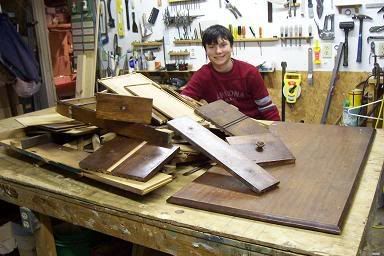
Here’s a picture of Robert in my workshop with all the pieces of the desk piled on the workbench.

Photobucket - Video and Image Hosting

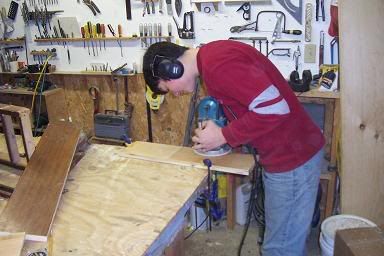
The wood in the desk was primarily poplar, with some other lower grade wood that I could not identify. The desktop had a mahogany veneer over a solid wood core of poplar. Here’s a picture of Robert routing an edge detail around the shelf board. This was the first time he has used a router to make a decorative edge.

Photobucket - Video and Image Hosting

Robert and I plugged away at the project off and on over the course of three or four weeks. There was a lot of table saw cutting in the drawers. I did that part because I don’t want Robert to use the table saw yet. But I do let him use the radial arm saw and he used that to cut many parts to size.

Every single piece of wood in the shelves came from the old desk, even the knobs on the little drawers. We carved them out of a piece of ¾”wood. I carved my four pulls and Robert carved his three. The challenge was to make them as alike as possible. We carved then using a little, tabletop bandsaw and a mini sanding wheel in a Dremel tool. They came out remarkably well.

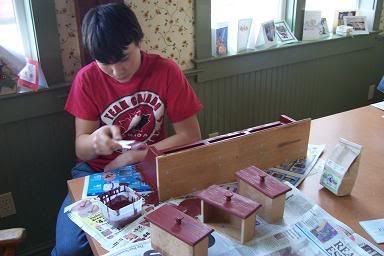
Then we went to the Old Fashioned Milk Paint Company on the internet and picked out colors for our shelves. Robert chose Barn Red and I decided to try black. Here is a picture of Robert painting his shelf with milk paint at the kitchen table.

Photobucket - Video and Image Hosting

After the milk paint dried, we brushed boiled linseed oil over the paint and rubbed it in with some 320 grit wet-dry sandpaper. This rendered a very smooth finish. The sanding also rubbed away the paint in some places, which gave the finish a comfortable, worn, older look—just what you want with yeoman furniture. Then we painted on a few more coats of linseed oil. Each coat was left on for maybe 15 minutes before wiping excess oil off and letting it dry. Here’s what Robert’s finished shelf looks like…

Photobucket - Video and Image Hosting

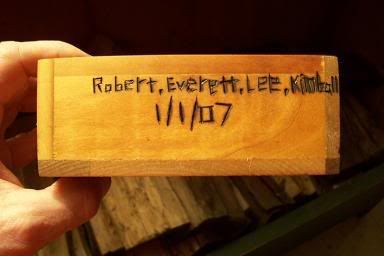
Robert took a real interest in this creative project and was very pleased with the finished result. He decided to use the woodburner he got for Christmas to put his initials and date on the back of the shelf. Then he burned his name into the back on one of the little drawers. He felt like he messed up his name in the drawer but I think he did just fine…

Photobucket - Video and Image Hosting

Robert asked if he would be able to put the shelf in his own house someday. I told him yes, of course, and we can make other furniture for his future home too.

Then there is my shelf, which we put in the kitchen. Marlene was concerned that the black milk paint would not look very good, but she likes the shelf just fine now. A black, hand-rubbed finish with worn spots looks “authentically old.”

The pottery pieces on the shelf (seen below) are from Sturbridge Village. We went there for vacation a couple years ago and James came into possession of the handcrafted pottery as a result of winning a turnip toss contest. I wrote about it here.

Photobucket - Video and Image Hosting

My Young And Short "Poetic Phase"

I was 18 years old when I developed an interest in poetry. It started with a poem by Henry Wadsworth Longfellow name Excelsior. I was so inspired by this poem and its message that I took it upon myself to memorize it. I adopted it as my favorite non-biblical poem. I still like it very much.

Excelsior tells the story of a boy on a journey. He bears a banner with the word "Excelsior." He encounters dire warnings and temptations and such along his journey but he does not give in. He does not falter as he marches on. It is a poem of youthful idealism and determination. Here is the first stanza of the poem:


The shades of night were falling fast,
As through an Alpine village passed
A youth who bore, ‘mid snow and ice,
A banner with the strange device,
Excelsior!

You can read all of Excelsior here

I liked memorizing that poem so much that I determined to find another that I liked and memorize it too. So I searched through poetry books at the library,, looking for just the right poem. I found it in Sir Walter Scott’s Lochinvar. It is a Scottish tale and I am of Scottish descent, so maybe there was a genetic appeal. Then again, I’m sure it was the brashness and romantic bravery of young Lochinvar. Such things appeal to idealistic 18-year-old boys. Actually, such things appeal to idealistic 48-year-old men too. The poem begins:


O young Lochinvar is come out of the west,
Through all the wide Border his steed was the best;
And save his good broadsword he weapons had none,
He rode all unarm'd, and he rode all alone.
So faithful in love, and so dauntless in war,
There never was knight like the young Lochinvar


Now, doesn’t that just fire up something in you? I love the part, later in the poem, where it says:


The bride kiss'd the goblet: the knight took it up,
He quaff'd off the wine, and he threw down the cup.


Just reading that makes me want to quaff off some wine and thrown down the cup (and I don’t even like wine). Then, of course, there is the "fair Ellen." This is a thrilling tale and you can read all of Lochinvar here.


While in this very short "poetry phase" of my young life, I decided to write a poem of my own, and I did. It was not a great poem but I was satisfied with it at the time. It was a poem that summed up my feelings as I was about to graduate from high school. My poem has one thing in common with the two above poems—it speaks of initiative and action.


Few Act

People’s lives are filled with dreams.
Some dream of the past.
Some dream of the future.
Some dream of life,
and love, and happiness.
Some dream of wealth,
and power and recognition.
Some dream of new shoes,
a car, or a new house,
Yes, everyone dreams.

Few act.

The world is full of unhappy dreamers.


I never ever anticipated that I would one day publish that poem. But thirty years later, along comes this remarkable thing called the internet where anyone can publish their poetry. And a lot of people do. They put me to shame. But, just for the record, I once wrote a poem.

What is Agrarianism?
What is Christian Agrarianism?

[Dateline: January 2007]

It is incumbent upon Christians to understand what agrarianism and Christian agrarianism is all about. I say that because the Bible is an agrarian book. It doesn’t speak specifically about agrarianism because it was inherent in the culture from which the book came.

Modern, industrialized life is a relatively new phenomenon in history. For thousands of years, even up to the early days of America’s founding, most people in the world lived within some form of agrarian culture. The closest thing to modern industrialism in biblical times was found in the ungodly cities and city-based cultures of the heathen peoples.

God Himself planted the first garden, showing Adam how it was done. Gardening and caring for creation was man’s original calling. Did God ever tell us to leave this calling? I may be wrong, but I do not think that He did. God calls His people to do many different things in His word, but every one of those things can (and, I believe, should) be done within the original agrarian mandate.

Jesus Christ was born in an agrarian setting (a manger is an animal feedbox or trough). His parables were almost all agrarian based and best understood by an agrarian culture. For example, references to sheep and the shepherd are understood by modern Christians, but a greater depth of understanding comes to those who have actually owned sheep and know their character.

I believe God is working in the hearts of many of His people in this time of history to bring them face to face with the reality of the ungodly industrialized culture in which we live. These people are realizing that the church of Christ has, in so many ways, taken on attributes of heathen industrialized culture. God is leading many of His fold, into a better understanding of what Christian-agrarian culture is.

Understanding is the first step to repentance, which is to say it is the first step to changing one’s worldview. Then comes a life change.

Am I saying you should change your lifestyle from what it is to a more agrarian-centered one? No I am not. I would never tell someone that. But if you seriously, earnestly, endeavor to understand what agrarianism is and, in particular, what Christian agrarianism is, I have a strong feeling that the Lord will convict you. And if you heed the conviction, your life will change. It may change gradually, in little ways. It may change faster and more radically. But it will change.

That said, the question in so many people’s minds is: “Well, what is agrarianism anyway?” Or, “What exactly is Christian agrarianism?”

I like to define Christian agrarianism as “Christianity lived within the agrarian paradigm.” A paradigm is an example, a pattern, or a framework. The only problem with my definition is that it does not explain what agrarian means. Well, I’ve come to believe that pure, undefiled agrarianism is, essentially, Christianity. How’s that for a circular definition?

The fact is, agrarianism and Christian agrarianism is, on one hand, simple, but on the other hand, it’s a very large concept to grasp. I think it is so large because we as a culture have strayed so far. Understanding the definition will require some reading, some thinking, and, of course, some prayerful searching.

Several men have written on the matter of agrarianism and Christian agrarianism. I think one of the better introductions to this subject comes from David Rockett. I suggest you read and consider the following articles by Mr. Rockett:

What is Agrarianism?  

Questions and Answers About Agrarianism 

The Prima Facie Credibility of Covenantal Agrarianism 

Creation & Community 

Howard Douglas King has written extensively and well on the subject of Christian agrarianism. His complete writings were once easily found on one website but that is no longer the case. You can, however read the following article which I think is very good.

The Biblical Basis of Christian Agrarianism

For a more “hardcore” discussion on the subject of agrarianism and Christian agrarianism, I recommend the next two essays by Michael Bunker. Keep in mind that I’m not endorsing everything that all the men I recommend in this blog have written. I’ve noticed that Mr. Bunker upsets some people with some of his writings. But, on the subject of Christian agrarianism, Mr. Bunker has written some thought provoking things that I believe are scriptural.

Agrarianism vs Urbanism

Towards a Biblical Agrarian Culture

Allan C. Carlson of The Howard Center is another Christian man who has written well of agrarian themes.

Then there is the little-known Christian-agrarian book, Writings of a Deliberate Agrarian. Rather than explain Christian agrarianism in great depth, the book presents a series of short, personal stories that serve to show the practical outworking of a Christian agrarian worldview in the life of one very common Christian man and his family. I am that Christian man.

I am a small fish in a big ocean, espousing something so incredibly simple, so biblically fundamental, and so contrary to the established norm that it comes across as newfangled and strange to the average modern churchgoer. Christian agrarianism is looked upon by many with great suspicion.

Is Christian agrarianism a cult? Is it a way to make money? Is it retreatist theology? Is it contrary to the great commission? No. No. No. And no. It is none of those things.

But don’t take my word for it. Read the above writings and judge for yourself what the “motivation” behind this movement is. If you do that with sincerity, I believe you will come away, not only with a clearer understanding, but, more than that, with a godly vision for personal, family, and cultural renewal.


The Fun, Fast Way
To Skin a Deer

Dateline: 12 January 2007


Some people live to hunt. Some people hunt to live. I don’t really hunt at all. I just didn’t grow up in a hunting family. My stepfather never even owned a gun. But, I’ve got guns and I think hunting animals is a fine thing to do. That being the case, I have encouraged my sons in their hunting desires.

Next year Robert will be old enough to gun hunt. It’s difficult to find a place to hunt deer if you don’t have land of your own. But we’ll find a place for Robert to hunt. Maybe we’ll set him up in a tree stand. Or maybe I’ll go with him. Or maybe Marlene will hunt deer with him.

Believe it or not, Marlene bought a license and went deer hunting a couple times this year with a friend of hers. It was pretty much the talk of the neighborhood. “Did you hear Marlene Kimball went deer hunting?” She didn’t bring home the venison but we still got two deer. That’s because when you live in whitetail country, you don’t have to hunt to get a nice deer. All you have to do is let your deer hunting neighbors know that you’ll take a deer if they get an extra one. That’s one nice thing about rural community.

For the past six years we have gotten at least one deer a year from Marlene’s brother or nephew or our neighbor, Brian Kehoe. This year Brian’s mother called just before sundown and said Brian was on his way with a deer.

We hauled the beast (a big doe) out of the back of Brian’s pickup and laid it on a plastic tarp in the back yard under the illumination of an outside flood light. We watched as he gutted the animal. We’ve watched him gut two deer for us now. I reckon I could do it myself. But not as easily and quickly as he does it. Afterwards, I hauled the animal’s innards, wrapped in the tarp, way out to the other side of the field across from our house (which Brian’s parents own). I remember there was a bright, full moon and the light reflected off the dusting of snow in the field so that it sparkled. I thought of the contrast: warm deer guts and twinkling ice crystals.

We hung the deerl from a ceiling hook in my workshop. Three days later, we skinned it, cut the meat off and froze it in plastic bags. We’re far from experts when it comes to cutting up a deer. We just slice the meat off the animal and package most of it for stir fry and stew meat. We grind the small pieces up like hamburger. Marlene made some sausage out of the ground meat.

The best meat on the deer is the backstrap--a strip down either side of the spine. Last year, Brian showed us how to cut it into “butterfly” pieces. Those will be cooked on the grill and enjoyed next summer.

A week or so later, another neighbor shot a smaller doe and called to see if we wanted it. Marlene had just been saying how nice it would be to have another deer in the freezer before the season ended. He delivered it a short while later and I was glad to see it was already gutted. We hung the animal from a tree limb on the edge of the woods behind our house.

The next day, a guy I work with told me how to skin a deer real easy, in one minute, using a golf ball. The idea made sense to me and the following pictures show how it is done…..


To start with, you have to cut the skin around the deer’s neck and pull it down a bit. Then put the golf ball underneath and tie a rope around it, as shown in the above photo. Since I don’t golf, I used an appropriately sized rock that I found on the ground.


I cut the lower legs off the deer with a hacksaw. Then I sliced the skin up the legs to the underside of the animal, and made sure the skin on the underside was cut all the way up to the neck. You could say I “unzipped” the animal’s hide so it would pull off freely. Then I tied the other end of the rope to the ball hitch on my 4WD Explorer. My son Robert drove ahead slowly while I took the picture above.


It takes a lot of power to pull the hide off a deer. The first rope I had on the critter snapped when the skin was half off. It was cheap sisal rope. We used a length of cheap nylon rope next and it held.. I don’t know if my $600 “rice burner” car would have been able to do the job. A tractor would surely have the power. The skin came off clean as the proverbial whistle.


This final picture shows James and Robert with the just-shucked hide and the deer carcass, ready for cutting up. “Golf ball skinning” was so easy and clean and downright fun that I reckon we’ll use the method to skin all our deer from now on.

===============

Besides meat for us to eat,a deer also provides bones for our dog, Annie, to chew on. We'll give her a hunk of bone with some meat still on it and she's in heaven.

Deer meat is real lean but there is fat on the animal's rump and a hunk of that gets hung out on the bird feeder for the woodpeckers.

I tied off the head, neck and rib cage out behind the chicken house for a few days. Annie chewed on it and our 21 chickens swarmed over it, pecking off meaty morsels for themselves. Many people do not realize that chickens are meat eaters.

The skin could have been taken to a hide buyer that is a couple miles away, but James wanted to keep it. One of these days, we will seriously pursue learning how to tan a deer hide.

Then we disposed of the head and remaining carcass by burning it in the backyard with some household papers and sticks gleaned from the woods.

No mess, no fuss.

====================

If you like hunting, trapping, guns, and stuff like that, I invite you to read some more of my essays...

How Not to Shoot The Bull

Trapping Class

The Charging Woodchuck

Going to The Trapper's Convention

Boys Will Be....Warriors (Part 1)

Boys Will Be...Warriors (Part 2)

Life Lessons From an Old Maine Woodsman

How to Butcher a Chicken

Molasses Crumb Cake Recipe

All this talk of community cookbooks makes me want to post a favorite recipe. This recipe for Molasses Crumb Cake comes from Mary Edmonds, who I mentioned in the blog before last.

Many a morning I sat at the Edmonds' kitchen table, looking out over their fields, with Skaneateles lake in the far distance, and had a piece of this Molasses Crumb Cake before Clancy and I headed out to whatever construction or remodeling project we were working on.

This cake tastes just fine right out of the oven, but it gets heavier and tastes better after it sets a day. A spoonfull of whipped cream is real good with molasses cake, but not a necessity.

Molasses Crumb Cake

4 cups flour
2 cups sugar
2 sticks margarine

Mix ingredients into crumb mixture. Take out one cup and set aside.

2 cups boiling water
1 cup dark molasses
1 tbsp baking soda

In a large saucepan, bring water to a boil. Add molasses and baking soda. Remove from heat and add to crumb mixture. Pour into a greased 13 x 9 inch pan. Sprinkle remaining crumb mixture on top. Bake at 325 degrees for 40 to 50 minutes.

Note: we eschew margarine in our family so Marlene uses butter. She also cuts back on the sugar and it still tastes just fine.

A Christian-Agrarian Community Cookbook?

I've been blogging about community and my previous blog entry was about a community cookbook. The thought occurred to me that someone should put together a Christian-Agrarian Community Cookbook.

I don't cook much and Marlene doesn't have time to put together such a cookbook, so I'm tossing the ball up in the air hoping someone else will catch it and run with it.

I think it would be neat if agrarian bloggers and interested agrarian readers out there all contributed some of their favorite recipes. A little bio of each contributor could be included in the book. There are all sorts of other interesting and useful things that could be included in such a cookbook.

It would be a community project.

Well, how about it?

Thinking About Community in a Cookbook

It was one of Marlene’s cookbooks that got me to thinking about the subject of community in my last blog entry. The cookbook is a 238 page, plastic-comb-bound, community cookbook that was put together and sold to raise money for the New Hope Fire Department woman’s auxilliary. I think I have that correct based on my memory. I can’t be sure because the cover and first few pages are missing, which gives you an idea of how much use the book has gotten since the early 1980’s when it was published.

(By the way, New Hope is the rural crossroads town that my family moved to from a suburban housing project outside Syracuse in 1973, when I was in ninth grade)

Such cookbooks, containing recipes from people living in a given community, are common in rural areas of America. They are nothing new. I have a Depression-era community cookbook published by the "Fidelis Class" of the Congregational Sunday School in Moravia, N.Y.

I think community cookbooks are wonderful expressions of community and, as I leafed through Marlene’s cookbook, looking at the names of the contributors, I found myself thinking about some of those people...

Janet Badman (strawberry rhubarb crisp)
When my family moved to New Hope, we attended a little Baptist church that was in a refurbished one room school house. Kenneth and Janet Badman and their four children (all close to me in age) attended that church. They had a small dairy (milking maybe 70 cows) and crop farm on Glen Haven Road. Before long, I was helping them unload hay wagons in the summer. After high school I worked a full year on their farm and saved enough to buy my first car. Janet died about a year ago. Her husband and two sons still run the family farm. They are the hardest working farm folk I’ve ever known.

Hazel Badman (fruit salad)
Hazel was Kenneth Badman’s mom. She and her husband operated the farm before her son took it over. Hazel lived in a house by the main barn while Kenneth and Janet lived a couple stone throws down the road. Every day at milking time, Hazel would give "Nutty Buddy" ice cream cones to her son and grandsons and me, the hired hand. It was like a little family tradition, and quite a treat.

Joann Head (rye bread dip)
The head family has a nice dairy farm on the state road at the north end of town. Three sons operate the farm. Joann is married to the youngest son, Leonard. I got to know Leonard one summer when I helped to build a big addition on the back of their cow barn. They gave me an old telephone pole that was lying around and I used it to hook up a temporary electric service when I built my house.

Jane Jayne (Grandfather Walter’s cheese pastry)
Wally and Jane Jayne have a dairy farm on Old Salt Road. The farm was cited in 1946 by the governor of New York as a Century farm which means it had been in the same family for over 100 years. Wally is the sixth generation Jayne to farm the land. Fact is, Wally’s ancestor bought the farmland from William Tuttle who was deeded one square mile of land in payment for his three years of service in the Revolutionary War. The Jane’s even have William Tuttle’s military discharge signed by General Washington himself. I first met Wally the summer I got a job helping a local guy spray paint barns and silos. We painted Wally’s barn roof. None of the Jayne children were interested in the dairy so Wally sold off his herd a couple years ago. Their farm is around the corner and just down the road from where I now live.

Kay Nast (zucchini ham casserole)
Jerome and Kay Nast had a small dairy farm on White Road (around the corner and just up the road from me). Jerome also drove school bus. Both Jerome and Kay have passed away but their son still runs the farm and has a firewood business. I buy my firewood from him every year.

Anna Buckler (Vermont pork chops)
Anna’s father, Les Ready, had a place on the state road south of town. In his later years he kept his hand in farming by growing a couple acres of potatoes. One year, I spent two days helping to pick the potato crop. At lunch time, we all sat down to a great home-cooked meal that Anna and her mom had prepared.

Olive Adams (cider cake)
Gerry and Olive Adams lived in a tidy little house at the bottom of New Hope Road. I remember Olive teaching Sunday school to the Badman boys and me at the little Baptist church. She was a wonderful artist and gave me painting lessons (but I was a hopeless case). She and my mother became best friends. Both Olive and Gerry have passed away.

Mary Murphy (Swiss chard and spinach pie)
Mary Murphy was my mother. The swiss chard and spinach pie was her only recipe contribution to the community cookbook. It was a pretty good dish that I had forgotten about. Maybe I can get Marlene to make it for me someday.

Thelma Stayton (oatmeal crispies)
Thelma’s husband, Don, had his own excavation business. When I built my house, I hired Don to dig me a well with his backhoe (it was only 10 feet deep). He and his son, Gary, put my septic system in. He lived close enough that he just drove the backhoe from his house.

Lois Weed (four way cake roll)
Leland and Lois Weed and their children also attended the little Baptist church. Leland owned New Hope Mills. I worked for him at the mill bagging pancake mix after school, on Saturdays, and during vacations for awhile when I was in high school. It was a great little job just a short walk up the road from my home. Leland passed away a few years ago. Lois attends the Baptist church my family now goes to. It is in a big, remodeled, farm pole barn. Her youngest son, Dale, is the Pastor.

Mrs. John Nemec, Sr. (European cheese pie)
The Nemec family has a farm that backs up against the banks of Bear Swamp creek, which ran across from my house, and I spent a lot of time as a teenager exploring down the creek. I’ve never really known the Nemecs that well. But I’ll never forget that when my dad broke his leg, and was out of work for months (he is a diabetic and doesn’t heal well), and money was tight, I came home from school one day to find a load of firewood in the driveway. I was told that John Nemec’s son, Steve and his brother in law, Bill Carmon (Jane Carmon-hot fudge sauce), cut it and gave it to us. That was a real neighborly thing to do.

Mary Edmonds (molasses crumb cake)
After getting a year of building trades school under my belt, I came home to try and find a carpentry job. I wasn’t very confident in myself, but The Badman’s, who I had once worked for, told me to go see their neighbor, Clancy Edmonds, about a job. They had already spoken well of me to Clancy. I got the job and worked with him for five years jacking up camps, repairing barns and remodeling houses, mostly right in the New Hope area. Clancy and Mary came from New Jersey and bought the old Freeman farm. During the summers, I spent a lot of afternoons helping Clancy get his hay in the barn. When I built my house, Clancy donated a set of stairs he once salvaged from a camp on Skaneateles Lake, and an old Andersen window he salvaged out of the Freeman house when he remodeled it. The stairs and the window are still part of my house.

Kay Scavone (noodles and cabbage)
Mrs. Scavone was an elderly lady who lived in a run-down old trailer. She attended the little Baptist church. I remember sitting next to her at a Jack Van Impe crusade in Binghamtom and when it came time for the alter call, she leaned over to me and asked me if I wanted her to go up with me.

Anna Hobart (saucy surprise cake)
Stan and Anna Hobart and their four children lived next door to my family. Stan is retired Navy. Anna sold Avon. Their oldest son, Rob, was my age. One day he and I took a canoe from the pond in New Hope way up into Bear Swamp. We had to get out and pull it up over beaver dams. After awhile we were in a vast expanse of open swampland that was so secluded and wild that we felt like we were the first humans to ever go there.

Esther Stoyell (chili sauce)
I think the first white man to walk into these parts may have been a Stoyell. The family name goes way back, and there are still several Stoyells in the New Hope area. Harold and Esther once ran the little country store that was on the corner in New Hope. I remember going on a nighttime church hay ride through the dirt roads of Bear Swamp State Forest and out to Bentley’s Knob. We had a big campfire there and Harold played his harmonica.

Georgie DeWitt (chicken casserole)
There’s also lots of DeWitts hereabouts. My parents bought their home from Georgie’s son, George (Sharon DeWitt-pumpkin bread). When we bought the house, we also got George’s dad’s old F-20 tractor. He gave my dad and me a lesson about how to hand crank a tractor to get it started. Another son, Don, is crop farmer. Don used to help Clancy Edmonds and I with the carpentry work when there wasn’t much farming to do. He once let me tear a granary out of his barn and keep the lumber. I used it to build a shed on my land, before we built our house.

I could go on but I’m probably boring you. There are so many more names and memories associated with just that one little cookbook and this little community of families. Many of the names are of people who have died. That is inevitable after 20+ years. But an updated edition of the New Hope community cookbook would contain the names of many children and even grandchildren of the above people, as well as new people who have moved into the community.

Keep in mind that this book came out of a relatively small community. You could go five miles down the road to the next crossroads community with a fire department and put together a completely different community cookbook, though you would undoubtedly see many of the same last names.

I believe God created us for community, and wherever people congregate for any length of time, some sort of community develops. Some community experiences are deeper, richer, and more fulfilling than others. When, as a boy, I lived in a suburban housing project, I experienced good community, but it was nothing compared to the rural community my family moved to, and which I still live in.

In the suburban setting, there was a close concentration of people, a prevalence of ungodly influences, lack of wide open spaces and natural settings, and higher turnover of people as families moved on to something better (the elusive American Dream). None of those things contribute to the best example of community.

My point with all this is that it is a beautiful thing to live in a rural area and become involved in the life of the community over the course of years. To raise your children, live your days, grow old, and die within such a setting, surrounded by neighbors you’ve known and trust and care for, is a blessing. I can’t help but think it is the way life should be.

City Living &
Some Thoughts on
Christian Agrarian Community

Dateline: 9 January 2007

Abraham allows his nephew, Lot, to choose the land he wants.

At two o’clock this morning, awake with a sinus headache, my head over a steaming-hot pot of herb-infused water, shrouded with a heavy canvas barn coat (to keep the steam in), I started thinking about the subject of community. It wasn’t the headache or the steam or even the peppermint that brought this subject to mind. It was one of Marlene’s cookbooks that I idly leafed through while sitting at the kitchen table waiting for the water kettle to boil. I’ll tell you more about the cookbook in my next blog essay. For now, I’d like to tell you some of the things that went through my steam saturated brain....

It seems to me that good community can happen anywhere. It used to be very common in close-knit ethnic urban areas. Jews, Irish, Germans, Poles, and so forth lived in distinct communities with a culture all their own (often these people had large gardens and were, for all practical purposes, agrarians). I’m sure that is still the case in some urban areas. Good community can and should also happen within churches. Indeed, within the ethnic urban neighborhoods I mentioned, there was almost always a nearby church that was central to the life of the community. Good community also happens within fraternal organizations, and other kinds of groups where like-minded people regularly gather.

Those examples are, to my way of thinking, examples of good community. But they are not examples of the very best to be found in the realms of community.

Those of us who are seeking to more closely embrace the ideals of Christian agrarianism, understand from God’s Word that the fellowship of Christian community is essential to the Christian life. And, beyond that, we know that we are called to be a witness for Christ with the life we live in the more-worldly community outside our church community.

But we Christian agrarians are also inclined to think that community lived within the agrarian paradigm (as opposed to an urban or metropolitan setting) is also more Biblical and more preferrable. Cities and urban areas are, and have, throughout history, almost without exception, been centers of human pride and rebellion against God. Such places are suited to be mission fields but I seriously question if such places are best suited to raise Christian families (and families are the backbone of a thriving Christian-agrarian community).

I know that statement will not meet with approval from millions of modern-day Christians who raise families in cities or suburbs. Please understand that I didn’t say it to be contentious, nor to condem. I said it simply because I believe it is true. I grew up in an urban setting and moved to a rural setting when I was a teenager. That gives me some personal perspective. And here’s some biblical/historical insight into why I think the way I do on this subject....

In Genesis 9, after the flood, God blesses Noah and his sons and tells them to be fruitful and multiply and replenish the earth. So "Noah began to be a husbandman, and he planted a vineyard." Noah was a pretty smart fellow. He knew better than to go start a city. Agrarian life fit what Noah understood God wanted of him and his descendants. (Of course, he shouldn’t have gotten drunk on his own homemade wine, but that’s a different thing altogether.)

Unfortunately, as is sometimes the case, the wisdom of godly fathers is not accepted by the children. It wasn’t long before some of Noah’s descendants left the agrarian life and assembled in cities. Most notable among these descendants was Noah’s great, great grandson, Nimrod. He formed the first great empire after the flood. It was centered around several cities in the land of Shinar, which was in the “fertile crescent” of Mesopotamia. The head of Nimrod’s empire was the city of Babylon. It was not a godly city.

In Genesis 11 we find some interesting happenings in the land of Shinar. The descendants of Noah said, "Let us build us a city and a tower, whose top may reach unto heaven, and let us make us a name, lest we be scattered abroad upon the face of the whole earth."

Well, God was not happy with these people and their city. Spreading out abroad upon the face of the earth was exactly what He wanted them to be doing. In other words, He wanted them to live a decentralized, rural existence. But they were determined to do just the opposite.

Whenever and wherever rebellious mankind congregates, they want to build monuments to their own greatness. So they worked together to "build a tower, whose top may reach unto heaven." We all know the rest of the story. God "confounded their language." They could not communicate and were forced to give up their plan. Foolish creatures!

But wait a minute.... Is the industrialized culture we now live in much different from Babylon? I think not. In fact, I dare say the ungodly corporate-industrial civilization we live in, working out of the major cities and urban centers of the world, taking upon itself the attributes of God, is exalting itself above God more than Nimrod and his tower of Babel ever did. Curiously, this prideful expansion and exhibition of man’s sovereignty has been facilitated largely by the inexorable and amazing expansion of communication technology. It is through various forms of attention-grabbing modern communication that the worst of city culture is now communicated to the masses, even into the rural heartland of America. That’s something to think about, but I digress.

A little farther ahead in history we find Abraham and his nephew, Lot, looking over the plain of Jordan. Abraham tells Lot to choose the right hand or the left hand to dwell in. Whatever is left, Abraham would be content to dwell in. What part does Lot take? He takes the part with the best water and the richest soil. It also has cities. Then Abraham goes and lives his agrarian life while Lot goes and pitches his tent toward the city of Sodom.

Before long, Lot is seated in the gates of Sodom, which I understand to mean he was one of the leaders of the city. It appears that it was not so much the good land of the plain that appealed to Lot as much as the cities that were in the plain. Wicked cities. What is the final outcome? The cities of Sodom and Gomorra are justly destroyed. Lot, along with his wife and daughters, are rescued by angels. Mrs.Lot, so in love with her urban life, looks back and is turned into a pillar of salt. Lot’s two daughters don’t turn to salt, but it appears from their actions afterwards that they were heavily influenced by the ungodly city culture. Lot, a godly man by every account, made a foolish decision to leave the simple life of an agrarian herdsman and brought his family into the more "exciting" city. I suspect there were more "opportunities" there, more things to do, better entertainment. One can easily justify urban life on such grounds. But it was flat out wrong for Lot’s family to get involved in the culture of the city. That’s the way I read it. And I don’t think much has changed since then.

I like the way Howard King sums it up in "A Christian-Agrarian Critique of Technological Society"...


"The ancient walled city of the Bible had the most in common with the modern city. It was most often a center of apostasy, a base for imperialism, a treasure trove for plundering tyrants, a monument to human pride, vainglory and rebellion against God... The city provides no ideal for culture since it is opposed to biblical culture. Like Babel, the prototype, it has been erected in defiance of God’s design for a decentralized agrarian civilization."

The point is, good community can be found in a lot of places but the very best in community experiences, the kind of community experiences that are best for raising a family for the glory of God are, I believe, found within agrarian settings. Having said that, I’d like to give you five primary ingredients that are found in the best community experiences. They are: Time, Place, Proximity, Mutual Concerns, and Mutual Kindness.

By time, I mean years. The more the better. Generations are best.

By place, I mean a home where a family lives, on a section of land that the family has, over time (maybe even generations) cared for and grown to love.

Proximity is the state or quality of being near. A new kind of community has emerged in recent years with the advent of the internet. Such a community can be good. But it can never be a best form of community because there is little proximity. Virtual proximity just isn’t the same as physical proximity and never will be.

Mutual concerns arise out of a mutual worldview. Worldview boils down to fundamental ideas about what is right and wrong, good and bad. Worldview is at the root of religious belief. Generally speaking, rural folks share similar belief systems. They may not all agree on religious doctrines but they think alike on many core issues. One example of this becomes clear during a national election when the rural areas of the nation typically vote the same (i.e., the “red states”).

Mutual kindness is when people in the community interact by speaking, visiting, working, caring, sharing, and giving to each other in some way, to some degree, preferably on a daily basis.

This kind of best community was once the norm in most rural areas of America. It was also found in small rural towns and villages. But as agrarian culture has given way to modern, industrialized culture, the social fabric of rural communities has become more and more threadbare.

That being the case, those of us who call ourselves Christian agrarians are looking to find and help reweave the beautiful fabric of rural community. We want to raise our families, put down generational roots, be good neighbors, be salt and light. Instead of living “part time” in a community while driving to the city to a job every day, we dream of actually working full time at or nearer our homes, where we can be a more integral part of the comunity.

I believe there are Christian families searching for the ideal community—one in which all those qualities I’ve mentioned work together flawlessly. Of course, such a community doesn’t exist. I’m sure, though, that some areas of rural America experience better community than others. Perhaps among the close-knit Amish and Mennonite sects you will find the best examples of agrarian community.

Whatever the case, each family’s search for Christian-agrarian community will take them on a different journey. For myself, for now, I believe the best community I can find is right where I am. I have lived in this rural area of central New York State since 1973. Unfortunately, this place is no longer as rural as it was 33 years ago. It isn’t so much that more people have moved into the area (there is plenty of room for more people in rural America), it’s that more people with urban ideas have moved in and, sadly, there are far less real farmers. The price of land has climbed (always just out of reach for me) and New York State property taxes are criminally high.

Sometimes I think of moving to another state like Tennessee or Missouri or Kentucky. Maybe someday I will. But I probably will not. This is a beautiful area. And after so many years I’ve come to realize that I have become part of this community. I know so many people. I actually know (and like) my neighbors. We attend a nice country church. The experience of rural community that so many people in America do not know, and so many are searching for, can be found right where I am. I suspect it can be found in most any rural area. It won’t be perfect. But you can make it better.

In closing, I guess I would say to aspiring Christian agrarians, those who are looking for a place to live and put down roots. Find an area of the country that appeals to you and find a small, rural, Bible-believing community church to attend and get involved with. Probably the church where the old local farmers go would be a good place. You’ll find “salt of the earth” people there. You’ll find community there.