The Christian-Agrarian “Awareness” Of Eric Sloane

As a teenager back in the 1970s I bought four paperback books by Eric Sloane. ”A Reverence for Wood,” “Our Vanishing Landscape,” “A Museum of Early American Tools” and ”Diary of an Early American Boy.”

Last year I read my tattered copy of Diary of an Early American Boy to my sons and they enjoyed it very much. I gave them the other books and they have studied them at length. It did my heart good to see them as captivated with Sloane’s books as I once was. Indeed, the illustrations and the information in those books stirred a great interest in me years ago, and they do it to me still.

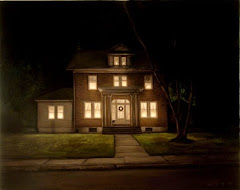
Sloane was an incredibly talented artist. His rural scenes of old barns and fields with big, cloud-filled skies, resonate with my agrarian passions. With that in mind, I thought it would be nice to get an Eric Sloane print, frame it, and hang it in my home.

I discovered that Sloane prints are few and far between. When I last checked, there was nary a one on Ebay. I did find a couple galleries that sell signed, limited edition prints and original paintings. But I wasn’t looking to spend thousands of dollars. I’m not even looking to spend hundreds of dollars. Maybe a few tens. :-)

Well, anyway, during my internet searching I happened upon a web site about Eric Sloane that was very interesting. Among this site’s offerings is a page titled, Eric Sloane’s Philosophy of Awareness. I’m not sure who wrote the essay but it is well done. I hope the author will not mind me reprinting the excerpt that follows.

Anyone interested in America’s agrarian past and the Christian-agrarian resurgence we see happening today (neo-agrarianism) will find this essay to be particularly interesting. There are basic principles and that stand out and beckon us. We can learn much from the example of our Christian-agrarian forebears, and that’s the point of the essay...

Eric Sloane devoted the greater part of his life to the exploration of what he later coined his "philosophy of awareness". The basic concept of awareness that Sloane articulated through his many books centered upon his belief that the man (and woman) of yesterday was more aware than his or her modern day counterpart. This heightened sense of awareness came principally from "doing for oneself". In order to even begin to understand what Sloane meant by awareness, you must understand the world of 18th century New England.

In 18th century America, everyone was by necessity a farmer. Even the local doctor or lawyer needed to keep a horse and likely had chickens, goats, pigs and perhaps a cow. The vast majority of New Englanders listed themselves as "farmers" on census forms. An 18th century farmer had no electricity, no indoor plumbing, no telephone, no television, no automobile and no "modern conveniences". Before you get wrapped up in the romantic warm blanket of yesterday, remember that life for these Americans was hard. Infant mortality rates were high. Life spans for healthy adults were short compared to today. Sickness could devastate a community. If your family was to survive, each family member was required to perform strenuous physical labor most of us couldn't imagine today.

Yet because of this, not in spite of it, the early American was peculiarly aware of many things that today we take for granted. Start with his very existence. Disease or injury, mild by today's standards, could kill. How would you live your life differently if you knew that the odds of you surviving to live 48 years were slim? Time and labor were not wasted. Families counted on each other for love and support. Communities banded together to help any and all members in need. The church and worship were the literal and figurative centers of the community.

From this emerged the early American. Hard working, God fearing, honest, and loyal. He and she worked a lifetime to build barns and homes to last generations. They cleared fields for planting, managed forests and in most cases practiced a form of animal husbandry and farm management that would ensure their farms would prosper for generations. Almost every single necessity was met on the farm: a tremendous variety of crops for food, medicine and clothing, trees for tools and building materials, herbs for cooking and healing, clay and rocks for building and sweet water for cooking and cleaning.

Most everything was done with an eye towards permanence and most everything was made by hand. How would you feel towards (and care for) a sweater that your mother knitted for you and dyed your favorite color by hand? Or a toy your father made for you when you were a child? Or a harvest table your parents made for you as a wedding gift from a Chestnut tree you once played on as a child that was since felled by a storm? Little wonder that most of what we now consider real "folk art" from the 18th and 19th centuries are beautiful works of art and extremely expensive.

As the early American man, woman and child looked about them, their sense of awareness was reinforced. The farm before them of well-tended fields, bountiful gardens, healthy animals and rugged stone fences all were transformed by their hands. The home and massive barn were built by friends and relatives in a Herculean community effort of love and support. The blanket chests, chairs, rope beds, quilts, clothing, candles - and nearly everything else in the home were made by a member of the family.

How did Eric Sloane, born almost a century after the declining years of what most of us consider to be "early America", come to understand his philosophy of awareness?......


You can read the rest of the essay HERE

===============

Note: If you would like to get some of Eric Sloane’s books for yourself and your family, check out the good selection at great prices over at Cumberland Books

Facets of "The Good Life" (October 2007)

Got Carrot Juice?
If I were asked to define “the good life,” I would do so by providing you with some examples. For example, here in October, I could simply say, “Fresh carrots from my garden.”

I have a great crop of carrots this year. The following picture is not a good one of me, but just look at those carrots!

Photo Sharing and Video Hosting at Photobucket

I happen to believe that the best way to eat a carrot is to drink it. Marlene and I are avid vegetable and fruit juicers, especially in the fall, when the carrots are big. To be able to walk out into my garden and pull large, vibrant-orange, chemical-free, nutrition-packed carrots from the earth, then, minutes later, be drinking the juice from those carrots.... that truly is “the good life.”

Why Juice?
Because raw vegetable juices are alive with enzymes. Cooking kills enzymes. The typical modern diet is enzyme deficient. Enzymes are biochemical catalysts. In other words, they make everything that’s good for a body happen. Our bodies crave the enzymes in raw fruits and vegetables. They are necessary for optimum health.

Juicing separates juice from the plant’s fibers, thus making it very easy for your digestive system to assimilate the nutrients. We’re talking about an all-natural, awesome-good-for-you energy drink here.

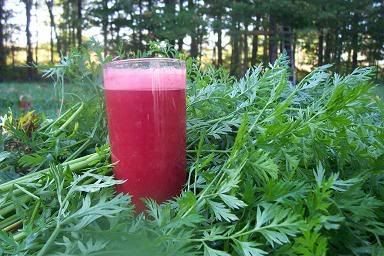
Take eight big carrots, a medium beet, and one large clove of garlic. Run them through your juicer machine (we have used a Champion juicer for years). You will end up with two glasses of down-to-earth ambrosia like this:

Photo Sharing and Video Hosting at Photobucket

One glass is for you and one is for your spouse (or another loved one). You drink it together by sipping, savoring, and reflecting on the goodness of it all.

A quiet moment together with my wife, sipping fresh vegetable juice concoctions. Uh-huh....”The Good Life.”

Tainted Meat
I chose, months ago, to deliberately “tune out” the daily news blather. But I still get bits and pieces in conversation. I understand there has been a recent “meat scare.” Tons of “factory beef” are being recalled because it is not fit to eat. Ho-hum…. So what else is "new?"

I’ll tell you what’s new. We are buying half a Black Angus from one of our country neighbors. It might be one of the ones that got loose and stampeded down the road into our yard (and my garden) awhile back. Cut (by a local butcher, any way we want it), packaged, and frozen, we will pay $2.00 a pound. I have no idea if that is a lot or a little to pay. All I know is that the animal was well cared for and healthy, and it was raised just up the road by good folks we have known for years.

Buying safe, locally-produced, beef and packing the freezer full... that’s yet another example of “the good life” here in October.

Firewood
The arrival of autumn here in central New York state makes us think seriously about winter preparations. I ordered firewood from another neighbor. He is a small-scale dairy farmer. He took the farm over when his father died a few years ago. He is a bachelor and works alone. The firewood sales are a way to supplement his income. This man, a year older than I, is the hardest working person I know. I buy my firewood from him every year.

Ten face cord of seasoned wood, split and delivered, sells for $40 a cord. The price actually went down $5 a cord from last year. I asked why. He told me it was because I was a good customer. I told him we were grateful for his wood, that it was a blessing to us. And I paid him $42 a cord.

$420 worth of firewood will heat my home for the winter. A single, old, Vermont Castings wood stove in the living room of our house has been our sole source of heat for 22 years. Wood is some trouble to handle, and it does make some mess in the house, but it is an inexpensive, locally-available, renewable resource. And if an ice storm shuts down the power for a week, we will still be warm and snug.

There you go again.... yet another example of “the good life.”

(The only thing better would be to have my own woods and harvest firewood with my boys. I love to cut firewood. Maybe someday.)

Applesauce
Marlene has been making and canning applesauce. The apples were free for the taking from yet another rural friend. The apple trees were planted by our friend’s grandfather long ago. They are not sprayed or otherwise cared for. But the apples are very good this year.

Apples from friends. Jars of homemade applesauce in the pantry. Yep. “The good life” again.

The Wedding
Last Saturday we went to a wedding. One of our pastor’s sons married a girl that any parent would love to have as a daughter-in-law It was a simple wedding in a rural Baptist church (the bride’s church). We knew just about everyone seated on the groom’s side of the sanctuary. They were mostly friends and neighbors from our church and community. There was no fancy restaurant reception after the wedding (finger foods in the church’s gymnasium were very nice). There were no limousines to take the wedding party away. There was no live band. No worldly foolishness. Like I said, it was simple, but it was Christ-honoring, and that made it beautiful.

During one part of the wedding ceremony, our pastor prayed over the two young adults, asking God’s blessing on them and their union. His voice cracked with emotion. And we who sat in the pews, we who understand the special significance of a man and woman covenanting before God through their vows, we had tears in our eyes.

Oh yes! It was another manifestation of “the good life.”

Farm Market
My bride of almost 27 years, The Lovely Marlene, has finished up another successful season of selling her homemade breads and rolls at the farmer’s market. She has, over the years, gained a loyal customer base. When the market’s opening bell sounds on Thursday afternoon, people are lined up at her booth to buy.

One woman this past year informed Marlene that she wanted to quit her job and go into business with Marlene, starting a bakery. She would take care of the marketing and Marlene would take care of the baking. With bread like Marlene makes, the woman was sure the business would be successful. HMarlene's bread really is that good.

Farm markets and homemade bread. The good life? You betcha.

Coming Home To Apple Juice
We have not yet made cider (as in past years), but my son, James, and I ran some apples through our Champion juicer last weekend and enjoyed a couple glasses of real fine apple nectar. That, in itself, was great, but it gets better…

Yesterday I came home from my factory job in the city and I was feeling a little gloomy. Factory jobs will do that to a man. But my gloom turned instantly to joy and satisfaction when James walked up to me with a just-made glass of apple juice. He had made a glass for me and him. He gave me a big hug. Marlene, working in the kitchen, smiled and gave me a cheery welcome. My other son, Robert, yelled from the living room, “Hi Dad.”

Lord Almighty! If that isn’t the good life, I don’t know what is.

Making Diamonds
I could go on, but I think you have the idea. These examples of the good life are, in themselves, little things. When you put them together, however, they are like the many shining facets of a beautiful diamond. And there is an analogy for you to keep in your mind, always:

Simple, Christian-agrarian, faith-and-family-based life is a diamond that we, with the help of our Lord, create for ourselves, for our family, for our community, for the generations of our family to follow, for God’s glory. We do this with the beliefs we hold dear, the choices we make based on those beliefs, and the work we do putting those beliefs in action.

Make no mistake about it—-the good life, as I have endeavored to describe it here is not carefree and easy. It is a life of work and difficulty, because, ultimately, it is a life of responsibility, which brings me to another facet of our life here in the autumn of 2007…

The Fall & Its Consequences
Three weeks ago my 76-year-old father (stepfather) fell and broke his hip. He was already frail with the effects of age and many years of diabetes. But, until the fall, he had been holding his own, and was doing relatively well.

Yesterday, Marlene and James brought him home from the hospital. He can walk some with a walker. But he is now weaker and more helpless than he has ever been. I remember when this man was healthy and strong and self-confident and capable. He was once a Marine. Semper Fi. He has always had a strong work ethic. He could take care of himself. But that is no longer the case. He is in the October of his life—maybe even closer to November or December.

It is sad and sobering to watch your parent’s age, get sick, and eventually pass from this realm. I went through it with my mother four years ago. Fortunately, my father, the now-feeble man, was there for her to the end. Now, who will be there for him?

I have two younger sisters. Their life situations, the choices they have made, prevent them from being there to help their father. That leaves Marlene and I. There are no other relatives. Caring for my father is our responsibility. We will be there for him. We will help him. We will take care of him. We will love him in this difficult season of his life.

Our home is not big enough to take him in. I wish it was. We are considering an addition to do this. In the meantime, he lives only three miles away. If it becomes necessary, we will move in with him.

The lion’s share of caring for my father will fall on Marlene. She is now, as she was when my mother was dying of cancer, a ministering angel. She will check in on her father-in-law daily, help him get the food he needs, and take him to the many doctor appointments and therapy sessions scheduled in the weeks ahead.

The boys and I will do what we can to help him and support Marlene. I am taking tomorrow off from work to don an apron (figuratively speaking) and help with cleaning and clothes laundering here at home.
We are willingly entering into what may well be a difficult and stressful time for our family. Perhaps, after a couple weeks, my father will recover nicely and be independent once again. We pray that will be the case. And we hope that, however things play out, we will be able to care for him to the end, at home. Time will tell.

The point I want to make in all of this is that, sad and difficult as caring for an ailing, elderly parent is, we consider the ability to do this, and the opportunity to do this, to be as much a part of “the good life” as all the other blessings I’ve shared with you in this essay.

========================================

On another note, Rick Saenz has written some very fine agrarian-based essays at his blog, Dry Creek Chronicles. The essays are classic Saenz: intelligent, insightful, cogent, and compelling. I recommend them to you. Click here for links: The Lost Tools of Living

What A Man Needs....

I took three days off from work last week so I could get some things done around home. My primary focus was to convert a section of my workshop into a book storage, packaging room, and office for my part-time home business, Whizbang Books. For the past few years I have stored books and packaged orders in my house and in my workshop. It has been an unorganized operation. But that is about to change.

My shop measures 24ft by 32ft. A portion of it was an 8ft by 16ft storage bay with an overhead door. I cleaned out the bay, removed the door, and framed two windows in the opening. Then I insulated the walls and sheathed over the open studs on the inside with OSB plywood. It’s not pretty, but it was fast, and it’ll be functional.

My two youngest sons, Robert and James, helped me off and on. One day James was watching me and asked me this question:

Can you stand not doing anything?”

I wasn’t sure what he was asking. “What do you mean?,” I replied.

“I mean, can you stand not doing anything? You have so many projects. Could you stand it if you didn’t?”

My brain quickly absorbed the question, and I realized that my son has always known me to be an active person with numerous interests and projects. There are book writing projects, home improvement projects, Whizbang inventions, garden projects, and other homestead projects.

Then, out of the blue, I had an answer for him. A succinct and profound answer. That is rare for me. More often, I ramble on and on with my answers. But not this time. I said to my son:

“No, I wouldn’t be able to stand not doing anything. Do you know why that is?”

He said no and asked why.

“Because, and I want you to hear this carefully, James, every man needs three things in life. Do you know what they are?”

He said no and asked what they were.

“A man needs three things, son. A man needs a God to serve, a work to do, and a woman to love. Don’t ever forget that James.”

And that was it. I felt so wise. Now, I’ll confess that I didn’t come up with that on my own. I actually heard it from my wife. Isn’t that funny? She heard it years ago from a speaker at a home schooling convention. She thinks it was Mark Hamby.

So there you go. I really do think that sums up what a man needs. It’s something to think about. And, perhaps, someday you will have an opprtunity to share those words of wisdom with your adolescent son.

Earth Oven Inspiration

Dateline: 2 October 2007

My last three blog entries were about our recent three-day family vacation to Pennsylvania. On two of those days we went to a sustainable energy festival. The festival introduced us to a lot of new ideas. One of the best ideas I saw is an old idea that is becoming popular once again.... mud ovens.

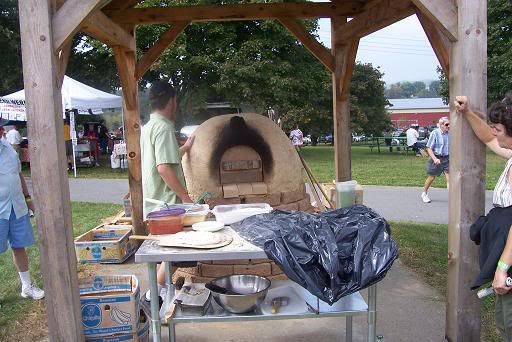
Here’s a picture of a very simple mud oven that was built at the festival last year:

Photo Sharing and Video Hosting at Photobucket

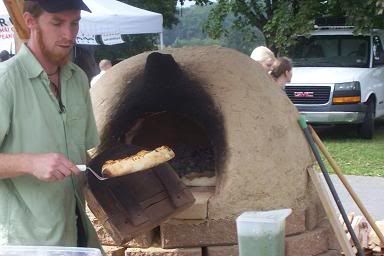
We stopped by the mud oven many times during the two days to study and watch it bake pizzas. Here’s a picture of a just-cooked pizza coming out of the oven (look closely and you can see another pizza is still in there).

Photo Sharing and Video Hosting at Photobucket

A mud oven is incredibly simple to make and use. First, let me tell you how it is made: A layer of firebrick is placed on a solid surface as a base. Then a circle is drawn on the firebrick (27” diameter will work). The circle is an outline for a half-circle dome of damp sand that you then place, pack down, and shape by hand (it's around 16” high). Once the sand dome mold is made, a 4” thick layer of clay/sand mix is carefully packed over it.

When the clay/sand mud has dried a bit (but not completely), a door is cut into the dome. Then the sand is scraped out and a small fire is built in the oven chamber to cure the mud.

After the mud is cured, a layer of clay-and-sawdust “insulation” mix is packed over the whole oven. Chopped straw can be used in place of the sawdust. The oven in the above pictures had bits of straw sticking out of the surface.

That is how you build a mud oven. There is more to it. I have simplified the process. But even with added details, it is still a very simple thing to build a mud oven. So simple, in fact, that I think I can do it. I'll bet you could do it too.

I purchased a book att he festival titled Build Your Own Earth Oven. It tells everything you need to know to make very inexpensive mud oven.

Such ovens are incredibly functional. In addition too cooking a pizza in 3 to 5 minutes, you can cook bread and anything else you would cook in a regular household oven. The flavor of foods cooked in an earth oven is said to be better than modern ovens. My son James had an earth oven pizza and said is was great.

To use the oven, a small, hot fire is built inside it. The heat of the fire is absorbed by the mass of the mud. It will get up to 600 degrees pretty quick—--just right for cooking pizza. The coals are then removed, or they can be pushed back out of the way. No electricity is needed. No propane gas of any kind is needed. Just a small amount of firewood. This is sustainability, efficiency, survival, and FUN in a simple heap of dried earth. I am inspired.

A man I work with was born in Italy. He moved with his family to America when he was 12 years old. He told me his grandparents had a simple earth oven in their back yard. He said everyone in Italy had such ovens, and used them all the time. He says you can make the best dried tomatoes in these ovens with the heat down low. I am inspired.

Last year when we went to the farmer’s market in Ithaca, NY, there were people there selling pizza made in an earth oven that they pulled to the market on a trailer. I didn't pay that close of attention. But I noticed they were selling a lot of pizza. Now Marlene is thinking that, instead of making hand-cranked ice cream at events as a money maker, maybe pizzas from a portable earth oven would be better.

Maybe it would be. But before we get to that point, I hope to build some sort of an earth oven in my back yard next year.

Making the oven, heating it up, cooking the food, eating the food... it is shared experiences like those that create memories, establish family traditions, and help to bring a family closer together.

That is a good thing. I'm inspired. Stay tuned.....

Our Family Vacation 2007 (Part 3): Lancaster Amish

Click HERE to read Part 1 of this series.

Click HERE to read Part 2 of this series.

We left the sustainable energy festival Sunday afternoon and drove south an hour or so to Bird in Hand, Pennsylvania, which is in Lancaster County. The second largest settlement of Old Order Amish in the US lives in Lancaster County.

As we drove along rural side roads, running through picturesque Amish farm countryside, we encountered a great many horse drawn buggies. The day was beautiful and we noticed that most of the carriages were being driven by younger men, many with a young Amish woman beside them. They were, we supposed, out for an afternoon joyride. I felt bad that so many cars (like ours), and a few semi trucks, were on the narrow roads with them. And, as much as I wanted to take a picture of one of the buggies, I did not.

There was a vacancy at the Bird-in-Hand Family Inn and we checked in. As always, I looked to see if there was a Gideon Bible was in our room’s bedside table. It was not there. The Bible was, instead, prominently displayed in a book holder, upright, and intentionally opened to John 3:16. That was a first and a welcome sight if there ever was one.

Unlike our hotel of the previous two nights, this one had an indoor pool. But the boys did not bring their swim suits, so we got directions to the nearest department store. We found our way to a Target store along a heavily traveled and well developed road leading into the city of Lancaster. There were no Amish carriages on this road.

Not far from the Target we saw a store named, Amish Stuff Etc.. I pointed it out to the kids and made it clear that was the kind of place we would not be stopping at. Robert wondered if there were stores named, Baptist Stuff, Etc. or Methodist Stuff, Etc.. We had some fun discussing that and the absurdity of a store in the midst of a busy urban retail environment selling Amish “stuff” to tourists.

We ate cheap at an Arbys but stopped at a Cracker Barrel restaurant so James could buy a couple packs of Black Jack and Beemans chewing gum at the store. He and Robert couldn’t resist adding more Billy-Bob teeth to their growing collection.

Photo Sharing and Video Hosting at Photobucket

Monday morning we enjoyed a breakfast smorgasbord at the Bird in Hand Family Restaurant. I decided to try the scrapple. Another first. It was pretty good.

Then we moseyed over to some gift shops, an antique store, and a bakery. We found some Amish “stuff” there, but these stores were not so crass. They were pleasant places to visit. I must admit, however, the boys and I had our fill of shopping long before Marlene.

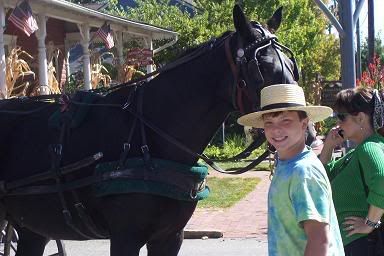
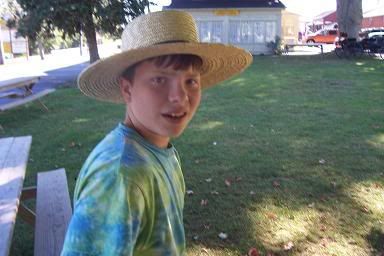
James asked me if he could buy an Amish straw hat. He likes to wear odd hats and I thought it was a practical purchase. It was also reasonably priced. Here is a paradoxical picture of James in a tie-dyed t-shirt with his new Amish hat:

Photo Sharing and Video Hosting at Photobucket

That horse was hitched to an Amish buggy outside the antique store. But we did not bother a true Amish horse in the taking of the picture. It was giving buggy rides to tourists. The lady on the cell phone paid for a ride. We did not.

Fed up with our shopping experience, Robert and I sat ourselves down on a picnic table in a central location and watched the world go by. A short while later, James walked up. He said he was ready to go and wondered where his mother was. I informed him that she just went into the candle shop over yonder, He said, “What! Why didn’t you stop her?!” That’s when I took the follwing picture. James was a little exasperated and ran off to fetch his mom.

Photo Sharing and Video Hosting at Photobucket

Our main objective that day was to visit the Mennonite Information Center before heading home. If you ever visit Lancaster, make it a point to go to this place. They have a Biblical Tabernacle Reproduction (with lecture) that every Bible believing Christian will appreciate.

The Mennonite Information Center also hosts a movie presentation titled, Who Are The Amish, followed by an 18 minute movie about the Mennonites. Again, this is well worth seeing.

We learned that the Mennonite sect arose out of the Reformation in Germany and Switzerland. The Amish began later, when a group of Mennonites felt their church was becoming too worldly.

There are many different groups of believers within the Amish and Mennonite sects and it is not easy to explain the differences in general terms. But after seeing the two movies, I think it is safe to say that the fundamental difference is, as it was from the beginning, the degree of worldly involvement. Mennonites have embraced much of the modern world’s technology and ways, while the Amish have not. Nevertheless, according to the movie, the numbers of Amish have doubled in the past 20 years.

Our stay in Amish country was not long, but it was long enough for my boys to see and, hopefully, understand the contrast between cultures. Beyond that, I hoped they were able to see the wisdom of the one over the other.

I pointed out to my sons that we had just spent two days at a sustainable energy festival, where we learned a lot abut how to run a car on used cooking oil, but that wasn’t nearly as economical, ecologically responsible, and sustainable as horse and buggy transportation. No, we sure couldn’t sustain our modern lifestyle with such a simple conveyance, but maybe our fast-paced modern lifestyle isn’t worth sustaining. It’s food for thought.

And here’s something more to think about: I’ll bet that if Baptists (or any other Christian group of believers) lived an exemplary agrarian lifestyle, a lifestyle focused on hard work, simplicity, family, community, and piety, as the Amish do, the surrounding culture would find that curious and interesting and compelling. Why, masses would probably flock to see these peculiar separatists in their communities. Before long, there would even be stores for tourists called, Baptist Stuff, Etc.

Our Family Vacation 2007 (Part 2): PawPaws & Scott Nearing

Click HERE to read Part 1 of this series


Sunday morning we headed back to the Pennsylvania Renewable Energy & Sustainable Living Festival (yes, we missed church) and got there as it was opening. Marlene had signed up for a 2.5 hour women’s workshop on basic photovoltaics. The boys and I went to a Vegetable Oil Fuel Shop Talk with Meghan Murphy from Ithaca Biodiesel.

The primary focus of the festival was alternative energy but there were also other seminars. For example, I sat in on two gardening presentations given by Lee Reich. Both were informative and inspiring.

The first seminar, titled My Weedless Garden is described as follows:


This slide lecture will introduce a novel way for caring for the soil, one that results in fewer weeds. My "weedless gardening" system is an integrated system that involves minimizing soil disturbance, avoiding soil compaction, maintaining a soil cover, and pinpointing watering. "Weedless gardening" takes care of the soil beneath trees and shrubs as well as in flower and vegetable gardens, and I'll show how I apply it to my new plantings as well as to maintain existing plantings. By emulating rather than fighting Mother Nature, plants become healthier and weed problems are minimized. The principles and practices are rooted in the latest agricultural research and also could be beneficially applied to sustainable, small farm systems.


Here’s a description of the other seminar, No Spray Fruits:


If you want to grow fruits, but do not want to spray, these are the ones to grow and this is how to grow them. In addition to some familiar fruits such as raspberries and blueberries, a few lesser known fruits -- including pawpaw, Nanking cherry, hardy kiwifruit, and medlar -- also are delectable and have no significant pest problems. This presentation will cover site selection, varieties, and, where necessary, pruning.


(I got my first ever taste of a pawpaw fruit after the "No Spray Fruits" seminar)

I have to say that the festival was not quite as good as I had hoped, but we still had a good time and learned a lot. One thing everyone in my family noticed is that people in PA seem more friendly than people in NY. Maybe it’s just people who attend sustainable energy festivals. And though there were some "hippie" types there, most folks were downright ordinary-looking, kind of like me. :-)

Speaking of hippies, we sat in on a 30-minute documentary movie titled, Living The Good Life. It was a film made in the 1970’s about Scott and Helen Nearing. The Nearings were not hippies but the back-to-the-land movement of the 1970s (which attracted a lot of hippies) was fueled to a degree by the couple’s 1954 book, Living The Good Life.

The Nearings worked hard, lived simply, and grew their own food. Principled and idealistic, yet pragmatic, Scott and Helen were, in many ways, exemplary agrarians. They were, however, not Christian agrarians.

Scott was 93 years old in the movie. He was still working hard in the outdoors, “living the good life” as was Helen at, I believe, 72. Near the end of the film Helen tells how someone once commented that when Scott passes, he will probably just say “hello” to Jesus and get right to work. The she tells of Scott’s reply that he would probably not say “hello” to Jesus and just go to work.

The quip met with laughter from many in the viewing audience, but I didn’t see the humor. It was a haughty comment, made by a mere man who, seven years later, would die and find himself in the presence of Jesus, the same Jesus who stands at the right hand of the Father, with all power and all authority in heaven and earth. No, I did not think the comment funny. I thought it foolish, and I felt a pang of sadness for Scott Nearing.

As I work at living the good life here with my family on this little spot of land, I do so with a full awareness that everything I enjoy in this life is a blessing from God. His grace and mercy sustain me. And were it not for Jesus Christ, there would be no good life.

We left the festival early in the afternoon and drove south, to Lancaster County.

(to be continued.....)

====================

Click HERE to read Part 3 of this series.

Our Family Vacation 2007 (Part 1): Sustainable Living Festival & Grease Cars

The chickens and turkeys we raised for meat this year are in the freezer. Most of the garden has gone to seed. Government school is back in session. It’s a good time to take a little vacation, and that’s what we did last weekend.

Marlene and I and our two youngest sons (Robert & James) headed south to Pennsylvania for four days and three nights of discovery and learning. The focal point of our journey was the 3rd annual Pennsylvania Renewable Energy & Sustainable Living Festival in Kempton, PA.

On Friday we drove to a nice-enough hotel on the western edge of Allentown. For something to do in the late afternoon, we went to Renninger’s Farm Market in Kutztown. That’s our idea of a good time—going to a farm market. We checked out the different vendors and each of us found something to eat. I had a small vegetarian pizza and a vegetable smoothie from Nancy’s Mediterranean Food. The smoothie was a puree of apple cider, beets, carrots, and celery. I watched Nancy make it in a Vita-Mix blender. She told me she grew the beet and carrot and pronounced, “Now that’s a healthy drink!” as she handed it to me. Indeed. It was downright good food.

Saturday morning we made our way to the Kempton Community Center and got to the fair as it was opening. The sky was overcast but it cleared up and turned out to be a beautiful day. In addition to a farm market and numerous vendors, there were many different speakers giving one-hour presentations throughout the day.

There was a lot of emphasis on biodiesel as a sustainable alternative to gasoline and petroleum-derived diesel. One woman there had a 2001 VW car that she runs on filtered, used cooking oil (referred to as “grease”) which she collects free from restaurants. She said she commutes 100 miles a day for her job and spends all of $9.00 a week for diesel fuel.

It so happens that you can run a diesel on straight grease but you must start the engine on diesel and switch to grease (from a separate fuel tank in the trunk) when the engine heats up to 190-degrees. Then, five minutes before you shut the engine off, you need to switch from grease back to diesel. If you don’t switch back the grease can solidify and clog the fuel injectors.

A ready-made conversion kit costs around $1,000. If you know what you are doing, you can do the conversion without a kit for a whole lot less.

There were some electric cars there and one enthusiastic young fellow I spoke with told me all about his electric lawn tractor made by General Electric back in 1969. He had a sickle bar mower, a snow blower, and a rototiller attachment for it. Impressive.

I had hoped to see and learn something about homemade alcohol fuel production but, unfortunately, no one was discussing this option. I sat in on a presentation about micro hydro power that was only mildly useful. Anther presentation on solar water heating was pretty good.

Lunch was good too. Nancy’s Mediterranean Food from Renninger’s Farm Market was there. Nancy reminds me of Mary Jane Butters in her appearance. She is obviously a hard-working, enterprising woman, and a good cook to. My dinner consisted of a homemade spinach pie, homemade tabbouleh, and homemade potato salad. Once again, I got a wholesome meal from Nancy.

The keynote speaker on Saturday was Jeffrey Smith, author of the book Seeds of Deception. Smith’s book “documents significant health dangers of genetically modified (GM) foods and the intense industry influence and political corruption that allow them on the market.”

Last year I purchased a DVD titled The Future of Food from the Seeds of Deception web site and blogged about it HERE
I also wrote A Christian-Agrarian View of Genetic Modification.

Mr. Smith was a fine speaker and he had an important message. He and his Organization are working to outlaw all Genetically Modified Organisms (GMOs) in the United States. With that noble goal in mind, he explained that they are working to reach religious organizations with their message. Smith said that evangelicals should be very concerned about the whole GMO issue because GMO also stands for God Move Over. It was a profoundly insightful comment.

Hearing about the corporate and government skullduggery that brought GM foods into the human food chain made me angry. Hearing about the probable adverse health effects of this evil science renewed my desire to avoid eating any food made with corn oil, canola oil, or high fructose corn syrup. That is, however, not an easy thing to do--unless, of course, you eat your own home cooking (or eat at Nancy’s Mediterranean Food).

Someone in the audience asked about a possible connection between Colony Collapse Disorder (CCD) in honeybees and GMO pollen, something I have speculated about here in the past. Smith said that GMO pollen does not appear to be a cause of CCD. But, he said that GMO pollen does put stress on the bee’s immune system.

Speaking of bees, I sat in on an interesting talk about raising and using Orchard Mason Bees as fruit tree pollinators instead of honeybees. I discovered that these non-stinging bees have a lot of advantages over honeybees, but they are suited only for pollinating tree blossoms (i.e., apple and peach). That’s because their life cycle coincides with tree blossoming time. Therefore, Orchard Mason Bees are not suited to general purpose garden pollination, and I was disappointed to hear that.

We left the festival around 5:00 on Saturday and headed back to the hotel room. On the way we saw a sign for a Cabela’s store. Robert and James got pretty excited about that and we made a detour to check it out. It proved to be one of the highlights of the trip for both boys.

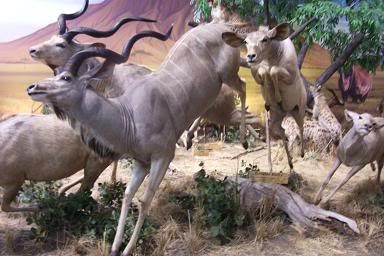
This Cabela’s was an enormous place. It was designed primarily to separate people from their money but there were attractions that cost nothing to enjoy. The extensive whitetail and mule deer display, with many legendary buck racks and the stories behind them, was exceptional. The African animal diorama was like something you’d see at a world class natural history museum. Here's a picture showing what I mean:

Photo Sharing and Video Hosting at Photobucket

We dined at the Cabela’s restaurant and, after more than two hours of “shopping,” I walked away without buying anything. Marlene got some postcards for her scrapbooking. The boys bought Cabela’s hats, rifle ammo, a gun cleaning brush, and some other little odds & ends.

We’ve found that traveling long distances with kids is a whole lot easier and more bearable while listening to audio books. I got an unabridged dvd of To Kill a Mockingbird from the library for this trip. I read the book when I was probably 15 years old. Marlene had never read it. If the book proved not to be a good choice, I had "Treasure Island" as a backup.

Our audio version was read by Sissy Spacek. She did an excellent job. We pulled into our hotel room as the rabid dog, Tim Johnson, entered the story line. Not wanting to wait until morning to hear how the story unfolded, we all sat in the car and listened to how mild-mannered Atticus meets the animal in the middle of the street and shoots it, to the utter astonishment of Jem and Scout.

(To be continued....)

====================

Click HERE to read Part 2 of this series.

Click HERE to read Part 3 of this series.


The Cherished Letter

Dateline: 20 September 2007


The cowboy shirt my grandmother made for me, circa 1960.

Those who have read my book, Writings of a Deliberate Agrarian, know that my mother’s parents, Percy and Gertrude Philbrick, were potato farmers in Aroostook County, Maine. I wrote the following of them in the book:


My grandparents were intimately familiar with hard, seemingly endless, often desperate work, and they knew, as only poor dirt farmers can, the heartache that comes with having labored so diligently and so hopefully, only to see it come to naught. Bad weather, potato rot, and punishingly low crop prices can, at times, conspire with such cruelty. There were also other character-building hazards of life, like sickness and the fire that burned their home to the ground in the winter of 1933.

But Percy and Gertrude were hardy people—they had no choice, really, but to be hardy—and the Lord blessed them. While they never accumulated an abundance of material possessions or a big bank account, those things by which the world so foolishly measures success, they did possess the plebeian wisdom, gentle humility, knowing patience, and grateful spirit that hardship and difficulty can cultivate in a life.

Those were important, emotional paragraphs for me to write, because I wanted to sum up the difficult life of these two people who loved me and who, because they loved me so, were very dear to me.

My mother, in moments of recollection, often spoke with utter amazement of her parents, especially her mother, Gertrude, and how incredibly productive she was as a farm wife and mother to ten children. My mother was most amazed by the fact that her mother managed to cook and clean and care for her family, while also sewing all their clothes.

My grandmother Philbrick was, like many women of her era and circumstance, an excellent seamstress. Sewing was not a hobby to her (at least not in her earlier years), as it is to some women these days. It was a necessity. My mother told me that she remembers her sewing late into the night after everyone else had gone to bed. And, she said, she and her sisters were always very well dressed as a result.

Years later, my mother asked her “mum” (that’s what she called her mother) where she learned to sew. She replied that Percy bought her a sewing machine and she taught herself to sew during the depression. She never used patterns and, more often than not, she made new clothing using material from old clothing.

I still own a grey and red wool cowboy-style shirt that my grandmother made for me when I was probably two years old. It is nothing short of a work of fabric art, complete with felt and sequin horse heads, and all crafted using salvaged tag-sale clothing.

I am telling you these things as a tribute to my grandmother Philbrick. She was an example and a blessing, not only to her children, but to the grandchildren who knew her, as I did. But there is another reason for telling you of this common farm wife who has faded into the history and lore of my family. Understanding something of her life brings perspective.

Which leads me to “the cherished letter.” It is a letter written by Gertrude to her sister, Helen, four months after the house fire (which, it turns out was in 1934, not 1933, as my book states). I know that the letter, written in faded pencil on now-yellowed notebook paper was very special to my mother because of the times, over the years, that she spoke of it and showed it to me, while marveling at the hardships her mother had to deal with. I recently acquired the old letter in a box of my deceased mother’s personal papers. How she ended up with it, I don’t know.

The letter was written two years and three months before my mother was born. She would be Gertrude and Percy’s last child. The newborn baby girl mentioned in the letter (and still unnamed) was my Aunt Jean. She and my mother would be close sisters all their days.

If you are a woman, imagine, if you can, as you read this letter, how difficult it must have been to lose your home and most of your possessions suddenly on a winter day to a ravaging fire. You are five months pregnant, with a nine-month-old baby and eight other children. Imagine what it must have been like to have six of your children scattered around the neighborhood, living with neighbors, while you and your husband and the two youngest babies live in a place that “isn’t much of a home.” Furthermore, the insurance that was on your home will not pay you and your husband a cent and you are cash-strapped, struggling potato farmers. And the children will have no clothes to wear unless you make them.

Yes, these were hardy people. They had no choice, really, but to be hardy. The point being, I, and most of you reading this story, have never had it so bad. Comparatively speaking, we have it easy. Perhaps even too easy.


Fort Fairfield, Me
May 29, 1934

Dear Helen:

At last I’m starting the long-looked for letter. Last Thursday the 24th of May another baby girl was born to us, weighing 9lbs. The 26th, Dorothy was 1 year old.

Since we got burned out we have been living in the old Cushman house. It isn’t much of a house but we were thankful to get it so near to the barn, etc. We got a good deal of things out of the house. We lost a lot of beds that were up in the shed chamber besides everything else that was there. Of course we miss the beds more now because we are so in need of them now. Everything in the shed we lost, but the washing machine was in the kitchen, for which I was very thankful.

Everything in the cellar was lost too—10 bbls. of apples; 15 baskets of Delicious apples; 10qts. strained bee honey; 12qts. mincemeat, besides all my canned goods.

There is always so many things one loses in a fire that isn’t missed until you find you haven’t got it. I had a lot of clothing upstairs that was smoked and scorched so badly they weren’t much good after they did get them. What insurance we did have on the house they cut us way down and then took what we were to get and put it on our indebtedness. That came under the new N.R.A. act.

I’ve got a woman taking care of me and doing the work and I’m giving her $2 per day while I’m in bed. She is real good and it’s a good deal cheaper than going to the hospital. The baby is awfully fat and real well and I feel real well considering what I have been through the last four months.

The package which you sent came just a few days after we got burned out. And things like that certainly put a lot of encouragement back in me. We’ve stayed over to Cushman’s, that is, Percy and I, and Lorraine. The rest of the children were scattered around among the neighbors.

They were all awfully good and kind and helpful in a thousand different ways. I was given 2 or 3 different bundles of clothing to make over. I still have a lot left that I haven’t got made yet.

I wished you folks could come up and stay awhile. I’d love to see all three and especially little Evangeline. Please forgive me for not writing but I didn’t have any help very often and I had to get the children some clothes made. It seemed that they didn’t have anything to put on when they took their heavy clothes off.

Try and help me think of a good name for the wee one. One that goes good with Dorothy would be nice as they are so near together.

Write when you can. I know I don’t deserve a letter for a thousand years but oh please forget it.

Love to all of you from all of us.

Gertrude

P.S. There is no need of sending this on to Mama as I’m mailing her one also.


I’ve noted in my past writings that I believe my life has been impacted and influenced for good due in part to the Christian character and faithfulness of three women in my family:

My mother
my Grandmother Kimball
my Great, Great Grandmother, Josephine Jordan

To that list, I now officially add my grandmother Gertrude Philbrick, the granddaughter of Josephine.

The letter above does not quote scripture but you can read of her thankfulness for simple things, and please note that she does not feel sorry for herself. In her later years, my grandmother Philbrick would write me letters with her labored and shaky (but neat) handwriting, and include Christian poems and Bible verses.

She was, as every grandparent should be to a grandchild, an influence for righteousness, and a very special person.


Me And My Turkeys

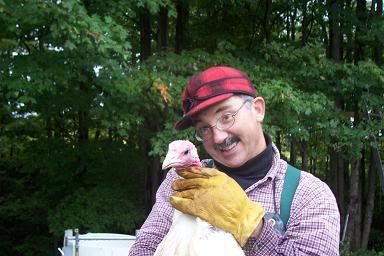
I very rarely post pictures of myself here. But today I’m making an exception. This is me and one of my turkeys. I’m the one on the right side of the picture.

Photo Sharing and Video Hosting at Photobucket

We raised turkeys this year for the first time. I wrote about it Here and Here. I discovered that I can talk to turkeys better than I ever could to my chickens. And they talk back to me. Turkeys have a certain dignity about them that I like. Fact is, I absolutely love turkeys.

But yesterday, I had to say good bye to my feathered friends. It was time to harvest the flock. The turkeys were not pets. Their purpose was to be food for my family. Yesterday we processed the birds.

It was a cool, overcast day with intermittent rain. I dressed warm with a turtle neck and my son James (my able and willing helper) said we needed to break out the Stormy Kromer hats we bought a few years ago on our trip to Maine. When the Stormy Kromers come out around here, you know it’s getting cold.

The ten turkeys we raised were 17 weeks old. The freezer weights ranged from 17 to 24 pounds. We freezed a few whole birds but cut most of them in half.

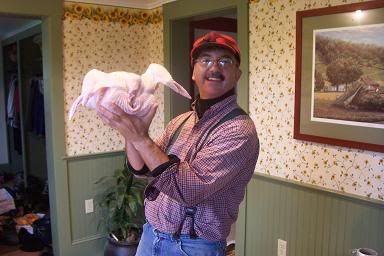
I'll spare you the gory details of the processing experience. Suffice it to say that turkeys are butchered pretty much like a chicken, and I have recently created a whole new tutorial blog telling how to butcher a chicken. I will, however, share with you one more picture. This is me holding an 18-pounder. He is coming in for a landing on the kitchen table

Photo Sharing and Video Hosting at Photobucket

How To Butcher A Chicken (My New Blog)

I was laid up with a bad knee for two days this last week (as explained in my previous entry) and that was a perfect opportunity to do something I've been wanting to do for a long time. I spent several hours in a recliner with my laptop creating a new blog.

The blog is not a blog in the commonly understood sense of the word. It is what I call a tutorial blog. I have created the blog specifically to teach.

My new blog is simply titled How To Butcher A Chicken.

If you have never butchered a chicken, my new blog will teach (and show) you how to get the job done in ten easy steps. If you happen to be an experienced chicken butcherer, I invite you to stop by and compare notes.

There are some minor changes that I plan to make, but How To Butcher A Chicken is 99% done. I welcome your advice or comments. And if you think the blog is worth recoommending, I hope you will recommend it to others at discussion groups and on your blog.

I admit that I have an ulterior motive in asking for your help to spread the word about my new blog. Ultimately, sometime down the road, I hope to sell books and even chicken plucker parts to those who stop by and read the blog. If I can sell more books and parts, my little home-based business will grow. If my business continues to grow, maybe, just maybe, I'll be able to shuck the industrial factory job in the city and come home. That, and to purchase a bit more acreage than the current 1.5 acres we now own, is the goal. Thanks for your help.

In the near future, I hope to create more blogs with a teaching focus. Stay tuned.

Woe is Me

Getting older can be a pain. Actually, it’s more likely to be a variety of different pains. Some days my back pains me. Sometimes my neck pains me. Sometimes my sinuses pain me. For the past two months, my elbow has been a major source of significant pain. Then, last Friday night, my right knee started to hurting.

My self-diagnosis for the severe elbow pain, and attendant weakness of the limb, was bursitis. My self-prescription for the ailment was to give it time. My elbow and arm are now almost 100% recovered.

The knee pain was different. I woke up Saturday morning, ready to get a lot of work done here on the homestead but the knee really bothered me. I limped at first. Then it got to the point where I was stepping ahead with my left foot and dragging my straightened right leg along. It hurt too much to bend the knee. Eventually, I ended up lying on the living room carpet with zip-lock bags of ice on my knee, enduring surges of pain. After half an hour of ice, the knee felt pretty good.

So I went back to work. Before long, I was back on the floor with the ice packs. I repeated that cycle throughout the day and wondered what I had done to myself to cause such a situation.

The only thing I could come up with was that Friday afternoon, when I got home from work, I sat in a chair outside and worked on my garlic. I used an old toothbrush to help peel away the dirty outside paper wrappers on each bulb. I did this for a few hours with my elbows resting on my thighs, just above my kneecaps. Perhaps I pinched a nerve, or something like that.

Saturday night I took some Extra Strength Tylenol (something I do not like to do). I had trouble sleeping. I was shifting around in bed, holding the ice bags on different areas of my knee, and keeping Marlene awake. So I went downstairs on the couch. A couple hours later, I decided I needed a blanket. I stumbled around trying to find a blanket but could only find a tablecloth. It, and a hooded sweatshirt, sufficed. I finally got a couple hours of sleep.

Sunday morning the knee seemed a lot better. But the more I walked around, the worse it got. I applied more ice. I skipped church. Marlene told me I should go to the Urgent Care office in Skaneateles. I thought about it. But I told her that I didn’t want to go unless I got some new socks and underwear. And all I had to wear on my feet was my leather work boots. My sneakers were tattered—just right for around the garden, but not for going to the doctor. I’d have to get some new sneakers too.

Marlene laughed at me. She said, “You’re just afraid they’ll give you a prostate exam, aren’t you?” She said that to me while holding her index finger up in the air, and laughed some more. My two youngest sons (who, I’m sure, do not know what a prostate is) laughed too. One of them quipped, “Yea, maybe you’ll have to do the turn-your-head-and-cough-thing,” which brought more howls of laughter. Such a response from my family was particularly disturbing to me. I tried to keep a serious face, but I must admit, I ended up laughing too.

Finally, later in the afternoon, I asked Marlene to call and see if I could get in at the Urgent Care place. She called and found out they closed at 1:00. It was too late.

This morning (Monday), I had to go to work. I didn’t sleep well but when 5:30am rolled around I found that the knee was feeling a whole lot better. I drove to work and took it careful. But my job requires a lot of walking and there are a lot of stairs. All the knee bending was too much. I left work after three hours and drove to Urgent Care.

Believe it or not, when I was a youngster, I wanted to be a medical doctor. My grandfather and my father were doctors. I figured I would do the same. I figured that was my “calling.” But it really wasn’t, and I’m glad I figured that out early. I decided, instead, when I was around 17 years old, that I wanted to be some sort of a farmer. That never happened either.

In any event, I do not go to a doctor unless I have a problem that really, really concerns me. As a result, I don’t go to doctors very much at all. And I wouldn’t have gone to the doctor today except that my job requires it if I am going to miss work for any length of time due to sickness or injury.

My employer doesn’t put much stock in self-diagnosis and self-prescription (i.e., “give it time"). I need a note from a genuine medical doctor saying that I should not go to work until I’m better. So that’s why I went to the doctor.

I have to say that my experience wasn't bad. I got to see the doctor after waiting only 1/2 hour. The people I dealt with were pleasant and professional. The doctor listened to me describe the pain and my theory about how I had injured myself. He moved my leg and knee around and determined that I was probably right. The tendon was somehow irritated. Even still, he wanted me to get x-rays of the knee. He said that sometimes a portion of the tendon attached to the kneecap will detach and take a portion of bone with it. That sounded plausible. Nothing about a prostrate exam was suggested.

There was, however, one new problem to add to my variety of aches and pains. Before the doctor came in, a nurse took my blood pressure and temperature and such. She raised her eyebrows at the blood pressure reading. “You have high blood pressure.” She said. “How bad is it?” I responded. She turned the instrument so I could see. The numbers meant nothing to me. She informed me I’m at risk of having a stroke. She told me I should make an appointment with my doctor, soon.

Then she asked me when I had my last physical exam. I told her it was 31 years ago. She raised her eyebrows again.

Seven short years back, I was an assistant teacher in a public school. About a week before I left that job, the school nurse came around and took blood pressure readings of all the teachers. She smiled and told me mine was perfect. Then I took a job inside a maximum security state prison. It is a stressful job (I’ve written about it here). I attribute my high blood pressure to my job. It is a job that, like so many industrial-world jobs, destroys people’s health with stress. But the industrial world provides “solutions” for the affects of stress. For example, prescription drugs. There is a prescription for just about everything.

My self-prescription would be to get out of the job I’m currently enslaved to. But what would I do? I was a carpenter and home remodeler for 20+ years. I worked very hard at it. I was good at my craft. But, after helping my kids build a small “barn” on our property recently, I realize that I am not physically capable of working like I once did.

I know what I would like to do. I would like to come home, live a slower, simpler, less stressful, more earth-and-home focused lifestyle, while writing more Whizbang Books, and selling project parts. The possibility of doing that full time is not as remote as it was a couple years ago. But it is still, for now, some time in the future.

So I face the dilemma of so many wage-slave men in our culture. They are not financially able to sustain themselves (nor their families) apart from an unnatural and overly stressful industrial job. And they do not feel they are financially capable of even considering the pursuit of other occupational options. Or, as in my case, they are downright afraid to chuck a decent-paying regular job for the unknown because they have been through a season of financial hardship in the past, and they don’t want to go through that again.

God has, after all, blessed me with a good job. Hasn’t He? Some people think so. But I really don’t know.

I am left with the same options I have been pursuing for the past seven years. Continue to pray. Continue to seek God’s guidance in this matter. Continue to work at building a home business. Continue to avoid debt. Continue to try to save some money.

The good news is that the doctor gave me a note to give to my employer saying that I need to take two days off from work. This is a first for me. Two paid days off from work because I got a doctor’s excuse. And that trip to the doctor only cost me $18. I’ve got benefits, don’t you know.

So here I am, at home, sitting back in an upholstered recliner, with a fresh country breeze blowing through my patio screen door. It is quiet and stress-free here. I am relaxing, and writing, and healing, and pondering my future, with just a little angst.


Digging Potatoes
With a Little Girl

Dateline: 2 September 2007

Back in June I posted a story with photos here about Planting Potatoes With a Little Girl. It was a story about children, brutish boys, cute little girls, and, in particular, the neighbor girl that Marlene had been babysitting.

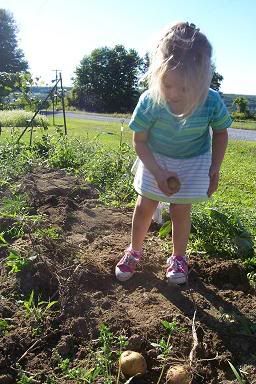
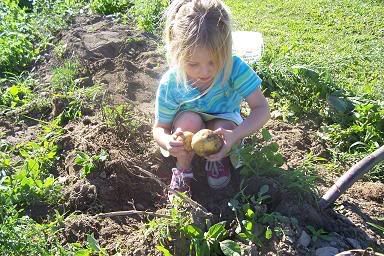
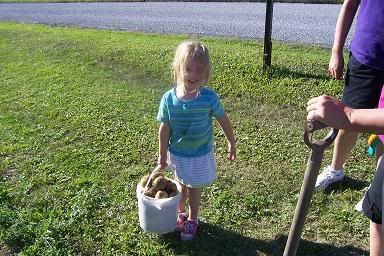
Yesterday, Marlene watched the little girl again for the day. We made it a point to take her out to the garden and dig some potatoes from the seed she had planted. The potato plants have died off and some weeds have grown up on the hilled rows. But just under the soil there is a beautiful crop of homegrown spuds. Marlene worked the fork, I manned the camera, and the little girl picked the hidden potatoes as they came into view.

She thoroughly enjoyed herself and went home with a small pail of her own delicious Yukon Gold tubers.

Photo Sharing and Video Hosting at Photobucket

Photo Sharing and Video Hosting at Photobucket

Photo Sharing and Video Hosting at Photobucket