Essays About Economics & The Economy

An Agrarian-Style Economic Self Defense Plan
Slouching Away From Prosperity (Part 1)
Slouching Away From Prosperity (Part 2)
Eleutheros on Debt
The Story of Thomas Jefferson's Personal Debt
Thomas Jefferson on Government Debt (Then & Now)
Thomas Jefferson vs Paul Krugman, Alan Greenspan, et al.
Bullwinkle Economic Soultions
Economics Lesson in a $5 Bill
A Missive on the Prosperity-Driven Life
700 Billion Divided By 300 Million
Gold at $1,000
The Agrarian Moneychanger
Social Security
Index To My Series of Home Business Ideas


Winter Tomatoes

Dateline: 25 November 2008


According to the book, Root Cellaring: Natural Cold Storage of Fruits & Vegetables, by Nancy Bubel:


"Mature green tomatoes will ripen in 25 to 28 days at 55 degrees."

Back just before the first cold frost of autumn, Marlene picked several green tomatoes from our garden, brought them in the house, carefully laid them out on a flat surface in a cool, dry room, with a towel over them. That was weeks ago. The fruits have ripened gradually. Some of the tomatoes develop soft spots or small rotten areas. But those infirmities can be cut out. Then again, many of the tomatoes ripen to picture perfection. Either way, such tomatoes are certainly edible, and a welcome treat long after the garden has died.

The above picture was taken yesterday. It is the end of November and we have several inches of snow on the ground. A storm was howling outside. But we had fresh tomatoes from our garden.

The effort to preserve these tomatoes was minimal. This preservation technique is nothing new. Down-to-earth people have done this with their tomatoes for generations. But I think the idea is worth mentioning every so often for those who have never tried it.


Slouching Away From Prosperity (Part 2)

[Dateline: 24 November 2008]

In Part 1 of this evolving series of essays I wrote about the deleterious effect that our current economic crisis and continuing decline may have on the big business of NASCAR and other professional sports. That essay had some tongue-in-cheek elements but this one does not. This is pure seriousness.

I’ve read that the average stock market investor has lost half the value of his portfolio in the recent stock market plunge. A man I work with, who has faithfully saved for years, and invested in stocks, admits to losing $250,000 this year, thus far. I have not lost so much. That’s because I don’t have so much. But if I did, I still wouldn’t have lost it because I wouldn’t have had it in the stock market.

People seem surprised that this economic downturn happened so fast and so seriously. Everyone from Alan Greenspan, to small business owners, to factory workers are expressing shock and awe at the sorry financial situation our country is in.

But why are they so surprised? I'm not surprised. A lot of people aren't surprised. It was no secret that the economy had some serious underlying flaws. It was no secret that we were due for a collapse of some sort. Even I, a relative financial ignoramus, knew that prosperity could not continue indefinitely, that trouble was soon to be, and that it would be significant.

All anyone had to do was read Bill Bonner’s free daily e-mail newsletter, “The Daily Reckoning,” to see that “Mr. Market” was due for a significant correction; that the whole interconnected, global house of cards was going to come down. And Bonner was just one of many voices in the wilderness, sounding the contrarian alarm.

I can recall a discussion with some coworkers a few years ago in which I asserted that the stock market was not a safe place to put one’s money. They laughed at that. They told me they had made a lot of money in the stock market. They said it could go down a lot and they would still be ahead. They told me that the stock market has always proven to be a very good investment over the long run.

I replied that, historically speaking, the stock market could go way down and stay there for years. What if it went down when they needed the money? I explained that the massive Baby Boomer generation was buying most of the stocks, that the stock market is, to a significant degree, driven by supply and demand. The demand for these stocks will not be so high when the Baby Boomer generation starts selling off. I told them that stock market profits, as long as they remain in the stock market, are something of an illusion; they can disappear as fast as they appeared. And I told them they didn’t have any idea what they were doing. Very few people really understand the stock market.

I was, of course, dismissed as a Doom&Gloomer. Now that the market is sinking like a rock, and the credit crisis is upon us, everyone is a Doom&Gloomer. The difference is that I still have all my money and they don’t.

But I’m not gloating. Really, I’m not. That’s because I’m persuaded that, before long, we are all going to suffer the significant consequences of an economy that is very likely only in the beginning stages of collapse.

What’s next? I sure don’t know. I’m no expert. I’m no prophet. But when I look at the big picture, with historical precedent in mind, the possibilities come into focus a little better, and it gets kind of frightening. That said, there are a couple of possible scenarios.

But before I talk about them, I want to say that these kinds of events can happen very quickly, as we’ve seen in the past couple of months. Look at Iceland. Up to a couple months ago, Iceland was a prosperous country. Their economy unraveled in a few days. Now the country has had to get emergency loans from the International Monetary Fund. It came apart in a matter of days.

Right now our American government is, as you well know, spending money like there is no tomorrow. It is bailing out private businesses with hundreds of billions of dollars that it doesn’t have. Under the Obama presidency government spending is sure to increase significantly. Where is the money coming from? It is borrowed. Who are we borrowing from? You know the answer as well as I do. The money comes from foreign investors.

Those foreign investors are not stupid. They will not invest their money in the debt of this country forever. There is some evidence to suggest that foreign investors are already putting on the brakes. Whatever the case, how will America pay back the debt, plus interest? We are not the rich industrial nation we once were. It is doubtful that we will ever pay off the debt.

The only “solution” to the problem would appear to be to print more money. That amounts to inflation. The more paper dollars in circulation, the less they are worth. Inflation is a devious way for governments to extract wealth from the masses. If inflation gets out of control, that could be a nightmare for America.

But there is another, possibly even worse, danger. At some point, it seems likely that American dollars will no longer be accepted as the reserve currency of the world. If, because of it’s unreliability and instability, the dollar is discarded, and another currency is adopted, that could well be the deathblow to our American economy, not to mention American hegemony.

We are not immune to experiencing a prolonged economic downturn equal to or greater than the Great Depression. Fact is, for the first time in the 79 years since 1929, America is in such dire financial shape that some who know far more about economics than I are suggesting we could be on the brink of a very long period of depressed economic activity; that we are on the brink of a Greater Depression.

While economic events can happen very quickly, the ramifications of those events on the masses of people can be somewhat slow to materialize. This is how it happened in the Great Depression. The full effects of the stock market crash did not hit most people until many months later. It is entirely possible that what we are now seeing in the news each day is nothing compared to what will happen as the full effects of the current crisis trickle down.

Some people are of the mind that a cartel of powerful people behind the scenes are manipulating all these events for their own wicked purposes. I suppose that is a possibility. I don’t know. All I know is that powerful forces and significant events are coming together in such a way that we are facing a form of reality that few people in this nation are prepared to handle.

Could it be that, one day soon, American money will, as a result of inflation, be so worthless that it is unable to purchase us the necessities of life? Or. could it be that, one day soon, the necessities of life will no longer be so plentiful or available for purchase in the stores of America? Answer: Yes, and Yes. Both outcomes are not only possible, they are probable, if current economic trends continue unabated to their logical conclusion.

Oh, there I go again... being a Doom&Gloomer. But,no, I’m being a realist when I write such things. I’m being a pragmatist. I’m being an activist. That is to say, I’m urging you to consider the situation, be decisive, and take action.

Right here is where I switch gears and sound my refrain. This is where I bring up Christian-agrarianism. It is the solution that I have been promoting here at this blog for the last 3-1/2 hears. I am now speaking to readers who are followers of Jesus Christ, and who take their Christianity seriously.

First and foremost, the economic downturn we are seeing is the physical consequence of spiritual disobedience, in the nation as a whole, and in those who call themselves Christians. We must, as individuals and families, humble ourselves, seek God’s face, confess our sins, repent, and pursue righteousness.

From there, we need to break our bonds with the Babylonian system that we live in and depend on for our sustenance. We must eliminate such dependencies. We must return to and focus upon a life of simplicity and separation. This is the clear Biblical mandate for God’s people (as I’ve discussed in other essays here). I’m not talking about some form of legalism. I’m talking about obedience and wisdom in a culture full of rebellion and foolishness.

Simplicity and separation calls for reducing our needs and wants, eliminating debt, growing our own food, preserving the harvest, homecooked meals, and working with our own hands to provide for ourselves apart from the goods of the industrial culture.

For many Christians, simplicity and separation may mean selling a large and comfortable home so they can move to a far more humble setting. To pursue this way of life is to pursue deprivation and hardship. Separation from Babylon is not easy.

Few who call themselves Christians in today’s culture will understand or agree with those last three paragraphs. What I am saying is so contrary to what they have known and what they desire for themselves and their children. Clearly, not all Christians will hear the call to this kind of life. But the calling is there.

The physical objective is to be able to provide for yourself and your family in such a way that, were money to become worthless, or were the stores shelves to become bare, you could still sustain your quality of life.

Some people define that kind of objective as “survivalism.” But I see survivalism as a temporary expedient, something to sustain life until the crisis passes. On the other hand, Christian-agrarianism is a lifestyle for a lifetime, and for generations to follow. It is the kind of lifestyle that my family has been pursuing for years. It is a full, active, healthy, satisfying way of life. It is not a lifestyle that revolves around the acquisition of money and things and success as the world defines it. It is a life centered around faith, family, community, and the daily work of the family on a section of land.

As I have said in the past, I am not the best example of a Christian-agrarian. I am still connected to Babylon primarily through my daily job. But I and my family are making progress away from our worldly dependencies all the time. It is a process. And, as the economies of the world crumble, we see much more clearly the simple wisdom of this process.

Isaac Watts, John Piper & The Sovereignty of God

As long as I live, I will never tire of hearing sermons that declare the total sovereignty of God. And so it is that I find myself greatly blessed by a ten-minute sermon that I watched on YouTube last night.

My dial-up internet service is painfully slow when it comes to downloading video and audio clips. But this particular video was well worth waiting for. My thanks to Amy Scott for putting the link on her blog. I encourage you to take a few minutes and watch this wonderful sermon:

The Supremacy of Christ, by John Piper

**********

Then, today in church, part of the pastor’s speech centered around the sovereignty of God. Marlene and I were both thinking of the John Piper video as we listened to the sermon. At the end of the service, the congregation sang the hymn, “Praise For Creation And Providence,” more popularly known as I Sing the Mighty Power of God, by Isaac Watts, the great puritan hymnal writer.

I went looking for some information about Watts and came up with this excerpt:
”At a very early age, Isaac showed exceptional aptitude for study and learned Latin at the age of five, Greek at nine, French at eleven and Hebrew at thirteen. For twelve years, his mother taught him the writing of rhyme and verse. Isaac developed a habit of rhyming his everyday conversation that became very annoying to his father. Being very irritated with young Isaac’s incessant rhyming, one day his father severely scolded him and young Isaac responded with, "Oh father, do some pity take, and I will no more verses make."
But he did make more verses. I love this story from the American Revolution:
”Altogether he wrote more than 600 hymns for the church plus rhyming verse and poetry for educational tutoring. These hymns were widely accepted throughout the English-speaking world and were welcomed by the early American colonists, as they were brought over from the old world by new English immigrants. The hymn books of the churches of New England during the time of the American Revolution were largely filled with the songs of Isaac Watts. During the war, while American colonists were engaged in battle with British soldiers, they ran out of ‘wad’ for their muskets. A local pastor who was nearby ran into the church and gathered up the hymn books. He then proceeded to tear out the pages and give them to the soldiers to be used as wadding in their muskets, as he yelled out "give 'em Watts, boys!"
Isaac Watts was a brilliant man but he led a difficult life, as this next excerpt attests to:
”Having suffered from smallpox when he was fifteen years old, Isaac Watts remained sickly and in poor health his entire life. In spite of this disability he became an outstanding theologian and master pulpiteer which attracted the Lords and Ladies of London to become part of his congregation. He was so loved by his church that to prevent him from resigning they hired an assistant to preach when he was physically unable.

Besides suffering from frailty of health all his life, Isaac Watts only stood five feet tall with an oversized head and large nose which gave him a very ugly and grotesque appearance. In spite of his physical disadvantages, he was a brilliant, mild-mannered, loving and magnetic personality that transformed the musical worship of the Christian Church for the last three centuries.
Here are the words to "I Sing The Mighty Power of God." These words were written over three hundred years ago. And they are as fresh and powerful and pertinent as the day they were penned. But of course they are. That's because the beauty of God's creation, and His supremacy over every square inch of His creation is eternal and profoundly pertinent to us in this day and age.

I Sing the Mighty Power of God

I sing the mighty power of God,
that made the mountains rise,
That spread the flowing seas abroad,
and built the lofty skies.
I sing the wisdom that ordained
the sun to rule the day;
The moon shines full at God's command,
and all the stars obey.

I sing the goodness of the Lord,
who filled the earth with food,
Who formed the creatures through the Word,
and then pronounced them good.
Lord, how Thy wonders are displayed,
wherever I turn my eye,
If I survey the ground I tread,
or gaze upon the sky.

There's not a plant or flower below,
but makes Thy glories known,
And clouds arise, and tempests blow,
by order from Thy throne;
While all that borrows life from Thee
is ever in Thy care;
And everywhere that we can be,
Thou, God art present there.


Ida’s Example

Dateline: 23 November 2008
Updated: 8 January 2014

Ida Risser
1920-2013
(click here to read her obituary)


I subscribe to an agricultural paper called, Lancaster Farming. For the past 38 years a woman by the name of Ida Risser has written a weekly column called Ida’s Notebook. The October 18th issue of the paper had Ida’s last column and an article about her. I think you ladies out there will find this excerpt from that article to be interesting and inspiring:


For 38 years, Lancaster Farming readers have followed the day to day happenings of Ida Risser as she transitioned from dairy farm wife and mother of six to a grandmother of 15, and a retiree who at 88 years wants to slow down a bit.

In her early columns her peers could relate to her as she juggled the many tasks of dairy farming, gardening, housekeeping, cooking, food preservation, child rearing and more. In recent years, her columns offered a glimpse into the lives of a former generation—a lifestyle that is fast fading away.

Ida’s weekly columns were like a page out of her diary. She wrote about growing and preserving papaws, quince, poke and other fruits and vegetables that few in this generation have heard about. She talked about her husband, Allan, who at 90 years of age needs for medical reasons to resort to using a cane, but hasn’t let that stop him from picking up black walnuts to fill numerous wheelbarrow loads, and who still drives a car and mows the couple’s hilly lawn. He rototills the large garden that his wife maintains. Because her husband can’t bend, Ida takes care of all the hand weeding and harvesting of the vegetables. Her husband gathers most of the many different varieties of fruit from trees planted on their property for his wife to preserve.

This year alone, Ida preserved 285 quarts of 27 different items. Her columns can educate even a food aficionado. For example, in one column, she recommended harvesting poke weed, considered a noxious plant by many. According to Ida, if the stalks are harvested in the spring and cooked, it tastes like asparagus. In fact, she has fooled people by serving poke and having them convinced it was asparagus.

In addition to preserving old-fashioned fruits such as quince and papaws, Ida cans and freezes more traditional fruits such as apricots, multiple varieties of cherries, red and black raspberries, apples for sauce, and much more. She also grows a variety of heirloom peas and beans that she dries and stores in glass jars until ready for cooking.


Whizbang Garden Cart Entries for 2008

As some of you know, I developed plans for a Whizbang Garden Cart and published them in the book, Anyone Can Build a Whizbang Garden Cart. Since publishing the book I have sponsored a garden cart contest each year. The contest is simple: build a cart, take some pictures, provide some feedback, and you’re officially entered. The deadline for this year's contest is December first. This year’s winners will be drawn on January first of next year. If you have made a cart and not entered it in this year’s contest, you still have a few days. Otherwise, you can start thinking about next year.

Building your own Whizbang cart would be a fine winter project. And the cart will certainly come in handy next year with your garden, yard, or farm chores. I was especially pleased to read what a recent entrant, David Larson, of Connecticut wrote me:
”I must congratulate you on creating the finest set of plans I have ever seen.”
And it warmed my hear when a woman named Dana Buckley, down in North Carolina, wrote:
”Thanks for writing such great, easy to follow instructions! It wasn't hard to build at all."
Better yet was to see pictures of the Whizbang cart hard at work on Bantry Bay Farm in New Brunswick, Canada.

You can see photos of these contest entries and read the commentary by going to The Whizbang Garden Cart Blog.

Here’s a little tip: “scratch & dent” copies of the book are on sale for the rest of this year. Get Sale Details Here


Slouching Away From Prosperity
(Part 1)

Dateline: 21 November 2008


The world as we have known it is changing. Or, perhaps, it could be said that we are now seeing The End Of The World As We Have Known It.

For example, a man I know recently lamented to me that, as a result of the current economic crisis, auto companies and other corporations may pull their sponsorship of events like golf tournaments and NASCAR. This lack of funding, and other economic shortfalls, would certainly result in the decline of these popular sports. He further opined that a lot of good jobs would be lost.

I must admit that, in the midst of The End Of The World As We Have Known It, with dire financial news rolling in like ever-bigger storm waves on the seashore, I have totally neglected to consider the very serious ramifications all of this may have on golf tournaments and NASCAR.

This whole financial mess is clearly getting very serious now. How can I possibly continue to pursue my Constitutional right to happiness if I can no longer watch people play golf and drive race cars around a track? And, to make matters worse, I just bought myself a deluxe, 60-inch, digital, plasma flat screen television. Have you seen a golf tournament on one of those things? Really impressive.

Yes, of course, I am being facetious. I do not own a fancy new television. I do not watch television. I loathe television. And, as far as golf tournaments and NASCAR, I am indifferent to the fate of such popular culture sporting/entertainment industries.

For that matter, I feel the same about professional football, baseball, basketball, and any other ball games. They mean nothing to me. I care not for their troubles and ultimate fate. Please, don’t make me laugh.

I could continue on down the list, but I’m sure you get the idea. It isn’t that I don’t like sports. I just don’t like watching sports. Neither do I like the hype and hooey and absurdity of professional sports. Why would I waste my time watching these “opiates of the masses.” Spectator sports and vicarious thrills don't do anything for me. And I never encouraged my sons to be involved in organized sports. There is too much else of real substance to do and learn.

Uh oh. Now I’ve probably offended a fair share of my readership. That is no way to make one’s site meter spin. I hope you don’t take my comments personally.

For me, occasionally pointing out the frivolity and excessiveness of modern culture is far more fun than getting involved in it. Which goes to prove that we industrial world contrarians, busy as we are with so much of practical value, aren’t against having fun.

We all know that the rise and popularity of mass-market sports has paralleled the rise of industrialism. Said industrialism brought unprecedented prosperity to We the Masses who were born into the industrial paradigm. Monetary prosperity has provided us with excesses of time and money with which to indulge ourselves in so many vacuous pursuits and amusements, like watching golf and NASCAR, to name but two.

Do you think these things would have risen to prominence apart from material prosperity? And do you think these things can maintain their positions of cultural prominence as America’s material prosperity wanes? Methinks not.

As America slowly, grudgingly, sullenly, slouches away from prosperity, towards what it dares not fully contemplate, it is only natural for so many inane amusements to be left in the dust. They, like consumptive industrialism itself, will simply become unsustainable. Such sporting events will suffer decline and maybe even fade into oblivion.

Hmmm, perhaps The End Of The World As We Have Known It won’t be all that bad.

==========

P.S. Might we see a government bailout of professional sports someday in the future?

==========

P.P.S. Will NASCAR racers have to go back to their hooch-hauling, revenuer-evading beginnings to make ends meet?

First Deer


Fourteen years old.
First year hunting.
7:00 am.
100+ yard shot.
Open sights.
Remington 870 (dad’s gun).
Smooth bore.
20 Gauge.
5/8 oz lead slug.
One shot.
Dropped it in it’s tracks.

He's happy.
I'm amazed.

And we have yet another definition of "the good life."

Pressing Cider in a Bucket
(An Experiment)

Dateline: 17 November 2008
(updated 20 September 2011)

We’re still making sweet apple cider here. This last weekend we pressed four more gallons of the delectable apple squeezin's. As usual, I ground the apples in my Whizbang Apple Grinder right in the kitchen. The grinder is now a household appliance—it will remain in the kitchen as long as the apple supply holds out.

Fresh cider is a daily drink for us nowadays. No chemical preservatives are added, as is the case with store-bought cider. And homemade cider doesn’t have a soapy flavor like some gallons I’ve gotten from the store in recent years. And we don’t pasteurize it. We don’t need to pasteurize our homemade cider because we took care choosing and washing the apples that went into it. This is cider that is safe and wholesome and full of stuff that’s good for a body.

Since the days and nights here in central New York state are now cold, we store our glass jars of cider outside the back door. It snowed today. So the jars are out there with little piles of snow on them. I guess that would be another definition of “the good life”.... jars of home-pressed cider out on the back stoop with snow caps on top.

This last cider pressing session gave me a chance to try out an idea I’ve been thinking about. Instead of using the nifty maple-slat pressing tub in my Whizbang Cider Press, I wondered if a cheap plastic pail would suffice for a pressing tub.

The pail I used is made of food-grade plastic. It once held ice cream ingredients. I paid a dollar each for a bunch of such buckets about ten years ago. They come in real handy here on our little homestead.

Of course, you can’t press cider out of a pail as it is. Holes need to be added. Or maybe I should say that holes needed to be taken away. Whatever the case, I drilled a bunch of holes in the bucket....


Those particular holes are 7/8” diameter. I used a Forstner drill bit to make them. It did a pretty good job but each hole had a lot of ragged plastic around it. So I had to clean up around every hole with a die grinder. A Dremel tool with a little grinder tip would have done the job too (if I were to make another bucket like this, I’d try a 1” hole saw or, better yet, a Unibit). All in all, it was a tedious process to perforate the bucket. But it was not hard to do. One bucket, an hour of work, and I had a cider pressing tub.

As noted in one of my previous cider essays, one pail of apple mash is equivalent to a bushel of apples. I ended up with a pail and maybe 1/3 of a pail more. We carried the mash out to my workshop where the press is. Here’s a picture of the bucket with a nylon pressing cloth in it and some mash.

The nylon pressing cloth is an absolute necessity when pressing apple mash that has been ground in the Whizbang Apple Grinder. That’s because the grind is so fine—much finer than any other grinder I’ve ever used. If the mash was not restrained inside the cloth, it would squirt right out the holes in the bucket. You can see in the above picture that, even without putting the pressure to it, a goodly amount of sweet cider is already streaming out of the bucket and into the collecting pan under the base of the press.

How do you press more than a bushel of apple mash in a 1-bushel-capacity bucket? Simple. You fill the bucket up, press it down some, then take the pressure up and refill the pail. That’s what I did.

Since the bucket is smaller around than my wood-slat pressing tub, I had to make a smaller pressing plate for this experiment. I outfitted it with a square receiver end to accommodate the end of the 2x6 pressing arm. But the bucket actually tapers; it is a different diameter at the bottom than the top. I cut my plate to the bottom diameter. That means it did not fit tight in the top. This next picture shows what I’m talking about...


I did not layer any pressing plates in with the mash (as shown and explained in this photo essay). I just pressed onto a solid pail full of ground up apples. As a result, it took longer to press the mash dry. But that was okay. I was only pressing one batch and was in no hurry.

The pail handled the pressure from a 6-ton hydraulic bottle jack on the mash just fine. And the juice seemed to flow out without any problem. The only difficulty I had was that the fabric tended to bulge up around and over the pressing plate when I put a lot of pressure on it. I had to take pressure off the plate, regather the loose fabric, and then retie a knot down tight to the mash. That pretty much solved the problem.

A pail-for-a-tub doesn’t look as nice as the traditional-style, wood-slat tub I usually use. And it doesn’t have the same mash capacity. But it serves the purpose very well. And the price is right. I would say the experiment was a success. 

==========
UPDATED INFORMATION
My book, Anyone Can Build A Whizbang Apple Grinder And Cider Press is now in print. you can get full details about the book and lots more information about homemade cider at www.Whizbang Cider.com


Eleutheros on Debt

Dateline: 14 November 2008
Updated: 15 December 2014


Careful now!

I very much enjoy reading the blog How Many Miles From Babylon (the blog is no longer at that link), which is authored by a man who calls himself Eleutheros (the word is Greek for ‘free man’). Eleutheros lives the life of agrarian simplicity in southern Appalachia, but this man is no simpleton.

In a recent essay about the current economic crisis and ‘Eleutheronomics,’ the reader feedback and ensuing discussion is as thought-provoking and enjoyable to read as the essay that prompted it.

For example, one reader asked this question:

Once in debt, how does one become free?  Let’s take for example someone 18 years of age that graduated from HS and went to college running up tens of thousands of dollars in debt, then moves to a city to get a job and racks up a hundred thousand more to buy a house. All these things were what the parents of the person said was the wisest things to do.

The response from Eleutheros was, well, typical Elutheros...

If someone said, "I was foolish in handling my 12 ga. shotgun loaded with 00 and I accidentally shot off my right foot. What do I do?"

Answer: You limp through life with no right foot.

There are certain things you cannot easily undo. So if you followed the wisdom of people you trusted, that’s a pity. Turns out it was really bad advice. Sucks to be you.

But having said that, I’m very happy to walk along with people who are limping on one foot, no matter the reason for their demise.

If you’ve been foolish, don’t be foolish any more.

One’s philosophy should feel no constraint to accommodate every form of foolishness. I can describe to you how to mow a field with a scythe. It doesn’t follow that the description must also cover how to do it if you only have one foot.


To the person you describe I’d say, “Get out of debt.” It won’t be as easy on you as it is on someone who has never gone into debt, but people do it all the time.


Obama: America's New Hope

Dateline: 12 November 2008

I do not watch television. I do not read news magazines. I get some national news from the radio and internet. Only a couple days ago did I see the following pictures:


I was astounded to see those pictures with crowds of 100,000+ people (a veritable sea of humanity) gathered to hear Barack Obama speak when he was running for the office of President of the United States of America.

More than astounded, I was frightened by what those scenes represent. Why did so many people come together to see and hear this one man? Had he done some heroic deed that warranted the adulation of such masses. No. He is just a skilled politician, and a political demagogue.

dem-a-gogue: a leader who makes use of popular prejudices and false claims and promises in order to gain power.


Demagoguery is what politicians do. Barack Obama did it very well. His story is remarkable. He has an incredible ability to influence people with his rhetoric. He is so good that he has become a demigod (a person so outstanding that he seems to approach the divine). What Obama has done is truly amazing.

There are many positive things I could say about the new president elect of the United States. And there are many negative things I could say. But this essay is less about him and more about all those people—the masses who have so willingly bought into his rhetoric.

Today I heard on the radio that 72 percent of Americans believe Barack Obama will solve the current economic crisis. I looked up the story on the internet. Here is an excerpt:

In one of the economy's darkest hours in decades, it looks as if people are taking Barack Obama up on his exhortations for hope and change.


Seven in 10, or 72 percent, voice confidence the president-elect will make the changes needed to revive the stalling economy, according to an Associated Press-GfK poll released Tuesday. Underscoring how widely the public is counting on its new leader, 44 percent of Republicans joined nearly all Democrats and most independents in expressing that belief.


The poll shows that faith in Obama is even broader, at least for now. Sixty-eight percent said they think that when he takes office in January, the new president will be able to enact the policies he pushed during his presidential campaign.


Faith....in Obama?

Methinks this is another case of "irrational exuberance," much like what America experienced during the dotcom bubble. You know, before it popped.

All of which makes it clear to me that America is a nation in rebellion against God. As a result, we are in the midst of judgment. The afflictions of our current economic crisis are but one facet of Divine judgement.

It has come to the point that if you say something like that in public (that our problems are a result of God's judgement), most people think you are a kook. So be it.

America has turned its back on the righteous standards of Biblical law. Other gods and other standards of law have been embraced. That which is good in God’s eyes is now called bad and that which is bad in His eyes is now called good. We have strayed so far from where we once were as a people. We have strayed so far that, for all practical purposes, God's law is lost and forgotten in America today.

The proper response of a nation in times of judgment is humility and repentance before God. That is not happening. America has, instead, chosen Obama to lead them out of the despair. America looks to Obama. America hopes in Obama. This man has become the long awaited savior of America. He will lead us to victory over our circumstances. He has said so much himself.

Unfortunately, such misplaced hope is an invitation to further despair, and even worse judgement.

Which brings me to the solution. God’s solution. Most Christians are well aware of this key Bible verse from 2 Chronicles 7:14...

If my people, which are called by my name, shall humble themselves, and pray, and seek my face, and turn from their wicked ways; then will I hear from heaven, and will forgive their sin, and will heal their land.


Last week in church the pastor quoted that verse and made an offhand comment that God doesn’t say to “seek my hand.”

That is what so many Christians in America have done. They have sought God’s hand of provision and material blessing more than anything. They have looked to Him to bless them with riches and stuff. They have desired to be and act like the heathen nation around them. I know this because I have been guilty of it. And when you’re guilty of it, you can see it clear as day in everyone else.

When Christians desire to be like the pagan civilization around them, they are fully engaged in the "wicked ways" mentioned in that verse. So many modern Christians think that "wicked ways" are just abominations like abortion and homosexuality. But syncretism is just as loathsome to God.

Where so many now see hope, in the person of this mere man, Barack Obama, I see foolishness and danger.

Clearly, these are epic, and very serious times we live in.

==========

P.S. Last April I wrote an essay titled Hope For America. I recommend it to you.

Whizbang Cider Pressin' In The Kitchen

Back when we were beefing up our preparations for Y2k, someone told us that buried chest freezers work really well for storing apples over the cold winter. So we hunted down a couple of broken freezers, buried them in the backyard and filled them with apples. We put bales of straw over the top to help insulate the contents. The apples kept very well through the winter.

A couple years later, we were, for some reason, not storing apples through the winter and I decided to pull the freezers out. Too bad. Now that I have perfected my homestead cidermaking system, we could be pressing our own stored apples for cider all winter.

That would be the ideal situation. Seems to me that it would make sense to press a few gallons of cider at a time, instead of a lot at once and freezing it. This is especially the case when you realize that, with my Whizbang cidermaking equipment, it's a simple thing to grind apples and press the juice out of the mash right inside the house. In fact, when it is cold outside, it makes perfect sense to make cider right in your kitchen.

A few days ago I posted THIS ESSAY telling (and showing) you all about my Whizbang cidermaking system. In that essay, my press was outside. This morning, I made cider in our kitchen. It worked out just fine, as you can see from the following pictures.


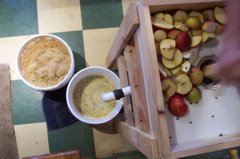
In the above picture, you can see the Whizbang cider press on the left in the background. On the right is my Whizbang apple grinder. Both tools are light enough and sized such that they can be easily carried into the house from my shop, where they are normally stored.

In the foreground are the apples. I am particular about washing the apples I use to make cider. Apple washing was easily done at the kitchen sink. Then I piled the washed fruit on the kitchen table. A bushel of apples was given to us by a friend. They were sound and good tasting but looked absolutely terrible on the outside. That's because they came from a tree that was not sprayed with pesticides and other poisons. Unsprayed apples from old trees are ideal for cider. I did, however, inspect them carefully and cut out numerous bad spots. All apples need to be cut in half or quarters anyway so they will fit into the apple grinder. Cutting the apples is easily and quickly accomplished with a big, sharp knife.


By the time my son, Robert, woke up this morning, I had the apples cut and ready to grind. The picture above shows him feeding the fruit into the grinder.


Looking down on the action, you can see Robert's hand is ablur, and the pails below are quickly filling up with the very fine apple mash.


The above picture shows the Whizbang Cider Press. The wood-slat tub is filled with pulp and the car jack is exerting pressure on it all. The sweet cider is filling the pan on the floor.


That's a top-down view of the press in action. Robert is getting a taste of fresh, wholesome cider, right out of the apple. No preservatives. No additives. Just pure cider.


Today, after pressing the pulp down some, I took the car jack out and substituted a six-ton bottle jack. I think the bottle jack exerts more pressure than the scissors jack. But the scissors jack does a fine job by itself.

Today's cider yield, from approximately 1.5 bushels of apples, was 4 gallons and a couple of cups. That was a little bit less than the last time I made cider. The reason for less cider was the apples from our friend were not as juicy. But the end result is still very delicious.

Making cider right in our kitchen was convenient and easy to do. There was far less mess to clean up than you might think. I thought about spreading a tarp on the kitchen floor but it was not really needed.

Right after Thanksgiving I will start working on putting together plans for making my Whizbang apple grinder and cider press. If all goes well, these plans will be available in March or April of next year. That'll give you plenty of time to get your own equipment made for cider season next year.

==========
UPDATED INFORMATION....March 2009
My book, Anyone Can Build A Whizbang Apple Grinder And Cider Press is now in print. Full details and much more home cidermaking information can be found at www.Whizbang Cider.com