Leo Sprauer's
Hop Hoe

Dateline: 28 April 2012

Note: This article is the first in what I hope will be a continuing series about useful tools made by agrarian craftsmen.

(click on any picture to see a  larger image)

Leo Sprauer’s grandfather was a blacksmith and he made the first hop hoe in the Willamette Valley of Oregon back in 1920. The tool soon became popular with hop growers and was adopted to other uses by farmers and gardeners in the region. After Leo’s grandfather passed on, another local blacksmith made the hoe up to around 1980. Then, back around 1987, Leo started making hop hoes. So I think it’s safe to say that making hop hoes is a Sprauer family tradition that is still being carried on.... 92 years later.

I like stories like that, and I like Leo’s handcrafted hop hoe. It feels good in my hands and I’ve yet to find a weed that the sharpened blade won’t slice through with ease. Though I’ve only had the tool for a couple weeks, I’ve used it to slice off suckers trying to grow outside my raspberry rows. I’ve also used it to slice through stout thistle and burdock in the field next to my house that I’ll be buying next month (my future pasture). I don’t think I’ve ever seen a hoe so well suited to chopping and slicing as Leo’s hop hoe is.

When I realized what a remarkable tool the hop hoe is I decided to call Leo Sprauer and ask him some questions about his hoe. What follows is a synopsis of our conversation. And if you would like to have a hop hoe of your own, I’ll tell you how to get one at the end of this article.


The Original Purpose 
Of A Hop Hoe
.
I asked Leo Sprauer what the original hop hoe was designed to do for hop growers. He explained that when hops were harvested in the fall, it was customary to cut the vines off around three feet above the ground. Leaving that length of growth on the plant helped the roots to better store nutrients for surviving the winter. In the following spring, the 3ft. lengths of vine were dry and hard. A hop hoe, with its sharpened blade, easily sliced away the old vines.

I don’t know if hops are still harvested that way, but I have a single hop plant that I’ve grown up a pole in the corner of my garden for several years, and I typically cut the vines down to ground level in the fall. This year, however, I’ll cut them high, and in the following spring I’ll use my hop hoe for what it was originally designed to do. But my hoe will see a lot more action than that because, as I’ve noted above, it is perfectly suited to any chopping/slicing work that needs to be done.


Leo’s Hoes Are 
Farmer-Made
.
Leo Sprauer is a farmer. He works the land his parents bought in the early 1960’s. Back then, they grew hops on the farm. These days, Leo grows boxwood nursery stock on the land. Making the hop hoes is a sideline to farming. 


A Truly 
Handcrafted Hoe
.
Leo Sprauer’s grandfather made the original hop hoes from old automobile leaf springs, but Leo uses T1 steel, which is a tempered steel, three times harder than common mild steel, and well suited for a hoe blade.

The finished blade is 12” long and has a gentle radius bend to it (as you can see in the photos). It is 4” wide on one end and 1.25” wide on the other. Both ends are sharpened.

The handle on Leo’s hoes is made of kiln-dried red oak, which Leo carefully selects. He cuts and shapes the handles himself and they are true to the traditional style. Instead of being round in cross section, as is the case with most every other hoe you’ve ever seen, the hop hoe handle is more of an oval shape, with two flat sides. 


With the flat sides, you don’t have to grip the handle as hard as you do with a typical hoe, and the hoe is easier to work with as a result.

The “farrow” or handle socket (5" long) is tapered, as it should be on any good hoe (to best hold the handle), and it is welded to the hoe head. The handle fits securely in the socket and is held in place with one short nail through a hole in the side of the socket. The nail goes only half way into the handle.

Leo says that the handle wood is well dried and should not shrink, but if the handle ever loosens in the socket, all you have to do is grind the nail head off, and set the nail down into the handle just a bit. Then refit the handle deeper into the socket and secure it with another nail.

If I were to reset the handle, I’d be inclined to use a screw instead of a nail. But the point is that repair or handle replacement is no big deal.

The total length of the handled hoe is just under 60", and I see that as a big plus. Long-handled hoes are a whole lot easier to work with than short handled hoes.


Total weight of the tool is just a skosh over three pounds.

Leo told me there are 32 steps in making the blade, farrow, and handle. And he typically makes 100 hoes at a time.


It’s Not a Grub Hoe
.
Leo Sprauer says the hop hoe I have is a “medium duty” hoe, which is to say that it will work well, and last a good long time, under normal working conditions. But if the tool is used as a grub hoe for digging, or for hammer-chopping in rock-hard soil, it will eventually break.

However, if someone expects to be using the hoe for extra hard chopping conditions, Leo makes a reinforced version of the hoe that will hold up longer under extreme use. 


Keep It Sharp
.
All garden hoes work best when they are sharp and I think this is especially true with a hop hoe. I put some small nicks in the blade of my hoe (that field I’m buying is really rocky) and had no problem sharpening the blade with a 12” bastard file. Leo uses an angle grinder to keep his blades sharp.


How To Get One Of 
Leo Sprauer’s Hop Hoes
.
Leo sells around 200 hop hoes a year. Some years he has sold as many as 400 hoes. Now that I’ve introduced his hoe to the world in this little article, I expect that 2012 might be an 800 hoe year. :-)

If you live in the Willamette Valley of Oregon, you can find a Leo Sprauer hop hoe at your local TrueValue hardware store. Some nurseries and tractor supply stores in the area also have Sprauer hoes for sale.

Those of you in other parts of the United States can get a hop hoe directly from Leo. There is no web site with easy online ordering buttons (yet), so you’ll have to contact Leo by e-mail (leaping.leo@hotmail.com) and make arrangements to get a hoe.

A Leo Sprauer handcrafted hop hoe will cost you $48. Figure another $30 for UPS shipping and you’ll end up paying a total of $78. I don’t think that’s an unreasonable price for a handcrafted tool that, if properly used and cared for, will serve you faithfully for a great many years.


A Medieval Weapon?

I showed Leo's hop hoe to my son, Robert, and told him all about it. His response was, "It looks like a medieval weapon." I hadn't thought of that, but it does look like a medieval weapon. So if you ever need a medieval weapon, a hop hoe should do the job.

The Short Version

(photo by Leo Sprauer)
The picture above shows a short-handled (approximately 20") version of the hop hoe. The head is scaled down in size too.


A Little Disclaimer
.
I’m impressed with Leo Sprauer’s hop hoe and am pleased to be able to tell you about it here. I want to make it clear that I am in no way benefiting financially from writing about this tool, and I am not receiving any money from Mr. Sprauer for hoes that he sells as a result of this review.

Also, though I have spoken with Leo Sprauer, and I have a good feeling about him, I do not know Leo and I can not vouch for his integrity as a businessman. Therefore, if you contact Leo Sprauer and purchase a hop hoe from him, I can not, and do not, guarantee your satisfaction.

That said, if you do purchase a hoe from Mr. Sprauer, I would appreciate it if you came back to this web page and provided some feedback in the comments section below. Your feedback will serve a valuable purpose, helping others to decide if they want to purchase one of Leo's hop hoes.

.
I’m Looking 
For More Useful Tools
.
I think Leo Sprauer makes a downright useful product. It is my hope that this article will help him sell more of his hoes, and I would like to help other agrarian craftsmen (and women) sell their products.


This blog has been in existence for six years and gets over 500 visitors a day, every day, 365 days a year. I have a readership that would like to know about and support such craftspeople. 

Do you know someone with a home business who is crafting a unique and/or useful tool that can help people to live a more self-reliant lifestyle? A “tool” can be for the garden, the barn, the kitchen, or the workshop (I’m not including books as tools for this kind of individual review). If so, send me an e-mail about it: hckimball@bci.net

I may request a sample of any product I write about here, but there will be no expectation (or acceptance) of financial remuneration in any way.

The Deliberate Agrarian Blogazine
March 2012

Dateline: 31 March 2012

I'm excited about growing these Champion of England pea seeds. They are an old variety that is supposed to grow up to ten feet high. I have a trellis almost 8ft tall for them. Presprouting the seeds is something I've started doing after reading Steve Solomon's excellent book, Gardening When It Counts.


Well, there goes another March. As far as Marches go, it was a rare one, with milder-than-normal temperatures. I have four varieties of peas planted in the garden, along with spinach, lettuce and Kale. That’s all good.

But March was also the month that I gathered my tax information together which, with my Whizbang home business, is always a detestable labour. I spend so many hours adding up invoices and figuring expenses that it puts me in a foul mood (I complain about this here every year).

It looks like I won’t have as much reason to complain about it next year. My wife, Marlene, is now helping me even more with the business. She is doing the “bookkeeping” like it should be done (on an ongoing basis, not all at the end), and I feel very good about that. Come next March, tax time should be much easier.


Marlene has also been doing the online postage for mail-orders that we send out. And she helps count poultry shrink bags. I couldn't run the business as well as I do without  my wife's help!

This is the way I believe a good marriage should function—with husband and wife yolked together in a home economy, providing for the needs of their family, at many different levels. It is, of course, totally contrary to the industrial model, which encourages husbands and wives to be economically independent earners and consumers.

Which reminds me of the excellent quote from Allan C. Carlson in his book, From Cottage to Work Station: The Family's Search for Social Harmony in the Industrial Age, which can be found on page 48 of my book, Writings of a Deliberate Agrarian...


"Nor is love enough to hold a family together... Meaningful family survival depends on the building and maintenance of a true household economy, one that exists apart from the national and international economies... Toward [this end], both men and women are still called home to relearn and recommit to the deeper meanings of the ancient words husbandry and housewifery."

And this quote, also from Allan Carlson, expresses much the same thought... 

Before the rise of modern industry... virtually the whole of humankind lived in family-centered economies. The family was the locus of the most productive activity, whether it be on largely self-sufficient farms or in small family shops... husbands and wives relied on each other, needed each other, shared with each other, so their small family enterprises might succeed. They specialized in their daily tasks, according to their respective skills. Marriage was still true to its historic definition: a union of the sexual and economic."
Right there, in those two quotes, is an enormous bit of wisdom that I think all young people, looking towards a sound and lasting marriage, should understand and pursue. 


Countdown To My Homecoming

“Home, the spot of earth supremely blest, A dearer, sweeter spot than all the rest” —Robert Montgomery

.
If you are a regular reader of this blog, you know I work in a factory. The factory is inside a maximum security state prison. It is not a job that I have ever liked or gotten any satisfaction from. But it has supported my family without my wife needing to work outside the home. So I’ve been very thankful for that. Nevertheless, it has been my hope and prayer for a very long time to be able to leave the wage-slave job and the bureaucratic foolishness.

My desire has been to work for myself and provide for my family with a home-based  business. Truth be told, I’ve dreamed of working from home since I was a teenager—back when I invented granola bars. I have pursued several ideas over the years (which didn't succeed) to achieve the objective.

When I wrote the Whizbang chicken plucker plan book back in the spring of 2002, I hoped it might help me get home. And now, ten years later, I can see that the book, and my home business that grew out of it, and my dream of coming home, has been greatly blessed by God. It has been an amazing thing to experience. I don’t need the government/industrial job anymore. Home is in sight.

I have, however, decided that it is financially prudent to stay with the factory job for ten more months. So I’m in countdown mode. I am ten months away from my next step in the long journey to escape from industrial-world bondage. Ten months to a way of life centered more closely around my home, my land, a cottage industry, and a more true home economy. Lord willing, I will come home next February.

.

Speaking of Land...


This survey stake is on the northeast corner of the land we are about to purchase.

We are very close to finally buying the 16 acres of woods, field and water that I told you about back in November. The survey is finally in process. The purchase offer is signed. A closing date of May 11th is set.

We will have no time to do much of anything with the land this year, but the doublewide home on the property will be immediately put to use as a much-needed Planet Whizbang warehouse and packaging facility. The house is  a short walk or bike ride from our house and my workshop.

.

My Next Book

My next book, The Planet Whizbang Idea Book For Gardeners, is still in the works. I made absolutely no forward progress on it in March. I am uncertain about how much I’ll be able to get done on it now that spring is here. Between the factory job (three days a week now), the Whizbang business, and the garden, I have more than enough to occupy my days. The book project will likely languish until next winter. But I do harbor a hope that I’ll fit in time to get a little done on it through the coming months.

In any event, I will continue to limit my monthly blogging reports here until the book is finally done. With that in mind, I have one thing I’d like to share with you this month....

.
Rumspringa in The UK
.
Leah Miller, a young Amish woman with strong Christian convictions, faces the hedonism of modern teen culture in the UK... and the light of her witness doesn't dim.

Rumspringa is a period of time when older Amish boys and girls may experience life in the world outside the strictures and order of their community. It is a time when they decide if they want to be baptized into the Amish church and abide by the Amish rules (the ordnung), or not.

I recently happened upon a British television program in which five American Amish young adults in the rumspringa stage of their lives travel to the United Kingdom and are introduced to the teen culture of that country.

Over the course of a month, the Amish youngsters live one week with four very different kinds of families. They begin by living with an inner-city black family. From there, they experience life with a rural-based, suburban-cultured middle class family. Then they spend a week living with a very wealthy family (in their castle) in Scotland. And the final week is spent living with a non-family group of surfers by the ocean.

In those four weeks, the five Amish youth (two girls and three boys) are introduced to various manifestations of the industrialized, Babylonian, Vanity-Faire-culture that they have been insulated from for their entire lives. If you have an interest in the Amish, or in Biblical-agrarian separation, you will find this program fascinating.

Though I enjoyed the series, I admit to having  mixed feelings about it. On the one hand, it makes me uncomfortable to see the Amish youth exposed to certain aspects of modern culture, and to see them face the moral dilemmas presented to them. But, on the on the other hand, I found this unusual secular documentary profoundly inspiring and uplifting, primarily because of the Christian witness of the two girls, Leah and Becky.

In my opinion, 22-year-old Leah Miller comes across as a Christian heroine. It is abundantly clear that her life and her actions are shaped and directed by her faith in Christ, and her biblically-informed worldview. Leah is a young woman full of godly discernment, wisdom, grace, and steadfast conviction.

Becky is much like Leah, but Becky is prone to compromise with worldly customs, though in ways that  most people would think are ridiculously minor.

As for the three boys... well, two of them (Jerry and Leon) clearly do not have the depth of faith and conviction as the girls. Only Andrew, Leah’s younger brother, is more reserved, cautious, and thoughtful. 


Andrew Miller "loves to hunt with bow and arrow, and knows how to skin a deer, milk a cow by hand, go ice fishing and plough a field....Andrew was home schooled by his father along with his 12 brothers and sisters. His family truly embrace the simple Amish lifestyle and have lived their lives very conscious of Amish values. Andrew is the main income earner in the family after his father, but turns all his earnings over to his father to manage. He will get 10% of his earnings back once he turns 21."
 

It is 18-year-old Andrew Miller who provides some of the best quotes (in my opinion) of the movie. In one instance, after spending a day at a private school for wealthy kids in Scotland, Andrew observes,  “Even though a lot of Amish leave school at the age of 14, I’ve never seen an Amish that wasn’t able to successfully provide for his family.”

Those who put this program together did a remarkably good job of showing the stark contrast between dominant modern culture and that of the Amish. Also, to the show’s credit, Amish beliefs are fairly presented, without ridicule or bias.

The show is named, Amish: World's Squarest Teenagers (click to go to the official web site). If you go to the web site, you can learn more about each of the Amish youngsters, about Amish history & culture, and about rumspringa.  


You can watch the entire series in 16 parts on YouTube. Part 11 (below) gives you a good idea of what the show is like (without too much craziness). And you can see what I mean about the witness of Leah and Becky.

Please Note: Some parents will want to preview these programs to decide if they are something they want their younger children to watch.


.

My Raspberry Surprise

Raspberry-Maple Smoothie Popsicle by My Raspberry Canes in the Spring
.
When I was a kid, my mother used to make popsicles with KoolAid in a Tupperware mold. Marlene latched onto two of the "six-pack" molds when we were cleaning out my parent's house last fall. Then, just a couple days ago, she made the surprise shown above. The frozen blend is a mix of homegrown raspberries, maple syrup and yogurt (no high fructose corn syrup & no artificial anything!).

We have lots of raspberries still in the freezer from last year, and have been using them in various ways. A couple of the best ways is in smoothies and on French toast with maple syrup... and  the smoothie pops are real good too!

If you're feeling nostalgic for Tupperware popsicles like your mother used to make, you can get the old molds on Ebay.

===

Let's plan on meeting back here on the last day of next month.....

The Deliberate Agrarian Blogazine
February 2012

 Dateline: February 2012

Liberty Hyde Bailey (1858—1954): He saw the beauty and wonder of creation in a peach, and wrote so poetically and beautifully of it, but failed to see or acknowledge the sovereign God that created peaches (and all the other wonders of the natural world around us).

So long February. I hardly knew ye. My life continues to pass by in a blur as I’m working my regular job, my Whizbang business, trying to get another Whizbang book written, and doing what I can to stop Big Gas from making a Big Mess of my little rural town.

The Planet Whizbang Idea Book For Gardeners is now into the page-layout stage. That means I’m taking the text and arranging it on each page, along with illustrations, which I draw directly on each page. All the drawings and all the arranging makes for a very time-consuming process. By modern technological standards, I would guess my hands-on approach to making a book is probably 50 years behind the times. I have 25 pages done. I think the book will be around 150 pages. So I have a long row to hoe yet.

As a result, I will continue to write very short monthly posts here, probably for the rest of this year. At this point, I’m thinking that if I can get the book done before 2013, that will be good, and that is now my goal.

In the meantime, it is my great pleasure to recommend another book to you....

.
Born-Again Dirt
.


Noah Sanders, over at Redeeming The Dirt blog has written a groundbreaking book titled Born-Again Dirt. It is subtitled, Farming For The Glory of God. I say Noah’s book is groundbreaking because it is the first and only book I’ve ever read that looks at farming and agriculture from God’s point of view, as revealed in scripture.

Every Christian reading this blog who either grows (or has a hankering to grow) a garden, or be any sort of larger-scale farmer, needs to read Born-Again Dirt. It is a Biblical-agrarian primer, laying a proper foundational understanding for God-honoring agriculture.

Noah is a young man but he has written a book that is full of old and largely forgotten (or totally ignored) wisdom. It is abundantly clear in reading Born-Again Dirt that Noah is an intelligent, clear-thinking, humble, and Biblically-grounded person. I dare say his thoughts and conclusions are inspired.
 

Born-Again Dirt is destined to become a classic in the world of contra-industrial, Christian-agrarian literature. It is the kind of book that, when read, and understood, and applied by young Christians today, will lead to proper perspectives and proper understandings and proper actions. And, years from now, those people will look back and realize how influential the book was in their lives.
.
Born-Again Dirt is a book that well-grounded Christian families should read together, and discuss. It is a book that should be given to every young believer in Christ, and every older believer too, if they have any interest in gardening or farming. It would make an excellent textbook for a home schooling family with agrarian inclinations.
 

I believe that agriculture is a high and holy calling for God's people, and Born-Again Dirt is an excellent guide for Christians who feel that calling.

I like this book so much that I have put it over on the right column of this web site. I hope you will buy a copy for yourself and for anyone you know who can benefit from the sound biblical worldview of agriculture that it presents. The solid biblical understandings in this book need to be distributed far and wide.

Here are a couple of quotes from the book:

"God wants us to reflect His image by displaying the same creativity and care in managing His creation that He did in making it. In this way we fulfill the greatest commandment, loving the Lord with all our hearts, worshiping Him by obeying His commandments and seeking to be like Him."
"...the most prevalent method of agriculture today, industrial agriculture, seems to be based on a worldview that ignores God and elevates man and his wisdom as the source of truth. This humanistic worldview results in a form of agriculture whose primary objective is maximum yield and profit and whose ultimate source of wisdom is science. Hence the large scale and complex technology of industrial technology."
"The solution to the problems with modern agriculture isn't just to return to the way things were done in the past. The solution to the problems of modern agriculture is to establish a Biblical foundation for our agriculture and seek to apply it in every area of our farming. We need to look at both the old and new forms of agriculture through the lens of scripture and try to learn from them. If we seek His truth the Lord can enable us to be more faithful in the area of stewardship than previous generations."

You can purchase a copy of Noah's book at this Amazon.com link: Born Again Dirt at Amazon.com
 
You can also purchase a copy of the book from the Born-Again Dirt web site: Born-Again Dirt

Here is a link to a Kevin Swanson radio interview with Noah Sanders: Farmer Boy 2012: Dirt and Dominion


"Peach"


I dug some carrots out of my garden clamp the other day. They were fresh and cold, perfectly preserved under the soil in my frigid February garden. I did this after recently reading the essay, “Peach,” by Liberty Hyde Bailey. And I thought to myself how neat it would be if I could clamp peaches like carrots, so as to enjoy them in the midst of the winter. That is, of course, impossible, but it was a fun thing to consider.

If you are in an area of the world where winter is still firmly in place, and you are dreaming of the fresh fruits that will come with the growing season ahead, here is a treat (written in 1927)  for you from Mr. Bailey, a Deliberate Agrarian from days gone by....


Peach

Here I hold a peach. It is a shapely oblong-spherical body nearly three inches in diameter, pleasant to clasp in the fingers, choice in its fragrance, captivating in its intergrade of tints. I do not know why it came here. I know that last winter a bare tree stood in yonder orchard, giving no sign of any intention but to be a bare tree. Then one day it shook itself loose in the glory of the resurrection we know as spring, and a sheet of pink brilliancy covered it.

The blossom fell. Leaves came. A little object began to swell on a last year’s twig, white-gray and fuzzy and solid. A brown, dry, papery ring fell from its end. The threadlike point withered and dropped away. The object gradually grew, we do not know why, it became as large as a marble and almost as hard, the white-gray fuzz turned to green, a groove showed along its side. Presently it took form, a blush was on the sunny side, and a passerby exclaimed, “Oh, there is a peach.”

A man from Mars, perhaps one no further away than the depths of the great city yonder, seeing this savory fruit in my hand and the flexible tree in the orchard, would not connect one with the other.

Out of the tree, bare but a few months ago, this great peach has come, the birth of a twig no thicker than my pencil. Tree and twig and peach all came out of the soil and the air. This peach is oxygen, yet you never saw oxygen to recognize it as a separate substance; it is hydrogen, yet you have not seen hydrogen as an entity; it is carbon, the carbon you see in yonder smoke; it is nitrogen, that you have not perceived as such although you are always within it; it is calcium, magnesium, phosphorous, that you have seen only in their compounds; it is iron, the iron that is in the locomotive even now belching to start from the station over there; it is potassium, and other elements beside.

It is water—water delicately and deliciously flavored with  many intricate compounds. Perhaps this peach is nearly ninety percent water, yet so nicely is the fluid held in fiber and cell that I revolve the fruit as I may and it does not spill.

This peach is sunshine. It is night, the twilight and the dawn. It is dew and rain. It is noon, and wind, and weather. It is heat and cold. It is the sequence of the seasons, winter and spring, summer and autumn, and winter again, all of which have gone into the tree that gave it birth.

It is the linkage of the elements and the days, and the showers that freshen the earth. The peach is more, even, than all this: it is a living thing, vital with its own protoplasm, performing a thousand secrets hidden deep in its cells, containing its own energy to assimilate and to grow and to catch the tints of the rainbow and the fragrance of clean, fresh winds.

Here with light pressure I part the fruit in halves. The aroma is an elixir. The wrinkled pit or stone is in the center, surrounded by a darker luster like an aureole; for securely inside this stone lies the mysterious kernel, which is an embryo peach tree; and next year the embryo will not forget to grow, if buried in he ground, nor fail to make a peach tree; and in the years to come, when you and I shall not be here to see, it or its progeny will bear peaches still.

The continuity of the centuries is in the flat kernel within this stony pit. I do not know why a peach pit and not a plum pit is in this place; I do not know whence on the earth the peach came; I do not know how or why this fruit chose to elaborate its nutrients in such proportions as to make itself a peach and not an apricot. Had I before me unlabeled chemical analysis of a peach and an apricot I suppose I could not tell which was which, so nearly would they be alike; size, shape, color, texture of skin and flesh, seasons, most of the attributes that distinguish the two fruits to us, might not be shown. Yet here is the peach in my hand, perfect and complete; it is mine.

You have made the conditions right. You have tilled the soil. You have protected the tree from enemies. You have guarded it for several or many years. You have beheld the miracle.

Though Liberty Hyde Bailey does not mention God, we who know Him and serve Him can read that essay with profound appreciation, not only for peaches, but the sovereign God who created peaches.  Peaches are a testimony of God’s awesome power, and they are a small but tangible measure of His common grace on all mankind.   The same goes for carrots.

I hope to see you here on the last day of next month for another short update
.  Have a blessed March.

Michael Bunker Does It Again.....

Dateline: 16 February 2012
(Special Report)


Those of you who are regular readers here may recall last year’s February blogazine post in which I reviewed Michael Bunker’s about-to-be-published book, Surviving Off Off Grid. In short, I liked that book very much because it was a contra mundum manifesto that offered some of the most wise and practical information you’ll find for preparing to deal with the collapse of industrial civilization. I’m not speaking here of economic collapse (though that is bound to be part of the big picture), I mean the collapse of the very underpinnings of our current modern world system, which is dependent on electricity (the grid) and cheap, plentiful crude oil.

Anyone with a clear and humble understanding of world history, can see that our “advanced” world system has become so interconnected, so interdependent, and  so morally bankrupt, that collapse is inevitable. Complexity always leads to vulnerability, and hyper-complexity like we now have equates to hyper-vulnerability.


When the collapse happens, our centralized energy distribution systems, centralized production systems, and just-in-time supply systems will no longer provide for the millions of people who depend on those systems. We will revert to the decentralized  “default setting,” which is localized agrarian culture. Life for those who can quickly adapt will be much more like it was before the industrial aberration emerged for its historically short season of time.

How civilization-as-we-have-known-it will eventually unravel and exactly how life will be in the aftermath is anybody’s guess. There have been a lot of Hollywood movies based on apocalyptic and post-apocalyptic scenarios. I don’t usually watch such movies. And, likewise, I don’t usually read post-apocalyptic novels, but I have made an exception by reading Michael Bunker’s newest book, The Last Pilgrims.

Frankly, I would never have even considered reading The Last Pilgrims were it written by anyone else. But I’ll read anything written by Michael Bunker because his worldview is profoundly Biblical and agrarian. That’s a rare combination these days. Precious few  people write as well and as consistently from that perspective.

I won’t go into detail about the story line except to say that it takes place in the wilds of Central Texas twenty years after the collapse of industrialized civilization.  It  involves a pacifist agrarian community that is facing an attack from the armies of the King of Aztlan.

While I’m not qualified to compare The Last Pilgrims to any other post-apocalyptic novel, and I don’t read enough other novels to rate it like somebody who does read a lot of novels, I can tell you, very simply, that the story drew me in and it didn’t disappoint me. There is a lot of action, and intrigue, and twists and turns to to the tale. The characters are interesting and, in some cases, very endearing. 

All the great themes that you want in a good book are in The Last Pilgrims—love, honor, duty, courage, self-sacrifice. There is violence and some brutality (this is a postapocylyptic novel, after all) but it is “within bounds,” as is the language. And the love between men and women is expressed without sex.

So, yes, I liked this book. I was, in fact, a little surprised at how well I liked it. And this is how good I liked it.... when I reached the last page, I wanted to read more (fortunately, there will be a next book in the saga).

Now, don’t get me wrong... Michael Bunker’s writing is not on par with great novelists like (fill in the name of a great novelist here), but  the man has written a downright good story. And if you’re in the mood for a good story, I really do think you'll enjoy The Last Pilgrims.

 
=======


P.S. The Last Pilgrims is being officially launched with a “book bomb” on February 24th. So please wait until that day to buy a copy. And here is the Amazon.com link where you can buy your copy: The Last Pilgrims


=====

For more details, check out the book's web site: The Last Pilgrims Web Site 

=====

The Deliberate Agrarian Blogazine
January 2012

Dateline: 31 January 2012

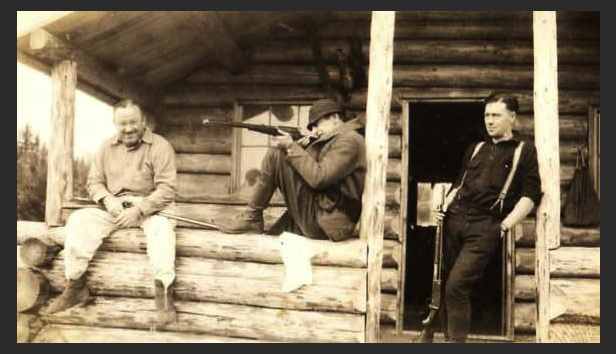
An Old Family Picture: From left to right, my grandfather, Dr. Herrick C. Kimball (at 38 years of age), Roger T. Hall, and Carl Johnson. The picture was taken in 1940 at Camp Munsungan in Northern Maine. My grandfather was one of seven original owners of the camp. Those were the days, eh?

As explained last month, The Deliberate Agrarian is now in sabbatical mode as I focus my energies into producing The Planet Whizbang Idea Book For Gardeners

Progress on the book has been slow and it has ground to a complete halt in the past week or so as I've diverted my attention to more pressing local concerns, as you can see in this new web site.

The land purchase I've written about here in the recent past is still moving ahead. We are still waiting for the land to be surveyed.

In other news, today, this last day of January, marks another trip around the sun for me. I'm 54 years old. I don't like birthdays like I used to. :-(


###

On a more upbeat note, I received a nice letter this past month that I think is well worth sharing with you here, and I do so with the author's permission.... 
Mr. Kimball,

My name is Noah Partridge, and I have been enjoying your blogozine for several years now. 

I am a young farmer leasing land in central Oregon, and I would like to thank you for the many contributions you have made to small-scale, productive agriculture, through your wonderful designs, products, and positive moral message.  I love a tool which lacks nothing, and has nothing in excess--and your tools certainly qualify.
 
Also, I have noticed that many people have commented on your blog about the frustration they experience, with wanting to homestead, but not having sufficient money to buy land, equipment, seeds, livestock, etc. 

I would like to offer up for consideration, an approach which I have found to be extremely simple and surprisingly effective.

Across this nation, there are countless millions of acres of arable land which are untended, but which could be yielding a wealth of foodstuffs. The owners of these properties, are generally pained to watch the heritage of their grandfathers (and the inheritance of their grandchildren), lay fallow and unmown, year after year. 

When I began looking for land to lease (I could not even conceive of buying land, with my tiny nest egg), I decided to focus on these properties, and bring the "house" to the field, so to speak. 

I realized the least expensive way to live comfortably (relatively speaking), was to either live in a yurt, a canvas wall tent, or used RV.  I had lived in a wall tent in Wisconsin for a season, while interning on a farm (Not winter, I might add), and found it very comfortable, even without plumbing, or electricity. My fiance refused to live in an R.V., so that left some shelter with canvas walls.

I knew where I wanted to live, so after selling all unnecessary valuables (what do you really need, in a yurt?), I posted an ad in the local Craigslist farm section, just to test the waters. My ad went like this:

Wanted: Pasture For Lease

Hello, I am a young farmer looking to lease 10-20 acres of pasture in this area.  I will raise a wide variety of vegetables and animals, without using any pesticides, synthetic fertilizers, etc. I would need to live on the property, and will build a small yurt, or a canvas wall tent. I am a honest, hard-working, and positive person.  I do not smoke, drink, or do drugs of any kind.  I am a competent carpenter, and handyman, and own a number of high quality tools. I will work hard to improve your property, and can provide as many references as you would like. Thank you very much for your time, and your consideration.
 
Within 2 weeks, I had well over 30 serious responses.  It was unreal.  People offered to build me studios, lease me their equipment, and more.  They were, I dare say, competing for my services, or more likely, competing to share in my dream.   

I ultimately found a wonderful, god-fearing couple, who were overwhelmed with their 40 acre property.  They offered the house, and half of the property to me, rent-free, in exchange for providing the labor (and skill) needed to remodel it. 

I also help them with any small jobs which they find difficult.  I bring them firewood, mow their pastures, and keep up their fencing.  They allow me the use of their tractor, and any other equipment that is just "laying around."

I am finally farming, and they are finally improving their property, both at almost no cost.

In conclusion, you do not need money to live simply, and richly.  When a man has the earth and skies before him at all times, he wants for almost nothing. 
 
Please keep up the good work Mr. Kimball, and I look forward to using your tools.

Noah Partridge


Noah,

Your letter is an inspiration to me, and I hope it will be to others. You are living proof of that old adage, "Where there's a will, there's a way."

P.S. When I was 19 years old, and working in Vermont, I lived for a summer in a tent. Actually I just slept there at night. As I tell the story in This Essay, "I don't think I've ever slept better in my life."


###


I dug the following Abe Lincoln quote this past month and posted it over at my Agrarian Nation blog. I present it here as Abe Lincoln's response to the Occupy Wall Street movement (he seems to be echoing my previously discussed "Occupy The Land" advice). 

"Populations must increase rapidly, more rapidly than in former times, and ere long the most valuable of arts will be the art of deriving a comfortable subsistence from the smallest area of soil. No community whose members possess this art can ever be the victim of oppression in any of its forms. Such community will be alike independent of crowned kings, money kings and land kings."
—Abraham Lincoln (1859)

###

Last month I posted here telling you all about the places in the world that I've sent a Planet Whizbang Wheel Hoe parts kit. Then, two days later, I got an order for a wheel hoe kit from Vanuatu. 

Vanuatu? Where in the world is Vanuatu? Well, Vanuatu is an archipelago of 83 islands 1,750 kilometers east of Australia. Here's a bird's-eye view...

Vanuatu

That looks like a great place for me to get away from it all, so I can focus on getting my book done!

And then I got a nice e-mail from the person in Vanuatu...

Hi Herrick,

I'm a reader of your Deliberate Agrarian and Agrarian Nation Blogs. I am managing a 20 hectare prawn farm in Port Vila which is inside a cattle ranch so we have land to spare. We have 2 hectares of pig pasture with about 40 pigs of different sizes and age, roughly an acre of vegetable garden, free ranged Sasso chickens and a duck yard with about 250 Muscovy ducks.

I'm actually from the Philippines and am working here on a contract. We're saving money to buy a farm back home where we can do prawn and fish farming mainly and raise vegetables and farm animals too.

Your blog and the links you share are a inspiration to me. We are Christians too and attend the Potter's House church in Vila.

I bought the wheel hoe kit to help you a little in your quest to own that 16 acre piece of land. God bless!
###


And while I'm posting letters, I got this one in the mail yesterday...
Herrick,

Just a quick, long overdue note of thanks for your effort! Your writings are extremely meaningful to me, as a 67 year old reborn Christian agrarian.

Several years ago, I picked up your book, "Writings of a Deliberate Agrarian," at a conference. Been hooked ever since!

Should you find yourself in eastern NYS with time on your hands, stop for a visit! All the best to you and yours!

###
Letters like I have posted here this month are proof positive that some of the nicest folks in the world read this blog. My life is enriched and blessed by your thoughtful comments. 

It makes turning 54 seem not so bad. :-)

Thank you!

###

That's it. I really want to get this new book I'm working on done before spring. Here's wishing you all a great February.

###


...LATE BREAKING NEWS...

I just got home from work today and Marlene informed me that our high school friend, Roger Phillips, sent me a congratulations because my Whizbang chicken plucker plan book made Jimmy Fallon's Books You Shouldn't Read List. I never heard of Jimmy Fallon but that's him in the picture above. Click on the picture to go to the short movie clip and see what Jimmy Fallon says (it's at 3:20 into the movie).

Thanks Jimmy!