Dateline: 30 November 2012
Dumpster Diving
To Live
 |
| Hungry residents
of the East Village of New York City scavenge for something to eat
three days after hurricane Sandy cut off the supply of food. |
“Buy land or get to some land in a rural area where you can fend for yourself. You need to be able to plant a garden, raise a few chickens, hunt, fish, trap, and forage for wild edibles. I’ll take fields and forest over city dumpsters any day.”
The above quote, from my January 2008 essay, An Agrarian-Style Economic Self Defense Plan, immediately came to mind when I saw the above picture earlier this month.
I have nothing against “dumpster diving” as a hobby. There are people who are really into that, you know? They live to dumpster dive. That's all well and good, but you don't want to be in the position where you have to dumpster dive to live, like those people in the picture above.
My home is in Central New York State (and, yes, I've dumpster dived a time or two in my life). We were warned to expect some storm damage from Hurricane Sandy. But it didn't happen. Some rain came. Some wind too. The lights flickered once. That was the extent of it. But there will be more storms. Maybe the next one will hit us hard.
I happen to like and appreciate electricity. It would be a real bummer to be without it. I especially appreciate hot running water. But I will not be surprised if I lose electricity here someday for a long time. I wouldn’t even be surprised if the grid went down for good someday. Whatever the case, I’m prepared to deal with it and adjust my life as needed to accommodate the change.
We have a store of food, land, and the ability to grow more food. We have water in a well that can be accessed without electricity, as well as creek water, and barrels to store rainwater if need be. We have firewood for heating and cooking, and woodland to cut more firewood. We have oil lamps for light and fat lamps for when the oil runs out (someday I’ll show you my fat lamps). Freezers and fridges are nice but not a necessity. There are other options for storing food. Yes, life would be harder here, but not desperate, because we have options available to us. Options that people living in the east Village of New York City (or any city) will never have.
Mind you, I don’t have wind or solar power, with a bank of batteries. I don’t have a big generator with an enormous fuel tank (though I do have a small, portable generator for temporary electrical outages). I simply have land, and tools, along with the skills and attitudes needed to make a go of it without electricity. If you would like to read a thought-provoking and useful book about living without electricity, check out Michael Bunker’s, Surviving Off Off-Grid. It’s an excellent book.
.
Cutting Firewood
 |
| Layland and 12A with a load of firewood |
Our new property (purchased earlier this year) has woods that will be a source of firewood for years to come. The five acres of woods are on each side of a stream and the land slopes down to the waterway on each side. The trees are mostly ash, maple and black cherry, with some enormous willows along the stream. There are some elms along the edges. Almost all the trees are scrappy, meaning that they are not timber quality.
I intend to spend the rest of my life working to develop a better stand of hardwoods on this little section of land. The willows will be cut down. dense shrubbery along the edges of the woods will be cleared. The grapevines that are strangling trees will be cut. Dead trees will be cut. And the scraggly live trees will be thinned out. New growth of maple and black cherry will be encouraged. I may try planting some oak trees throughout the area and I want to plant some hardwood saplings along the woods, out into our field, to extend the woods. The county soil & water department sells hardwood saplings for a dollar each in the spring. I hope to take advantage of that. This is work I can really get into.
The wood in the picture above is from a basswood tree that was rotten at the bottom and blew down in the wind from hurricane Sandy. Basswood is not the best firewood because it is so light in weight. Pound for pound, wood is wood and, once dry, it will burn very nicely, but less dense woods like basswood (willow, and poplar too) will burn quickly. As a result, the woodstove has to be loaded more often. So we will use that basswood (now split and stacked under cover) for boiling maple syrup.
.
A Good Chainsaw &
A Great Saw Sharpening System
 |
| Yours truly cutting a dead elm with my 038 |
I bought a used Stihl 038AV chainsaw from Marlene’s father many years ago. I haven’t used it much, until now. With the acquisition of wood land, the saw is now getting a workout. It is my only chainsaw, but I bought another used Stihl saw on Ebay and am awaiting its arrival.
I've bought the new/used saw for Marlene as a wedding anniversary present. I looked up the traditional list of wedding anniversary gifts, and for the 32nd anniversary it said “chainsaw.” Perfect.
Marlene actually wanted a chainsaw that she could use to cut small trees. The Stihl MS170 looks like it’ll be just right.
Once I get the saw, I’ll outfit it with a new bar and buy two new blades. If the sprocket is worn at all, I’ll replace that too. I’ll get the new parts from Bailey’s. I will get saw chain that I can sharpen with a Carlton File-o-Plate.
 |
| The Carlton File-o-Plate |
When I was 18 years old, and a student at the Sterling School in Caftsbury Common, Vermont, I learned about the Carlton File-o-Plate. We used chainsaws to cut pulpwood (which was hauled out of the woods with horses) and used the File-o-Plate to keep the blades sharp.
Relatively few people have heard of the File-o-Plate, but it was developed in 1965. Among those who understand such things, the Carlton File-o-Plate is considered to be the most intelligent and effective device ever invented for sharpening chainsaw blades. You can buy one for about five bucks and it will last you a lifetime (if you don’t lose it).
The File-o-Plate itself does not actually sharpen a chainsaw blade. It serves as a guide for hand-filing the teeth, and for progressively lowering each tooth’s depth gauge. So, in addition to the File-o-Plate, you need a chainsaw file and a flat depth gauge file. Depth Gauge height is critical to sharpening a chainsaw, especially as the tooth is shortened from many sharpenings.
The Carlton File-o-Plate is kind of a mysterious little device until you figure out how to use it. Then, once you get the technique down, you will love it. Not only does it help you easily hand-file a very sharp blade, it frees you from being dependent on someone with a blade grinder to keep your chains sharp. Those motorized blade grinders often take off too much metal. So you don’t get the life span out of a blade that you can get by simple hand-filing.
This YouTube video offers a good overview of how the File-o-Plate is used: Carlton File-O-Plate
There are all kinds of other clever chainsaw sharpening devices on the market. Maybe some of them are as good as the File-o-Plate. I don’t know. But I’m real pleased with my File-o-Plate.
By the way, the Carlton company once published a very informative booklet, The Complete Book of Saw Chain, that explains how chainsaw blades cut (you might be surprised) and how to keep them in proper working condition. I don’t think the printed version of the book is available anymore. There are online pdf versions. If you'd like me to e-mail a pdf copy to you, just request it from me at hckimball@bci.net
By the way, if you missed my mid-November post here about my Whizbang firewood cutting rack, Click Here For Details.
.
A Young Entrepreneur
 |
| Shelby Grebenc |
I have a lot of respect for any young person who has the gumption and focus to pursue a moneymaking idea. So teenage entrepreneurs—especially those who focus on an agri-preneurial business—always grab my attention. The picture of Shelby Grebnec above comes from This Denver Post Article. Shelby keeps poultry and sells both meat and eggs at local markets. Her article is unique in that Shelby herself wrote it and submitted it to the paper. And it’s kind of an unusual article because Shelby is so opinionated. But if you have ever tried to sell eggs or poultry at a farm market, and make money at it, you'll be able to relate to her experiences.
.
On Older Entrepreneur
 |
| Glen Tompkins is 81 years old and has a busy woodworking business |
A reader of last month’s blogazine here left a comment with a link to an article (Click Here to Read the article) about 81-year-old Glen Tompkins of Peru, Maine who has a woodworking business. He makes clothes-drying racks and other items.
Most people at 81 years of age are not working with their hands to make a living, and if they are, they are not usually pursuing an entrepreneurial vision, building a business. Mr. Tompkins is an inspiration to me, and his example should be an inspiration to everyone who understands the value of doing productive, creative work into their so-called retirement years.
I intend, Lord willing, to be physically working, crafting with skill and passion, in my home workshop to a ripe old age. That’s my retirement plan.
.
.
Social Security
(Are Your Feeling Lucky?)

Speaking of retirement, I remember years ago hearing the late financial advisor, Larry Burkett, say that he decided not to sign up for Social Security because it was, technically speaking, a government handout, similar to food stamps or welfare. He felt that proper lifelong stewardship of his financial resources, and God’s blessings in his life, were such that he did not need to collect Social Security.
Larry Burkett made it clear that he was not condemning anyone for taking Social Security, or advising anyone not to take it. He just felt strongly convicted that he should not collect any money from the program.
You certainly will not find many people with that opinion of Social Security! Most everyone looks forward to the day they can start getting something back after a lifetime of paying. People figure that they deserve the money.
Well, no matter how the government has sold the Social Security program over the years, the FICA “contributions” are clearly a tax. The money isn’t invested, and recipients are paid largely from incoming Social Security tax levies. Social Security really is a type of Ponzi scheme. Those who get into the scheme early benefit the most, while those who get in later, will benefit the least.
I admire Larry Burkett for the stand he took, and I’d like to do the same. I don’t know if I will, but if I can continue to be productive into my older years, without taking Social Security, that’s what I’m going to do. Time will tell.
There is another aspect to this whole matter of Social Security and that is the question of whether or not it will even be around to collect in the future. Thus the subheading above: “Are You Feeling Lucky?”
Social Security, and other “entitlement” programs that Americans have grown to depend on, are predicated on ever-expanding economic prosperity. As long as the economy is growing and prosperity abounds, the money to keep paying the commitments that were made in years past is more easily available. But that is no longer the case.
The economy is not booming any more. And I think the reality that it’s never going to boom again like it once did is settling into the consciousness of Americans. It will get harder and harder for government to pay the handouts as it has in the past. I don’t suppose I’m telling you anything you don’t already know.
My point in writing this is to suggest that it behooves us all to contemplate emerging realities and start preparing now for life without government entitlements of any kind. How does a person prepare for such a thing? I suggest that the best way is to: 1) focus on living a healthy lifestyle, 2) eliminate debt, 3) reduce your needs and dependencies by creating a productive homestead, 4) plan on working into your old age and, 5) if you have not done so already, establish a home-based business that you and your family can operate far into the future.
Establishing a viable home-based business is easier these days than it has ever been because we have the internet to help market and sell goods and services. At this point, the internet is forever entwined with the success of the industrial economy. If the internet goes down, the whole economy goes down, and vice-versa.
In addition to economic crashes and long-term economic decline, I don't think it's out of the question that we will experience a severe infrastructure crash someday. As I’ve mentioned here before, complexity brings vulnerability. All complex, centralized civilizations have eventually collapsed. Why would our modern, industrialized civilization be any exception? It could be many years before that happens. Then again.....
Until then, even the most agrarian and contra-industrial-minded people need to work within (or on the edges of) the industrial economy to make the money they need in order to provide for themselves and their families.
It is impossible to make a living without tapping into the industrial economy, unless you are independently wealthy. Or unless you try to live on the handouts of others who make their living in the industrial economy.
When Social Security and all the other government freebies are no longer available, and/or the infrastructure crashes, if you have positioned yourself on a piece of land and have the tools and skills to be self reliant, then you will be able to shift your focus to full-time subsistence (without the need to dumpster dive). Having an industrial-world income certainly won’t be the necessity then that it is now.
That advice—that strategy for the future—is exactly the course of action I’ve been pursuing, with a lot of focus and determination, for the last 12 years. It is a deliberate agrarian strategy that takes into account industrial-world realities and necessities.
If my thoughts on this subject resonate with you, there is no time to waste in formulating your own plan. Start taking positive steps towards a future of greater self-reliance (as opposed to reliance on the government/industrial providers). Plans can and will change but righteous and wise objectives are where you should put your overall efforts.
.
A Boom In Business Jets?

I was in my workshop a couple days ago, making chicken plucker parts while listening to Fox News’ Neil Cavuto on my Satellite radio. He was interviewing the CEO of the Bombardier company, which had just made a 7.8 billion dollar deal to build 142 deluxe, global executive aircraft for a company called VistaJet.
I wasn’t paying a lot of attention to the story until Mr. Cavuto asked the CEO why VistaJet was buying these special aircraft. The man said that large corporations needed them in their global search for natural resources. That answer did not elicit any response from Neil Cavuto, but it would have if he was a “student” of Professor Walter Prescott Webb’s boom Hypothesis of Modern History.
Later on, I went to the internet to see if I could find out more about this reason behind the big jet contract and I found it in This Article. It says that VistaJet’s billionaire corporate customers need to fly from point to point, across the globe on short notice, and that the need for these aircraft is driven by the "race for resources" in areas such as Russia, Africa and Mongolia.
Professor Webb foresaw the decline in easy availability of natural resources back in the 1950’s and wrote about it in his amazing history book, The Great Frontier. He showed that the prosperity of the western world was built on the vast new lands and plentiful natural resources that came with the discovery of North and South America around 1500. The Western world experienced an economic boom that lasted 400 years, until around 1900. Now we’ve come to the “race for resources.”
Without a new source of vast natural resources—another Great Frontier—to develop and exploit, the industrial world can not sustain itself.
.
The Crash of 1929
PBS has produced an exceptionally good 1-hour documentary about the stock market crash of 1929. I can’t recommend it enough to anyone who has an interest in economics and history. I’ve watched it twice. Fascinating.
.
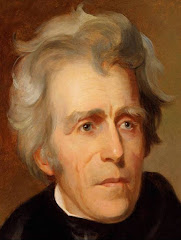
Andrew Jackson
Hated Paper Money
 |
| ....and central banking too! |
If you have not yet read my mid-November essay about Andrew Jackson, his war against the central bankers of his day, and constitutional money, Click Here.
As the industrial era wanes, the paper money schemes of governments in collusion with central bankers, will eventually fail, and the masses who have put their life savings into paper-based assets will lose. It won’t be the first time in history.
I recently heard Rand Paul, the son of Ron Paul, say that people are always asking him what they should do to preserve their assets so they’ll have something left after the paper dollar is destroyed and worthless. Mr. Paul said that he recommends that people buy land or another home that they can rent out. The point being that some things will still have value when paper money has none.
Land. A section of land that you can live on, husband, and draw sustenance from, is a tangible store of value. Always has been. Always will be.
.
My Apple Trees
 |
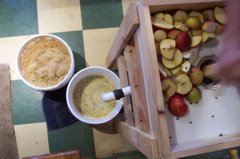
| Black Oxford apples. My mouth waters at the thought of one day biting into a Black Oxford apple that I have grown myself! (photo link) |
Last month I reported here that I intended to get half a dozen apple trees planted on our new property next year. Well, I’ve now ordered and prepaid for a dozen apple trees and three pear trees from Cummins Nursery. I ordered Ashmead’s Kernel, Black Oxford, Enterprise, Golden Russet, Goldrush (the moron-proof apple), Honeycrisp, Newtown Pippin, Esopus Spitzenburg, and Wolf River. Total cost: $362
These trees will be our first long-range plant investment into our land and I confess to being a little anxious about it. I planted half a dozen apple trees on our 1.5 acre homestead many years ago. They grew big but I didn’t care for them properly, and they never produced much of anything. I ended up cutting them down and planting Concord grapes in their place (the grapes have yielded wonderfully).
So I have a history of not being good at growing apple trees. To make matters worse, I’ve been reading Michael Phillip’s two books, The Apple Grower: A Guide for the Organic Orchardist and The Holistic Orchard. Though Mr. Phillips knows his subject well, he has a wordy, roundabout way of writing, and the books are dense with information. His books leave me a bit overwhelmed at the prospect of growing a dozen apple trees without it being a major effort and expense, and eventual failure. There are so many animals, insects, blights and molds that will attack my trees that it’ll be a miracle if I ever get a good apple. That’s the way I feel going into this.
Then, to further muddle my thinking, there is Sep Holzer who says in His Book that he pretty much just plants his apple trees and lets them grow wild. There is a definite appeal in that kind of approach.
One thing for sure... these trees will be a learning experience. And now I’m contemplating a Carpathian walnut grove.
.
The Road To Serfdom
(Beware of the Planners!)
 |
F. A. Hayek (1899-1992)
|
I have finally read The Road To Serfdom (click for Wikipedia link) by F. A. Hyek. I didn’t read the whole book. I read the Reader’s Digest condensed version (published in 1945).
You can find a link to a pdf download of the condensed version at this web page. After you download the pdf, I suggest that you go directly to page 31, which will take you past all the commentary to the actual Reader's Digest article. It will take you an hour or so to read it. You must read it. You will be wiser for doing so. It will give you insights into what is happening in America today, and where we are headed as a nation.
.
Hayek warned about the great dangers that come as a result of centralized government planning, especially when it comes to the economy. Hayek makes the point that central planners may have honorable intentions, but their actions will invariably lead to the destruction of individual liberty. He embraces the basic agrarian principle of decentralized power and individual freedom within the rule of law. Here are some quotes from the book:
"Individualism, in contrast to socialism and all other forms of totalitarianism, is based on the respect of Christianity for the individual man and the belief that it is desirable that men should be free to develop their own individual gifts and bents."
"Nobody saw more clearly than the great political thinker de Tocqueville that democracy stands in an irreconcilable conflict with socialism: ‘Democracy extends the sphere of individual freedom,’ he said. ‘Democracy attaches all possible value to each man,’ he said in 1848, ‘while socialism makes each man a mere agent, a mere number. Democracy and socialism have nothing in common but one word: equality. But notice the difference: while democracy seeks equality in liberty, socialism seeks equality in restraint and servitude.’
“...the virtues which are held less and less in esteem in Britain and America are precisely those on which Anglo-Saxons justly prided themselves and in which they were generally recognized to excel. These virtues were independence and self-reliance, individual initiative and local responsibility, the successful reliance on voluntary activity, noninterference with one’s neighbour and tolerance of the different, and a healthy suspicion of power and authority. Almost all the traditions and institutions which have moulded the national character and the whole moral climate of England and America are those which the progress of collectivism and its centralistic tendencies are progressively destroying.
.
Nodding Wold
A reader of this blog recommended the book, Nodding Wold, by the British author, Herbert Leslie Gee. I bought a copy, and read it, and found it to be a pleasant book.
It is the story of a man and his wife who move from a town to live in a small rural English village named Nodding-On-The-Wold. The time period is the autumn of 1938 to the autumn of 1939, when England declared war on Germany (and this figures into the story). The book is narrated by the man (we don't know his name but I would assume that it is H.L. Gee). He and his wife, Judith, find the pace and way of life, and the people of Nodding Wold to be much different that they had known in the bigger town where they had been accustomed to living.
What I found so endearing about the book is its primary focus—the people and the community of Nodding Wold. It is a diverse community but a community united by shared custom and tradition. Nodding Wold is an idealistic, fictional, rural community, but I think that H.L Gee does provide his readers with a peek into a way of life that genuinely once was, and which now is practically extinct.
There is a sentimentalism about the story of the community of Nodding Wold, and it appealed to my agrarian senses. Agrarianism is as much about small-community interreliance as it is self reliance.
In some ways, Nodding Wold brought to mind Bedford Falls, the fictional town of the classic movie, It's a Wonderful Life. The combination of people living in community, their fraternal love and benevolence towards each other, and their faith in God makes for a good story every time.
If you like stories like that too, find yourself an inexpensive copy of Nodding Wold, stoke the woodstove, settle back in your easy chair, and enjoy your visit.
Here is a passage from the book that gives you a taste of H.L. Gee's writing (John Brandt is the farmer in the story. He has recently lost his wife. The narrator has just expressed his condolences at the loss.)...
There was a pause before John Brandt replied. When he did, his answer seemed to have no bearing upon our conversation. 'I've been on this farm all my life,' said he with a touch of pride which seemed to make him more human than he had been all along. 'I've worked here, man and boy, these sixty years. I've seen wheat sown time and time again. I've ploughed and harrowed and thrashed year after year. But I've never understood what I was doing. I've never known how God changed one seed into many, how His rain, which spoils a line of washing, matures the grain, and how His sun, which fades the curtains, ripens the wheat. It's all beyond me—but I haven't sat idle because of that. I've done what I could.' Once again pride was in his voice, and I loved him for it. 'I've done what I could, and I've done it honestly, I think—and the harvest has never failed.'
The noise of the thrashing machine could be heard, a deep, steady hum below the cries of men and the intermittent barking of a dog. I caught sight of Harry (a very unbookish Harry) racing after geese, and I saw John Bradt smile as the bit of mischief flashed past the window. Then, in the quiet which followed, he said: 'I've always trusted God. I think I always shall. A man has to do what he can, and do it with heart and soul, leaving the rest. A man has to love a woman as long as he may keep her; and then, when God gathers her to Himself, he has to believe that what seems worst is best, and that in good time he'll understand.'
My copy of Nodding Wold is a "seventh impression, 1955" of the book, which was first published in 1940. It appears to have been a good selling book, and H.L. Gee was a prolific author, with over 30 other books written by him listed inside the front cover. Nevertheless, I can find nothing about him on the internet. He is something of a mystery.
Also, I wondered if maybe Nodding-On-The-Wold was a real place. A Google search did not find the town, but I did find Stow-On-The-Wold. A Google Maps search of Stow-On-The-Wold showed that it is surrounded by rural fields and woods. Perhaps Stow-On-The-Wold was Gee's inspiration for Nodding-On-The-Wold, like Seneca Falls, New York is believed to be the inspiration for Bedford Falls.
==============
You have finally reached the end of this month's Deliberate Agrarian blogazine. Postings for the next few months will probably be much more brief as I'm about to start getting serious about producing my next book: The Planet Whizbang Idea Book For Gardeners. Thanks for stopping by.


 Kate Towle, My Great Grandmother




 Posts