The Story Of
My Grandfather’s Ring


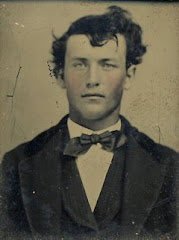
Dr. Herrick C. Kimball
3/17/02—1/2/66


I was named after my grandfather, Dr. Herrick C. Kimball, of Fort Fairfield, Maine. My Grandmother Kimball once told me that my grandfather was actually given the name, Herric, and he changed the spelling to Herrick while in college.

She did not know what prompted my grandfather to ad a "k" to the end of his name. But I have recently come upon a possible explanation and hope to write about my interesting discovery one day soon.

I’ve never had a nickname that stuck. I’ve always been Herrick, and that is fine with me. But when I was a wee lad, my grandmother always referred to me as “Little Herrick.” That helped to avoid confusion, like when she would relate to one of her friends on the phone: “Little Herrick is visiting for the summer.”

My grandfather died in 1966, when I was seven years old (almost eight). My recollections of him are few. Nevertheless, he has played an important role in my life. Not only do I have his name, I have some of his possessions, like his high school class ring, with our initials engraved on the inside. It is a ring with a remarkable story. But I am getting ahead of myself.

I think I have told the story here in the past about how my grandfather Kimball was the son of a potato farmer. His was not a family of means, by any means. But he was exceptionally intelligent, knew what he wanted to do with his life, and worked hard to rise above his humble circumstances.

He graduated from Bowdoin College in Maine. It was a four year school and he got through in three. From there he went to Case Western Reserve medical school in Ohio. Getting a college education back in the 1920s, when you came from a relatively poor family, was not an easy thing to do. More than once, I have heard the story of how my grandfather sold his blood while in college to get some money.

Before long, he returned to his hometown in the northern Maine farming community of Fort Fairfield. There, at 25 years of age, he established his medical practice. He lived in that town for the rest of his days.

My grandfather also established a hospital in the town. Unlike the specialists of today, my grandfather pretty much did it all. He delivered babies. He did internal surgery. I understand he was even the coroner.

It has occurred to me in recent years that my grandfather could have easily been a prosperous big-city doctor. But he chose to go home and live in the little rural community he was born in. My aunt recently told me that the town helped pay for his education in return for him coming back to be the doctor. I didn’t realize they did that sort of thing back then. I think they got their money’s worth.

In any event, I am, to a degree, like my grandfather. He loved history and was an avid reader. I inherited his love of history as well as many of his books. In the front room of my grandparent's large house on Presque Isle Street, on the wall by the bookcases that held his books, there was a framed picture of Winston Churchill. As a little boy, I thought the man in the picture might be my grandfather—there was something of a resemblance (which makes me wonder, will I resemble Winston Churchill when I am old?). When my grandmother told me it was the Prime Minister of England, I thought he and my grandfather must be friends. But it was explained to me that my grandfather was an admirer of Churchill and one of his patients had given him the photograph.
.

And so it is that I have many of my grandfather’s books and a few medical instruments, and other small mementos. But one of my most curious keepsakes is his gold high school class ring, which fits me just right:


My grandmother gave me the ring when I was in jr. high school and she told me this story.....

It so happened that my grandfather lost his class ring while still in high school and working on the farm. I imagine that must have been a real disappointment. To own a gold class ring when your family is not of means must have been an extravagance. Perhaps it was given to him as a gift, which would make the loss of it even more disappointing. Whatever the case, the ring was lost and gone.

But it was not to be lost forever. Years later, after getting through medical school and returning to set up his small-town medical practice, a man stopped by his office and handed him the long-lost ring.

This man had bought the family farm and found the ring outside the barn. My grandmother says he found it in a manure pile. But I’m not sure that would be correct as so many years had elapsed. Perhaps my grandfather lost it while pitching manure. In any event, the man saw the gold (which never tarnishes) and knew immediately who it had belonged to when he saw the initials on the inside.

So that’s the story of my grandfather and his high school class ring. I am not one to wear jewelry. I don’t own a wedding band and wear no rings or bracelets or any adornment of any kind (I don’t even wear a wrist watch any more). But every so often, I put my grandfather’s class ring on, and I wear it for a day or so.

The ring is a reminder to me. It brings to memory my grandfather, the man I am named after. I think of the focus and determination and work he put into achieving the measure of success he had. I think of the fact that my grandfather served his community by helping the people who came to him for so many different problems. I think that, in many ways, I have failed to live up to his example. But I am still his grandson, his namesake, and I am thankful for the influence of his example.

Dr. Herrick C. Kimball
of Fort Fairfield, Maine
Circa, 1963

Introducing My Homemade Whizbang Cider Press

[Dateline: 4 November 2008]

I have been working over at least four cider seasons to develop a simple, efficient, homestead-size system for making apple cider. Now, finally, I have a complete system that I’m very happy with. In this essay, I’m going to tell and show you my cider press.

But first, I want to point out that the heart of any good cidermaking system is the apple grinder. I have yet to see a hand-crank apple grinder that grinds apples to a fine pulp, easily and quickly. If you rig a motor to a hand-crank grinder, you’ll get your pulp quick and easy but not really fine. The finer the pulp, the greater the juice you’ll get for your time and effort.

However, as I explain and show in a previous essay, I solved the apple grinder problem by modifying a kitchen garbage disposal to do the job. The disposal by itself is not well suited to continual grinding. But I found I could “tweak” the unit to create an incredible apple pulping machine. It turns apples into virtual applesauce as fast as you can feed the fruit in, and it can do this for long periods of time without jamming or overheating. So that problem was solved with the development of my Whizbang Apple Grinder [Upadte 2010: you can now see the Whizbang apple grinder (and press) AT THIS WEB LINK). Next I needed to come up with a Whizbang press.

Year before last, I was convinced that, for a homestead cider press, a commercial-style rack-and-cloth pressing system would be better than a slatted tub held together with hoops, and I pursued that option in 2007. I discovered that if the “cheese” (as the built-up layers of wood racks and cloth-wrapped apple pulp are called) is not built just so, and pressure is not applied just so, the cheese will tip out of balance as it is pressed. The whole thing can become a real hassle to work with.

It turns out that in days of old, it was a special craft to build a good cheese for pressing. I find that admirable and fascinating but the method is not as simple and user friendly as I was thinking it might be So, back to the slatted tub I went. But this time with a modification: What if I were to place “pressing discs” in the tub as I put the pulp in? These discs would act much like the racks in the rack and cloth system. Instead of putting pressure to a large mass of pulp, the pressure would be distributed more evenly and squeeze the pulp more thoroughly with the discs. And since it would all be contained within the confines of the tub, noting would get out of balance.

Then there was the matter of what to use to do the pressing. All the cider presses I had used in the past employed an acme screw that was screwed down on a pressing plate, on top of the pulp. I actually made a press with such a screw pictures are at the end of this essay). But I also made a press that employed a scissors jack from a car (or a hydraulic bottle jack)..

After comparing the two pressure sources, I had to conclude that I liked the car jack better. It was faster and just as easy to use, perhaps even easier. I paid somewhere around $140 for an acme screw, acme nut, and the welding to put the screw mechanism together. But the car jack was free. As much as I like the traditional appearance of the screw press, the jack press was more of a Whizbang method.

All of which brings me to this year’s cider press design. I have now developed a design for a press that is “conspicuous for speed, excellence, or startling effect,” which is the definition of Whizbang. The pictures that follow are an introduction to my non-traditional-looking but very simple, and very effective, homestead cider press....


The above picture shows the basic Whizbang cider press frame. It is made of 2x4 and 2x6 lumber and is modeled after the old Garden Way press I owned 30 years ago. The frame is light in weight (easily tipped on its side and carried with one hand) yet strong.


A pressing pan fits into the base of the frame. The pan catches the cider as it is squeezed and a drain hole channels the juice into your container. My pressing pan is made of HDPE plastic, which is strong, easy to clean, and food grade. A pan could just as easily be made of wood sealed with polyurethane. Stainless steel would be nice too. In any event, the pan slides in and out of place easily. It is convenient enough in size that you can take it right into your kitchen and wash it at the sink with hot water if you want. The lattice grid you see in the picture is the pressing platform. Here’s another view, showing the pressing platform up close....


The slatted tub rests on top of the pressing platform and it allows cider to flow from underneath the tub, out the drain hole.

My pressing platform is also made of HDPE plastic. It was originally a solid piece of 3/4” thick plastic. I made the grid with multiple passes over a dado blade in my table saw. It is a deluxe platform. A very adequate platform can also be made of pine. When I get the Whizbang Cider Press plan book together, there will be plans in it for a very simple wooded pressing platform.


The above photo shows the pressing tub in place on the pressing pan. The wood staves (maple) are my nod to traditional style and nostalgia. I do like the look of the natural wood staves. The tub hoops are 1/8” thick HDPE plastic and they are held on with stainless steel panhead screws. I would liked to have used stainless steel hoops but they would have been expensive, and stainless steel is very hard to drill so many holes in. The HDPE is inexpensive, and seems to do the job just fine.


The above picture shows a nice feature of the press. The whole press pan with the tub can be slid ahead for easier filling, then pushed back under the pressing shaft when it’s ready to squeeze.


Pressure is applied down on the apple pulp by means of a 2x6 pressing shaft. At the end of the shaft is a pressing plate. Again, I have made my pressing plate using HDPE plastic and it is sized to fit snugly inside the diameter of the hoop tub.

As the photo above shows, the end of the pressing shaft fits snugly into a square-box that is part of the pressing plug.


Above is another view of the pressing tub and pan, pulled ahead for filling.


Before putting apple mash into the tub, a nylon liner is fitted inside, as shown above.


The above-pictured pail of apple pulp was ground in my Whizbang Apple Grinder. A bushel of apples weighs 42 pounds. There is exactly 42 pounds of mash in that bucket. To be more specific, the bucket contains 20 pounds of Ida Red apples (Qty:35) and 22 pounds of Cortland apples (Qty: 64). I weighed and counted very carefully for this featured pressing. I also carefully measured the juice output from this one-bushel pressing.

By the way, using my Whizbang Apple Crusher, I was able to grind that bushel of apples by myself in less than 5 minutes. My arms did not ache from cranking a handle round and round. I just fed the apples down into the disposal opening as fast as I could.


The picture above shows ladled pulp in the pressing tub. Notice the juice is already dripping into the pot under the drain.


After scooping in three inches or so of pulp, I place a pressing disc down onto the apple slurry. Again, these discs are HDPE plastic. I layer on more of the apple mash and put another disc on top. The macerated apple pulp is so fluid that it self-levels as the discs are placed on top.


With the rest of the mash in the tub, I fold the nylon mesh down on top. Please note that one bushel of apple pulp fills the Whizbang tub only about half way. The tub will take at least another 3/4 bushel of apples. So this press has a 1-3/4 to 2 bushel capacity. That is a good homestead size!


The pressing pan with its tub of mash is positioned under the pressing plate. Then the dowels that hold the 2x6 pressing shaft up are removed and the press plate drops down onto the pulp. It is time to apply pressure.


The car jack I’m using is from the trunk of my reliable old Nissan Sentra. The jack rests on a small 2x6 platform screwed to the top end of the pressing shaft. Small blocks of scrap 2x6 are stacked on top of each other as needed to boost the jack up to the top cross bar. Since the tub is only half full, several more blocks are needed than would be the case if the tub were full.


The car jack is operated by turning the end. A pair of Vice Grip pliers gives me a nice handle. The top of the jack rests against a solid bearing surface made using three steel electrical box covers.


Crank the jack handle and the sweet cider pours out the drain hole. When it slows to a trickle, crank the jack some more. It’s a beautiful thing to see fresh-squeezed cider flowing into your collecting pan.

In time the juice flow will slow way down, even with a lot of jack pressure on it. You could leave the press to set another hour or so while yet more cider trickles out (and tighten the jack a bit more every ten or fifteen minutes) if you want to get as much juice as possible from the pulp. I stopped pressing in this series of photos because the sun was setting and I wanted to get everything cleaned up.


The above picture shows the pressing shaft on the pressing plate. Notice the little bit of cider around the end of the shaft/ That should not be. It is there because I drilled a small center home when making the pressing plate. I will have to plug the hole next time I make cider. And if I make another press, I will not drill that hole.


The easiest way to clean up (or get ready for another pressing) is to retract the pressing shaft and remove the tub from the bag of pomace (squeezed-out pulp is called pomace).


The above picture shows the layers of pomace and pressing discs. The pomace is dry, but I think I could have squeezed another pint of cider out of it if I took the time.


And there’s the beautiful finished product—sweet, full-bodied, pure, wholesome cider. That bushel of apples rendered three gallons and two cups of the liquid goodness. A full basket in the press would have produced at least six gallons.

==========

So that, my friends, is my Whizbang cider press. As you can see, it is a very simple design, but very effective. It is also very inexpensive to make. Granted, the HDPE plastic parts can run up the cost, but basic plywood and pine with an ample coating of polyurethane would substitute just fine and keep the cost to a minimum.

Best of all, this simple press will reliably press cider for many, many years to come.

==========

There are a lot of people who will find my Whizbang Cider Press as I’ve introduced it to you here to be sufficient inspiration and information to build their own press. There is nothing wrong with that. But most people will find the project a whole lot easier with some specific specifications and directions. With that in mind, I am in the process of putting together a set of drawings and construction notes for the Whizbang Apple Grinder and the Whizbang Car Jack Cider Press. If all goes well, these plans will be available early in 2009.

Stay tuned......

==========
UPDATED INFORMATION....March 2009
My book, Anyone Can Build A Whizbang Apple Grinder And Cider Press is now in print. You can get full details about the book and learn a lot more about cidermaking in general at this link: www.Whizbang Cider.com

Random Thoughts for The End of October 2008

A surprising number of readers (around 50) took advantage of the special October offer and purchased a copy of my book, Writings of a Deliberate Agrarian. And I was pleased to get some nice feedback from those who read it.

Thank you all

*****

If you would like a used copy of my book, Making Great Garlic Powder you can currently pick one up for only $325.00 at Amazon bookstore. Here’s the link: My Garlic Powder Book at Amazon (thanks for the heads-up Cheri)

*****

Not long ago, I posted a Series on Home Business Ideas. To the list I could add, running a boarding house. With the economy in decline, there is more of a demand for boarding houses.

I remember there used to be a guy in the nearby town of Moravia, who rented rooms by the week. He lived in a big house which he kept up well. I think he did a pretty good business. For the right person this might be just the ticket.

When I think of boarding houses, I think of that movie, “It’s a Wonderful Life.” Do you recall the part where Clarence the guardian angel is showing George Bailey what the world would have been like if he had never been born? George goes to his mother’s house. Without George to support his mother, she runs a boarding house, and she doesn’t know him.

*****

I am in the beginning stages of producing a plan book for a Whizbang cider press and apple grinder. That being the case, I thought I better get a copy of all books I could find on the subject of making cider. One, from the UK, titled, “Cidermaking,” is about how cider used to be made in the British Isles, back when they still had a strong agrarian culture.

One chapter of the book speaks of old apple varieties, including one called “Coccagee.” Here is what the book says of this variety:

”Coccagee, a Somerset and North Devon variety, was brought over from Ireland in the eighteenth century (the name is said to mean ‘goose turd’ in Irish.”


That does not sound like an apple I would want to consume.

*****

I got an e-mail from Johnny’s Seed Company saying that they are holding their 2008 prices until November 15th. After that, prices will go up due to increased costs.

*****

During our recent vacation to Thomas Jefferson’s Monticello we learned that the large vegetable garden is patrolled at night. It is patrolled by beagles. The beagles are brought in during the growing season at 7:00pm and taken out in the morning before the tourists show up. The dogs are restrained within the garden area by electronic collars and their purpose is to keep wild deer from doing any damage.

*****

Have you been to Jeremy Myers’s blog Oldtime Smith? Check it out.

Jeremy has a self-produced CD titled Nail that Catfish to the Tree! I bought a copy. I appreciate his traditional Missouri old-time fiddlin’

*****

My watch broke a few weeks ago, before going on my Virginia vacation. I decided to see if I could get along without it. Turns out I can.

*****

Daylight savings time ends this weekend. Prior to establishing time zones in this country, noon, wherever you were located, was when the sun was at it’s highest point in the sky? Established time zones came with the development of our continental railroad system in 1883.

I don’t know the history of watches but I suspect there wasn’t much need of them when we were still an agrarian nation.

*****

With election day next week I feel like I am in an airplane that has gone through turbulent weather and is nosediving. Oxygen masks have deployed. The pilot is standing in the open doorway, with his parachute on. Two men are fighting over who will get into the cockpit and pilot the plane. Neither one appears to be well qualified to fly the craft. Some passengers are getting involved in the brouhaha. But I am in my seat, near the back, watching the scene unfold, unable to do anything to make a difference. My knuckles are white, gripping the armrest.

*****

Michael Pollan had a thought-provoking article in the New York Times Magazine of October 12th. It is titled, Farmer in Chief and is in the form of a letter to “Mr. President Elect.”

Pollan urges the next president to do what he can to fix our broken industrial food system, which now “expends 10 calories of fossil-fuel energy to produce a single calorie of modern supermarket food.”

The author proposes a “sun-food” agenda which will work to drive oil-dependence out of America’s food system. It is, he says, a matter of national security.

”We need more highly skilled small farmers in more places all across America—not as a matter of nostalgia for the agrarian past but as a matter of national security.”


Michael Pollan’s article is a lengthy read but a must-read for all agrarian-minded folks.

*****

But in case you don’t read it....

In the above-mentioned article, Pollan urges the next president to “tear out five prime south-facing acres of the White House lawn and plant in their place an organic fruit and vegetable garden.”

What a fine idea! Then Pollan writes:

When Eleanor Roosevelt did something similar in 1943, she helped start a Victory Garden movement that ended up making a substantial contribution to feeding the nation in wartime. (Less well known is the fact that Roosevelt planted this garden over the objections of the U.S.D.A., which feared home gardening would hurt the American food industry.) By the end of the war, more than 20 million home gardens were supplying 40 percent of the produce consumed in America. The president should throw his support behind a new Victory Garden movement, this one seeking “victory” over three critical challenges we face today: high food prices, poor diets and a sedentary population. Eating from this, the shortest food chain of all, offers anyone with a patch of land a way to reduce their fossil-fuel consumption and help fight climate change.... Just as important, Victory Gardens offer a way to enlist Americans, in body as well as mind, in the work of feeding themselves and changing the food system — something more ennobling, surely, than merely asking them to shop a little differently.”


*

PETA-Approved Chicken Dinners (& Frog Steaks too!)

The following blurb in the New York Times Magazine of October 12th really fired up my imagination (but not my appetite):

”In April, People for the Ethical Treatment of Animals offered $1 million to the first successful candidate to produce a commercially viable chicken product in a laboratory—real chicken, but without killing a chicken.

The idea isn’t just science fiction. In 2005, the Dutch government gave a grant of 1.7 million euros to three universities to pursue “in vitro” meat research in the hope that a commercially acceptable product might come to replace slaughterhouses and feedlots. The basic science draws on the work of tissue engineers who have created skin and cartilage by cultivating stem cells in a growth medium.

There are several technological obstacles to applying this to meat. The most cost-effective growth medium on the market at the moment is made from fetal calf’s blood—hardly animal friendly. And if the new cultivated meat cells are not properly stretched and stimulated—mimicking muscle activity—the resulting product has a stomach-churning consistency that one tissue scientist described as “jelly on fabric.”

Oron Catts, a biologist and artist at the University of Western Australia, grew some small frog steaks in vitro several years ago and set up a performance-art piece where eight people sat down to have them for dinner. Four of the diners spat their portions out. Catts got his steak down, but he has been a vegetarian ever since. Charles Wilson

Pre-Winter Homestead Preparations

The weather man was right. He said snow was in the forecast for higher elevations here in Central New York State. Three miles down the road it is raining hard. But at my house the wet snow is coming down sideways. The ground is white.

I don’t mind winter. In fact, I like winter. But I don’t like having to drive to and from my job in the city five days a week, in the winter. I’d rather stay home and work in my shop. I like working in my shop, with the wood stove cranking out the British Thermal Units, and the snow blowing outside, and my home just a short walk away. I’d rather write and illustrate a couple more Whizbang how-to books in the winter than go to my city job every day. I could be very productive in the winter.

But, if all goes well this winter, I will still be productive, on the weekends. I hope to make big progress on a Whizbang Cider Press and Apple Grinder plan book. And in my shop I am now getting set up to produce a new Whizbang product that is still top secret. I think it will be big. I hope it will be big. Really big. Every serious gardener in the country will want this item. No. Every serious gardener in the WORLD will want one of these things! At times like this I have to reign in my Walter Mitty inclinations.

My goal is to grow my home business and quit the city job. In time, I might actually be able to do this. But not quite yet. And before all of that, though, with snow and cold in the forecast, there were things that needed to be done here on our little homestead.....

********************

I informed my 14-year-old son, James, that the rest of the pile of firewood (our home-heating fuel for the winter) needed to be split by last weekend, or our agreement (to pay him) was off. He enlisted the help of his brothers and got the job done. Splitting firewood is, as I have written here before, good work for older boys. Here are a couple of them on task:


That is Robert with the splitting maul held aloft, reveling in his youthful strength and ability. He and his brothers expend twice as much energy as needed to get the job done. But they have an abundance of it to expend. Me? I’ll split a few chunks for old time’s sake and go back to stacking.

Marlene helped stack a lot of firewood too. I took a picture of her but can’t post it here because she did not approve of it. All pictures of Marlene must be approved by Marlene before getting posted to this blog. That’s the rule and I comply. Of course all pictures of me have to be approved by me. ;-)

But I really wanted to show you the picture because Marlene had two different colored gloves on and I thought it reflected the practicality of our rural life. Unlike a glossy magazine picture showing some illusion of country life, complete with nifty duds, and matching gloves, we just make do.

But wait! We were able to find a compromise. I figured out how to crop the picture on my computer. Here it is:


Now all of our firewood is stacked and under cover. Just in time. Here’s a picture this afternoon (three days after the above pictures) taken in the same general direction as the one above with Robert & James.


********************

Earlier this year I posted an essay in which I showed you my squash plants, mulched with sheets of old steel roofing. Now, here is one of the many squash we harvested:


That particular squash is a Marina Di Chioggia, a warted Italian heirloom variety. Some might call it ugly. But its ugliness is only skin deep. Underneath that warty exterior is a beautiful, golden, sweet interior.


Marlene typically bakes big squash like this in the oven. Then she scrapes the insides out, adds some butter, and sometimes a little maple syrup.

********************

This was a good grape year. The last time I showed you a picture of my Concord grapes on the vine, they were green. Well, they ripened and sweetened and here is what they ended up looking like last week:


After the killing frosts, when the leaves turn brown and start to fall off, that’s when the grapes are their sweetest. And that’s when Marlene makes grape juice. I hope to post an essay here shortly about making grape juice.

********************

I grew some red kidney beans this year. Two days ago, with snow in the forecast, I pulled up the row of leafless stems with dry bean pods attached. I piled them on a plastic tarp, carried them into my shop and dropped them on the floor. Soon, I will get to removing the individual pods and I'll let them further dry down. Then I will shell them and harvest the beautiful bright red beans. Some of the beans will be planted next year. The rest will be used to make chili... homemade chili.


What a remarkable system: Plant a few beans in the ground and harvest a lot of beans. Save a few to plant again the next year and eat the rest. Repeat this procedure year after year, generation after generation. Absolutely amazing!

*******************

We were late getting our potatoes dug. But not too late. The day before the blowing snow arrived we finished digging the last row of spuds. Now they are in my shop, drying down. This next weekend I will crate them up and take them down into our basement. We will eat our own homegrown potatoes through the winter and into the spring. Then, just like with those beans, we can plant some of the potatoes and grow more.


********************

One crop we did get harvested before the last minute was onions. Once again, the Copra variety of onions that I always grow did very well. They are big. They are fairly sweet, and they are excellent keepers. I have several net bags of these hanging from nails in the ceiling of our basement.


********************

Those last days before the first snow storm of the season blows in are busy ones on a homestead. But this is the “reward” time of year. The work is now pretty much done. The larder is full of wholesome, homegrown food. The firewood is split and stacked by the door. Now the snow is here and the roads are slippery. We are inside, warm and comfy, watching the show out our window.

Put all of these things together and what does it add up to? We call it “the good life.” And in the midst of a crazy world, we are very thankful for it.

Thomas Jefferson vs Paul Krugman, Alan Greenspan, et al.

[Dateline 26 October 2008]


===============
To read the previous essay in this series, Click Here: Thomas Jefferson on Government Debt (Then & Now)
==============

Paul Krugman is a popular guy these days. The American economist was awarded a Nobel prize in Economics this year. In a recent interview I heard Krugman say that no one person is responsible for America’s current financial crisis. But, he said former Federal Reserve chairman Alan Greenspan certainly deserves a lot of the responsibility.

As for Greenspan, he spoke this past week before Congress and said he was “in a state of shocked disbelief” about what has happened to the economy. He further stated: “This crisis, however, has turned out to be much broader than anything I could have imagined.”

Greenspan went on to blame the crisis on “explosive demand by investors around the world” for what were (at one time) very profitable mortgage backed securities. To feed the great demand for these investment vehicles, mortgage lenders started giving mortgages to people who, under normal circumstances, would never have been able to get such loans. As a result, the securities being bought by investors all over the world were tainted with what is now known as “toxic assets.”

Meanwhile (and, incredibly) these risky securities were being rated as relatively safe and sure investments. When it came to light that they were not so safe and sure, the house of cards started to fall, and it is still falling.

How could bad investments be rated as good investments? According to Greenspan: “The whole intellectual edifice... collapsed... because the data inputted into the risk management models generally covered only the past two decades, a period of euphoria.”

So, "Surprise. Surprise. Surprise! Sergeant Carter"... the rating agency’s computers were working with flawed data. Here’s another surprise: The whole economic system of the nation is, itself, flawed. Maybe a better word would be skewed, which is to say: “distorted or biased in meaning or effect.”

Even a cursory look at the long term “risk management models” for an economy driven by central bankers, debt-based creation of money, and fiat (paper) currency, will reveal it is both distorted and biased in favor of those few who control and manipulate the machine to serve their own interest for profit and power. Even a cursory look at the kind of economic system we have will reveal a long train of economic abuses in the form of inflation & deflation, booms & busts, recessions & depressions, all brought on by this kind of economic system.

Thomas Jefferson, third president of the United States, understood this problem very well. He had nothing but disdain for conniving, corporate banking interests. He abhorred having a national debt owed to the monied interests. He recognized nothing but specie (gold & silver coin) as the legitimate currency of the Constitutional Republic he helped to found.

The following quotes from Jefferson provide proof of his understanding and his concerns for America if it veered off the path of fiscal responsibility. You can get the references for these quotes and read a much larger selection of Jefferson’s writings on this subject at this University of Virginia link: Thomas Jefferson on Politics & Government

"Specie is the most perfect medium because it will preserve its own level; because, having intrinsic and universal value, it can never die in our hands, and it is the surest resource of reliance in time of war."
"Paper is poverty,... it is only the ghost of money, and not money itself."
"The trifling economy of paper, as a cheaper medium, or its convenience for transmission, weighs nothing in opposition to the advantages of the precious metals... it is liable to be abused, has been, is, and forever will be abused, in every country in which it is permitted."
"It is a cruel thought, that, when we feel ourselves standing on the firmest ground in every respect, the cursed arts of our secret enemies, combining with other causes, should effect, by depreciating our money, what the open arms of a powerful enemy could not."
"We are now taught to believe that legerdemain tricks upon paper can produce as solid wealth as hard labor in the earth. It is vain for common sense to urge that nothing can produce but nothing; that it is an idle dream to believe in a philosopher's stone which is to turn everything into gold, and to redeem man from the original sentence of his Maker, 'in the sweat of his brow shall he eat his bread.”
"It is said that our paper is as good as silver, because we may have silver for it at the bank where it issues. This is not true. One, two, or three persons might have it; but a general application would soon exhaust their vaults, and leave a ruinous proportion of their paper in its intrinsic worthless form."


This last quotation is sometimes referred to as “Thomas Jefferson’s Prophecy.” It comes from a letter he wrote to his Secretary of the Treasury, Albert Gallatin.
”I believe that banking institutions are more dangerous to our liberties than standing armies...If the American people ever allow private banks to control the issue of their currency, first by inflation, then by deflation, the banks and corporations that will grow up around [the banks]... will deprive the people of all property until their children wake up homeless on the continent their fathers conquered. ...The issuing power should be taken from the banks and restored to the people, to whom it properly belongs.”


Yes, Thomas Jefferson foresaw the problems we now have with unjust currencies and usurious banking practices. He warned against them. Our nation has strayed far from the wisdom of our Founding Fathers. We are now firmly in the clutches of a parasitic monster economic system that slowly but surely saps the economic vitality from its host. And as the system currently falters (once again) here in 2008, all the economic wizards of the world are working to fix it. Their fix will not address the systemic problems that Thomas Jefferson spoke about. Their fix will draw us deeper into debt and bondage. Their fix may, likely, trade a measure of American sovereignty by submitting to a new economic world order.

And so, you may wonder, “What’s your point?” My point is simply to educate; to show that the economic system we live under is fundamentally immoral. I am not advocating for some solution. The solution, if it ever comes, will not come easy. America will not revert to the honest and Constitutionally lawful economic “default setting” without very significant financial collapse and, more than likely, a violent revolution. That's what I think, and I don’t see this happening in my lifetime.

Nevertheless, the realities of the faltering economic system we must deal with can be very harsh, as many people around the world are finding out right now. I'd like to point out that it was exactly a year ago this month that I posted a blog essay here titled Economics Lesson in a $5 Bill (And the Road Ahead). I told you about my friend who sits on the board of a local bank and who had just returned from a bankers convention in Las Vegas. He told me (and I told you) “...[E]very speaker had a gloomy economic forecast. ...[W]e are headed for a “deep, dark recession for the next 4 to 10 years.” And “possible depression.”

A lot has happened in the past year. My friend was right. Those in the banking industry knew bad things were coming. But, amazingly, Alan Greenspan was in a “state of shock and disbelief” when the economic crisis started to unfold.

**********

In closing this series of essays about my recent Virginia vacation, which veered into the subject of Thomas Jefferson’s personal debt, and the whole Jeffersonian attitude towards national debt, and his admonitions about “modern” corporate-banking, I come back to the personal: How do we as individuals and families, living in the midst of a wicked economic system with it’s inflation and recession and unemployment and so forth live our lives without being harmed by the crisis?

This is where I return to the down-to-earth agrarian solution. After all, idealism and proper understandings are what underly pragmatism and practical response. Here is where I recommend to you my essay titled An Agrarian-Style Economic Self Defense Plan (written last January).

Paul Krugman, Alan Greenspan, et al. would not think much of personal agrarianism as a response to the economic crisis. But I’ll bet Thomas Jefferson would.

**********

P.S. Do you see the irony of putting a picture of Thomas Jefferson on a Federal Reserve Note? It is really an insult to the man.

Thomas Jefferson on Government Debt (Then & Now)

[Dateline: 24 October 2008]


In my previous essay (The Story of Thomas Jefferson's Personal Debt), I told you the story of Thomas Jefferson’s problems with personal debt and how he, as a result of his debt, was financially devastated later in life.

There are lessons for those of us here and now in that Jefferson story from the early 1800s:

1. Live within your means
2. Avoid taking on debt.
3. Do not cosign loans

So it was that Thomas Jefferson personally understood the dangers of debt. And, no doubt, it was this firsthand experience, as well as his well-read historical perspective, that led Jefferson to have strong opinions about the subject of national debt.

Thomas Jefferson was our third President. Prior to his taking office in 1801, the previous administration of John Adams had run up the national debt. One of Jefferson’s goals as president was to pay off that debt. It was not an easy thing to do. Reducing the size and budget of any government entity, especially on the federal level, is always difficult. But Jefferson was resolute in this matter.

The Jefferson quotations that follow reveal a degree of wisdom and foresight that deserve not only our admiration but our serious consideration (more of my commentary follows):
”There does not exist an engine so corruptive of the government and so demoralizing of the nation as a public debt. It will bring on us more ruin at home than all the enemies from abroad ...”
"It is incumbent on every generation to pay its own debts as it goes. A principle which if acted on would save one-half the wars of the world."
"Then I say, the earth belongs to each of these generations during its course, fully and in its own right. The second generation receives it clear of the debts and incumbrances of the first, the third of the second, and so on. For if the first could charge it with a debt, then the earth would belong to the dead and not to the living generation. Then, no generation can contract debts greater than may be paid during the course of its own existence."
"Private fortunes are destroyed by public as well as by private extravagance. And this is the tendency of all human governments."
"I consider the fortunes of our republic as depending in an eminent degree on the extinguishment of the public debt before we engage in any war; because that done, we shall have revenue enough to improve our country in peace and defend it in war without recurring either to new taxes or loans. But if the debt should once more be swelled to a formidable size, its entire discharge will be despaired of, and we shall be committed to the English career of debt, corruption and rottenness, closing with revolution. The discharge of public debt, therefore, is vital to the destinies of our government."
"Having seen the people of all other nations bowed down to the earth under the wars and prodigalities of their rulers, I have cherished their opposites: peace, economy, and riddance of public debt, believing that these were the high road to public as well as private prosperity and happiness."
"The accounts of the United States ought to be and may be made as simple as those of a common farmer and capable of being understood by common farmers."
Paul Krugman, an American professor, has won the Nobel Prize in Economics this year. I heard an interview with Krugman the other day. This man’s solution to the current financial problems of America is, essentially, for government to spend more money—a LOT more money. The current national debt is now in excess of ten trillion dollars, and growing at an alarming rate. But Krugman believes more debt is good. His “solution” is in direct opposition to the political and financial ideology of one of America’s greatest founding fathers. And Thomas Jefferson was not alone among the founders in this regard.

But, of course, creating more debt is the only possible “solution” in a world where our whole financial system is built on the fiat-money schemes of central bankers; debt is the lifeblood of the monster they have created to serve their own purposes.

It wasn’t always this way, and it didn’t have to be this way. Jefferson’s vision for America was, as I noted in a previous essay, that we would be an agrarian nation. Usurious, debt-based economic systems are contrary to the agrarian ideal. But they are absolutely necessary to build an industrial nation and an industrial culture, and that is what happened.

Thomas Jefferson could see the madness of European-style, corporate-industrialism. He knew it was headed our way. He didn’t like it. But he couldn’t stop it.

I think Thomas Jefferson was a far better economist than Paul Krugman is. If it were up to me, I would have awarded the Nobel economics prize posthumously to Thomas Jefferson.

===============
In my next essay (the final one of this series) I will look once more to Thomas Jefferson for his insights and wisdom into another aspect of national economics. To read the essay, Click Here: Thomas Jefferson vs Paul Krugman, Alan Greenspan, et al.
===============

The Story of Thomas Jefferson’s Personal Debt

[Dateline: 23 October 2008]


===============
To read the previous essay in this series, Click Here: Visiting Thomas Jefferson's Monticello (Part 2)
===============

I’ve been writing a series of essays about my recent vacation to several historical sites in Virginia, one of which was Monticello, the home of Thomas Jefferson. In this essay I’m going to tell you about the great problem of personal debt that Jefferson and his family faced near the end of his life. There are lessons that we can learn from this real-life example.

It so happens that Jefferson was plagued with financial problems for many years. Several reasons are given for this. First, it is reported that Jefferson inherited debt from his father-in-law, John Wayles who died in 1773. Thomas Jefferson was 30 years old at that time and had been married one year to Martha Wayles. I have never heard of inheriting debt, but that is noted in the historical record.

A second reason for Thomas Jefferson’s financial problems was his expensive tastes. French wines, so many books, and many fine furnishings contributed to his problems. In other words, he lived beyond his means.

But, in his later years there were two events that conspired to ruin Thomas Jefferson. One was that he cosigned a sizable loan for a friend. The man died a year later and Jefferson was stuck with the debt.

Then there was the matter of the Panic of 1819 and the severe recession that ensued. From what I understand, this national economic calamity came about as a result of expanding credit and real estate speculation which led to a bubble market and eventual crash. Banks failed, real estate values plummeted, and loans were called in. Unemployment in the cities was as high as 75%. It was a bad time for the nation as a whole and many families of means were devastated, including Thomas Jefferson’s.

Near the end of his life, Jefferson faced the probability that he and his family would have to leave their beloved home at Monticello for Poplar Forest, Jefferson’s smaller plantation further south in Bedford County, Virginia.

Thomas Jefferson’s grown grandson, Thomas Jefferson Randolph, known in the family as “Jefferson,” played a prominent role in trying to ameliorate the dire consequences of his grandfather’s financial troubles. In a letter written by Thomas Jefferson’s daughter, Martha (“Jefferson’s” mother), she tells the story of their plight at that difficult time. By the way, Martha’s husband was, I’m quite certain, also financially ruined in the crash of 1819.
”...the arrangement made by him and fully acquiesced by me, was that we should go to Bedford, retaining only the necessary furniture for that house, and a small but effective household of servants and sell the whole property here and as many negroes as would pay the debts—it was a most bitter sacrifice to us all, but nothing to the anguish of seeing my dear father turned out of his house and deprived in his old age of the few pleasures he was capable of enjoying, and to know his few remaining years would be embittered and shortened by it made us recoil from the cruel task of proposing it to him; but the crisis was at hand, things could no longer go on in the train they were, the consequences of a delay would have been complete ruin a few years later, when we should no longer have possessed a home to shelter us. It was paying too much for the privilege of living a few years longer at Monticello. I never saw Jefferson so much agitated as he was, and the situation of the rest of the family even down to the little children was really as if a recent death had taken place. To my father the shock was as we foresaw dreadful. He said that he had lived too long, that his death would be an advantage to his family. But Jefferson easily convinced him that under existing circumstances it would, independent of our love for him, be a calamity of frightful magnitude. That his life was as necessary to the interests of the grandchildren and my self, as it was precious to our hearts. The first shock over, he became reconciled and we were trying to look forward to plans of future comfort and improvement.”


It is reported elsewhere that the ruddy-faced Thomas Jefferson turned white when confronted with the scheme to sell his Monticello and escape to Poplar Forest. But then he came up with a scheme of his own, and Martha explains it in her letter...

”...lying awake one night from painful thoughts, the idea of the lottery came like an inspiration from the realms of bliss to my father. The moment it was light he got up and sent for Jefferson who immediately saw in all its bearings the immense advantage of the scheme. Property enough sold at a fair value to pay his debts, a maintenance for the family, the means of educating the boys, and a home for myself and children that might be unprovided for, and last tho not least, the undisturbed possession of Monticello during his precious life. All that will be ensured. And to make the crops adequate to our necessary expenses we must look to that being to whom under heaven we are indebted for every comfort we enjoy, and to the lengthened life of my dearest dearest father who but for that precious gift of heaven (Jefferson) would have had his heart broken by his difficulties and ourselves reduced to abject want.”


The lottery idea faced obstacles but it was pursued. I don’t totally understand how it was to work. But it never did work and was eventually abandoned. The lottery idea did, however, evidently, buy precious time. Thomas Jefferson died at Monticello on the 4th of July, 1826, fifty years to the day after he signed the Declaration of Independence.

Shortly thereafter, the contents of Monticello were auctioned, as were the slaves. Then Monticello itself was sold. It was a sad ending to the story of a great American.

===============
In my next essay I will continue this dialogue about Thomas Jefferson and debt by telling you the story of Jefferson’s attitude towards national debt. This subject is, of course, very timely as 175+ years later, our nation faces a growing mountain of debt beyond anything our third President would have ever imagined. Thomas Jefferson's insights into the subject are very wise, and very sobering.
===============
To read the next essay in this series, Click Here: Thomas Jefferson on Government Debt (Then & Now)
===============

Visiting Thomas Jefferson’s Monticello (Part 2)

To read the previous essay in this series, Click Here: Visiting Jefferson’s Monticello (Part 1)
**********

We arrived at Monticello early in the morning. The home, which Jefferson designed, started to build when he was 26 years old, and worked on the rest of his 83 years, is an architectural treasure. It is on the top of a mountain. The word, “Monticello,” means “little mountain.”. The whole place is a testament to Jefferson’s talent, and his creativity.

Our tour of the house was a delight. I knew almost nothing of Jefferson’s family prior to the tour. But I found myself drawn to the story of his daughter, Martha Washington Jefferson. Our tour guide pointed to a large painting of Martha and explained that she was one of two daughters born to Jefferson and his wife, Martha Wayles Skelton Jefferson. Martha, the daughter, was known as Patsy.

Jefferson and Martha actually had six children but only two survived to adulthood. She died after giving birth to the sixth child. Martha and Thomas Jefferson had been married only ten years. He was heartbroken and despondent for a long time after her death, and he never remarried. Patsy’s younger sister, Polly, died at 25 years of age after giving birth to her second child.

What attracted me to Patsy was the fact that she had 11 children, home-schooled them, and her home was Monticello. She also served as her father’s First Lady when he was president of the U.S.

Where was Patsy’s husband? Well, according to our tour guide, Patsy was married to Thomas Mann Randolph, Jr., a Virginia planter and one-time governor of the state, but she was entirely devoted to her father.

Imagine for a moment, Thomas Jefferson, the grandfather, surrounded by his eleven grandchildren, all living in the same home. Our tour guide told us that other family members were frequently there too. It was a very busy household!

Thomas Jefferson retired from public service to Monticello, where, for the next 17 years, he was active in farming, gardening, scientific observation, and so much more. But he was also very involved in the lives of his grandchildren. From what little I’ve read on the subject, his grandchildren had the fondest memories of growing up at Monticello and of their grandfather’s influence in their lives. That is, to me, a very endearing picture.

In Jefferson’s library, the tour guide pointed out several pieces in the room, including a walnut and mahogany “seed press,” that was probably made by the slave, John Hemmings.

That was all that was said and it begged the question (I tend to ask a lot of questions of tour guides): “What is a seed press?” It turns out that “press” is an 18th century word for an upright cabinet or case used for storing objects. For example, Jefferson would not have called a bookcase a bookcase; he would have called it a book press.

And so Jefferson's seed press was a cabinet where he stored glass vials with specimens of the many garden seeds that he collected and planted each year in his gardens. He kept his vegetable and flower seeds right there in his library. They were important to him.

That cabinet intrigued me. As the rest of our tour group filed out of the room and into the next, I lingered and visually studied the press. Though we had been forbidden to touch anything in the home prior to entering, I was tempted to open the door for a little peek inside (but I didn’t).

What surprised me about Jefferson’s seed press is that, compared to much of the rest of the furniture in the house, it was very primitive. It was, in fact, a classic example of Yeoman Furniture (without milk paint). I’d like to have measured drawings of the cabinet and make a reproduction.

Our tour of the house was much too short but that was, I suppose, necessary considering the crowds of people who show up to see Monticello. Pictures in the house are not allowed, but I took these pictures of the kitchen, which is in a basement setting (that was typical for plantation kitchens of the time). Something like this kitchen would make a great summer kitchen on any busy modern homestead.


Our next stop was a tour of the gardens. Jefferson’s vegetable or "kitchen garden" was a 1,000-foot-long, two-acre piece of land terraced into the mountainside, just south of the house. Here are a couple of garden pictures:


To the left in those pictures and out of view is a stone wall which retains the terraced land, allowing for a large, level area on the slope of the mountain. Below the wall, Jefferson had an eight-acre orchard (300 trees), two vineyards, and plots of figs, currants, gooseberries, and raspberries.

Preservationists know the what, where, and how of Jefferson’s gardens because he kept copious records. He was into it.

In 1793 Patsy wrote her father complaining of insect damage in the garden. His response is insightful:

”We will try this winter to cover our garden with a heavy coating of manure. When earth is rich it bids defiance to droughts, yields in abundance, and of the best quality. I suspect that the insects which have harassed you have been encouraged by the lean state of the soil. We will attack them another year with joint efforts.”


In the background of the above pictures you can see a taller mountain. That was once a part of Jefferson’s plantation and he called it Mount Alto. In recent years, the Monticello foundation purchased 300 acres on the top of the mountain. They plan to reforest the cleared area so the view will be as it was in Jefferson’s day.

Our tour guide told us that the Foundation paid 15 million for the Mount Alto property. That amounts to $50,000 an acre. Coincidentally, it was Jefferson as President who paid 15 million to Napoleon Bonaparte for the Louisiana Purchase. That purportedly calculated out to three cents an acre.

There is much more I could say about Jefferson and Monticello, but this is rambling on. I will post one more blog about Jefferson and tell you about the significant financial crisis he and his family faced later in his life. There are lessons that we today can extrapolate for ourselves from the story.

===============
To read the next essay in this series, Click Here: The Story of Thomas Jefferson's Personal Debt
===============

Visiting Thomas Jefferson’s Monticello (Part 1)

To read the previous essay in this series, Click Here: Visiting Madison's Montpelier & The Big Woods
===============

I’ve been writing here about the recent trip my two sons and I took to historic Virginia. On the first day we visited the National Firearms Museum. On day two we went to George Washington’s Mount Vernon. Day three was James Madison’s Montpelier. On our fourth and final day we went to Thomas Jefferson’s Monticello.

I have mixed feelings about Thomas Jefferson. On the one hand, I admire him. How could I not admire the man who wrote “The Unanimous Declaration of the Thirteen United States of America,” otherwise known as the Declaration of Independence.

At one time in my life I decided I would memorize the document. I made it as far as these two awesome sentences:
Prudence, indeed, will dictate that governments long established should not be changed for light and transient causes; and accordingly all experience hath shown that mankind are more disposed to suffer, while evils are sufferable, than to right themselves by abolishing the forms to which they are accustomed. But when a long train of abuses and usurpations, pursuing invariably the same object evinces a design to reduce them under absolute despotism, it is their right, it is their duty, to throw off such government, and to provide new guards for their future security.
The Declaration in its entirety is a powerful arrangement of words and ideas. Jefferson deserves a lot of credit for not only composing the words, but putting his name to them. He and the 55 other men who signed that piece of paper mutually pledged their lives, their fortunes, and their sacred honor. They did this, as Jefferson put it, with a "firm reliance on the protection of divine Providence".

Every one of those brave men were committing treason against their country (England), and every one would, as a result, be wanted men. Some of them did lose their lives and their fortunes by signing that document. But none lost their honor.

And I admire Thomas Jefferson’s sagacious vision for America. He believed the new form of government he helped to found was best supported by a population of independent yeoman farmers. In other words, he believed America’s best hope for the future was as an Agrarian Republic. With that thought in mind, here are some pertinent quotes from Jefferson:
”Cultivators of the earth are the most valuable citizens. They are the most vigorous, the most independent, the most virtuous, and they are tied to their country and wedded to its liberty and interests by the most lasting bands.”
”I think our governments will remain virtuous for many centuries; as long as they are chiefly agricultural.”
”It is not too soon to provide by every possible means that as few as possible shall be without a little portion of land. The small landowners are the most precious part of a state.”
”Those who labor in the earth are the chosen people of God, if he ever had a chosen people, whose breasts he has made his peculiar deposit for substantial and genuine virtue.”


Yes, there is a lot to admire about Thomas Jefferson. But, unfortunately, Jefferson disappoints me with his deistic haughtiness. He wrote a book, commonly referred to as Jefferson’s Bible, in which he retells the gospels of Matthew, Mark, Luke, and John. But Jefferson removed references to the deity of Christ, the miracles he performed, and His resurrection.

As I learned about Jefferson’s bible I found myself feeling sorry for this man who was gifted with so much intelligence and talent, yet was so ignorant and foolish in the most important matters of life. To die without believing and fully knowing the salvation of Providence, as explained in scripture (that scripture which was not edited by Jefferson), is a tragedy.

Then there is the Sally Hemmings story. Did Jefferson father children by his almost-white mulatto slave? Recent evidence shows that at least one of Sally Hemming’s children had Jefferson DNA. But some say the father may have been Thomas Jefferson’s brother. In any event, it is reported that Sally’s boys looked like Thomas Jefferson. And of the six slaves Jefferson freed (two in his lifetime and four in his will), all were of the Hemmings family. We may never know for sure, and it really doesn’t matter.

In the final analysis, Thomas Jefferson was a truly remarkable man but he was only a man. He was prone to commit the same sins that have beset all men in all ages. I am not one to idolize any man, but I do have my favorites in American history. Washington and R.E. Lee rank up there higher than Jefferson. Nevertheless, I do not hang framed images of any “famous” man on the walls of my home.

But that is just me and, once again, I have strayed off the path with this discourse. It is supposed to be about my vacation. So here is a picture I took of the east front of Jefferson’s home.


The west front is the more popular view of the house. It is the side that you can see on the back of a nickel. Here is another view of the west side.


There is a walkway that surrounds the west lawn (you can see part of it in the foreground of the picture. Jefferson’s flower gardens were located all around the walkway.

Do you know what other piece of American currency (besides the nickel) bears Thomas Jefferson’s likeness? It is the two-dollar bill. It so happens that two-dollar bills are still printed by the U.S. mint but they are no longer in general circulation. The only place you can get them is at Monticello.

Which makes me wonder what the purchasing power of two dollars is now compared to Jefferson’s day. Probably a nickel.

==========
In my next essay, I will share some more pictures of Monticello. I’ll also tell you about Jefferson’s “seed press,” his daughter, Patsy, and the little-known crisis he faced later in life.
==========
To read the next essay in this series, Click Here: Visiting Thomas Jefferson's Monticello (Part 2)
==========