Back in the days when agriculture was the predominant culture, when entire families worked together on their land to provide for themselves, when there were no WalMarts or supermarkets or Toys-R-Us to provide our every necessity (and an endless supply of non-necessities), back in those days people simply produced almost everything they needed themselves. And what few things they didn’t produce, they procured by trading with someone in their community.
The people who lived like this were the yeoman farmer, farmsteader, and homesteader families. They cleared and planted their land. They harvested crops for food and trade. They raised animals for food and trade and transportation, and to help them work the land. They put up their own food and cooked their meals from scratch. They heated their homes and cooked with their own firewood. They made their own clothes and quilts, and ox carts and toys and musical instruments. They were craftsmen of necessity. They built their own barns and homes, and furniture too.
Though I am far from a yeoman, I am inspired by the example of the yeoman’s approach to life. I love the idea of learning different skills, and of working with my hands to create things that my family needs. I love the idea of not needing the supermarkets and the department stores. This idea of using the time, strength, mind, and abilities God gave me to provide for myself, for my family, and, at times, for my community, without needing the help of government agencies or the industrial providers is the embodiment of freedom. It is the outward expression of Paul’s admonition to the church at Thessalonica, as written in 1 Thessalonians 4:11-12
Make it your ambition to lead a quiet life, to mind your own business and to work with your hands, just as we told you, so that your daily life may win the respect of outsiders and so that you will not be dependent on anybody.
All of which brings me to my new wood box.....
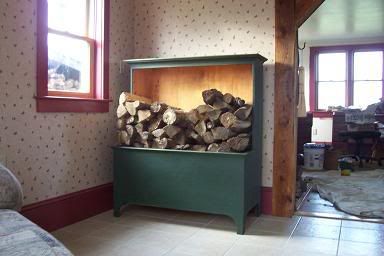
I built an addition on my home over the past two years. It is finally finished and the wood box in the picture above sits in one corner of the new room.
Just around the corner on the other side of the wall, is our woodstove. It’s an Old Vermont Castings stove I bought used 20 years ago for $250. That stove has been, and continues to be, the only source of heat in our house.
If I had sufficient woodland, I would cut my own firewood. I love to cut firewood. As it is, I cut some when it is available but purchase most all my wood from Kevin, a bachelor neighbor who has a small diary farm and firewood business. Every year I buy 10 face cord of firewood from Kevin. He delivers it with his old Allis Chalmers tractor using an old manure spreader converted into a wagon.
If I’m home when he delivers the several loads, I’ll go help him throw the wood off into a big pile in my side yard. Then I pay him cash. For the last several years he has charged me $35 a face cord. This year he upped his price to $45 and I was glad to see it.
Some of my friends and neighbors will spend more than $450 a month to heat their big houses with fuel oil or kerosene or propane, or electricity through the frigid New York winter that is quickly approaching. But my family will be warm and snug in our small home for substantially less money. We are not dependent on any foreign country for our heating fuel. We will not need any furnace repair man to keep our heating system operational. We will not need to buy a new furnace when the old one gets obsolete or run down; the woodstove should serve us just fine for another 20 years. And, incredibly, that $450 of firewood will not only last us through the winter, it will fuel the woodstove in my workshop when I need to warm it up, and it will be sufficient to fuel our makeshift maple syrup evaporator when we boil down a few gallons in the backyard next spring.
But I am heading off on a rabbit trail. This story is about my wood box....
Outside the window that is right next to the wood box is our winter woodpile. Kevin’s wood is split and seasoned for a year, but much of it is in big split chunks. So I pay my son Robert $75 to go through the pile and re-split it into more-convenient-to-handle and easier-to-fit-into-the-woodstove pieces. We used to rent a hydraulic wood splitter and the whole family worked together to get it split in one day. But two years ago, Robert asked me if I would pay him what it cost to rent the splitter if he did the splitting himself with a splitting maul. As you might imagine, such a request was like music to my ears. It brought joy into the heart of this pseudo-yeoman father!
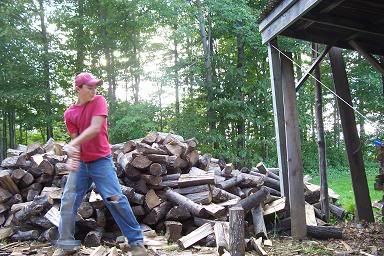
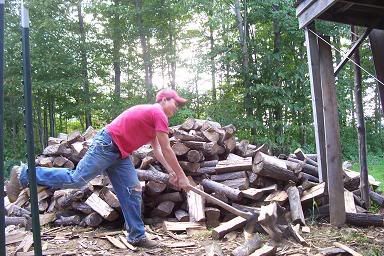
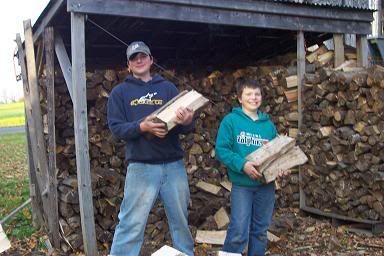
Robert splits the wood, and the rest of us stack it into a makeshift firewood lean-to that I built a few years ago using a bunch of cheap pressure treated 4x4 posts and 2x pine boards (priced cheap because the wood was so warped that the lumberyard couldn’t sell unless it was cheap) and some galvanized roofing that came from my dad’s barn, which fell down several years ago. It was never intended to be a permanent structure, just a cheap and adequate place to stack firewood and that is what it has been.
So we have the firewood just outside the window and the wood box just inside. (Oh, by the way, the window was also purchased from the local lumberyard at a reduced price—$40—because it had once been a display model.) Our system for getting firewood in the house is for one person (typically my son James) to go outside and hand it through the opened window to another person, who places it in the wood box. The inside dimensions of the box measure 18” deep (firewood lengths are 16 to 18 inches) by 38 “ wide by 36” high. That much wood is enough to last us for several days even in the coldest part of winter.
I made the wood box two weeks ago using 1 x 10 pine boards. My son Robert helped me and got to see that a man doesn’t have to go buy furniture from a store. He can just make it. I told Robert that there was no reason why he couldn’t make most all the furniture in his home someday, not to mention the house itself. And, I told him that the furniture he made would be more unique and special to him and his family, not to mention future generations.
I confess that I have not made all the furniture in my house. But I have made quite a few pieces and I plan to make more in the days ahead. Fact is, I’d like to start a home business making furniture. That was part of the plan I had in the back of my mind for the big old Grange hall we had hoped to buy last summer (see previous posts for the whole story on that). Frankly, I’d like to start all kinds of home businesses, but I already have several part time home businesses! What a dilemma.
Anyway, Marlene and I like furniture styles that fall into the country, shaker, or primitive category. That should come as no surprise, Such furniture is, essentially, agrarian. I like to think of it as yeoman. That is the name I wanted to give my home and hand-crafted furniture company: Yeoman Furniture. Maybe someday yet.
Yeoman furniture is far easier to build than, say, Federal, or Queen Anne. Those high fallutin’ furniture styles require special woods and finishes and joinery skills. Yeoman furniture is built using very basic materials and tools and skills. And the beauty of yeoman furniture is that if it gets a little banged up, it looks better. A little “distress” is actually preferable. If a board cracks from expansion and contraction of the wood, that’s okay too. It doesn’t mean the piece will fall apart. Not hardly. Yeoman furniture is solidly built. Oh, but it is attractive too! Functionality and durability without being attractive to the eye is not my idea of good Yeoman furniture.
Years ago, when I was writing how-to books for The Taunton Press, I had an idea for a book that I wanted to call, The Practical Cabinetmaker. It was an anti-big-tools-and-fancy-shop how-to book. It seemed to me that every cabinetmaking book on the market required the reader to own expensive tools and a big shop. My book would tell people how to build beautiful cabinets without a lot of expensive shop tools. The book never happened.
The fact is, you don’t need a jointer, or a planer, or a radial arm saw, or even a table saw (though a small, portable, inexpensive, table saw comes in handy). The fact is, you can build real nice cabinets using nothing more than basic power hand tools— power saw, an electric drill, and some basic hand tools would pretty much get you going. In other words, the same tools you’d use to build your barn and your house.
And you don’t need a fancy shop either. I built the cabinets for my kitchen in the kitchen when I built the house. I’ve build other cabinets outside under the roof of a shed I once had. Now I have a shop but it is cluttered and cramped, yet I can still make cabinets there.
The same applies to furniture. Maybe someday I’ll make a video or two showing myself making furniture with basic tools and basic techniques in my very crowded shop. It would, no doubt, be comical as I tripped over the junk around my work table. I would be the furniture making contrarian. Furnituremaking purists would laugh and howl insults at me. But your average unskilled person would love my instructional videos because they show how to make beautiful and useful pieces without all the stuff and bother. There I go again, Walter Mitty-like dreaming of another home business. I just can’t help myself. :-)
Back to my new wood box.... Like I said, I built it out of 1x 10 pine boards. I built it to fit in the corner by the window. I built it in less than 8 hours over a period of several days. I built it without any plans; just a vision in my mind. When I was done I decided to finish it with milk paint. That’s the finish that many a yeoman might have used. I’ve used it before and I absolutely love milk paint. My understanding is that milk paint is made with milk, lime and pigment. It is incredibly durable. I bought powdered milk paint mix (just add water) from an internet company. Lexington Green is the color. One of the really nice things about milk paint is that it has no volatile solvents. it’s very natural and safe to use (though it can be caustic with the lime).
I painted two coats of milk paint on the box (the inside was stained because I wasn’t sure if I would have enough paint to cover the inside and I like the color contrast anyway). Milk paint is very dull and drab looking and it goes on kind of lumpy— very unlike modern paint from a can. It could be left that way but I decided to take the finish a step further. After the paint was dry (it dries fast) I poured boiled linseed oil (You buy it that way. I did not boil it.) on each surface and rubbed it with some very fine wet/dry sandpaper on a sanding block. This step smoothed the painted surface, sealed it, and darkened it. The sandpaper also distressed the surface by rubbing paint off in some areas, as shown in this next picture.
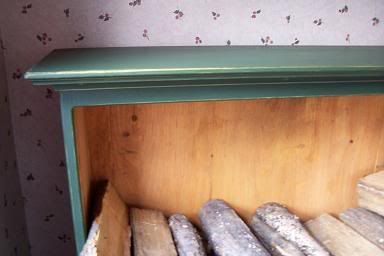
Thus finished, the outside of the wood box is now silky smooth to the touch. James told me that Pa Ingalls used to use linseed oil to finish furniture followed by some bees wax, but I’m going to leave it as it is.
For my next project, I’m working on the room seen beyond the wood box in the first picture above. I need to put a fresh coat of paint on the ceiling and wallpaper the walls. In fact, that’s what I’m going to go do right now.......
The people who lived like this were the yeoman farmer, farmsteader, and homesteader families. They cleared and planted their land. They harvested crops for food and trade. They raised animals for food and trade and transportation, and to help them work the land. They put up their own food and cooked their meals from scratch. They heated their homes and cooked with their own firewood. They made their own clothes and quilts, and ox carts and toys and musical instruments. They were craftsmen of necessity. They built their own barns and homes, and furniture too.
Though I am far from a yeoman, I am inspired by the example of the yeoman’s approach to life. I love the idea of learning different skills, and of working with my hands to create things that my family needs. I love the idea of not needing the supermarkets and the department stores. This idea of using the time, strength, mind, and abilities God gave me to provide for myself, for my family, and, at times, for my community, without needing the help of government agencies or the industrial providers is the embodiment of freedom. It is the outward expression of Paul’s admonition to the church at Thessalonica, as written in 1 Thessalonians 4:11-12
Make it your ambition to lead a quiet life, to mind your own business and to work with your hands, just as we told you, so that your daily life may win the respect of outsiders and so that you will not be dependent on anybody.
All of which brings me to my new wood box.....
I built an addition on my home over the past two years. It is finally finished and the wood box in the picture above sits in one corner of the new room.
Just around the corner on the other side of the wall, is our woodstove. It’s an Old Vermont Castings stove I bought used 20 years ago for $250. That stove has been, and continues to be, the only source of heat in our house.
If I had sufficient woodland, I would cut my own firewood. I love to cut firewood. As it is, I cut some when it is available but purchase most all my wood from Kevin, a bachelor neighbor who has a small diary farm and firewood business. Every year I buy 10 face cord of firewood from Kevin. He delivers it with his old Allis Chalmers tractor using an old manure spreader converted into a wagon.
If I’m home when he delivers the several loads, I’ll go help him throw the wood off into a big pile in my side yard. Then I pay him cash. For the last several years he has charged me $35 a face cord. This year he upped his price to $45 and I was glad to see it.
Some of my friends and neighbors will spend more than $450 a month to heat their big houses with fuel oil or kerosene or propane, or electricity through the frigid New York winter that is quickly approaching. But my family will be warm and snug in our small home for substantially less money. We are not dependent on any foreign country for our heating fuel. We will not need any furnace repair man to keep our heating system operational. We will not need to buy a new furnace when the old one gets obsolete or run down; the woodstove should serve us just fine for another 20 years. And, incredibly, that $450 of firewood will not only last us through the winter, it will fuel the woodstove in my workshop when I need to warm it up, and it will be sufficient to fuel our makeshift maple syrup evaporator when we boil down a few gallons in the backyard next spring.
But I am heading off on a rabbit trail. This story is about my wood box....
Outside the window that is right next to the wood box is our winter woodpile. Kevin’s wood is split and seasoned for a year, but much of it is in big split chunks. So I pay my son Robert $75 to go through the pile and re-split it into more-convenient-to-handle and easier-to-fit-into-the-woodstove pieces. We used to rent a hydraulic wood splitter and the whole family worked together to get it split in one day. But two years ago, Robert asked me if I would pay him what it cost to rent the splitter if he did the splitting himself with a splitting maul. As you might imagine, such a request was like music to my ears. It brought joy into the heart of this pseudo-yeoman father!
Robert splits the wood, and the rest of us stack it into a makeshift firewood lean-to that I built a few years ago using a bunch of cheap pressure treated 4x4 posts and 2x pine boards (priced cheap because the wood was so warped that the lumberyard couldn’t sell unless it was cheap) and some galvanized roofing that came from my dad’s barn, which fell down several years ago. It was never intended to be a permanent structure, just a cheap and adequate place to stack firewood and that is what it has been.
So we have the firewood just outside the window and the wood box just inside. (Oh, by the way, the window was also purchased from the local lumberyard at a reduced price—$40—because it had once been a display model.) Our system for getting firewood in the house is for one person (typically my son James) to go outside and hand it through the opened window to another person, who places it in the wood box. The inside dimensions of the box measure 18” deep (firewood lengths are 16 to 18 inches) by 38 “ wide by 36” high. That much wood is enough to last us for several days even in the coldest part of winter.
I made the wood box two weeks ago using 1 x 10 pine boards. My son Robert helped me and got to see that a man doesn’t have to go buy furniture from a store. He can just make it. I told Robert that there was no reason why he couldn’t make most all the furniture in his home someday, not to mention the house itself. And, I told him that the furniture he made would be more unique and special to him and his family, not to mention future generations.
I confess that I have not made all the furniture in my house. But I have made quite a few pieces and I plan to make more in the days ahead. Fact is, I’d like to start a home business making furniture. That was part of the plan I had in the back of my mind for the big old Grange hall we had hoped to buy last summer (see previous posts for the whole story on that). Frankly, I’d like to start all kinds of home businesses, but I already have several part time home businesses! What a dilemma.
Anyway, Marlene and I like furniture styles that fall into the country, shaker, or primitive category. That should come as no surprise, Such furniture is, essentially, agrarian. I like to think of it as yeoman. That is the name I wanted to give my home and hand-crafted furniture company: Yeoman Furniture. Maybe someday yet.
Yeoman furniture is far easier to build than, say, Federal, or Queen Anne. Those high fallutin’ furniture styles require special woods and finishes and joinery skills. Yeoman furniture is built using very basic materials and tools and skills. And the beauty of yeoman furniture is that if it gets a little banged up, it looks better. A little “distress” is actually preferable. If a board cracks from expansion and contraction of the wood, that’s okay too. It doesn’t mean the piece will fall apart. Not hardly. Yeoman furniture is solidly built. Oh, but it is attractive too! Functionality and durability without being attractive to the eye is not my idea of good Yeoman furniture.
Years ago, when I was writing how-to books for The Taunton Press, I had an idea for a book that I wanted to call, The Practical Cabinetmaker. It was an anti-big-tools-and-fancy-shop how-to book. It seemed to me that every cabinetmaking book on the market required the reader to own expensive tools and a big shop. My book would tell people how to build beautiful cabinets without a lot of expensive shop tools. The book never happened.
The fact is, you don’t need a jointer, or a planer, or a radial arm saw, or even a table saw (though a small, portable, inexpensive, table saw comes in handy). The fact is, you can build real nice cabinets using nothing more than basic power hand tools— power saw, an electric drill, and some basic hand tools would pretty much get you going. In other words, the same tools you’d use to build your barn and your house.
And you don’t need a fancy shop either. I built the cabinets for my kitchen in the kitchen when I built the house. I’ve build other cabinets outside under the roof of a shed I once had. Now I have a shop but it is cluttered and cramped, yet I can still make cabinets there.
The same applies to furniture. Maybe someday I’ll make a video or two showing myself making furniture with basic tools and basic techniques in my very crowded shop. It would, no doubt, be comical as I tripped over the junk around my work table. I would be the furniture making contrarian. Furnituremaking purists would laugh and howl insults at me. But your average unskilled person would love my instructional videos because they show how to make beautiful and useful pieces without all the stuff and bother. There I go again, Walter Mitty-like dreaming of another home business. I just can’t help myself. :-)
Back to my new wood box.... Like I said, I built it out of 1x 10 pine boards. I built it to fit in the corner by the window. I built it in less than 8 hours over a period of several days. I built it without any plans; just a vision in my mind. When I was done I decided to finish it with milk paint. That’s the finish that many a yeoman might have used. I’ve used it before and I absolutely love milk paint. My understanding is that milk paint is made with milk, lime and pigment. It is incredibly durable. I bought powdered milk paint mix (just add water) from an internet company. Lexington Green is the color. One of the really nice things about milk paint is that it has no volatile solvents. it’s very natural and safe to use (though it can be caustic with the lime).
I painted two coats of milk paint on the box (the inside was stained because I wasn’t sure if I would have enough paint to cover the inside and I like the color contrast anyway). Milk paint is very dull and drab looking and it goes on kind of lumpy— very unlike modern paint from a can. It could be left that way but I decided to take the finish a step further. After the paint was dry (it dries fast) I poured boiled linseed oil (You buy it that way. I did not boil it.) on each surface and rubbed it with some very fine wet/dry sandpaper on a sanding block. This step smoothed the painted surface, sealed it, and darkened it. The sandpaper also distressed the surface by rubbing paint off in some areas, as shown in this next picture.
Thus finished, the outside of the wood box is now silky smooth to the touch. James told me that Pa Ingalls used to use linseed oil to finish furniture followed by some bees wax, but I’m going to leave it as it is.
For my next project, I’m working on the room seen beyond the wood box in the first picture above. I need to put a fresh coat of paint on the ceiling and wallpaper the walls. In fact, that’s what I’m going to go do right now.......



















 Posts
Posts










.JPG)
.JPG)


.JPG)

.JPG)



.JPG)


