My Vision
And A Fond Adieu

Dateline: 21 August 2005

”I sought a piece of land which I could love passionately, which I could spend the rest of my life cultivating, cherishing, and improving, which I might leave together, perhaps, with my own feeling for it, to my children who might in time leave it to their children.”

That quotation from Louis Bromfield’s classic agrarian book, Pleasant Valley, is a wonderful summation of my own yearning desire for land and part of the reason I so desire it.

Those who have read this blog know that I do already have a piece of land. It is a beautiful, private, 1.5 acres out in the countryside, with a decent little home that I built over 20 years ago. I own this debt-free and am very thankful for it.

But the Lord has, in recent years, given me a multigenerational agrarian vision, and this vision involves, in part, more land. Because I believe God has given me this vision, I believe He will supply the land.

Of course, I would like the land right now because there is so much I want to do, right now. But I’ve learned very well that God does not give His children everything they want. And even when He has given us a vision for something, he provides according to His plan in His time. After all, God does not exist to please me. I exist to please Him. More specifically, as I have only in the past couple years learned, from the Westminster Catechism, The primary purpose of man is to glorify God and enjoy Him forever.

Does borrowing money to finance my yearning bring glory to God? No. I have concluded that it would not. But, humbly, contentedly, patiently waiting and trusting for His provision does. Working (using the talents and opportunities He provides) and saving, slow and steady, also brings glory to God. It is a testimony of God’s truth and faithfullness to my children, and to others.

All of which leads me to the fond adieu: it is time for this Deliberate Agrarian to take leave of blogging for a season. As much as I love writing here, I am feeling very strongly that I must allocate my time more toward projects that will help me one day acquire the land I so desire.

Unfortunately, I have so much more that I would like to write about in this blog. I have not told you about making apple cider, my boys splitting firewood, Marlene’s homemade soap, shooting PVC spud guns, propolis tincture, peppermint sinus saunas, helping my grandfather on his farm when I was little, how I invented granola bars, my Grandmother Kimball's greatest gift to me, and so much more. There are just not enough hours in the days to do everything I want, and that means I must prioritize while maintaining a healthy balance. So, as difficult as it is for me to do, I must take this self-imposed sabbatical from blogging.

In case you are interested,there are six projects I am working on that will contribute to helping me achieve my vision. Let me tell you about them:

1.) I have been and am currently working to get my house in better shape to sell, if that becomes necessary. Toward that end I have been siding (cedar shakes--I do not like vinyl siding) and staining on the outside. I have put in a couple new windows, new flooring in the kitchen, and done other interior modifications. Yesterday the boys and I started building a small (10ft by 12ft) addition on the back of the house. This will give us a bit more needed room and a big sliding door out onto a backyard patio (next year’s project, along with general landscaping) made with large flat stones we gleanded from the creek bed behind our house (we pulled the stones up out of the creek using our old Ford Taurus station wagon). My sons are at an age where they can be a big help to me with the construction. They worked hard yesterday and learned a lot.

2.) Though I have not written about it here, I do have a small agrarian business growing garlic and processing it into delectable homemade garlic powder. I have done this for several years now. It is enjoyable and financially rewarding and will require a lot of work in the coming weeks.

3.) Another thing I have not written about here is the small home business I have as a writer and self-publisher. My goal is to write and publish one new how-to book (with an agrarian focus) every year until I am no longer capable of doing so. I currently have half a dozen books in mind and partially written. Producing books that help others realize their own agrarian dreams is something I enjoy more than anything else I’ve ever done. This little business is slowly growing and I believe it has great potential.

4.) Closely related to one of the books I’ve published is the small mail order business I have making and selling parts to people who want to build their own chicken plucking machine. As with everything else, this business takes time.

5.) I must get a web site for my various agrarian ventures up and running. I have been putting it off and need to get it done, hopefully before the end of this year.

6.) Marlene’s home baking business has a lot of potential and I am planning to convert part of my workshop into a summer kitchen for her. I will be able to use the kitchen for processing my garlic into powder. And it could be utilized in so many other ways. If ever I build another house, you can bet it will have a large summer kitchen built into it, right from the start.

There are other projects but those are the primary ones. I am pursuing these things while working a regular 40-hour-a-week job—an industrial job, I might add (one that I hope to leave in due season). And I’m also endeavoring to be a good father to my children, which is a big job in itself, and far more important than making money.

So you can see that I have a full plate here. I will continue to read and enjoy the wonderful blogs of my agrarian friends (they are listed over on the right side of this page). I hope that more agrarians and aspiring agrarians will take to blogging because it is an inspiration and encouragement to others (me included). Occasionally, I will post a story here, but the stories will, for awhile at least, be few and far between. But please do check in once and awhile.(My next post will be a collection of links to the blogs I’ve written and enjoyed the most.)

God's blessings and my sincere best wishes to you all,

Herrick Kimball
The Deliberate Agrarian
E-mail: Herrick@PlanetWhizbang.com


My Oldest Son’s Summer Job

Dateline: 18 August 2005

As I’ve mentioned in a previous blog entry, my oldest son, Roy, made some money in past summers by helping his mother bake bread and sell it at the farmer’s market. It was a good experience for him. But Marlene and I felt that this summer he needed a more regular job of some sort. He wanted a job too. One that he could, hopefully, make more money at because he is saving to buy a car. This is a good thing because I have told my boys I will not be buying a vehicle for them. They will have to earn it themselves. If a boy earns his car he will appreciate and care for it better than if it is given to him. I know this because I had to work and save to buy my first car.

Finding a decent summer job for a 17-year-old when you live in the country can be kind of difficult. It seems like the typical kid-job these days involves working in town at a retail store or a fast-food restaurant. I did not want my son doing these kinds of jobs. I wanted him doing physical work. A 17-year-old needs physical work. A farm job would have been nice but they are few and far between these days. So Marlene and I were praying about this, and Roy was too.

Last winter, as we were thinking about this, it occurred to me that the lumber yard in Moravia might be able to use a teen for summer help. I’ve done business at this lumberyard for at least 25 years and I know the manager fairly well. His name is Ed. So, with the snow still on the ground, I asked Ed about a summer job for my son. He said that sometimes they hire a student for the summer and to mention it to him again in the spring.

As spring neared, I casually mentioned the job a couple more times. Ed wasn’t saying yes or no. Finally, school was near closing for summer and we were thinking the job was not going to pan out. Marlene took Roy to a nearby Methodist summer camp to apply for a job as a dish washer (we heard there was an opening). It was the only thing that we could find. I wasn’t too thrilled about a dishwashing job but if that was the way it worked out, that would be fine.

Then, a couple days later, Ed asks me if my son found a job yet. I said no but he had applied for the dishwashing job. Ed said he had decided to hire a teenager for the summer and had another boy in mind but to have Roy stop down and see him.

This was a positive development, but Roy was not very enthused with the idea when I told him. He is a reserved and somewhat shy boy. He is also very self conscious. He was afraid he would not know how to do something or that he would make a mistake. I think it is normal for a teenager to feel this way. Washing dishes would surely be a lot easier to figure out and less likely to lead to embarrassment. I told Roy that he did not have the dishwashing job and God had presented him with another opportunity. He needed to go talk with Ed.

Would I go with him for the interview? No, I would not. I told him I was not going to hold his hand (he did not like me saying this). He said he did not even know who Ed was. I told him he’s the oldest guy in the place, to just go in and ask for Ed and tell him who you are.

Well, I set up an interview time with Ed and dropped Roy off an hour before closing on a Wednesday. He was quiet as we drove to the lumberyard. I coached him about shaking Ed’s hand firmly and looking him in the eye when he talked and to speak clearly; not to mumble, not to speak so softly that he could not be heard. He remained quiet and, when we got there, he resolutely got out of the car. “God bless you.” I said as he departed.
I stayed in the car and prayed. Marlene was doing the same at home. We were nervous about this little interview too.

Time passed. A full half hour later he came back out to the car with a grin. “How’d it go?” I asked. “Good,” he replied (he is not a person of many words). I asked him questions about what had happened. He responded to the questions. Then he blurted out, “Now I’m really nervous!” I asked why. “Because I think I might actually get the job.”

I went into the lumber yard two days later and Ed waved me into his office. He told me he had a couple concerns about hiring my boy. I listened carefully. First, he thought Roy might be too shy, too quiet. But more than that, he wasn’t sure if he could physically handle the work. I could see why he would think these things. I wondered them myself. I figured the other kid Ed had in mind was probably some sort of body building football player and he was going to get the job. So I said, “Ed, you’ve hired a lot of people over the years and you know who is going to work out and who isn’t. If you don’t think Roy is a good fit for the job, that’s okay. No problem.”

Then Ed said something I did not expect. “I’d like to give him a try to see how he does.” I wasn’t sure I heard him right. I think I said something like, “Really?”

Well that was a Friday afternoon. Roy started his new job on the following Monday (the first Monday of his summer vacation) at 7:30 am. Marlene would take him the six miles into Moravia and I would pick him up at 5:00 on my way back home from work.

I waited for him in the car outside the store after his first day. He came out smiling. He said his day had gone good. He told me he had worked hard. It had been a brutally hot day and his t-shirt was soaked with sweat. His arms and neck were dirty. It was a beautiful sight.

When I went to pick him up the next day I went into the store about 15 minutes before closing. Ed waved me into his office. I steeled myself for bad news. “How’s he doing?” I asked. “He’s going to work out fine!” Ed replied. Then he joked about how everyone there was taking bets that first day about whether or not he would come back the second day. I breathed a sigh of relief. Ed’s approval was like music to my ears.

This has been a hot summer. Roy has been working 5 days a week and 4 hours on Saturday mornings. He continues to come home sweaty and dirty. He helps load lumber, drywall, concrete blocks, and and other building materials into customer’s vehicles. He unloads and stacks lumber from delivery trucks. He goes on deliveries to job sites. He has learned to drive a fork lift. He carries a radio on his hip to communicate with the people inside the store. He has not missed a day of work. He has lost weight. He has developed muscles that needed to be developed. He is meeting all kinds of people and getting to know some of them. One customer even gave him a three dollar tip the other day. He has learned a lot. He has gained self confidence. He loves his job. It is a good job, for so many reasons. And the pay (which was not even an issue- -I’d have paid them to put him to work!) is good too. Roy has saved almost all he has made.

Now there are only a couple weeks left before my son goes back to school. He has been homeschooled all but the last two years when we paid for him to go to a Christian school. But this year he will be attending a vocational program at the public school for 1/2 day and do homeschool the other half.

I never would have thought one of my children would ever be going to public school (Marlene and I were attending homeschool meetings when Roy was still in the womb), but I think this is going to be a good thing. It is a brand new graphic arts program. The class size is limited to 16 kids. The teacher is highly qualified and new (and full of enthusiasm). I checked the guy out behind the scenes and we all met with him a couple days ago. Another good thing is that Roy’s good friend, Kasey, another homeschooled boy, will be in the same class. And Roy is really looking forward to the program. He has a great opportunity to learn a useful skill. We are feeling very good about it.

Better yet, Ed says Roy can continue to work on weekends and vacations until business slows down in the winter. It looks like he will have a summer job waiting for him next year.

To sum it up, this summer job has been, as Marlene says, “a God thing.” We are so thankful for the Lord’s care and provision in our son’s life.

The Sermon I’ll Never Forget

Dateline: 18 August 2005
Updated: 18 April 2013


Iwo Jima and Suribachi today.

When I was halfway through the 9th grade, my family moved from our tiny ranch house in a suburban subdivision outside Syracuse, New York, to a big old farm house with 25 acres out in the countryside.

A half mile down the road from our new place was a tiny one-room schoolhouse that had been abandoned in the 1960’s. Shortly before our arrival in the community, a handful of local families made a church building out of the schoolhouse. They painted and repaired the structure, moved in a piano, lectern, and lots of folding chairs, before putting up a sign: Calvary Baptist Church. My family started attending regularly.

Prior to that, we had irregularly attended a medium-size suburban Methodist church. Whereas I did not really like going to church before, I thoroughly enjoyed the small, rural, community church. We were packed to the walls on Sunday mornings. If there were any fire codes with maximum capacity allowances, they were surely violated.

Our pastor was Ralph West. He and his wife lived in a neatly-kept trailer next to the church. Pastor West drove a school bus to supplement his income. I remember Pastor West doing his best to teach his flock the complicated Baptist doctrine of dispensational eschatology (a.k.a., rapture theology), complete with diagrams on the blackboard. I remember Pastor West baptizing me. The schoolhouse had no water to dunk me into so we had a ceremony at the bigger Baptist church in Moravia. And I remember Pastor West preaching a sermon that has been lodged in my mind now for 32 years.

In his younger days, Ralph was a soldier in the Marine Corps. On the morning of February 19, 1945 Ralph was among the tens of thousands of soldiers who stormed the black volcanic sand beaches of a jerkwater Japanese island named Iwo Jima.

Iowa Jima is an eight-square-mile speck of creation where God, in His providential plan, foreordained that 6,821 American Soldiers and more than 20,000 Japanese would die in brutal, bloody warfare.

When young Ralph and his fellow Marines swarmed onto the beach that fateful day, they had to make their way uphill in deep sand, with 100-pound packs on their backs. All the while they were totally exposed to the withering gunfire of a well-entrenched enemy (the Japanese had 800 pillboxes and over three miles of tunnels). This attack has been described as “throwing human flesh against reinforced concrete.”

Men were dropping, wounded, dead, and dying, all around him, but Ralph pressed on. Ralph turned to look at his best friend beside him and saw the greater portion of his head instantaneously blown away. This is the way Pastor West’s sermon began. He took his congregation into the battle and he had my rapt attention.

Later, during that first day, having found his way to a secure area, Ralph was part of a body of soldiers who were ordered to march to a tall mountain in the distance. It was Mt. Suribachi, the highest point on the island, and the primary target of the invasion.

After what those men had been through, they were too physically exhausted to make the march. To make matters worse, it was a brutally hot day. Pastor West told us that Suribachi looked so far away. But it was not a voluntary exercise. They started out. Many soldiers fell by the wayside from exhaustion and heat stroke. Ralph felt he would be one of them before he reached the mountain. He did not see how he could possibly make it.

But private West did make it when so many others with him did not. He told us he was able to overcome the pain and fatigue by keeping his eyes on the Mountain and taking it one step at a time. Step. Step. Step. Step. Surely he could take one more step. Each was a challenge. Step. Step. Step. Step. And each step was a small victory. Pastor West told us that he never would have made it if he did not take it one step at a time.

As he preached his sermon that day, he kept returning to those five words: “One Step At A Time.” At one point, he said the words over and over in a crescendo. It was a powerful sermon.

His objective was to associate the struggles involved in the Christian walk with the hardships of a soldier in battle, and to encourage his little congregation to keep their eyes on Jesus as they take life’s journey, one step at a time. It is a fine and compelling analogy.


============================


Five days after the start of the invasion, at 10:20 A.M. the first Marines reached the summit of Suribachi and Lt. Harold Schrier raised a small American flag. Ralph West saw it go up. Later on, a group of marines raised a much larger flag. This raising of the 2nd flag was staged and photographed by Joe Rosenthal. It is the most famous and recognizable war photograph in American history. Private West saw it firsthand.

I have read that the U.S. underestimated the Japanese strength on Iwo Jima by as much as 70 percent. It took 33 days to completely take the island. In addition to the 6,821 American dead, there were more than 20,000 wounded. Only 1,083 Japanese survived.


On top of Suribachi


Marlene Blogs
About Her Bread Business

Dateline: 16 August 2005

The Deliberate Agrarian (my husband) has asked me to write about my farm-market bread business. Here goes....

I started out doing the farm market on a whim-- a new one had started in our small town six miles from our home. As Herrick mentioned I thought it would be good for our oldest to do the market with me and earn a little cash while getting “real life” learning. I have always loved making and selling things and this has served as a wonderful creative and social outlet for both me and the boys.

I started just using the bread recipes that I was used to-- my grandmother’s oatmeal bread and Herrick’s mom’s whole wheat. (Both recipes are of very sentimental value to me and right now I’m not ready to share them. ) I grind my own whole wheat flour and I also use only unbleached white flour, honey and olive oil for the sweetening and fat. My customers who truly care about the quality of their food really appreciate that. There’s something about homemade bread that people just go crazy over it. The low-carb craze has had no effect on my business.

From the oatmeal recipe I make plain oatmeal, oatmeal raisin,cinnamon swirl and nutty grain. The nutty grain was something I came up with one day when I wanted to be creative and do something different. It is now my signature bread--my best seller. It is the oatmeal base bread with raw cashews, sunflower seed, sesame and ground flax. People absolutely love it. It was fun to create and we had fun coming up with a name for it.

From the whole wheat bread, I have expanded to a whole wheat and toasted walnut bread, and also a cracked wheat and oat bread. Those two recipes you can find at www.breadworld.com. I have added a cup of oat bran to the cracked wheat bread and increased the water a bit because I have quite a few customers who want lots of fiber in the bread.

I do one small batch of white bread because I have customers asking for it (All I can think of is the whiter the bread, the quicker you’re dead). Unfortunately, the boys love it too. For some reason, I have trouble with white bread. The loaves blow out the sides or one end will puff up higher than the other. The boys call these “brain tumors.”

I make the medium bread pan size (approx. 8 x 4) and then I make mini loaves (5x3). The minis have proved to be an excellent idea. There a lot of older people who are now single, or people who love bread but just don’t want to have a lot on hand, who love these mini loaves. Also newbies to the market who are timid about buying a big loaf can try out my bread to see if it’s good. ( and they usually come back the next week to buy a big loaf.)

Another thing I do that is a nice touch is that I brush most of the loaves with an egg and water mixture and put a topping down the center top. This gives the loaves a nice country look and also helps my boys identify which bread they are bagging and labeling. For example, the oatmeal has oats on top, the nutty grain has a scattering of flax seeds and the wheat and walnut has finely chopped walnuts.

At the market I always try to have my tables looking very clean and pleasant with nice tableclothes--sometimes a vase of fresh cut wild flowers. I display quick breads and cookies in wicker baskets or pretty platters. I also try to have things priced clearly--there’s nothing worse than going to a vendor’s table where nothing is marked and you have to ask.

I started out small, kneading by hand and with one oven. Now I have a mixer that can handle a 7 loaf batch, and I have two ovens. I started in a small town and did fairly well but it was very inconsistent at times. The Lord opened up several doors for me to move to a bigger market where I can get a price worthy of the quality of my bread and where people really appreciate it. I get $3.75 for large loaf and $2 for the minis.

I did have to get our water tested and the kitchen inspected by Ag and Markets but it proved to be very easy. The only drawback in this bigger market was that I had to get a vendor’s liability policy and also increase the insurance on our vehicle that would be at the market. I guess if someone trips on my tent pole and gets hurt I’m covered and the market is covered. I fretted over these extra expenses but my sweet husband told me not to worry about it.

I am making up to sixty loaves (20 on Wed. a.m. and 40 on Thurs. a.m.) while supervising the boys at baking cookies and quick breads. I also have a friend who’s helping to make pies. It is to the point now that anything I make and put on the table sells because I have built the appreciation and trust of a great customer base. My only limitations now are the smallness of my home kitchen(I am praying and researching whether to invest in a biggerb mixer) and my own stamina (sigh) It has been an extremely hot and humid summer here in central NY and it is extremely exhausting to do this many loaves with basic equipment and no “girl” help The boys do very well with most things but are still in training. They aren’t naturally intuitive about what needs to be done unless they are instructed, and though they enjoy eaning money, this isn’t something they are passionate about. They don’t “just love to bake.”

This is now my fifth year and though I’m not making a large profit the foundation has been laid for us to expand in several different directions if we so desire. I have been asked to come to sell at several other markets but I don’t want to be that busy yet. Herrick and I are working together thinking this through.

It is a nice little business that anyone could try with little starting capital--it just takes some time to build up. Children can learn a lot of business skills-- figuring change without a calculator or cash register is a lost art. They also learn “people skills”. The boys have made a lot of nice impressions on people and I enjoy sharing that they are homeschooled. I strongly believe that people can see the difference in their behavior-- that they are well adjusted normal kids and that the “need for socialization” argument can be tossed out the window. The market is also just fun to be at. We come home with lots of stories about the various interesting people we meet and different little incidents that happen. #3 son took pictures last week and we had a slide show that evening.

That’s pretty much it--I’ve rambled on for quite a bit here. I pray it is beneficial information. If anyone has any more questions, feel free to write. It just takes me a while to respond. Below is the “ molasses cookie” recipe that mistakeningly came out like fabulous pancakes. It really does make a delicious cookie.

Gingersnaps:

Cream together in large bowl: 1 cup sugar, 3/4 C butter, 1/4 C molasses, 1 egg. In another bowl mix: 2 1/ 4 flour, 2 t. baking soda (scant) 1/4 t. salt, and 1 t. each cinnamon, cloves, and ginger. Blend the two bowls together and roll into balls then flatten slightly or alot. Bake 325 for 10-15 minutes.

Note: I use 1/2 c butter (never margarine--just my convictions) and 1/4 oil. Adjust the flour if they are coming out too flat and adjust cooking time if you want them chewy or crisp. They
also come out good with whole wheat flour in place of half the white.

God bless you all--I enjoy reading about everyone and am thankful that the Lord has blessed Herrick and I with like minded people to share our thoughts with.

*****

UPDATE: September 2008

Some things have changed in the three years since this blog essay was first written. For one thing, Marlene has taken this year off from selling her baked goods at the farm market. But she still has a customer base and occasionally makes bread for several people. Due to the rising cost of olive oil, she now uses canola oil in her recipes. Also, the price for a loaf of her homemade bread is now $5. She was concerned no one would buy her bread for that price but it has been no problem.

Also, after this blog was written, she experimented with selling plates of cinnamon rolls. The price is $5 and they sell very well. They are also easier, faster, and less money to make than the bread. She gets twelve plates of rolls out of a mixer batch of dough. Each plate has seven rolls. It costs her about $10 for ingredients. The "secret" to her delicious cinnamon rolls is in the white frosting she drizzzles on the top. She uses real vanilla instead of the imitation and it really makes a difference.

Another home-baking idea Marlene has been pursuing is granola. She has been selling 12oz bags of granola for $4. They sell well if she offers samples. She says she should probably be charging $5 a bag considering the cost of nuts and dried cranberries.


Children Making Habitats

Dateline: 15 August 2005

People sell old aquariums at garage sales all the time. They’re usually cheap. My son Paul recently paid one dollar for a good-size aquarium. If you have young children, especially boys, buy them a cheap garage-sale aquarium. The bigger, the better.

You don’t want the aquarium for fish, because keeping fish in an aquarium is expensive. It’s boring too. At least, I think so. A far better use for aquariums is to set them up in the garage or the back yard and build little hapitats in them.

Habitat building will not cost one penny beyond the cost of the aquarium. All you need is dirt, stones, some choice sticks, a pan of water, green plants, and some little critters. Snakes, frogs, and salamanders are all good little critters. Insects are good too. Nature provides the creatures free for the finding.

Arrange each of the components into a little environment and add the critters. All you have to do is show your kids just once how to create a habitat like this. They will grasp the concept quickly and spend many happy hours of their childhood building, rebuilding, and watching their own little created worlds. It is great fun! It’s educational! It’s even better than watching television!

At the end of the summer, dump the habitat out and store the aquarium away until next summer. Eventually, somehow, the aquarium will end up getting broken. Thgis is to be expected and it is no problem. When it breaks, just throw it away and find another cheap aquarium at a garage sale.


My Antique Chicken Feeder

Dateline: 8 August 2005

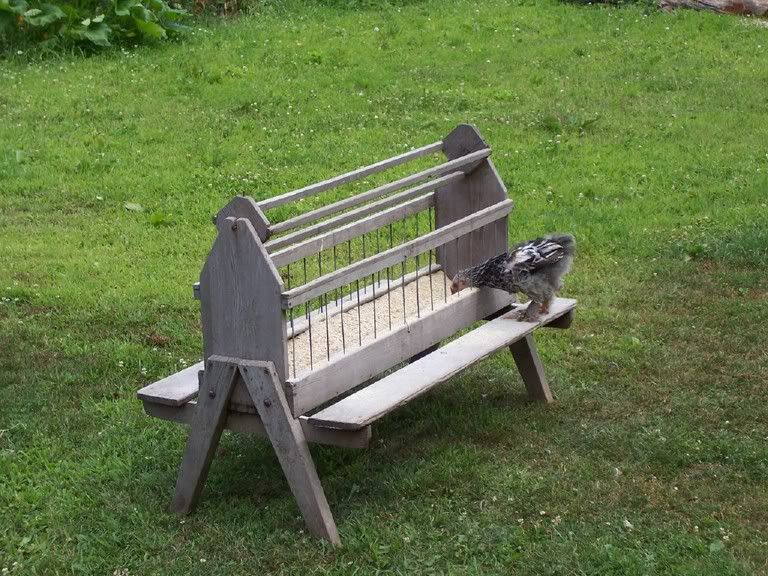
Back in Our Annual Garage Sale Safari, I told you the story of how I bought a wonderful old chicken feeder.

I have been trying to post a picture of it on this blog and have been unable to do it because my Mac is not compatible with much of Blogger and/or I'm not very compatible with computers. In any event, I think This Link will take you to the picture.

You'll notice that the feeder is all wood except for the vertical dividers where the chickens stick their heads through to feed. Those are a heavy galvanized wire. The thing on top spins around to discourage chickens from roosting. One strip of wood is missing on the spinner but can be easily replaced. Also, the spinner thing lifts right off so feed can be put into the feeder. Being so high off the ground gives chickens room to scratch around underneath.

I'm curious to know if anyone has seen a feeder like this? Do You have any idea how old it is? Was it homemade or bought? Does anyone know of an old or new book that has plans for this classic feeder?

Thanks for your help.

Our Annual
Garage Sale Safari

Dateline: 2 August 2005
Updated: 27 July 2013

New York State Route 90 is a pleasant 50-mile stretch of rural road that winds its way through the rolling countryside not far from my home. It passes by quaint old villages and country-crossroad towns with names like Aurora, Union Springs, King Ferry, and Summerhill. Every year, on the last weekend of July, this normally-quiet thoroughfare hosts what has become a major regional event. It's called the Route 90 Garage Sale.

Imagine it... A 50-mile-long garage sale adventure! Thousands of people clog Route 90 for this extravaganza. My family has been among them for so many years that we consider it a family tradition.

The people who live on Route 90 are not the only ones doing the selling. Folks from all around will cart their crafts, foods, and assorted stuffs to the roadside and set up shop. We did this a couple years ago and managed to unload enough unneeded junk to buy Marlene a nice new $400 dough mixer for her little bread business. But we also came to the realization that searching the sales is far more fun than selling.

This last Saturday morning, Marlene and I and our two youngest boys piled into the SUV and headed out on our annual summer garage sale safari. It was the first time the whole family did not go. Our oldest son now has a summer job and had to work. It was too bad but, on the other hand, it meant we had more room in the vehicle to pack our treasures (and we really did pack ‘em in).

I went with only one objective in mind: to find a good garden hoe. It isn't that I don't have a hoe because I do. Fact is, I own several of them (some bought at previous Route 90 sales). I just happen to like hoes a lot, and I'm always on the lookout for another good one. I feel the same way about hoes as I do about guns.... a man can never have too many of them.

Well, I did see some hoes, along with all kinds of shovels, rakes, mauls, and post hole diggers. None of them appealed to me, but I found some other agrarian things that were even better!

For example, my best find of the day was an old wooden (no sheet metal and no plastic) chicken feeder. It is a feeder like maybe I remember being in my grandfather’s chicken coop when I was a little boy. It is a beautifully crafted blend of form and function, well used but still sturdy and almost perfectly preserved. I would say it has to be at least 50 years old and probably a lot more than that. Here's a picture of the feeder...


Click picture to see a larger view

The young guy I bought the feeder from had just hauled it out of his barn, along with all kinds of horse equipment and other old things that had probably not seen the light of day for decades. The feeder trough had ancient, dusty chicken manure and straw in it. There was no price.

“How much do you want for that chicken feeder over there?”

The man said he had to get $25 for it. I would have to pay more than that just to buy the lumber to make such a feeder. I didn’t dicker. We strapped it to the top of the Explorer with bungee cords and drove off, with me cackling excitedly to Marlene and the kids about what a rare and special find I had found, and dusty old coop crud trailing in a cloud behind us.

Later on, as we were slowly motoring through a crowded village, intently surveying the garage sale wares along the roadside, Marlene asked me, “Why is everyone looking at us?” I told her they were not looking at us. They were looking at my antique chicken feeder. It turned a lot of heads.

If a Modern had bought my chicken feeder, it would probably become a plant stand; a place to show off petunias. What a shame that would have been. I have a better idea. I will use it to feed chickens. In fact, I am already doing this. But I’m thinking that I should build an exact reproduction and give the original to my country agricultural museum.

I was also thinking that I could put together plans telling others how to build their own Classic American chicken feeder. Surely there are a lot of fellow agrarians out there who would appreciate the simple rural elegance of this wonderful piece of farm equipment from days gone by. Then again, I thought I could go into business making reproductions and I could sell them to Moderns as plant stands. This is the way my mind works. I can’t help it.

There were a couple other nifty agrarian finds that I hope to tell you about in future blogs. But, for now, I want to tell you about one purchase my 10-year-old son, James, made. I gave him $12 spending money for the sale and he made some excellent buys. His most expensive purchase was $4 for what he thought was an adze.

James wants an adze to use in conjunction with his axe (which I wrote about in a previous blog) to square logs into beams. He watched a man do this at the Common Ground Country Fair in Maine last year. How many 10-year-olds do you know who want to buy an adze?

Unfortunately, the adze was not an adze. When he showed me his purchase, I had to tell him that it appeared that he bought a very, very old hand forged hoe. It looks like it could have come over on the Mayflower. It looks that old. I would call it a grub hoe. Someone with more hoe know-how might say it was a grape hoe.

Whatever the case, James is not into hoes (yet) and was a little disappointed. But it all worked out in the end because I happen to have a real adze and I found it for him to use. Then I gave the boy $4. I can use a good grub hoe.


Agrarian Thoughts

Dateline: 31 July 2005

I have recently acquired a copy of the book Agrarianism in American Literature, edited by M. Thomas Inge. Though I have not read much of this book yet, I have skimmed it and it looks good. I found the introduction to be particularly insightful where, in an attempt to define the word “agrarian,” the editor introduces some “thoughts which are generally to be understood as “agrarian.” I think you will appreciate these Agrarian Thoughts:

1. The cultivation of the soil, the mother of all arts, has within it a positive spiritual good and instills in the cultivator such virtues as honor, manliness, self-reliance, courage, moral integrity, and hospitality. These folllow from his direct contact with physical nature, the medium through which God is directly revealed and which serves to remind man of his finite nature and dependence on God. It is an occupation singularly blessed by God, since He was the first husbandman, having wrought order and creation out of confusion and chaos, and it is the first employment ordained by Him of Adam, the first man.

2. Only farming offers complete independence and self-sufficiency, because regardless of the state of the national economy (provided the farmer and not the bank owns his land), his basic needs of food and shelter are provided through his cooperative relationship with nature. The standard by which an economic system is judged is not how much wealth or prosperity it produces, but how effectively it encourages freedom, individuality, and morality.

3. The farmer has a sense of identity, a sense of historical and religious tradition, a feeling of belonging to a concrete family, place, and region, which are psychologically and culturally beneficial. His life is harmonious, orderly, and whole, and counteracts tendencies in modern society toward abstraction, fragmentation, and alienation.

4. Industry, capitalism, and technology, and the thriving metropolises they have created, are often destructive of independence and dignity, and encourage corruption, vice, and weakness.

5. Agricultural communities, where the brotherhoods of labor and cooperation bring about increased understanding, provide a potential model for an ideal social order.

Benny's Grandfather
Was A Ditch Digger

Dateline: 17 July 2005
By: Herrick Kimball

And Benny's grandfather grew tomatoes

Benny is a guy I work with. He is of Italian heritage. He is a Vietnam vet.

We got to talking about garlic the other day and Benny told me his wife uses a LOT of garlic in her cooking. She uses fresh garlic in season and minced garlic from the store out of season. Benny eats out a lot but he never eats Italian out because no one makes Italian as well as his wife. I've had Mrs. Benny's pasta with the garlic and tomato sauce and it is good.

Well the conversation that day turned to Benny's grandfather. He was born in Italy, but came to American and lived in Auburn, NY. Benny told me his grandfather was a ditch digger. He hand-dug many sewer lines in the city of Auburn. If you've ever hand-dug a ditch (as I have, on several occasions) you can't help but have a lot of respect for someone who digs ditches for a living.

But that wasn't all Benny's Grandfather did for a living. It turns out he had a big market garden. It was in the city and Benny says it was a city block long. He spaded the garden by hand. He did not have a rototiller, or a tractor with a plow. Just a shovel. It was a city block long! If you've ever spaded a garden by hand you can't help but have a lot of respect for a man who spades his market garden by hand.

Benny's grandfather grew garlic, and scallions and tomatoes. This was, after all, an Italian family. The scallions and tomatoes were his specialty. He supplied all the little markets in the city. Little markets that, except for a single remaining dinosaur, have become extinct in the city of Auburn, NY. A couple Mega Supermarkets now dominate.

Benny's grandfather had a sink set up in his basement to prepare his produce for market. The tomatoes he grew were huge, says Benny, and he holds up this hands to show me just how big they were (and I wonder if Benny might be exaggerating just a little).

How did Benny's Grandfather grow such huge tomatoes? Chicken manure. He would get burlap bags of dried, crusty old chicken manure and dump them into big open-top barrels by his garden and fill them with water. He had a lot of these barrels. Benny says, "That s--t would ferment and he'd dip the water off the top and pour a ring of it around the tomato plants early in the morning."

I relate this story to you because I think it is a wonderful look back....to a time when men worked for a living, when men turned the soil over by hand with a spade, when men grew food for their families and communities, even in the cities. It was a time when there were little markets in each community throughout the city. Was this an idyllic time? Yes it was. One definition of idyllic is "pleasing or picturesque in natural simplicity." It was idyllic.

Clearly, Benny's grandfather did not live an easy life. But it definitely had idyllic qualities. There is, without a doubt, great value in manual labor, in working the soil, in growing food. There is great satisfaction in such things.

I asked Benny how old his grandfather lived to be. The man was 97 when he died. Homegrown garlic, tomatoes, scallions, and hard work. How's that for a longevity plan?

“Can You Feel The Energy?”

Dateline: 13 July 2005
(Note: today’s blog is a continuation of yesterday’s blog post, 
Earl The Bee Man & My First Hive)

My honeybee hive wintered well and was full of activity in the spring. Then something amazing happened. I was working in my garden one morning and became aware of an audible humming in the direction of my hive. I looked over and saw that there were far more bees in the air than normal. The corporate buzzing became louder as the bees collected into a cloud. Then the cloud rose into the air and made its way out over the trees in the back woods.

I went into the house to tell Marlene what I had seen and ended up having some breakfast. The boys heard my story and went out to investigate. They returned shortly to tell me there were “millions” of bees on the ground by one of my apple trees. I headed right out to see for myself.

Sure enough, there was a tight bunch of bees, about half a peck in size, maybe more, at the base of the tree. I called Earl Downes, the local bee-man and my mentor, and he came right over. He was suited, as usual, in his white bee-suit coveralls but wore no gloves or veil as he carried a section of hive (called a super) over and set it on the ground a couple feet from the beebunch.

Earl explained that when the hive population grows too large for the hive, the bees make another queen and a portion of the bee population takes off with her to find a place to make a new hive. It’s called a swarm. The tight cluster of bees before us was surrounding the queen, he said.

I was trying to figure out why I saw a cloud of bees take off and here was this churning mass before me. Did they come back and clump here when I was eating breakfast? Or were those bees in the cloud the house hunters? If Earl answered that question, I don’t remember. He told me they would find the super he brought and move right in with the queen. Then he would return tomorrow and take it away and set the bees up somewhere in a full hive. He told me this while on his knees right next to the swarm.

Standing a few feet away, I inquired about the possibility of him getting stung. Earl explained that a fresh swarm won’t sting because they gorged themselves with honey before leaving the hive. But as the swarm ages, and the honey is consumed, the mass of bees will become a “dry swarm,” which can get downright mean.

“You can put your hand right into the swarm and they won’t sting you,” he said to me.

You can do that,” I said. “But not me!”

“No, really!” he replied. “Watch this....” Earl slowly eased his ungloved hand into the moving mass. It enveloped him like a fluid up to his wrist. “There is incredible energy in a swarm of bees. You can feel the energy. Want to try it?”

I gave it a brief thought, threw caution to the wind, and did the unthinkable. Yes, it’s true, I put my bare hand into the middle of the massed bees.

“Can you feel the energy?” Earl asked.

Oh yeah, I could feel it alright. My bare hand was inside the organism of moving bees. It was one of the ultimate agrarian thrills of my life. I lifted my cupped palm slowly out of the swarm and bees, like water, flowed over the sides back into the mass. I tipped the cup and bees poured out. Believe it or not, I did not get stung.

Using his bare hands again, Earl parted the swarm, looking for the queen. He saw her for a moment. I did not. He manipulated the mass some more, spreading it out. “There she is! See her?” I saw a bee that looked to my untrained eye, pretty much like all the others, except maybe a little longer.

It was a learning experience for me that day.

As soon as Earl left, I headed back into the house to tell my family what I had done. I urged them to come out and watch me stick my bare hand into the swarm.

They huddled a safe distance away while I kneeled on the ground by the bees and told them, like an experienced bee man, what was going on. Then I said, “Watch this.” and I slowly eased my bare hand into the swarm.

Marlene and the kids were very impressed. Then I exclaimed, “You can feel the energy!” as I lifted a handful of bees into the air. At that moment I felt a different kind of energy. One of those little buggers must have dried out and got a bad attitude. Bee stings hurt and I yelled, “Ow!” and gave my hand a quick shake.

I probably don’t have to tell you that a good bee man does not shake his hand violently when he gets a sting. Several bees, still latched to my fingers, became alarmed and responded by stinging me several more times. I was on my feet by then, slapping my hand repeatedly on the side of my jeans. I noticed some bees were flying close to my head and swatted at them with my other hand. Things were getting ugly. I yelled to the family... RUNNNNNNNN!.... and we all hightailed it back to the house.

I was standing in the doorway when they got there. They couldn’t run very fast because they were laughing so hard.

My fingers swelled up like hot dogs.

Yes, it sure was a learning experience for me that day.


Earl The Bee Man
And My First Hive

Dateline: 12 July 2005

Earl Downes is the bee man around these parts. Earl really knows bees. He lives off the beaten path on Dresserville Road, a few miles outside Moravia. Earl has sold his honey self-serve for many years from a display stand in his front yard. In the barn next to his house is a workshop where he builds and repairs hives. There is also a nice extraction room there and he recently added a nifty little honey store on the side.

Folks from all over, including many city people, go to Earl’s for honey of many varieties. Early in the spring, the bees around here make basswood honey. I never knew there was such a thing as basswood honey until I met Earl. Buckwheat honey is a regional favorite. Buckwheat flowers are white and a field of them has a unique pungent aroma that I rather like, but some folks find it offensive. Whatever the case, buckwheat honey appears dark brown in the jar on a shelf. But, as Earl showed me one day, when you hold it up to the light, you can see that it actually has a gorgeous translucent mahogany hue.

Sometimes people will stop by Earl’s to get stung, on purpose. No kidding. They say it’s good for what ails you-- arthritis in particular. Earl tells me country folks have been using bee stings as medicine for centuries. Nowadays they call it “bee-sting therapy.”

When someone stops for a sting, Earl holds the bee by its wings and touches her (only females have a stinger) down on the desired location. The bee will oblige by injecting a barbed hypodermic syringe full of venom into the patient. Earl is glad to help folks out this way. He doesn’t even charge for it.

In his younger days, before he became the local bee man, Earl was a local building contractor. I met him when, in my younger days, I went into business as a remodeling contractor.

Earl used to go down to Lehigh Lumber in Moravia most every morning for coffee and conversation. An irregular regular bunch of men would be there, some of them old-timers. On winter mornings, when work was often less pressing, I liked to linger and join the discussion. Sometimes we would all sit around in the back room where Joe DeForrest repaired the broken window sashes that customers brought in. He rescreened windows and doors too. And if you needed a lamp rewired, he could do that.

A fellow can learn a lot chewing the fat over a cup of coffee with old-timers down to Lehigh in the early morning: the local news, national happenings, politics, construction, and beekeeping were recurring topics. This is where I first met and got to know Earl.

When I was a teenager I bought a paperback book all about keeping honeybees. They’ve always intrigued me. But I never did get a hive. I told this to Earl one morning and he said he would set me up with a hive any time. More years passed and Earl kept offering. Finally, in the spring of 1999, with the Y2K crisis looming, I took him up on the offer. It seemed like a good time to get more self sufficient. Besides, Marlene uses a lot of honey when making her breads and granola.

Well, to make a long story shorter, I’ll tell you that my first year of beekeeping was a great success. I put the hive out on the corner of my property, off the lawn, near the brambles, along the woods. Every so often I’d pull on my white leather bee gloves with the canvass gauntlets, tie my pants tight to my boots, put on my bee veil, fire up my smoker and, hive tool in hand, crack open the top lid of my hive. This was always an adventure because the bees usually got quite upset with me and, on occasion, I would get a sting or two, even with the protective equipment. Honeybees are very persistent when they are angry. And I can tell you it’s just alittle unnerving when they cluster on the bee veil a couple inches in front of your nose.

I did not really know what I was doing or what I was looking for when I delved into my hive but it was definitely a happenin’ place in there, and those fascinating little creatures sure were making lots of honey. In the fall Earl helped me harvest and extract around 75 pounds of the glorious natural sweetener. He said that was a good amount for a new hive. I was thrilled. Even though the bees did all the work, I felt like I was quite the apiculturist. I had visions of being an old bee man, like Earl.

My hive wintered well and was a hum of activity in the spring. Then something amazing happened..... (to be continued in the next blog)


Wendell's Wisdom...

Dateline: 11 July 2005

Wendell Berry is the foremost of Agrarian writers. His perspicuity is rare, refreshing, inspiring and, at the same time, sobering. Berry is an expert when it comes to pointing out that the Industrial Emperor has no clothes on. So it’s only natural that what little I’ve read of Berry’s writings, I’ve liked (I hope to read more soon). Mr. Berry has an article in the recent issue of Orion Magazine. Here are a few quotes....

“We agrarians are involved in a hard, long, momentous contest, in which we are so far, and by a considerable margin, the losers. What we have undertaken to defend is... “good farming.” I mean farming as defined by agrarianism as opposed to farming as defined by industrialism; farming as the proper use and care of an immeasurable gift.”

“...Because industrialism cannot understand living things except as machines, and can grant them no value that is not utilitarian, it conceives of farming and forestry as forms of mining; it cannot use the land without abusing it.”

“...one of the primary principles in industrialism has always been to get the worker away from home. From the beginning it has been destructive of home employment and home economies. The economic function of the household has been increasingly the consumption of purchased goods. Under industrialism, the farm too has become increasingly consumptive, and farms fail as the costs of consumption overpower the income from production.”

“I said awhile ago that to agrarianism farming is the proper use and care of an immeasurable gift. The shortest way to understand this, I suppose, is the religious way. Among the commonplaces of the Bible, for example, are the admonitions that the world is made and approved by God, that it belongs to Him, and that its good things come to us as gifts.... The world, Gerald Manley Hopkins said, is charged with the grandeur of God. Some such thoughts would have been familiar to most people during most of human history. They seem strange to us, and what has estranged us from them is our economy. The industrial economy could not have been derived from such thoughts...”

“Even now, if they cared, I think agricultural economists could find small farmers who have prospered,not by “getting big,” but by practicing the ancient rules of thrift and subsistence, by accepting the limits of their small farms, and by knowing well the value of having a little land.”

“If you have no land, you have nothing; no food, no shelter, no warmth, no freedom, no life.”

“To be landless in an industrial society obviously is not at all times to be jobless and homeless. But the ability of the industrial economy to provide jobs and homes depends on prosperity, and on a very shaky kind of prosperity too...”