The Deliberate Agrarian Blogazine
January 2011

Dateline: 31 January 2011

It's About Food


Here at the end of January, as I am about to post this monthly blogazine essay, the country of Egypt is in turmoil. There are demonstrations in the streets. Protesters are clashing with police. Buildings are being looted and burned. People are dying. Why?

Yes, the people live in a dictatorship and they want freedom. But they have lived under that kind of government for decades. Something tipped them over. As I listen to the mainstream media on my satellite radio, very little is said about the spark that ignited this unrest. But I heard it mentioned in passing with a news media interview of the Israeli ambassador. 

The ambassador was at a world economic summit in Switzerland. In the course of the interview he made the statement that, "These people are hungry. They are facing food shortages." No further comment was made about this subject of food. But there it was. It's not really a secret but it doesn't seem to be something that the mainstream press is talking about.
.
Back on January 22, I happened upon an online article at Business Insider titled, The 25 Countries Whose Governments Could Get Crushed By Food Price Inflation. I recommend the article to you.

Egypt is on that list. The amount paid for food, as a percentage of household consumption, in the country of Egypt, is 48.1%. The country is a negative net food exporter. In other words, Egypt is not food independent; it is unable to provide for the food needs of its population. And all those people who are clamoring for a change of leadership to bring them some relief are helpless to provide for themselves. 
 .
They are primarily city dwellers, and city dwellers are among the most helpless dependents of any nation when it comes to providing for their most basic food needs. This is a tragedy and it is bound to spread. Look at the countries on the list. Some of them may surprise you.

No, the United States is not on the list. As near as I can determine, the percentage of income spent on food in the US is around 12%. But that was an old statistic—from before the 2008 crash. Such statistics in this country have surely changed in the last two years.

Nevertheless, Americans are facing food price increases, and any unrest in other parts of the world can and will affect our economy, which really isn't all that stable at the moment. The industrialized world we live in is so interconnected, has so many complex systems, with complex dependencies, and control over major markets is so centralized, that we are in a precarious situation.

What lessons can we as a nation and as individuals learn from the chaos in Egypt?

Jeffersonian Democracy
.
.
I get a kick out of mainstream news commentators who throw the phrase "Jeffersonian democracy" out when speaking of governments. The inference being that Jeffersonian democracy is a good thing—the ideal form of government—and that other nations would be better off if they could somehow become Jeffersonian democracies.

Well, of course they would. And I  believe that America would have a better from of government if we had a Jeffersonian democracy too!

Thomas Jefferson would be aghast to see what has happened to this country. It isn't what he envisioned. Jefferson warned about the dangers of industrialism and the powerful banking interests that would, if the nation was not careful, destroy the Republic. Jefferson believed American would be strongest if it were an Agrarian Nation. He warned of the great dangers of being a nation of dependents.
“Dependence begets subservience and venality, suffocates the germ of virtue, and prepares fit tools for the designs of ambition.”
Yes indeed, Jeffersonian democracy is a prudent form of government, but I dare say the talking heads out there don't know what they're talking about when mention Jefferson democracy. (Click Here to read my "Jeffersonian Solution" essay if you have not already done so)

29 Years Old!


The last day of January is my birthday, once again. I am 29 years old, once again. I am feeling wistful, once again. Birthdays are like that for me.

Three years ago (when I turned 50 26) I decided it was high time that I learned to play a musical instrument. Some of you longtime readers may remember this event in my life. You may remember that I settled on the banjo because banjo music agrees with me. I figured that learning to play a banjo couldn’t be that much harder than learning to butcher a chicken, which I like to think I’m pretty good at (Click Here to see).

So I bought myself a real fine banjo, handcrafted by a goat farmer/banjo maker in the hills of Virginia. It’s a beautiful instrument that I really like.

Now, three years later, I can tell you that, without a doubt, I am a failure as a banjo player. An utter failure. Butchering chickens is much easier to learn than playing a banjo is.

I will keep my fine, handcrafted banjo safe in its case and maybe, just maybe, I’ll have a grandchild someday that will take an interest in the instrument. That would please me.

Meanwhile, I have given a lot of thought to another instrument that I’d like to play, instead of the banjo.


Bagpipe music agrees with me. How hard can it be to play a bagpipe? I’ve got a good bit of Scot in  me, you know. Seems like that would help.

So I mentioned this desire of mine to learn the bagpipes to my wife, Marlene. She looked at me with a perfectly straight face and suggested that maybe I should consider the tambourine instead.

Then she burst out laughing at her suggestion, like she had told a funny joke.

A real comedian, that Marlene is.


The Franz Family
.


Speaking of music—I mean really good music—have you seen the Franz family? Mom, dad, and the four kids are remarkably talented (perhaps I could learn to play the dobro).

Some Blogs For You To Visit
.
Photo of Owen Bridge with his haymaking equipment from The Ruminant web site
.
It has always been my policy to recommend other agrarian-minded blogs that I come across. I think there are a lot more of these coming online all the time, and that's a good thing. Here are three links that you may like...
Stone Cottage Diaries— I'm not sure how I found my way to this down-to-earth blog, but the first thing I read there was Nickel & Dimin' it in 2011 in which the young woman who writes the blog tells of how she and her husband are focusing on paying off their mortgage early. But, beyond that, Bo (her husband) has done something this year that most men only dream of... and his wife is totally supportive of it.... and it is really nice to see.

The Ruminant— Jordan Marr up in Canada has a nice little blog in which he's trying to spread some good farming and homesteading ideas around. I read his story titled Owen Bridge's Hand-Made Hayrake and liked it very much. 

Stumbling Homestead— The Menard family out in Oregon have a pleasant web site with a variety of podcasts. I found them when they asked me if I would be interested in doing a podcast interview. It is my policy to politely decline all requests for interviews (because I am a shy and not-well-spoken agrarain) but I do like what they are doing.


Update on My Book Project
.
I'm so  old... 
I did my first typing as a kid on a typewriter very similar to this.

As mentioned last month, I have decided to self-publish another book and I launched myself into it as of January first. I have spent many days this month working on the book. I have sat for hours pounding the keyboard and staring into the cathode rays of my computer screen. My fingers hurt and my optical nerves are frazzled. But I am making very good progress towards my goal of having the book ready for the printer by the last day of February. 

In high school I learned to type on an electric typewriter like this. It was probably the most useful thing I ever learned in high school. I'm a five-finger typer. I use three fingers on my right hand and two on the left. I'm pretty fast.... but I have to look at the  keyboard most of the time. So I guess I didn't really learn to type very well in high school.

I’ve told Marlene that I think this might be my last book. She has never heard that from me before. Well, maybe one more after this. We'll see :-)

My new book will be something of a magnum opus for me. It will be large at 8.5” x 11” and I think it will have 200-plus pages. It will contain a tremendous amount of information.

And right about here, a good ways into the project, with a good ways yet to go, with a surprisingly high price quote from the printer, with the economy in the dumps, I find myself questioning whether I should even be doing this book. 


But this kind of questioning is pretty much par for the course.

Maybe it is the same for other seat-of-the-pants, amateur, self-publishers too. But I wouldn’t know because, frankly, I don’t know anyone else who self publishes books like I do. It’s a lonely obsession.

I bought myself a Personal Word Processor similar to this in the early 1990s to help me with typing job descriptions and price quotes for my remodeling business. I would compose what I wanted on the screen, hit a button, and the typewriter would automatically clack away, typing off a single copy. I started my career as a professional writer (meaning that I got paid for it) by typing articles for Fine Homebuilding magazine on this kind of machine. When I wrote my first book for Fine Homebuilding back in 1995, they told me they needed the manuscript on a computer disc. That's when I bought my first computer.
A Mac, of course.
 .
Regardless of any pangs of doubt midway through the project, and barring any unexpected problems, I will get this book done because it is something I've felt compelled to do for a few years, and I believe a lot of people will find it informative, useful, and inspiring. 

The book will be appreciated by people with an agrarian mindset, and especially people who are have an interest in old agrarian ways and the culture of America when we were once an Agrarian Nation. It will be an informative, thought-provoking book with new-old ideas and inspiration. Did I mention that it would be an inspiring book?  

I will be starting a new educational blog to promote the book and to expand on the ideas and information in it. I will post to the blog a couple times a month (more frequently than here!) and I think it will be a lot of fun.

More details next month..... hopefully

The New Precious Metal
.
I was speaking with a 12-year-old boy the other day. He told me he collects coins. I asked him what kind of coins he collects and he told me that mostly he looks through the cash register at his parents diner for wheat pennies. That got me to thinking....

I remember very well when I was 11 or 12 years old and started collecting coins. Back then it was possible to find an occasional buffalo nickle, or a mercury dime, or even a standing liberty quarter in circulation. But mostly I looked for pre-1965 dimes and quarters because they had real silver content.

When I had some spending money I would walk to the bank branch in the shopping center outside our housing development and trade cash for rolls of dimes, nickels and quarters. Then I'd eagerly sort through the rolls looking for the silver coins (Jefferson nickles between 1942 and 1945 had a 35% silver content). After a few days I'd turn the rolls back in at the bank for cash. Then after a few more days I'd repeat the process.

Today a roll of pre-1965 silver dimes, with a face value of five dollars, sells for around $100. That's twenty times the face value. So if you had the foresight in 1964 to put aside $100 worth of common pocket change (dimes or quarters), it would be worth $2,000 today.
.
I never took wheat pennies very seriously when I was a kid. The last year they were made was 1958, the year I was born, and they were plentiful for a lot of years. But, amazingly, a 50-cent roll of wheat pennies is now selling for $3.50 on ebay. They are worth approximately seven times their face value. That's a 700% increase in value.

This got me to thinking about the value of paper money and coins. The intrinsic value of paper dollars is pretty much nothing. But it turns out this is not the case with some coins, even though they no longer contain any silver. 
.
It so happens that the copper content in  Lincoln pennies minted before 1982 is 95%, and the copper content in any Jefferson nickel now in circulation is 75% copper (and 25% nickel). With the current copper value at around $4.30 a pound, pre-1982 pennies are worth just about three cents each. And the copper/nickle value of every nickel now in circulation is just about seven cents.

Based on that knowledge, it makes a lot of sense to save those pre-1982 pennies and every nickel you can find. Before long, the copper/nickel alloy used in nickels is sure to be cheapened, probably to inexpensive zinc, as has been done with modern pennies.

If I were 12-years-old again, I'd be looking for not just wheat pennies but all Lincoln pennies with the 95% copper content.

It turns out that quite a few people are now "investing" in rolls of nickels. They are getting $100 boxes of rolls at the bank and just squirreling them away. And there are a lot of people out there seriously "mining" rolls of pennies, looking to extract all the copper cents. There are even machines you can buy to run your pennies through. The machine automatically separates the zinc pennies from the copper pennies. It won't be long before the copper pennies are gone from circulation.

Copper, primarily in the form of pennies and nickels, is now the "poor man's" precious metal. Do an Ebay search of "copper penny bullion" and you will find copper pennies for sale. For example, you can buy $100 face value of pennies (68 pounds worth) for around $200. There are no listings for Jefferson nickel bullion.... yet, but there will be some day. 

Many people are loading up on a supply of nickels and pennies for another reason. If the Powers That Be can't work their financial magic and save the economy from it's decline, we may well have an inflationary depression. The value of paper money will decline significantly, perhaps even to the point of worthlessness. America has never experienced this sort of thing, but that doesn't mean we won't. If it happens, copper pennies and nickels, with their intrinsic metal value, may become widely used for exchange instead of worthless dollars. It's entirely possible that a Jefferson nickel would have more buying power than a one hundred dollar bill. And if we go the other direction with a deflationary depression, the coins will hold their value. It would appear that you can't go wrong with copper pennies and nickels as an investment, or so it seems to me.

To keep track of the current melt-value of all kinds of American coinage, check out www.CoinInflation.com

For my young readers who are inspired by this coin collecting idea, I suggest that you let your friends and relatives know that you have taken up penny collecting. I'll bet many of them will be glad to help by saving pennies for you.

Here's An Idea
(for 12-year-old boys of all ages)


If I understand correctly, no significant new copper ore discoveries have been made in a hundred years. Copper demand currently exceeds production levels. That's why scrap dealers are paying the highest prices they've ever paid for copper scrap. This could, of course, change if industrial demand (primarily from China) were to drop significantly, and that's why pennies, with their face value, are better to "invest" in than bars of copper bullion. But there is another way to get yourself a supply of premium copper....

Every electrical appliance that has a motor has a power cord that has copper wire in it. And the electric motor itself has a lot of copper. Everything from garbage disposals to washing machines to vacuum cleaners to electric kitchen mixers have copper in them. If you see one of these items being thrown away, cut the cord, extract the motor, and salvage the copper. 

This is an educational, as well as a lucrative, little hobby that I recommend primarily to boys (and men) because most boys (and men) have a natural love of disassembling machines.

Just last week Marlene's electric kitchen mixer broke. No problem (she had a garage-sale backup on hand).  I decided to see just how much copper wire I could get out of that cheap little mixer. I performed the extraction operation using a few basic hand tools at the  kitchen table. It took about 15 minutes. And it was a lot of fun. In the end, I had myself 1-3/4 ounces of clean, bright copper wire, which always brings a premium at the scrap yard.

Broken mixer on left. Copper "mining" tools on the right. Copper wire in the center. Small Farmer's Journal underneath

Now, let's see.... If the value of copper is now up to $4.30 a pound, that's about 27-cents an ounce. So my 1-3/4 ounces of copper is currently worth about 47-cents. That's from a chintzy little plastic mixer. 

Who knows what copper will be worth a year from now, or five years from now? It could be worth a whole lot more than $4.30 a pound. Recycling can be a good investment. Mining thrown-out appliances for the copper makes good financial sense. Put your wire in a big plastic pail and add to it whenever you can, like a savings account. That's what I'm doing.

Inflation Calculations


Speaking of inflation and all of that, I think this is a good time to mention the US Inflation Calculator. It's a fascinating little web device that allows you to figure out how much value the American dollar has lost since 1913, which is the year the Federal Reserve Bank was established. :-(

For example, according to the calculator, it would take $754.52 in today's dollars to buy what $100 dollars would buy in 1958, the year I was born. 

So, according to the calculator, in the year 1964,  when my Grandfather Kimball made two $500 deposits into the savings account he started for me, it was the equivalent of a grandfather today making two deposits of $3, 517.02 (a total of $7,034.04) for his grandson. That puts things in a whole new perspective.

It's unlikely that I will ever be able to put away money like that for my grandchildren. Maybe I can save a few rolls of pennies and nickels. :-)


Garden Planning

Another Great Idea!


 .
After much consideration, Marlene and  have ordered our garden seeds. I have great hopes for this year's garden. The last couple of years I've had very productive gardens but they have not looked so good. My problem is a real lack of time to keep them properly cultivated, especially as I am working at the factory job and trying to run the Planet Whizbang business here at home. It's too much for me, and the garden gets neglected. Still, I have high hopes, and I mean that literally...

Last year I experimented with some trellis growing ideas for beans, tomatoes and cucumbers. I had some successes and some failures, but I learned a lot, and I'm anxious to expand on the ideas that worked. For example my trellised tomatoes, pruned a certain way, came out beautiful. Here's a close-up from last summer...

These Tommy Toe tomatoes trellised up beautifully and yielded bountifully for us in 2010.
.
We ended up with many pounds of those Tommy Toes from three tomato plants. This year I will be trellising eight varieties of tomatoes, and only three plants of each. If they grow and yield anything like the Tommy Toe, we will have plenty of tomatoes for our needs.

I grew a section of trellised green beans last year and a couple long rows of bush green beans. Marlene told me to just grow the trellised beans this year. They are much easier to pick and seem to yield over a longer length of time. 

Trellised cucumbers were also much easier to pick. Someday I hope to have my trellising system worked out to my satisfaction and I'll give you a  lot more details. 

One gardening idea I decided to try last year that did not work at all for me was those upside down tomato planters. I put two by our back patio. They were vibrant, healthy, plants (that Marlene had started from seed) when I put them in the upside down planters. A few days later, this is what they looked like....

I won't be trying this idea again

“Oh God, Pride Of Man,
Broken In The Dust Again”
.

In my younger days, I liked to listen to the folk music of Gordon Lightfoot. Feeling wistful and a little nostalgic in this month, I went to YouTube and checked out some of the Gordon Lightfoot clips. One was a song that I had never heard before. It is titled Pride of Man and was written by the folk singer/actor, Hamilton Camp, back in 1964 (there's that year again).

Pride of Man is a secular song, yet full of prophetic and vivid Biblical imagery, with the destruction of Babylon, and Egypt, two ancient pagan cultures. It’s interesting to note that he mentions a  falling tower and terror. I happen to believe the Twin Towers were a symbol of the pride of man in our modern Babylonian culture, just as is the entire modern financial system.

From what I’ve read of him, Hamilton Camp was not a Christian, yet his song resonates with me as a Christian. I am particularly struck by the last two lines:

 
And only God can lead the people back into the earth again 
Thy holy mountain be restored, thy mercy on thy people Lord
.
.
Deliberate Contentment
(A Chapter From My Book)
One Man's Ruminations About Faith, Family and Livin' The Good Life
In the comments on last month's blogazine, a man mentioned that he appreciated the chapter about contentment in my Writings of a Deliberate Agrarian book. Since I have been working feverishly on a new book this month, and have not been able to commit the usual amount of time to preparing this here blogazine issue, I've decided to publish that portion of the book here for you....
Chapter 6
Deliberate Contentment

A few stories back I told you how Marlene and I acquired our land and the home we live in, and how God has blessed our family. I believe the agrarian life we experience here is truly idyllic. That is, however, not to say it is carefree, because it is not. And neither do I mean to imply that difficult and unpleasant things do not come our way, because they do. But the goodness and satisfaction of our lifestyle is authentic.

All of this originates with our Christian faith and rests on the fundamental truth that God is in total control. He orchestrates the circumstances of our life for His good purposes. This is the very definition of His being sovereign.

Understanding and accepting God’s absolute sovereignty is foundational to living a godly life. Whenever I talk about The Good Life, what I really mean is a godly life lived within an agrarian paradigm.

I do not believe you can remove godly living and still realize The Good Life. You can have a lesser imitation but not the genuine article. All of which leads me to the subject of contentment, which is another vital part of The Good Life.

To my way of thinking, contentment is the same as being satisfied and comfortable with God’s provision, with His blessings. It is, very simply, the humble acceptance of His sovereignty and will.

On the other hand, discontentment is pride, it is anger, it is war against God’s providence. It is the same as saying to Him: “This is not enough! I want more!” Discontentment breeds bitterness, and rebellion, and worse.

Instead of working and waiting patiently for God’s greater provision (if He so chooses to grant it), the discontented person gets what he wants by other means: plunging into debt, questing for wealth, and even stealing, which, to my way of thinking, includes culturally acceptable forms of theft, like taking government grants or other handouts of taxpayer dollars.

Those who live with a proper understanding of their relationship to God understand that, because of Adam’s sin, God doesn’t owe us anything more than death and damnation. That this Holy Sovereign would send His sinless Son to live among us and then die a cruel death to atone for our sins is difficult to comprehend. This alone is far more than we deserve. That He then meets the basic needs of those who call Him Lord (and many who do not) is further evidence of His incredible goodness. That, in most instances, He grants us gifts far beyond our genuine needs is a further manifestation of His grace (getting what you don’t deserve) and mercy (not getting what you do deserve).

Nevertheless, after all such blessings are embraced and enjoyed, God’s people are prone to whine and cry and moan and complain. We have the audacity to believe we should have more. Some even think to themselves that they deserve more. This is nothing short of a crime, and when we do this sort of thing, we open ourselves up to very bad consequences.

the spirit of discontentment is always there, in the shadows, watching. He dogs you, waiting for his opportunity, waiting to exploit your weakness. He will let you first entertain those other spirits: jealousy, envy, covetousness, and materialism. They will lead you off the path. They will tear at your soul. They will weaken your faith. They will marinate you in their sourness. Finally, they will deliver you to the demon. And when discontentment sinks his teeth into you, the joy and peace of godly contentment leave.

It is sad to see discontent in others. It is sadder yet to see it in ourselves.

Some Quotes to Ponder
.

“To have what we want is riches, but to be able to do without is power.”
—George McDonald
.
"There are two ways to get enough: one is to continue to accumulate more and more.  The other is to desire less."
— G. K. Chesterton
.
"Prosperity knits a man to the world. He feels that he is 'finding his place in it' while really it is finding it's place in him."
—C.S. Lewis
.
"The public are swine; advertising is the rattling of a stick inside a swill-bucket. "
—George Orwell
.
"We must achieve the character and acquire the skills to live much poorer than we do. We must waste less. We must do more for ourselves and for each other. It is either that or continue merely to think and talk about changes that we are inviting catastrophe to make. The great obstacle is simply this: the conviction that we cannot change because we are dependant on what is wrong. But that is the addict's excuse, and we know that it will not do."
—Wendell Berry


The Deliberate Agrarian Blogazine
for
December 2010


.
Looking Back...
.
 .
It is New Year’s eve. A time to reflect on the past and the future. I will have some comments on the future at the end of this blogazine issue. As for the past year, my thoughts center on blessings. Perhaps it is my age... the older I get the more cognizant I am of blessings. Not that I didn't have any disappointments and difficulties in 2010, because I did, but the blessings are always foremost in my mind.

Among so many other things, I'm thankful for all the people who stop by this blog to read what I have to say. I appreciate the encouraging and inspiring feedback that I have gotten from you. Many readers here have also bought my books and the project parts I sell, and I sure do appreciate that too.

.

My Son Has Come Home
.

My Sons: James, Robert & Chaz
 
My oldest son, Chaz, returned from his one-year tour of duty in Korea. The picture above is him with his brothers just after getting home from the airport. It took almost 48 hours of travel time for him to get from Korea to Syracuse New York.  There was some concern that he might not get out as scheduled with the tensions running high over in that area of the world, but he’s home for a couple of weeks and he’s very glad to be back on American soil. 

.

Follow-Up on Home Hog Butchering
.
Hog Butchering Picture by Scott in Pennsylvania
In response to last month's discussion here about family hog processing, I received the picture above and the following e-mail from Scott in Pennsylvania:
Here in south central PA, family butchering is still alive, but perhaps alive and well would be an overstatement.  I'm trying to attend as many butcherings as possible to get the skills, and tools, while the info is relatively accessible and free.
And then there was there was Gina’s blog post this last month at "Home Joys".....


“Every December, my parents hold an old fashioned hog butchering at their farm. This year we butchered four hogs raised by a local farmer. The average weight of these hogs was 430 lb - much larger then a typical hog. That translates into a lot of great pork to be shared by several families in the coming year.”

Photo by Gina
It so happens that Gina’s family is also from Pennsylvania and they are Mennonites. Her excellent photo-essay shows family and friends working together to get the hog-butchering work done. Even if you don’t have an interest in hog butchering, you will find the whole story of these people working together to be inspiring and endearing. Here’s the link: Hoof to Freezer: Butcher Day 2010


Interesting Book 
With A Terrible Title
.

This building in Old Economy Village, Pennsylvania, is part of what remains of the nineteenth century Christian communal group known as the Harmony Society. The Harmonists were known worldwide for their piety and prosperity. Members of the society followed their founder, Georg Rapp from Germany seeking religious and economic freedoms.

A friend of mine gave me a book that he was sure I would like. This book was first published in 1875. It is titled The Communistic Societies of The United States. If I were to come across this book in a store, that title would be an instant turnoff. I have no interest in communism as it is understood these days—in the national, political sense.  But it turns out that this book isn’t about that kind of communism.

“The Communistic Societies of The United States" was written in 1875 and it is all about groups of people who voluntarily united into well-organized communal groups or societies. The Shakers, for example, were a communistic society, and they are discussed at length in a chapter of the book.

 
Some other communistic societies with chapters in the book are The Amana Society, The Harmony Society, The Separatists of Zoar, Wilhelm Keil's Aurora Commune and Bethel Commune, The Icarians, and The Bishop Hill Colony.

What makes this book unique and of particular interest is that its author, Charles Nordhoff, a newspaper correspondent, actually visited all these communities. He spent time studying and understanding them. For example, eighteen Shaker societies were in operation in 1874 when Nordhoff did his research, and he visited all but four of them. His book is a factual firsthand account of what he saw as an outsider looking in.

Nordhoff had a specific reason for visiting and studying these communistic societies. He felt they might offer a solution to growing labor problems in the nation. Nordhoff foresaw a significant problem developing because the cheap and fertile frontier lands of America were almost gone. 

 .
It was the availability of unsettled farm land that had, from the beginning of American history, provided common men of no means with the opportunity to achieve independence and prosperity on their own piece of land.

When such lands were no longer there for hardworking and independent-minded people to settle, Nordhoff thought that communistic societies might provide much the same benefits of ownership and prosperity, not individually, but corporately, and not politically, but on a small, voluntary scale.

Upon learning this about Nordhoff, I immediately thought of my favorite historian, Walter Prescott Webb and his remarkable book, The Great Frontier. Webb’s book was published  77 years after Nordhoff’s. By then, all those practically-free frontier lands were gone. The Oklahoma Land Rush of 1893 pretty much marked the end of the 400-year-long era of economic boom that came with the discovery of vast new-world lands and their incredible store of new natural resources.

Professor Webb’s boom hypothesis of modern history is well worth understanding because, as I have stated here (numerous times) in the past, we today are living in a post-boom era. Unless someone discovers a new world chock full of natural resources to plunder, and amenable land for human settlement, our civilization will continue its inevitable decline from that era of historical-abberation prosperity.

The communistic societies that Charles Nordhoff visited and wrote about are now gone. They are historical curiosities. But they served their purpose for a season. In many instances, they allowed poor people with little hope for the future to join with others and work for the common good. Many of these societies were quite prosperous (though they lived simply and economically). Once established, the people lived comfortably and many lived to an old age. They were not subsidized by the government and they provided much in the way of “social services” help to the community around them.

I think we will see a resurgence of interest in these kinds of “communistic” societies in the days ahead. As economic conditions continue to decline, as standards of living fall, as local and state governments go bankrupt and government programs like Socialist Security and Medicare fade into history, as we enter a postindustrial agrarian era, it makes sense that intentional, voluntary communities of like-minded people will become more common.

Anyone with an interest in such societies would do well to read Charles Nordhoff’s book for some historical and practical perspective. Used copies can be found on the internet for a very reasonable price.


The Premise of Hirelings 
.

Factory-Worker Hirelings in Pink

In Charles Nordhoff’s introduction to his aforementioned book, “The Communistic Societies of the United States,” he makes some comments that really resonated with me. It would appear that in Nordhoff’s day, trade and labor unions were a force to reckon with. They supposedly served the best interests of workers, and on the one hand, this was true. In those days miners and factory workers who were being exploited were able to get better working conditions because of unions. But Nordhoff didn’t like the unions. He did not like them for a reason that I certainly never considered and I doubt you have either. I’ll let Mr. Nordhoff tell you that reason:
”The member of a Trades-Union is taught to regard himself, and act toward society, as a hireling for life; and these societies are united, not as men seeking a way to exchange dependence for independence, but as hirelings, determined to remain such, and only demanding better conditions of their masters.”
”Any organization which teaches it’s adherents to accept as inevitable for themselves and for the mass of a nation the condition of hirelings, and to conduct their lives on that premise, is not only wrong, but an injury to the community.”
Well, 135 years after those words were written “that premise” is now fully ingrained in our American culture. Very few people these days value and pursue such independence. Very few are, as Nordhoff puts it elsewhere in the book, “independent employers of their own labor.”


As I considered this situation I had to ask myself why this is. The answer I came up with is that it’s a lot easier to be a hireling. The whole industrial system, with it's onerous government regulation and taxes, coupled with inexpensive, centralized mass-production of goods by factories, along with corporate-monopoly control of markets, has done much to stifle personal initiative and force people into the hireling mold.

Bearing that in  mind, I recently heard someone (an entrepreneurial woman) state that young people shouldn’t be looking for jobs because jobs just make you lazy. Instead, young people should be entrepreneurs, looking for and working towards having their own business. This advice was directed towards a young boy with a low-paying, menial job that he hates but endures because he doesn't see any other options.

But developing an entrepreneurial mindset is totally contrary to the way our culture educates its children. Children are educated to be hirelings. After high school, they go on to college where they are further educated and directed into a job as a higher-paid (hopefully) hirelings. How many people train their children up to be independent minded entrepreneurs? Can you think of any?

Well, I happen to have one single friend who has done this. His name is Dale Weed and he owns New Hope Mills. Dale has taken the 1823 mill and business his father started in 1947 and grown it into something that his father would be amazed to see if he were still alive. Most of Dale’s children work in the family business. They are a Christian family (Dale used to be pastor of the church I attend), and they have a “family economy” (a family working together to support itself) that is rare in this day and age. It is a pleasure to behold.


Though Marlene and I have stressed the virtues of self employment and entrepreneurship, and modeled entrepreneurial activities in our family, and our children have helped us in those activities, none of them have taken to it. I'm not sure why. It might have something to do with the lack of maturity and impatience of youth. They lack focus and determination when it comes to delayed gratification, which is the kind of gratification that typically comes with an entrepreneurial venture. 

It is rare to find a truly entrepreneurial child. I suspect that most children who are lauded for a successful entrepreneurial enterprise have a hard-working parent or two doing more than meets the eye behind the scenes.

In my own instance, I've come to the conclusion that the best I can do for now is provide the entrepreneurial example, encourage my children to develop a good work ethic (even if it is as a hireling) and to encourage them to acquire marketable skills. In time, with maturity, I believe the entrepreneurial spirit will come.

Also, I'm inclined to think that imagination and creativity are essential to developing the entrepreneurial mindset. Most artistic people who make money at their art are, of necessity, entrepreneurial. 

Thinking back on my own boyhood, I can see that my Grandmother Kimball was an artistic influence in my life. She involved me in the crafts that she was doing, and bought me different kinds of craft kits to work on when I stayed with her in the summers of my childhood. If you would have creative, entrepreneurial children, it seems to me that they should be exposed to a variety of artistic and creative skills.
 

Before closing on this topic of hirelings and dependents vs. independent entrepreneurs, I can think of a specific group pf people in America who successfully train their children up to be independent employers of their own labor. It’s the Amish, and I suppose we could include the Mennonites too. Not all of these people are self employed but I’m certain that a significantly greater proportion of them are self employed, as compared to the rest of the culture around them. I suspect that a great measure of this success comes from teaching their children how to work....
.

Teaching Children to Work
.

In last month’s blogazine edition I talked about the ages-old way that young boys learned to be men and do the work of men. They did it by doing the work of farming and trades along with their fathers and other men of the community, starting from a very young age. The Amish are an excellent modern-day example of this. It would appear (from Gina’s hog butchering story above) that the Mennonites are too.

This thought was reinforced in my understanding a couple weeks ago when I happened upon a free internet movie about the Amish. I think this movie is probably the best thing you could watch to learn about and understand the Old Order Amish culture. The film was made in 1975 and it is 54 minutes long (and free to watch). I recommend it to you. Here is the link: The Amish: A People of Preservation.

If you watch that film you will see young children working and helping in the important work of the family farm. You will see entire families working together. One segment shows a boy maybe six years old driving two large draft horses pulling a piece of farm equipment. Here are some quotes from the movie
”Shared within the family, hard work becomes a seasonal ritual.”
”Work, under the right circumstances, is as enjoyable as play. Shared work is, in many cases, the Amishman’s recreation.”
”The child learns to work primarily by imitation. He learns to respect work because it’s close to shameful to be lazy.”
”[A boy] begins to work as soon as he is physically capable. You ask him to gather the eggs as soon as he is able to carry a basket out into the chicken house. He is taught to have responsibility.”
”Then as you grow older, you get more and more responsibility. And then eventually you get to the place where you can do the chores so that if Dad is gone, he doesn’t have to worry about being at home on time. It’s very serious to accept your responsibilities and fulfill them.”
”The Amish find their happiness and meaning in labor, rather than escape from it.”
.
It appears to me that when young boys are given responsibility they are faced with problems and situations that require them to come up with their own solutions. In so doing, they exercise their imagination and learn self-reliance. Such self-reliance brings confidence. And, of course, doing their work brings a well-developed sense of self worth.


My Story
.

That boy is not me, but close enough. I used to wear gloves just like that when handling hay bales on the farm.

I did not grow up in an Amish environment. My stepfather was an insurance salesman, working out of his car, driving to appointments every day. The suburban neighborhood I lived in until half way through ninth grade was full of fathers who left their home each morning for industrial jobs (fortunately, most mothers were still at home back then). This situation left me and all the boys I knew with little to do but try to amuse ourselves. We didn’t have electronic games and cell phones and all of that back then. We watched television. We played some informal sports. And we did a lot of things we shouldn’t have been doing. It was not an environment conducive to raising boys to be productive (or independent) men. Not at all. Juvenile delinquents, yes. Productive, capable men, no.

Then, by the grace of God, my parents bought an old farm house out in the rural countryside. It was in an agricultural community. I had a chance to see farmers doing work, and when the haying season came around, I had work to do, helping a local farmer and his three sons get the hay crop in. Unloading hay wagons and packing the bales into the barn is man’s work. I watched and learned and helped. Helping and learning from men doing the hard work of farming had a profound impact on me.

A mile or so up the road from our house there lived a man who did mechanic work. His garage was literally attached to his house. The farmer I worked for had this mechanic do some of his repairs (I say “some” because the farmer was very capable and resourceful when it came to doing his own repairs). I learned that there was little that this mechanic could not do. I looked up to him because he was so incredibly capable with his hands. He could build anything. He could fix anything. And he had learned much of what he knew working with his father who was a self-employed boat mechanic and owned a marina on a nearby lake.

The mechanic was independent minded. So were the farmers. The rural countryside of America is full of people like that. 

Once I got out of suburbia into the countryside I was exposed to one hardworking, independent-minded male role model after another. Many of these men happened to be Christians. Theirs was a powerful example to me at a time in my life when I was really looking for my identity. I did not look to my peers, or sports “heroes,” or movie and rock stars for role models. My role models were the rural men I knew and worked with.

Oh, I will admit that I was an admirer of Ralph Waite as John Walton on "The Walton’s" television program. And of Michael Landon as Pa Ingalls on the "Little House on The Prairie" program, but that’s because those men were like the men I knew and admired in real life.


John & Olivia Walton from "The Waltons" Television Program (1972—1981). As a teenager, I admired John Walton. Does television have such wholesome role models today? I wouldn't know because I don't watch television anymore.
 
Boys need good role models at an impressionable age. I was blessed to be in an environment, and to take a path, that exposed me to some very decent role models.

In my senior year of high school I worked at New Hope Mills every day after school and on vacations, packing pancake mix into bags for Dale Weed’s father, Leland, a remarkable man who was certainly an independent-minded entrepreneur. 


In time, I worked full time on a dairy farm for one year. I also worked for one summer with another independent-minded, resourceful, self-employed man cutting pulpwood and spray painting bars. Then I went into the building trades and got a chance to work closely with other men building and remodeling. Carpenters, roofers, masons, drywallers, plumbers—all kinds of capable, resourceful, independent-minded craftsmen—were my examples and mentors.

So that’s my story (you can read an expanded version At This Link). If I had never moved from the housing project, none of this would have happened. I probably would have gone on to college and become a doctor. That was my aim in life from a kid right up to ninth grade. Nothing against doctors, but I’m a whole lot more satisfied with the path I took.

.

Boys to Men

"Farm Boy And Horse Team Loading Hay" by Victor C Anderson (1882-1937)


 .
So then the question arouse.... what about my own boys? How will they get a chance to work with men and, hopefully, develop manly skills and confidence? 

The ideal situation would have been for me to have a farm, but that was beyond my ability. So Marlene and I chose a deliberate agrarian lifestyle. We lived in the country. We grew our own food. We homeschooled our kids (more about this shortly). We worked together as a family doing things like making maple syrup, and getting the firewood ready for winter, and butchering chickens. When I worked in my workshop, my kids had access to the shop and the tools and the scraps of wood to work with. We did the best we could with the resources we had to model and teach the goodness of hard work associated with self reliance.

My two youngest sons took to all of this exceptionally well. When they were maybe 11 or 12 years old they had an opportunity to help a nearby dairy farmer pick stones from his fields before planting in the springtime. This farmer and his grown son, both Christian men, asked lots of boys from their rural church to help with the stone picking. Picking stones in the hot sun is hard, dirty work but when you got a bunch of your friends all working together, the work is almost fun, just like they said in the Amish movie quote above.

In time my two sons had the opportunity to help with hay and chores and other tasks on that farm, then on other farms. It turns out that opportunities come to children who have a good work ethic.


Another neighboring farmer took James under his wing. He has taught James all about so many aspects of farming and animal husbandry and machine operation. Robert, got a job working for a contractor who has an extensive maple syrup operation on the side. He has gotten all kinds of hands-on experience working with men to do skilled, productive, hard work.

This picture of my sons, James & Robert was taken 4+ years ago. You can read the story that goes with the picture at my essay titled, Hay Hooks.

It’s not the Amish experience, but it’s akin to it, and I feel my boys are all the better for it. I dare say, this sort of thing rarely happens outside of a rural/agrarian setting.

I know there are plenty of men who read this blog that were blessed with farm work in the country when they were boys—work that helped shape who they are. And, looking back, these men understand the value of their rural upbringing. But there are others who read this blog and see the wisdom of this but can’t seem to figure out how their young sons will be able to transition properly into manhood because the dominant popular culture has redefined manhood for boys— it strives to feminize boys and turn them into immature, self-centered, materialistic men who are virtually helpless when it comes to manual work and manual skills.

I’m no child psychologist, and God knows I’m not the best example of a father, and I in no way claim to be an expert on raising children, but I know firsthand the wholesome, positive influence that a rural-based, self-reliant family lifestyle can have on a boy (as compared to the urban/suburban lifestyle). 


.
The Homeschooling Factor 
(And The Amish)
.
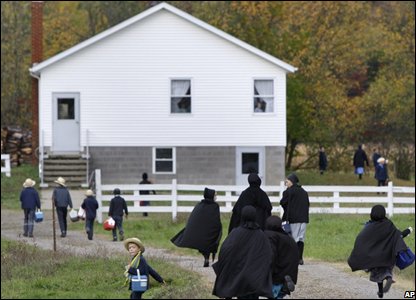
An Amish school in Middlefield, Ohio. The Amish have won the right to school their own children as they wish and do not have to send them to government schools. Do you think they are able to give their children a decent education for less money than the government school system? You better believe it!
It occurs to me that, even living in the country, my sons would never have had all the opportunities they have had to work with  men doing men’s work if they went to a government school. And, probably, had they gone to the government school, they wouldn’t have been interested in doing the work they have done.


Those boys my son worked with when helping the dairy farmer pick rocks were all homeschoolers. They picked rocks when other kids were sitting in a classroom. Same goes with loading hay trucks in the winter months. It’s hard to find boys to help load a hay truck when school is in session, but it’s no problem when those boys are homeschoolers. James has gone numerous times with his farmer/mentor in the farmer's truck to deliver big loads of hay, and been gone all day on a school day. Marlene was concerned about him not doing his schooling but I told her it was okay—James was learning things those kids in government school will never have a chance to learn. That is part of the beauty of homeschooling.


Which brings me back to the Amish... The Amish don’t have to send their kids to government school. In 1972 they won a landmark supreme court case that allowed them to take care of schooling their own children. Supreme court justice Warren Burger wrote the following in response to the government’s argument that the Amish were wrong in their approach to educating their children:
”There can be no assumption that today’s majority is right and the Amish and others like them are wrong. A way of life that is odd or even erratic but interferes with no rights or interests of others is not to be condemned because it is different.”
What’s different about Amish schooling is that Amish kids are educated only to the eighth grade, and their Amish teachers have only an eighth grade education. There is no high school and there is no college for Amish children. To the typical Modern American the thought of educating children only to 13 or 14 years old is something like child abuse. But I dare say that government schooling is more child abuse than Amish schooling.


Which brings me to John Taylor Gatto. No one can condemn government schooling as well as John Taylor Gatto. He was in the system, distinguished himself as a remarkably effective educator, realized the great evil of it, got out, and has been sounding the alarm ever since.

In one YouTube movie I watched, Gatto makes the point that in the 1850’s virtually everyone in America had an independent livelihood. They were farmers or craftsmen—capable, self-reliant, resourceful men (and women). This era was, by the way, the era in which Charles Nordhoff lived.
.

John Taylor Gatto 
On Modern Education
.

Government-Schooled Boys Getting An Education

If you are not familiar with John Taylor Gatto, do yourself a favor and read his article that was in Harper's magazine:  Against School: How Public Education Cripples Our Kids And Why. Gatto has written whole books about the dangers of the government education system, but that magazine article is a concise summation of his insights. Here are a few choice quotes (but, really, read that article):
By the time I finally retired in 1991, I had more than enough reason to think of our schools—with their long-term, cell-block-style, forced confinement of both students and teachers—as virtual factories of childishness
We have, for example, the great H. L. Mencken, who wrote in The American Mercury for April 1924 that the aim of public education is not...

“to fill the young of the species with knowledge and awaken their intelligence. ...Nothing could be further from the truth. The aim ... is simply to reduce as many individuals as possible to the same safe level, to breed and train a standardized citizenry, to put down dissent and originality. That is its aim in the United States... and that is its aim everywhere else.”
Gatto explains that our current educational system was intentionally modeled after the Prussian educational system. This Prussian system created “a population deliberately dumbed down and declawed in order that government might proceed unchallenged and corporations might never want for obedient labor.”
There were vast fortunes to be made, after all, in an economy based on mass production and organized to favor the large corporation rather than the small business or the family farm. But mass production required mass consumption, and at the turn of the twentieth century most Americans considered it both unnatural and unwise to buy things they didn’t actually need. Mandatory schooling was a godsend on that count. School didn’t have to train kids in any direct sense to think they should consume nonstop, because it did something even better: it encouraged them not to think at all. And that left them sitting ducks for another great invention of the modern era—marketing
Now, you needn’t have studied marketing to know that there are two groups of people who can always be convinced to consume more than they need to: addicts and children. School has done a pretty good job of turning our children into addicts, but it has done a spectacular job of turning our children into children. Again, this is no accident. Theorists from Plato to Rousseau to our own Dr. Inglis knew that if children could be cloistered with other children, stripped of responsibility and independence, encouraged to develop only the trivializing emotions of greed, envy, jealousy, and fear, they would grow older but never truly grow up.
Now for the good news. Once you understand the logic behind modern schooling, its tricks and traps are fairly easy to avoid. School trains children to be employees and consumers; teach your own to be leaders and adventurers. School trains children to obey reflexively; teach your own to think critically and independently. Well-schooled kids have a low threshold for boredom; help your own develop an inner life so that they’ll never be bored. Urge them to take on the serious material, the grown-up material, in history, literature, philosophy, music, art, economics, theology—all the stuff schoolteachers know well enough to avoid. Challenge your kids with plenty of solitude so that they can learn to enjoy their own company, to conduct inner dialogues. Well-schooled people are conditioned to dread being alone, and they seek constant companionship through the TV, the computer, the cell phone, and through shallow friendships quickly acquired and quickly abandoned. Your children should have a more meaningful life, and they can.
You can learn more about the work of John Taylor Gatto at his web site: the Odysseus Group: Challenging The Myths of Modern Schooling

.

This is Our Slaughterhouse
.

This picture is not directly related to the story below.  I just like it, and it comes from an essay titled, Chicken Butchering 2010, at the (not so) Urban Hennery

Speaking of resourceful, self-reliant, imaginative, hard working people, self-employment, the family economy, and rural life, it was my great pleasure to discover a neat little (22 minute) movie on the internet titled, This Is Our Slaughterhouse.

The Boerman family processes poultry for themselves and people in their community every weekend. The whole family and several friends work together. It’s a beautiful thing to see, and I especially like the movie because I’m fascinated by the subject of poultry butchering.

If there was a poultry slaughterhouse like this movie shows in my community, people for miles around would come to it. I suspect that such places are few and far between (I know of none anywhere in central New York state) because of the onerous government regulations that come into play.

The movie was made in 2000. I e-mailed Matthew Boerman to ask if his family’s poultry butchering business was still in operation. The good news is that they are still at it.

Kudos to the Boerman family!

.
.
What About 
The Amish Community?
.
.
I find it curious that Charles Nordhoff, in his study of “communistic societies” back in 1874, did not mention the Amish. They came to America in the 1700’s to escape persecution in Switzerland. Though the Amish are not communistic in the sense that they hold all property in common, they do have a very close community that helps each other, and they are united by well-ordered rules and their religious faith.

The Old Order Amish Wikipedia link says that...
“From 1992 to 2008, population growth among the Amish in North America was 84%. During that time they established 184 new settlements and moved into six new states. In 2000, approximately 165,620 Old Order Amish resided in the United States, of which 73,609 were church members The Amish are among the fastest-growing populations in the world, with an average of 6.8 children per family.”
I'm glad to see the population of "plain people" is going up. I'm sure that anyone looking to establish an "intentional community" in this day and age can learn more from the Amish example than they can from the failed Utopian communities that Charles Nordhoff wrote about in 1875 (but the Nordhoff book is still useful in many respects).


The Great Shaker Barn 
of Mount Lebanon
.

This Shaker-built barn was once the largest barn in America

In reading the Nordhoff book mentioned above, I found this excerpt:
As you drive up the road from Lebanon Springs, the first building belonging to the Shaker settlement which meets your eye is the enormous barn of the North Family, said to be the largest in the three or four states which near here come together, as in its interior arrangements it is one of the most complete. This huge structure lies on a hillside, and is two hundred and ninety-six feet long by fifty feet wide, and five stories high, the upper story being on the level with the main road, and the lower opening on the fields behind it.
I wondered if this barn was still standing and did a Google search. Here is what remains today after a fire in 1972:


Plans are in order to restore this barn to its former beauty. I'd like to see that.


Shaker Faith
.
This Shaker woman is Eldress Anna. Eldress Anna gives me the creeps.  Eldress Anna reminds me of a character from the original Star Trek television program I used to watch when I was a suburban kid. But that was fiction and Eldress Anna was real!

What I like about the Shakers was their example of agrarian lifestyle, simplicity, economy, order, and hand-craftsmanship. Their buildings and furniture are beautiful. Unfortunately their faith was nothing short of weird.

The Shakers called themselves “The United Society of Believers in Christ’s Second Appearing” which sounds like some sort of Christian denomination. But their belief system was not Christian and Charles Nordhoff in his Communistic Societies book makes this very clear:
”They reject the doctrine of the Trinity, of the bodily resurrection, and of an atonement for sins. They do not worship either Jesus or Ann Lee, holding both to be simply elders in the church, to be respected and loved.”
(Ann Lee was the founder of the church and died in the 1700’s.)


The Shakers did not accept the most central and fundamental doctrines of the Bible (a book they referred to but rarely read). Instead they were avid Spiritualists who sought guidance from the spirit world through mediums and clairvoyants in their midst. Nordhoff presents excerpts from a book written by a Shaker man in which he tells of some bizarre experiences with the spirit world. Clearly (to me, at least) the spirits were demonic.

So, as much as I admire the Shaker work ethic and lifestyle and craftsmanship, I am profoundly disappointed with their religion.

.


Exploring Folkstreams
.
Tinsmithing was once a necessary craft. Then came the factory-made tin goods, and now we have plastic—lots of plastic—and tinsmithing is a "folk craft." CLICK HERE to see a movie of a tinsmith at work.
.
If you go to the previous links I gave you for the Amish movie and "This is Our Slaughterhouse" movie, you’ll find that they are on a web site called Folkstreams, which has quite a collection of interesting documentary movies, all free for the watching.

I especially like the movie clips in which elderly craftsmen are making something using old tools and techniques. One such movie is Ben’s Mill: Making a Sled. This 26 minute movie is described like this: “Ben Thresher's mill is one of the few water-powered, woodworking mills left in this country. Operating in rural Vermont since 1848, the mill is a unique link between the age of craft and the age of modern industry.”

I’ll never make a horse-drawn sled for hauling logs but that is beside the point. The man in the movie is a multitalented, resourceful craftsman like was once so commonly found in rural New England.


If you like that movie, there is another movie on YouTube showing Ben Thresher making a sod lifter and a round wood stock watering tub. CLICK HERE to see the movie.

Another fine film clip is Alex Stewart: Cooper. The 11 minute film is described as follows: “A 1973 film of Alex Stewart, a mountain craftsman from near Sneedville, Tennessee, constructing a churn.  Film includes discussion of the use of non-powered tools and skills handed down in Stewart's family in making wooden containers, such as buckets and barrels. “

Mr. Stewart, 83 years old, learned the coopering trade from his father, who learned it from his father before him. What is remarkable is that this man supported a wife and nine children on the income from farming and coopering. And his workshop is remarkable for its simplicity. 


If you have an interest in different cultures and old ways, I encourage you to visit the entire list of movies, all of which can be watched for free online, at this link:  Folkstreams Movie List


Looking Ahead 2011
.
 

I don't own a television so I didn't watch the recent 60 Minutes program about the coming crisis in the municipal bond market. But I heard about it at my December town board meeting and looked it up on the internet. You can (and should) read about it because it's going to affect you. Details and the 15-minute program segment are at THIS LINK.

It is a sobering economic prognosis we Americans are faced with. Even now, our economy is in a slow motion, years-long train wreck. The train is still moving, with cars crunching up, jumping the track, and rolling over. It will get worse before it comes to a stop. At this point there is no holding back the inertia of the credit crisis—we can only watch and try to keep out of the way.


I have a satellite radio in my workshop and sometimes I listen to the Glenn Beck show in the afternoons. The more I hear the man, the more I like him. On a recent program he repeatedly said that our economic system was "in the crapper" and there is nothing we can do about changing that reality. His concern seems to be that Americans will keep their wits about them as the economic crash intensifies.

Glenn Beck understands that great economic crisis, coupled with a large population of people dependent on government support, is the recipe for violent revolution and the loss of individual liberty. Masses of people unable to accept responsibility for meeting their own needs may willingly give up their freedom to a despotic individual or system of governance if that entity promises to alleviate their suffering. This is when our constitutional republic will face the greatest danger in its history.

I'm not sure, however, if Mr. Beck understands that when our American form of government was originally established, we were a nation of independent farmers—we were an agrarian nation—and that our constitutional system is best supported and preserved by a self-reliant agrarian population.

Thomas Jefferson knew this, as did most other founders, and I have discussed this very important (but largely ignored) point in my essay titled, The Jeffersonian Solution.

I applaud Glenn Beck for his efforts to educate and encourage his large audience to be aware of our situation, to humbly pray for God's help, to be prepared for what we face, and to never trade the blessings of our constitutional republic (individual liberty, primarily) for any other form of government.

My only concern is that he is missing the agrarian connection. It is implied in some of the monologues I've heard but I've never heard it specifically addressed. Perhaps Glenn could do a show on Thomas Jefferson's agrarian vision for America, and explain why Jefferson thought that an agrarian nation (where the greater portion of people live on the land and draw their sustenance from it) was the surest support of republican government. Then maybe he could present an economic self defense plan like I outlined back in 2008 (Read it Here). Then his detractors will really think he's crazy. God bless Glen Beck.
.

My Big 2011 Project
.

Starting in January 2011 (tomorrow) I will begin the process of producing another book. I have authored 11 books so far and self-published the last 8. There are few things in life that I enjoy more than self-publishing my own books. 

This particular book has been on my  mind for a few years. I have written and re-written the Introduction a few times. That's where it starts for me with a book—the Introduction serves to explain what the focus and intent of the book is. Then comes an outline, and I'm on my way.

Developing the idea for a new book is the fun part. Then one must get started, and that is much harder. Once started, the task soon becomes a burden, especially when there are so many other competing concerns. Finishing the project becomes something of an obsession. That has been my experience in the past. Maybe this time will be different. In fact, it might be different because this particular book is going to be something different for me.

My goal is to have this book done and to the printer by the end of February. I may not achieve that goal, but every author must have a completion date to shoot for. Thus, the next couple of blogazine issues here may be shorter than usual.

I have not given you any specific details about the book because I don't like to do that until it is well along and, preferably, ready to hand off to the printer. But I will tell you that the focus is most definitely agrarian. The book should be of interest to small-scale, sustainable farmers and serious gardeners, as well as all manner of homesteaders. My book will be historical, informative, entertaining and of practical value. To some extent, it will be a how-to book. As far as I know, there is no other book quite like it. 

Lord willing, I will complete the book and when I hand it off to the printer I will tell you all about it. I will also offer it to readers here at a reduced, pre-publication price. Stay tuned.


My Overall Plan 
For The New Year
.

I have an overall plan for the new year. It’s the same plan I had for last year. It seems to work well for me. It’s found in 1 Thessalonians 4:11-12

Make it your ambition to lead a quiet life, to mind your own business and to work with your hands, just as we told you, so that your daily life may win the respect of outsiders and so that you will not be dependent on anybody.

Those words come from the apostle Paul. He didn’t advise the Christians in Thessalonica to be popular “movers and shakers” in their society. He didn’t tell them they should strive for riches and power and acclaim. He told them they should live quietly and work with their hands, providing for their own needs, so as not to be dependent on others. This is a call to humility, simplicity and physical work. Such a call is totally contrary to the spirit of our age.

This calling for Christians is in accord with another bit of advice from Paul, this time to the Christians at Corinth (2 Corinthians 6:17):

Wherefore come out from among them, and be ye separate, saith the Lord, and touch not the unclean thing.

Both verses speak of  cultural separation or, as I’ve otherwise heard it put, cultural secession. This is a challenge in a world in which conformity is expected, and dependency on the worldly industrial system is encouraged. All industrial-world assumptions come into question.

Such separation is a deliberate, step by step process. And so, in this new year I hope to continue the process, I wouldn’t call that a New Year’s resolution. It’s just a renewed commitment to continue on a path that I see as wise and full of truth.


Here's wishing you and yours a safe, healthy and blessed year in 2011.