The Deliberate Agrarian Blogazine
June 2011

Dateline: 30 June 2011

Richard C. "Dick" Murphy

In 1968 I was ten years old and America was in turmoil. That was the year Martin Luther King, Jr. and Bobby Kennedy were assassinated. There were antiwar demonstrations on college campuses, and riots in the streets.

My family lived in a little ranch house in a big development outside Syracuse, N.Y. Five years before that, my mother and stepfather had married and emigrated to New York from Springfield, Massachusetts. Both had failed marriages. They were starting out on a new life together, with me in tow.

There is an incident that is forever etched in my mind from that time. Our family was visiting the Bolton family across the street. We were having a summer cookout in their backyard. Jerry Bolton was a city cop. He was a cocky, loudmouthed guy. He was telling my stepfather about some riot control training he had been to. Mr. Bolton had learned some new techniques for using his police baton. He wanted to show them to my dad.

Jerry got his baton and stood on the lawn holding it out in front of him, horizontally with both hands. “Come on, Dick. Try and take it away from  me.”

My stepfather, sitting on the picnic table, demurred. Jerry insisted. “Come on, Dick, I want to show you what I learned.” He stood there, holding his baton, waiting.

My dad got up and went over and grabbed the baton. He and Jerry were facing each other, their hands on the menacing stick. “Go ahead, Dick, try to take it away from me.”

They started to struggle. It got serious. I got scared. But it didn’t last long. Jerry was on the ground in no time flat. My dad was standing over him with a big smile, holding the baton.

I was impressed. Still am. Things like that lodge themselves into a little boy’s mind. My stepfather was 36 years old in the summer of ‘68. He was an ex-Marine. He was tough and strong, capable and confident.

Forty-three years later... June 17, 2011...

I am at the Veteran’s Administration Hospital in Syracuse, New York. My stepfather is lying in bed, propped up, looking ahead, at nothing in particular. Numerous intravenous tubes are feeding into his body. His left leg was amputated below the knee months ago. His remaining foot is ulcerated and infected. He can’t swallow food very well. His lungs are filling with fluid. He can barely hear, barely speak, barely see. He is totally helpless. He has been this way for some time.

The doctors and nurses and social workers have left the little room. Our emergency meeting is over. My wife, Marlene, and my youngest sister and I remain. They are looking at me, and they are looking at my father. The door is closed.  There is silence in the room.

Marlene and I thought we had been summoned to the hospital to discuss the plans for finally bring my father back to his home. A wheel chair ramp is in place, a hospital bed, a Hoyer lift, all of it unused. But, instead, they called us to this place to tell us there is nothing more they can do for him, except amputate the remaining leg and put a feeding tube in his stomach.
 

I have to talk to him. I have to make things clear to him. He needs to understand his options. He needs to make his desires clear to us.

After a few moments I position  my face down  near his. I look at him directly. He looks at me. His eyes are blue and open wide but languid. I say to him... 


“It doesn’t look good.”

I pause, considering my words briefly. I say it again, slow and clear: “It doesn’t look good, Dad. The infection is into the bone. Your lungs are filling up.”

I continue. I ask the questions. We wait, straining to hear what he will say. He speaks with great effort... “No.” He doesn’t want any more medical procedures.

I am not prepared for this exchange on this day. I feel flushed. Waves of hot emotion smash into the hard, icy detachment I have maintained for so long. 


I collect my composure. I get up close to his ear, my hand on his arm, and speak four words that I have not spoken to him since I was a little boy: “I love you, Dad.”

*****

Marlene and I left the hospital a short while later. We were emotionally drained. Before we were out of the parking garage, the IV tubes were disconnected from his body. He had entered the palliative care stage of his life.

He died seven days later, at 79 years of age.


*****

I don’t suppose it is easy to step into the role of father to another man’s son, especially as the boy, angry and disappointed because he is detached from his “real” father, grows to resent you.

Our relationship became strained as I entered the teen years, But it was never as difficult as it might have been, primarily because of my mother. We both loved her. I did not wish to hurt my mother and I'm sure he did not either. My mother was the glue that held us together. 


So my teenage rebellion towards my father was subdued and tempered by an overriding sense of responsibility on my part, coupled, I’m sure, with forgiveness on his part. We were never estranged; we were always there to help each other through the years, but we were not emotionally close. That is a sad and regrettable testimony.

*****

I know now, and I have known for years, that Dick Murphy was probably a better father to me than my birth father would have been. He had his flaws, like all men, but they do not come to my mind like they once did. Instead, I see and understand that he was a model of integrity and responsible manhood to me, and I am thankful for that influence in my life.

He was a hard worker. He was a selfless man who loved and provided for his family to the best of his ability. If he had any bad habits, I don’t know what they were. I’m sure he must have had incidents of anger, but I do not remember him getting angry. He was a man who wanted to do the right thing, to take the moral high ground. That is what I saw in him.

He taught me how to do pushups the right way—the way Marines do pushups. He told me that doing pushups was one of the best ways to get strong and stay strong. So I did a lot of pushups when I was a kid. And I got strong.

One day, when I was 15 years old, and our family had recently moved out of suburbia to the countryside, I was in a new school, and I was arm wrestling with some guys in my class. I remember a big farm boy asked me: “How did you get so strong?”  I replied: “Pushups.”


*****

My father had been a Boy Scout. He encouraged me to get involved in Scouts and I did, starting as a Cub Scout. I didn’t go far in scouting. I never got a single merit badge. But it was all a good experience and he was involved to some degree with all of that.

He collected stamps as a boy and gave me his stamp collection. For several years of my boyhood I was a serious stamp collector. He collected coins from a young age and my interest in coins comes from his influence.

When I see a butterfly, I think of my dad. I remember him making a butterfly net when I was a kid. We went butterfly hunting and he showed me how to mount them with pins, like he had done as a boy. I think it is safe to say that, like most fathers, he relived his childhood to some extent through me as I was growing up.

My dad had a lot of hand tools that had belonged to his father. He was not real skilled at using them but we once made a two-step stool together in our basement in the suburbs. The stool was for me, so I could step up and see myself better in the mirror over the bathroom sink. With his guidance, I painted it yellow. In retrospect, it was crude but it served the purpose, and I remember it fondly.

When we moved to the country, we heated our old farmhouse with two woodstoves. He and I cut firewood together out in the wooded swamp behind the house. So I learned about using chainsaws and cutting trees down from him. Maybe, though, we learned together, because I don’t think he had cut firewood before. We bucked the wood into lengths that we could carry on our shoulders, and walked them along narrow trails out of the woods. It was hard work, but it was necessary work, and it was good work, and we did it together.


*****

When I was maybe 12 years old, and feeling sorry for myself because Dick was my stepfather instead of my “real” father, my mother’s sister, Aunt Jean, who happened to be visiting us at the time, told me a story about Dick, and I remember that it made me cry.

He had two sons from his first marriage. I knew that. I had met them once, before my parents married. Their names were Richard and David. One was my age. One was a year younger.


My father had named his firstborn son after himself, and his second son was named after David, his older brother (by two years), who had died suddenly and unexpectedly at 20 years of age, while in college. 

My father's brother was a musical prodigy; the shining star of the family. I can only imagine how devastating David Murphy's death in 1949 must have been to his parents.

My Aunt Jean told me that when Dick and my mother were married, a minister who he respected had counseled him to leave his sons, to have nothing to do with them, to focus on being a father to me and on starting a new family. And that is what he did.

He left his own boys to be my father. He never saw them again. Their mother remarried and they took another man's name.

Dick never spoke of his sons to me. My mother mentioned them a couple of times later in her life. I sensed that their loss was a tremendous regret in his life. How could it not be?


*****


Life never turns out the way you think it will.

I had everything figured out years ago. Dick would die first because he had been sick with one illness or another for years. My mother, who had hardly been sick a day in her life, would live to a ripe old age. Marlene and I would get a bigger house and she would have a place to stay with us. I suppose that Dick thought the same—that his wife, the incredible caregiver she was, would always be there for him. But it was not to be.

Cancer came, out of the blue, and my mother was gone within a year. She refused all medical-establishment help right from the beginning. That was some eight years ago. Dick was devastated. My mother’s death was the beginning of the end for him. The next eight years were a long, brutal, agonizing, ugly, hellish decline. Some people are allotted a fast and relatively easy death while others, like Dick Murphy, must meet their demise little by slow. That is the way diabetes  works.

Marlene spent countless hours caring for him. There were so many trips to doctor appointments, dressings on his foot to change, food to take up to him, visits to the hospital and rehab. Oh my God. I have been blessed with such a dear woman for a wife!

And then, for the last three years, his daughter, my sister, Tammy, came home from her wayward roving and helped to care for her father. She was able to take much of the load off of Marlene. She was truly a devoted and caring daughter. My other sister, a single mother with four children, living in another state, struggling to make ends meet, was unable to be there for her father as she would liked to have been.

Many of you reading this have faced a similar situation with a sick parent. It’s hard.


*****

As a young boy I was always concerned about my parent’s finances. They struggled with money problems pretty much all their married life. It wasn’t that they squandered money. I never saw that. My parents rarely treated themselves to anything extravagant. It was just that money was always tight.  As a result, I grew up careful with my own finances, loathing credit cards and debt of any kind.

It didn’t help that Dick had suffered so many setbacks in his health beginning in his early 40’s. It began with the gall bladder surgery that nearly killed him. He went to the hospital healthy as a horse (at least he looked that way on the outside) and came home many days later, so weak that my mother had to help him from the car, up the stairs into the little ranch house.

In time, he bounced back, only to be knocked down a few years later with another health related setback. That was the way it went for the rest of his life, and money was always tight.

It is worth noting that  my mother never worked a job until later in life, after we kids were grown. She could have worked (she worked before they were married) to help with the finances but that didn’t happen. I believe it was important to both of my parents that my mother be home for her family, and she always was.

I was ashamed of our financial hardships as a boy, thinking how much better I would be if I was with my birth father, a successful orthopedic surgeon in Maine. But I was a selfish child. The truth is, I and my sisters never lacked the important things in life. Our father and mother both loved us and sacrificed and worked very hard to provide for our needs. We were blessed to have such parents. 


*****

In the end, my father was faced with the need to go on Medicaid because he had no money to pay for rehab care after his leg was amputated. There was no money beyond the monthly Social Security check. No retirement plan. No pension. No insurance. No nothing, except an aged car and a home.

He had paid off the 30-year mortgage on the old farm house and 24 acres of land a few years before my mother died. It was a great achievement for them to be debt-free. It was their hope that the home would be an asset that would help my mother after he passed on.
 
But, as I’ve noted, life doesn’t go according to our plans. My father never imagined that he would lose the house. He thought the Veteran’s Administration Hospital would take care of all his medical care right to the end. Well, surprise... they didn’t.

Marlene and I bought his home and land. We bought it because we could afford to. God had provided us with enough money to do it. He provided through a moderately successful book I had written— a book about how to build a chicken plucker. Yeah, a chicken plucker. We never could have done it otherwise. Pretty crazy, eh?

Thus it was, by God's provision, that my father would not have to suffer the indignity of losing his home, and he would have a place to come home to when he got better. But he never did.

Now, in the aftermath of his life, my father’s estate consists of the furniture and personal effects that are in his house. Nothing more. And I am tasked with the responsibility of trying to sell what I can so my sisters can get some small inheritance. It is a sad task.


*****

I have one more story that needs to be told....

Prior to the fall of 2009, my father had done nothing to prepare for his end of life. There was no will. I did not feel I could talk to him about it. Truth be told, he could be a curmudgeon at times.


I figured I would have to settle his estate the hard way once he was gone. This was before the Medicaid situation came into the picture. But then an angel came into our lives. His name was Stan.

Stan and my father had been the best of friends growing up in Springfield. All I knew about Stan Kusiak was that he sent a Christmas card to my parents every year.

But in August of 2009 I met him. He drove here to central New York from his home in Massachusetts. Though not in the best of health himself, Stan had come on a mission. He felt a strong conviction that he must help his old friend, my father, get a will and put his affairs in order.

Stan worked with my dad to find all the important papers. He took pictures of everything (including the picture of my dad sitting on the porch of his home that is shown above). He located the best elder-law attorney in the area, and he paid the bill. He contacted the funeral home and got that process going. He contacted the cemetery. He left no stone unturned. Stan happens to be one of the most organized and thorough people I have ever met.

Stan told me later that he was the only person in the world who could have gotten Dick to do these things—that my father never would have done them otherwise. Then he told me something that really touched my heart...

When Stan was a boy, he didn’t have the best family situation. But Dick’s mother and father treated him like a son, like he was a part of their family. The influence of Dick’s parents made a tremendous difference in Stan's life; he was a better person because of it. That’s the gist of what he told me. 


And when Dick’s father, Earl Murphy, lay in the hospital, dying of cancer back in 1958, Stan went to visit him. In the course of  their conversation, Earl asked Stan to keep an eye on Dick. 

Stan didn’t feel like he had kept an eye on Dick in the ensuing years, but he made up for any shortcomings in the end.  It was out of respect and appreciation for Earl Murphy, and his lifelong friendship with my dad, that Stan felt a strong compulsion to do what he did.

I thank God for Stan Kusiak.


Dick Murphy and Stan Kusiak in August of 2009

*****
This month’s blog installment has been out of the ordinary for me. I have told you very personal details of my life and my family. I felt compelled to do this because, for one thing,  I find catharsis in writing and sharing these things and, for another, I want to honor the memory of a decent man, my father, Richard C. Murphy. 

You can read my father’s obituary at THIS LINK

 .
 .
Meanwhile
Life Goes On 
.
Marlene took this picture of a young robin in our raspberries this month. It is about to leave the nest.
This is the second month of my self-imposed  five-month summer sabbatical from blogging, but you'd never know, would you?
.
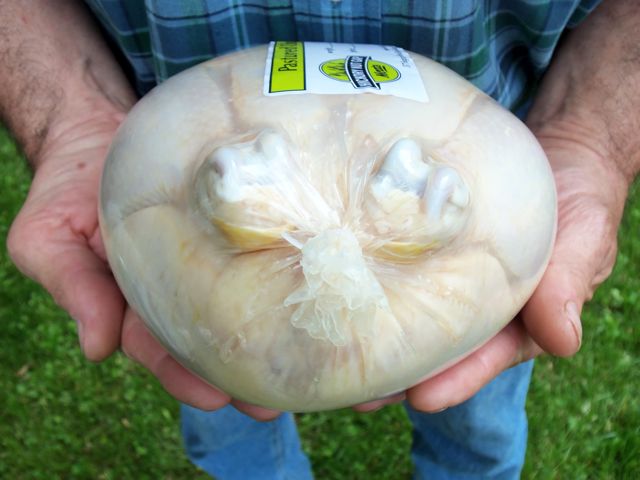
As I am sitting here in the living room of my house, typing on my computer, there are 50,000 poultry shrink bags in boxes,  stacked over four feet high and ten feet long right next to me. They are the next chapter in our Planet Whizbang home business. You can learn more at www.PoultryShrinkBags.com
.
We are now selling poultry shrink bags like shown here. You can see a complete photo-tutorial about how to use these bags at This Link
.
Pictures From Our Garden
.
This is part of the garden in early June
We love beet greens!
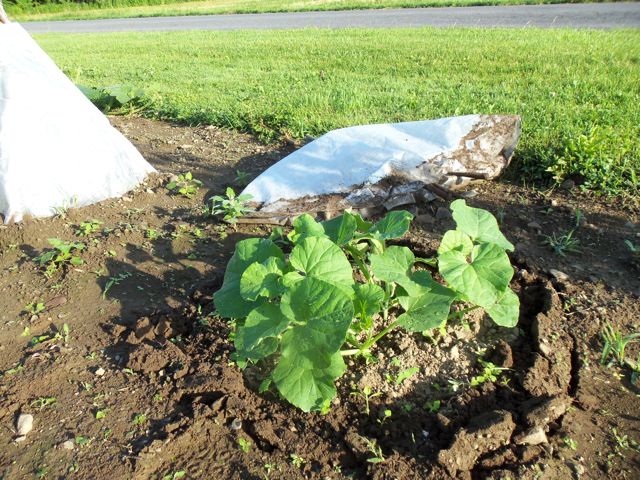
I've been experimenting with some homemade solar cones this year.
The solar cones create a terrarium-like environment, with diffused light, which is perfect for melons and other heat-loving crops. I planted the melons a bit late this year and I planted the seeds directly (not transplants), so I was hoping the solar cones would get them off to a fast and healthy start, and that's exactly what they did.
Here are the melon plants with the solar cone removed. They are perfectly healthy,  perfectly beautiful, and ready to really take off.

.
Agrarian Nation 
.

 I hope you have been reading my twice-a-week postings at Agrarian Nation. If not, here are links to the  June excerpts:


The Deliberate Agrarian Blogazine
May 2011

Dateline: 31 May 2011

Marlene and I made a compost pile early in May. It became "Active" very quickly. And we have had an active month ourselves!

This last day of May marks the end of the first month of my five-month sabbatical from blogging. But I am here to give a brief report.....
.


The big news within our family is that our oldest son is now married. His new wife, Sammy, (Samantha), is from Ohio. They met online and corresponded most of last year when he was stationed in Korea. Congratulations Chaz & Sammy!

In other news, our middle son, Robert, completed a 8-month Auto Technology class at a local vocational school. At the end of the class he had a two-week internship, after which the auto dealership offered him a job as a mechanic. He has his own bay, and has been working now for a few weeks, and it's all very good.
.
It is worth noting that Robert's $6,000 tuition to the vocational school was paid with chicken plucker fingers. Some of you long-time readers may recall that back in 2007 I posted an essay about Robert getting into the business of selling rubber poultry plucker fingers (you can Read it Here). Well, Robert sold a LOT of plucker fingers and was easily able to pay for his own schooling. Plucker fingers have been a real blessing to this family.

Our youngest son, James, has a job working at a popular local diner. He washes dishes, cleans, serves, and even cooks. It's a good job for him. And when not doing that, he continues to help a local farmer part time.

James bought himself a chain saw this month. A Husqvarna. I asked him how he settled on the particular model that he bought. His answer: "It was the biggest one they had."

Then Robert bought a Stihl chainsaw. He e-mailed me this picture a couple days ago......

Robert & his new chainsaw. The tree was next to a church we used to attend. He climbed up and limbed his way down, then dropped the trunk without hitting the church or nearby power lines. He told me about this the next day. It's just as well I didn't know about it when it was happening.

This is James with a turkey he shot in May. He has also been hunting frogs with a pellet gun. I was surprised to learn there is a frog hunting season here in New York. James says the frog legs are delicious (they taste like a "fishy chicken"), but I have yet to try them.

As for Marlene and I, we are adjusting to an "empty nest." Although Robert and James still live at home, they are gone most of the time doing their own "thing." It is different around here.


Our garden is a big focus these days. Marlene started our tomato and pepper plants, as she usually does. I am impressed with how well she does without any heat mat, lights or hoop house. She starts the plants inside, puts them on the windowsill and then gets them outside into a cold frame, which is nothing more than a garden cart with a sheet of clear plastic over it...


Marlene's tomatoes in May
I am continuing to develop my own approach to growing tomatoes. All of our tomatoes this year will be grown on trellis supports and all of them will be mulched with grass clippings...


Tommy Toe tomatoes are great for trellising. The ones we transplanted into a plastic-covered "hoop-house" (like the one shown here) have done exceptionally well. The hoops have now been removed and trellis strings are in place.

This is my busy season with the Planet Whizbang business. I continue to work a 28-hour week at my factory job, but am thinking more and more that it is time to leave. It is increasingly difficult for me to work both jobs... and tend to my garden.


Speaking of Planet Whizbang and gardening, if you have been holding off on getting yourself a Planet Whizbang wheel hoe, now is the time. I have dropped the price on metal parts kits to $99. That is a significant discount. I have maybe 100 more of the kits to sell at that price. Then I will have more parts fabricated and I'm sure my costs will be much higher. Everything is increasing in price. 


A completed Planet Whizbang wheel hoe. It's not just beautiful and affordable, it's a remarkably efficient tool for destroying weeds!
.
And while I'm marketing things.... if you are a reader of this blog and you have not yet read my book, Writings of a Deliberate Agrarian, I can't think of a better summer reading recommendation. Here's the amazon.com link: Writings of a Deliberate Agrarian
 
Not only is the book available at Amazon, you can also purchase a copy directly from me at This Link (it's on sale through the summer).


Men with Mangel Wurzels (or maybe they're sugar beets). Read all about it at Agrarian Nation.


I have been posting regularly (every Monday and Friday) to my Agrarian Nation web site. Here are excerpts from this past month:

#10— A Farmer's Creed (1881) 
#11— May Farmer's Calendar Excerpts (1840-1858)
#12— The Milch Cow (1825-1849)
#13— Maxims For The Farmer (1866)
#14— Hot-Beds (1880)
#15— Corn (1835-1889)
#16— May Farmer's Calendar Excerpts (1859-1874)

#17— Sweet or Carolina Potatoes (1830)
#18— Culture of Roots (1871)


.


.
At any one time I am reading half a dozen books. Some are better than others. The one pictured above, Healthy at 100, is

a very good book, though I have only read Part 1 (the first 85 pages) which is titled, "The World's Healthiest and Longest-Lived Peoples."


I thoroughly enjoyed reading about the Abkhasia people of Russia, the Vilcabamba people of Ecuador's Andes Mountains, the Hunza people of Pakistan, and the Okinawan people of Japan. All of these cultures have unusually long life spans. But they don't just live long, they are healthy for longer. 

Reading about the Abkhasians brought to mind an old Dannon Yogurt commercial I remembered from the 1970s, and I found it on YouTube....


We hear claims that modern medicine is helping people in industrialized nations live longer lives, but many of them are not living healthy long lives. I'm not impressed with medicine that prolongs life but not health. There is a big difference.


There are common denominators with cultures that live longer and are far more healthy into their old age. One common denominator is that they do not eat the typical industrialized food that is so common in America. Another common denominator is that they live simple, agrarian-based lifestyles. 


I'll probably have more to say about this book when I return from my blogging sabbatical. In the meantime, if you have an interest in this subject, I recommend the book.


Now for something completely different. I'll bet you have never heard of Alben W. Barkley. He was Harry Truman's Vice President. His last words were spoken in 1956 when he was 78 years old and giving a speech at Washington & Lee University. It is worth listening to.

And here is a picture of something that some of my female readers may want to consider....
.

"Homemade pie crust, enclosing a filling of Minnesota Haralson apples. The steam vents in a fern design is a family tradition, passed from mother to daughter for several generations, from what is now the Czech Republic to the United States."  Have you ever heard of such a family tradition? What a great idea! Perhaps you baking mothers and future mothers out there would want to develop a family heirloom steam vent pie design. And if you do, I'd love to know about it.

That's it for this month. I'll be back for another quick blogging-sabbatical update on June 30th........

The Deliberate Agrarian Blogazine
April 2011

Dateline: 30 April 2011
 

Thoughts 
About An Old Picture
.
(click on picture for a much larger view)
.
I happened upon the above picture while cruising through Google images this past month. The old photo has found its way to numerous web pages and I do not know its provenance. I think it is safe to assume that it was taken in the 1800s. Beyond that, we can only look and wonder, and I found myself looking and wondering about this particular picture much more than other old pictures.

The photograph was,  no doubt, staged. Cameras back then were not like today—they required some time to set up. We could assume the old couple is married and that they are in their home. What we see is probably a third of the entire structure. So the home may measure ten feet wide and be fifteen feet long, or even less than that.

Are these two people slaves? Perhaps, but I don't think so. It is possible that they were once slaves. It’s also possible that, though they were freed slaves in the picture, they were still, to a large degree, beholden to a landowner (a former slave owner) who employed them. So the house might have been theirs and, then again, it might not have been.

Whatever the case, this place where the two live and make their home is obviously simple and crude, but adequate. Cooking is done in the open fireplace. The fireplace also serves to provide welcome heat when it is cold outside—and unwelcome heat when it is warm outside and the cooking must still be done. There is, of course, no electricity, no running water, no refrigeration, no bathroom, and little in the way of conveniences. We can be assured that the food the couple ate was very basic and that, even in their older years, they grew, or helped grow, most of the food they needed.

Study the picture. Look at every detail, right down to the newspapers stuck to the sidewalls and the stains on the rough floor boards, and then ask yourself this question: Could you be content if you lived in such a home?

Or, let us move ahead in history to a year, and place, and people we can know more about..... Pie Town, New Mexico, 1940. The Jack Whinery family. It is the Great Depression. 


The Jack Whinery family of Pie Town New Mexico, 1940. From left to right: Wanda, mother Edith, Velva Mae, Jack, baby Laurence, Laura, and A.J (click to enlarge)

That famous picture, taken by photojournalist Russell Lee, shows the Whinery family in their dugout home. That is to say, they live partially underground, in a structure made out of earth and logs. The walls around them are "papered" with pieces of corrugated cardboard boxes. There is a very small window behind Laura.

The story goes that Jack and his family arrived in Pie Town with thirty cents, and Jack spent that thirty cents on some nails to use in making the dugout home. Here is an outside view of the Whinery dugout.


 Pie Town was a settlement of homesteaders who, in Grapes-of-Wrath-fashion, fled from places like Texas and Oklahoma; they were driven out by the Dust Bowl. They stopped in Pie Town on their way West, away from the despair. Pie Town was as far as they got. There was a community of people in Pie Town who were, more or less, all living much like the Whinery family.

When considering this way of life, the question again comes.... could you (or could I), reduced to living in a dugout home, be content in such circumstances?

Those pictures, and the broad, long history of the world, indicate that it is possible for people to live healthy, productive, largely self-sufficient lives without electricity, running water, and expensive houses. And I am confident that many of the people throughout history who have lived such lives were happy and content. But could you and I be content to live such a life?

As a Christian, I am particularly interested in this question because in 1 Timothy 6:6 it says, “But godliness with contentment is great gain.” Then, in 1 Timothy 6:8 it says: “And having food and raiment let us be therewith content.” In Hebrews 13:5 it says, “Let your conversation be without covetousness; and be content with such things as ye have.” And in Philippians 4:11, the Apostle Paul says, “I have learned, in whatsoever state I am, therewith to be content.”

Based on those verses, I think it is safe to say that Christians are commanded to be content in whatever circumstances they find themselves. This matter of contentment could be considered a doctrine of the Christian faith. It is, or should be, a fundamental part of what it means to be a follower of Jesus Christ.

That said, it is worth pointing out that contentment is completely contrary to the doctrines of Industrialism, which is the dominant worldly system that we all live within. Industrialism survives and thrives by creating materialistic discontent; by encouraging the natural, inherent covetousness within each of us. People must buy stuff of all kinds, lots of it, for all their days, in order to support the industrial system. I dare say, envy, materialism and discontentment are the lifeblood of industrialism. This anti-Christ system can not survive unless it breeds discontentment in the masses.

All of which brings me to The Rare Jewel of Christian Contentment, by Jeremiah Burroughs. Thank you Tom Holliday for sending me a copy of this 1648 classic of Puritan literature and biblical understanding (by the way, I welcome all Puritan books that anyone would like to send me—and, for that matter, I’ll take any non-Puritan books that you think I might like). The Rare Jewel of Christian Contentment (click to read online public domain copy) is rich with wisdom and proper perspective. Rich.

I am still working my way through it but I would like to provide a couple of simple quotes. First, I give you Burrough’s definition of Christian contentment: 

 .
“Christian contentment is that sweet, inward, quiet, gracious frame of spirit, which freely submits to and delights in God’s wise and fatherly disposal in every condition.”.
 
Pastor Burroughs further wrote that Christian contentment is an “art and a mystery” that he believed could not be truly obtained outside the grace of God working in a person’s heart, which is to say, it is not of this world. Burroughs' book delves into the art, the mystery and the grace. One very small bit of the art and the mystery is this...
.
“A Christian comes to contentment, not so much by way of addition, as by way of subtraction.”
..
The Rare Jewel of Christian Contentment is a jewel of a book, filled with wisdom that I need, and that anyone who desires contentment in a world system geared to keep people in a constant state of materialistic discontent needs. It is a timeless book, but it is of particular value in these times of economic loss, as we see the living standards of more and  more people ratcheting ever lower.

A final verse on this subject of contentment....

Keep falsehood and lies far from me; give me neither poverty nor riches, but give me only my daily bread. Otherwise, I may have too much and disown you and say, ‘Who is the LORD?’
—Proverbs 30:8-9


"Poverty" & Community

.
A portion of "Politics, Farming and Law in Missouri" by Thomas Hart Benton

In Wendell Berry’s essay, The Work of Local Culture, he tells the story of walking with an old friend to see the “ruining log house” that had belonged to the friend’s grandparents and great-grandparents. Wendell listens to the story of those who once lived in the place, and he writes of them:

“They were poor, as country people often have been, but they had each other, they had their local economy in which they helped each other, they had each others comfort when they needed it, and they had their stories, their history together in that place. To have everything but money is to have much.”

To have everything but money is to have much... If you read of Depression-era Pie Town, New Mexico, you'll see that there was a community in that place. When I look at the picture at the top of this page, I sense that the old couple are part of a community. Close communities were once common in rural America. 


Industrialism has destroyed close, interdependent communities and the economy of those communities. Such community is now difficult to find. Thus, few people in this day and age experience the richness of community as it was once known. I don't experience it like it was once known. But there have been times in my life when I have come close, and it is a sweet thing.

My point here is that I believe contentment is easier to find when one is in the midst of a community of people who share common needs, common understandings, common values, and common experiences.

.
Defining Poverty
.

.
I have been careful not to use the word poverty in my opening essay above. It was tempting but I was not sure it was appropriate. It so happens that poverty is a relative term and therefore difficult to define. One man's poverty is another man's plenty. One man's plenty is another man's poverty. How would you define poverty?


To bring some clarity to the matter, I consulted Webster's 1828 dictionary. Webster defines poverty, in part, as "want of convenient means of subsistence," and further states that "the consequence of poverty is dependence."

Dependence? 

Well, if the consequence of poverty is dependence, then the whole industrial system, despite its abundance of stuff, and convenience, and amusements would appear in actuality to be a system of poverty. After all, industrialism perpetrates dependency. Modern man is now dependent for most of his subsistence upon the industrial providers who supply him with food, shelter, fuel, transportation, clothing, entertainment, and so forth.


Could it be that we moderns have been hoodwinked by the industrial paradigm? Could it be that the richness of subsistence and simple plenty once found within the paradigm of land-based family and community economies (people working with their hands to provide their own needs) has been exchanged for something that is more truly poverty? Could it be that the industrial system has established and perpetrated itself by redefining what poverty is?


As a Christian I do not believe that God wants His people to live in poverty. But I also do not believe that God defines poverty the same as the industrial system does.


A Voice From Within 
The Greek Tragedy
.
A view of rural Greece


America has economic problems. But things here are not as bad as they are in Greece. That isn't to say they won't eventually become as bad. There are minds more knowledgeable and informed than mine that think America will go the way of Greece. But what exactly is going on in Greece these days?


Well, I received an e-mail from a citizen of that country this past month and part of that e-mail summed up the problem there in a few poignant sentences. It is worth understanding the problems in Greece, especially if we may be in line to experience a similar fate. Here is what the e-mail said:


"As you may know, Greece is living for two years now very hard economic times and severe depression. The average income of the Greek citizen falls every month that passes by, with increasingly tougher economic measures by the government and constantly bigger taxes.


The difficult economic situation & unemployment in the big cities leads people back to the farms of their fathers who had abandoned them 10-30 years ago. They realize that probably they never should have abandoned their roots and the land of their ancestors."
.D
About Agrarian Nation
.

Last month I told you about my new blog, Agrarian Nation. Twice a week, every Monday and Friday morning, I post an excerpt from the pre-1900 agricultural writings that I've gleaned from my old farm almanac collection. Nine excerpts were posted in April.

Response to Agrarian Nation has been more positive than I expected. Many people are telling others about it on their blogs and on Facebook. I really appreciate you all spreading the word!

And some people have given financial donations to the work of Agrarian Nation. I am thankful and grateful for them. One donation was a real surprise. You can see it  in the picture above. Three silver Mercury dimes were sent to me by a kindred agrarian and fellow blogger.  


Silver is “honest money.” It can not be devalued by immoral inflation, like paper money, and it is therefore a “safe” form of money. It doesn't necessarily "make" you a profit (based on usury) like "money in the bank" but it holds it's value in the long run.  Silver is a contra-industrial kind of money because the financial powers-that-be cannot manipulate it as easily as fiat paper dollars in order to extract (steal) wealth that they did not earn. Paper (fiat) money is fraudulent money.

Those three dimes, dated 1917, 1930, and 1938, remind me of the thirty cents that Jack Whinery used to buy nails for making his dugout home in Pie Town back during the Great Depression. It was all he had, or so the story goes. You know, one of those dimes pictured above could have been part of Jack Whinery’s last thirty cents. If those dimes could talk!

And then it occurred to me that those three dimes were a sign, a message— a portent of my future. I am not superstitious, but it is an amazing coincidence that as I was reading and learning about Jack Whinery spending his last thirty cents to buy nails to build a dugout, I receive thirty cents in the mail. It makes a person wonder.........

.
I Have Acquired The Rosetta Stone of the Agrarian Nation
.

You must understand that I am sometimes prone to hyperbole when giving titles here. What I should say is that I have come into the possession of something akin to the Rosetta Stone for understanding how rural people lived and worked in pre-1900 America (but that’s too long for a title).

the Rosetta Stone, for you who don’t know, is an ancient Egyptian monument with some sort of ancient decree inscribed on it. The inscription is in three ancient languages, one of which is Egyptian hieroglyphs. The Rosetta Stone was discovered in 1799 by a French soldier and it enabled modern researchers who care about Egyptian hieroglyphs (but didn’t understand what they meant, because, I suppose, all the Egyptians forgot) to finally figure out what those old writings were saying.

Anyway, I was on eBay this last month, looking at old agrarian literature, and I happened upon a listing for a bound copy of one year (52 issues) of The Cultivator & Country Gentleman magazine from 1869. I was not familiar with this magazine, and there was no picture for the listing, but the description had me intrigued. So I bought it. The book is pictured above and here is a picture from inside the book...


When I first looked through the many pages in the book, I felt as if I had discovered the Rosetta Stone of Agrarian America, or a significant portion of it. I think I may have even trembled a little as I considered what a wealth of information from pre-grid rural America was in the volume—I felt sort of like what Allan Quatermain would have felt when he first discovered the treasure of King Solomon's mines (sort of).


The Cultivator & Country Gentleman magazine was subtitled: The Farm, The Garden, The Fireside. I like that. The bound issues I purchased were originally sent to Dr. Al Norris of Horseheads, NY. The volume had been donated to the University of Chicago. I guess the University of Chicago deemed the old magazines of no intellectual or academic value.


But I was greatly moved by this tossed debris of the Chicago University. I saw such tremendous cultural value (for agrarian-minded folk) in it, that I went back to eBay and bought eight more bound years of the magazine—every year I could find on eBay. I won't tell you what I paid. I don't want to think about it.


I was hoping to find more volumes from before 1870 but there were none. Instead, I bought 1871, 1873, 1874, 1875, 1876, 1877, 1879, and 1880. This amount (108 issues) of original-source information far exceeds the information I have assembled over the past several years in my pre-1900 farm almanac collection. I will be able to post interesting and informative excerpts to my Agrarian Nation web site for years, with just these nine volumes. Here's another look at one page from my new acquisition:


This picture, from the February 2, 1871 Cultivator & Country Gentleman has the following caption: Imported Berkshires, the property of C.C & R.H. Parks, Glen Flora Farm, Waukegan, Ill.


An Old Solution For High Unemployment

Unemployed men during the Great Depression of the 1930s


We are living in a time when many men in this country are out of work. It is not the first time this has happened. Problems of unemployment are common to the industrial system and have been so for a couple hundred years. That's because the industrial paradigm has lured people off the land into industrial jobs, and then, in time, "pulled the rug out from under them." 

Economic booms within the industrial model are great while they last, but then comes the bust. It it the industrial cycle; it's all par for the course. Boom & Bust. Boom & Bust. Boom & Bust. Boom & Bust. Boom & Bust.....?


What's different about today, as opposed to long ago, is the number of women in the workforce. The integration of more women into the industrial workforce appears to have preceded World War II (1939) but was helped greatly by the war. When so many men went off to fight, women were needed in industry. Rosie the Riveter was an idealized role model.


I think it is interesting to know that during the Great Depression (prior to the war), there was widespread consensus in America that women should not be in the workforce, particularly if they had an able, working husband. This excerpt from Allan C. Carlson's book, The American Way, provides some historical perspective:


A 1936 Gallup poll asked if wives should work if their husbands had jobs. Eighty-two percent of respondents said "No," leading George Gallup to observe that he finally "discovered an issue on which voters are about as solidly united as on any subject imaginable—including sin and hay fever." Later in the decade, Saturday Review's Norman Cousins captured the popular attitude:


"There are approximately 10,000,000 or more women, married and single, who are job holders. Simply fire the women, who shouldn't be working anyway, and hire the men. Presto! No unemployment. No relief rolls. No depression."


We've come a long way since the 1930's. I wonder what the results of such a poll would be today?


Eleanor Roosevelt and The Subsistence Homestead Program


This photo shows First Lady, Eleanor Roosevelt, mowing a field of hay as part of the Subsistence Homestead Program she helped to establish.


Last month I told you about how the women's rights movement of the 1920s and 1930s, allied with industrial interests, endeavored to use the power of government to weaken the agrarian family economy and redefine the traditional (agrarian) roles of men and women. Eleanor Roosevelt was among a cadre of "maternalists" who stood against the femi-industrial movement as it sought to have "industry, rather than family and father... provide sustenance and meaning" within the family. This was what I had learned from reading Allan C. Carlson's book, The American Way. 

Now I'd like to quote Allan Carlson again so as to explain another Depression-era program that few people know anything about. It is a program that, among government programs, is remarkable for it's practicality. The idea appears to have been lofty and well intentioned. Unfortunately, government is not well suited to doing these things. It would be much better if the government removed restrictions and regulations and made it easier for individual people and private organizations to do them instead. Here's the story....


The Subsistence Homestead program


This openly reactionary project, a favorite of Eleanor Roosevelt's, sought to deindustrialize and decentralize American life. It grew directly out of the back-to-the-land movement promoted in the 1920s by Bernarr McFadden of Liberty magazine and Ralph Borsodi, an apostle of family self-sufficiency and home production. Before his inauguration, Franklin Roosevelt spoke among aids of his desire to put a million families into subsistence farming. Senator John H. Bankhead of Alabama successfully included a $25 million appropriation for subsistence homesteads in the NIRA measure. During the next eight years, the federal government launched over two hundred projects under the "homesteading" banner. Commonly, the government built homes on three- to ten-acre lots, laid out as a village, which were provided to worthy families for modest rent, with an option to buy.


Leftist critics of the program saw it as an effort "to build up ... a sheltered peasant group as a rural reactionary bloc to withstand the revolutionary demands of the organized industrial workers." Certainly the hope of subsistence homestead champions was to restore some elements of pre-industrial, family-centered life. The project reflected a "general disillusionment with laissez-faire capitalism" an "ardor for conservation" of both human community and nature. Senator Bankhead saw this as a chance for "a new basis for American society, in that restoration of that small yeoman class which has been the backbone of every great civilization." Secretary of Agriculture, Henry A. Wallace justified the homesteads by noting that "we are more than economic man." One of the project's staff members, the Quaker activist Clarence E. Pickett, argued that behind "facade of abundant production," Americans "had forgotten that the hearth where the family gathers and where neighbors are welcomed is at the very heart of human life." The homesteads would decentralize workers in industry, fulfill "yearnings for  a home, for a good life for children, [and] for community," and free the imaginations and intelligence "of men and women who had mostly been treated as cogs in a machine."


WOW. Did you read and understand those words as I did? That was some profound thinking that those people were doing. They understood and saw the dangers of industrialism, and they were trying to preserve the best aspects of an Agrarian Nation to the best of their ability. Here is the rest of what Allan Carlson wrote on this subject:


Program administrator M.L. Wilson admired the Mormon villages found in Utah—their unity of soil, family, and community. He looked to the homesteads as a way to renew village life nationwide through handicrafts, closer family relations, abundant children, and cooperative work. Every homestead would have a garden, a chicken house, and perhaps a pig or cow "for home consumption and not for commercial sale." The selection of homesteaders would focus on stable and honest married couples, with one or more children. The process especially favored large families. Those who abandoned gardening and other home production acts were weeded out and replaced.


The picture at the top of this segment is from a web site about Norvelt and Penn-Craft, two Subsistence Homestead Communities in Pennsylvania. I encourage you to check them out (on the internet). A Google search will get you more information about this obscure but impressive government program from the 1930s. Oh, and by the way, that's not really Eleanor Roosevelt mowing hay in the above picture. I'm just kidding.


For The Next Five Months...

Another view from the old agrarian writings
 .
I truly enjoy writing and putting these monthly blogazines together. But it takes time that I'm feeling more and more must be spent on other pursuits, especially now that spring is here. I need to focus on the work of my home business, my garden, and the cottage economy we have here on our little acreage. I need to be living more of what I have been espousing in my Deliberate Agrarian writings here over the past five years. Because I love to write it is easy for me to get out of balance when it comes to writing, and it is difficult for me to change an enjoyable course.

Nevertheless, for the next five months, I will be taking a break; I will be "at large," as they say in the world of writing, when an editor leaves his regular duties for awhile. There will still be a monthly post here but it will be on the light side. I may post a few photos, or a few quotes, or excerpts from the writings of others, but there will be little in the way of lengthy or thoughtful writings from me.

My hope an expectation is that after the five month sabbatical, my batteries will be recharged, that I will return with renewed vigor, and focus, and so on.

Meanwhile, I will continue to post old agrarian excerpts, sometimes with commentary, over at Agrarian Nation every Monday and Friday morning.


Best wishes,


Herrick Kimball