God Speed The Plough

Dateline: 18 May 2013


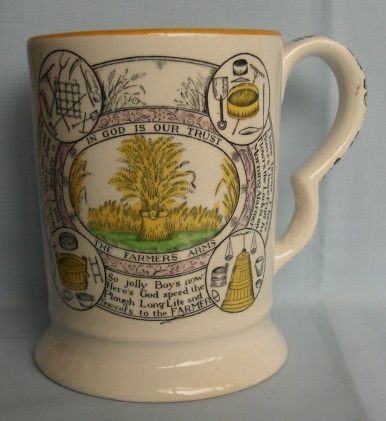
I have long realized that a lot of very nice folks read this blog. One evidence of this is that several readers have sent me gifts. Such is the case with the mug shown in the picture above (and below).

This unusual agrarian-themed piece was sent to me by Roberta M. from Wisconsin. Roberta collects "God Speed The Plough" china. She wasn't sure if I'd like the mug, but as a long-time reader she knew I would appreciate the verse. Well, I am delighted to have both. Thank you Roberta!


You can click the pictures to see an enlarged view. The verse on the back says:


Let the wealthy and great
Roll in splendor and state
I envy them not, I declare it
I eat my own lamb
My own chickens and ham
I shear my own fleece and I wear it
I have lawns, I have bowers
I have fruits, I have flowers
The lark is my morning alarmed
So jolly boys now
Heres God Speed The Plough
Long life and success to the farmer


Near as I can tell, the mug was made in England in the early 1900s. Here are pictures of some other "Farmer's Arms" or "God Speed The Plough" china...



cider tankard


Finding & Eating Morels

Dateline: 16 May 2013

(click for an enlarged view)
.
My middle son, Robert, quit his job as a mechanic at an auto dealership after working there only a year. He was bored. So he went back to work for a local man who has a maple syrup operation. The guy makes maple syrup on a grand scale. This year he boiled down around eight thousand gallons of syrup. That's a lotta maple syrup, and it requires a lotta man-hours of work in the woods, installing and maintaining the sap lines. So instead of working indoors on cars, my son is in the great outdoors. This morning he told me he's working on installing a "main line" up through a gully. It's work that he enjoys.

Robert told me a few days ago that the man he works with loves morel mushrooms, and this is the time of year to find them in the woods. I told Robert that I didn't think morels grew in these parts because I've never in my life seen them. I used to roam the woods around here quite a bit in my teen years, and I knew about morels back then, but I never saw one. Robert insisted that his coworker was finding them. He said they grow where there are ash and elm trees (not maple trees). I said I'd be really surprised if he found any.

So I was working in my shop a couple days ago, in the late afternoon, making Whizbang chicken plucker parts, and Robert walked in to inform me that he had found a patch of morel mushrooms on our new land. I expressed skepticism and he produced his phone to show me pictures. I was amazed. "Show me where they are." I declared, and we headed straight away into the woods.

Sure enough, there was a patch of yellow morels right here in our own woods. And these pictures show them.


Last night Robert picked 4 morels and cooked them. He cleaned them, sliced them in half, coated them with flour and fried them in butter. He seasoned them with salt and pepper. Him and Marlene and I ate our first morels. Robert announced that they were "pretty good." I said they were "not bad." Marlene didn't say much. We ended up dipping them in Ranch salad dressing. They were better that way.

Last year Marlene and I cooked up our first puffball mushroom—a wild delicacy that many people rave about—and we decided that we didn't really like puffballs. Now we've had morels and, though they were, in our opinion, much better than puffballs, they aren't something we're real excited about eating again. But Robert has plans to cook more. Next time he intends to fry them longer, so they're a bit more crispy. 

Homeschooling Conviction
(some personal retrospection)

Dateline: 14 May 2013


Marlene and I went to our first homeschool meeting when she was pregnant with our first child. That was some 26 years ago. We didn't go out of curiosity, wondering if maybe we would or should educate our child at home. We went out of conviction, knowing full well that we never wanted our children to be exposed to or influenced by the anti-Christian, paganistic culture of government schooling.

Prior to the birth of that first child, Marlene worked full time as a secretary in a doctor's office. I worked for a local home remodeling contractor. I worked mighty hard, but Marlene actually made more money than me, though neither of us made a lot.

In addition to homeschooling our soon-to-come baby, we had a similar conviction that Marlene should leave her job for good, and be a full-time mother when the baby was born.

It was not a difficult decision for Marlene to leave work and focus on being a full-time mother, but it was a difficult reality. Our yearly income was cut to less than half. In addition to that, Marlene struggled with the significant "culture shift" that comes with leaving a busy full-time job to be a full-time mother. If you are a woman who has done this, you can probably relate.

But Marlene has never gone back to working a regular job, and, by the grace of God, we made it, though I can tell you it was not easy. Finances were always tight. 

There were times over those lean years when Marlene suggested that she could get a part-time job to make some money. But that never happened. I discouraged every thought of it. It was more important to me (and to Marlene) that our children (two more would be born) have a full-time mother.

Living in a state of perpetual financial difficulty and lack was not hard to bear, knowing that our sacrifice was part of fulfilling what we saw as a higher calling. A truer poverty in my mind would have been to see my wife working a regular job and our children without their mother at home for them. A truer poverty would have been to take the easier path and let my children be cared for each day by the Babylonian educational system. 

In the final analysis, conviction is a powerful force. People will endure tremendous hardships (far more than we had to deal with) to do something they are strongly convicted of—especially when it comes to their children.

In retrospect, Marlene and I have some regrets about some of the ways we homeschooled our children, but we haven't a single regret that we chose to homeschooled them. The biggest regret I have is that we sent our oldest son to two years of a "Christian school" and then to two years of public vocational school. But we learned from that— the two younger boys never experienced a single day of "Christian" or government schooling, thank God.

The lion's share of educating our boys fell on Marlene. She is the heroine in our homeschooling story. There is no doubt about that. Maybe someday my sons will truly understand the sacrifice and commitment their mother made in educating them at home. Maybe not. But she has my eternal gratitude for such selfless dedication to our children's education.

Mothers who take on the task of homeschooling their children, out of conviction, are remarkable people. It is a selfless act to commit to educating your children at home. It is contra-industrial. It is not easy. I have tremendous respect for homeschooling mothers.

As for me, I was 100% supportive but I was not the teacher Marlene was. I was more consumed with trying to make enough  money to keep the bills paid. Had I to do it again, I would do things a little differently. 

All of this is a roundabout way of introducing you to a documentary movie I recently bought, and watched, and really liked. It is called IndoctriNation: Public Schools and the Decline of Christianity in America

The movie sets out to answer the question.... Should Christians send their children to the government schools? 

The movie makes it abundantly clear that no right-thinking Christian should ever  submit their children to pagan indoctrination through the government school system. The film makes it's point in an entertaining way, but this is a very serious documentary.

Though my children are now beyond school age, I have younger Christian friends who are just starting to homeschool their children, or they are thinking about maybe homeschooling them. I bought the movie to lend to them. 

And, beyond that, I now have a grandson. He is a year old. 

Here's the trailer to "IndoctriNation"...

IndoctriNation Trailer from indoctrination on Vimeo.


People who are not Christians and read this may not fully understand the conviction that so many Christian parents have for homeschooling their children. That is understandable. And, no doubt, there are professing Christian parents who will disagree with my beliefs about homeschooling, asserting that lots of Christian children go to government schools and come out just fine. 

That is, I'm sure, true, just as it is true that many people survive airplane crashes.

My purpose with this essay is not to condemn or to be dogmatic. It isn't to start an argument. It is to give my testimony and my opinion. It is to encourage any Christian parents out there who are considering the home education of their children.

If you are a Christian who thinks government schools are a good place to send your children, I dare you to get the IndoctriNation video and watch it.

Mother's Day Reading

Dateline: 12 May 2013

My great great grandmother's life as a farm wife was not easy....

A little over six years ago I established the web site, Diary of an 1892 Farmer's Wife. It presents one year of entries from my great, great grandmother's line-a-day diary. It doesn't take long to read through the whole year of entries and if you do you will get a glimpse into the life of a farmer's wife 121 years ago. 

This morning I had notice of a comment left at the web site by a woman who had read my great great grandmother's 1892 diary entries, and I thought it worth sharing here:

"Just a random place to say thank you for sharing this wonderful piece of history. I am enthralled with the stories of our American past, and although personally caught up in all the modern conveniences can appreciate the idea of a time when "simpler" did not mean "easier". At the end of the day, these ancestors gained satisfaction from the work they did, which was almost exclusively the work of home and family. Today the "busy-ness" of life mostly has to do with non-essential tasks. I can't imagine the work involved in laundry, cooking, and planting as they did then, but know that I would have gone to bed glad for the rest. Thanks again for sharing your families history."

If you are a wife and mother, I think you will especially appreciate Josephine Jordan's diary.

Jersey Cabbage

Dateline: 11 May 2013


I have recently learned about the giant cabbages grown on the island of Jersey. The cabbages grow very tall, as the picture above shows. In years past, the cabbages were an important part of the island's agricultural economy. Leaves were stripped off and fed to cows or sheep. The dried stalks were used to make walking sticks.

This Link explains more about Jersey cabbages. 

This Link provides some more historical perspective and growing advice.

This Link takes you to the web page of some folks in Jersey who make cabbage walking sticks. They also sell seeds. 

I couldn't resist ordering a packet.


Starting Tomato Seedlings
or
"Cherokee Tomato Will Survive"

Dateline: 10 May 2013

Homegrown tomato seedlings (click to see an enlarged view)

Starting plants, like tomatoes, from seed is something that we have done for years. I say "we," but in the division of labor in our family economy, my wife, Marlene, has been the primary plant starter. This year, however, Marlene went to Oklahoma for our grandbaby's first birthday, and I decided to get the tomato seeds started myself. I planted the seeds on April 7th.

The picture above, taken on May 9th, shows one of two flats of home-grown tomato transplants. Twelve days earlier I took a picture of the seedlings in a Whizbang solar pyramid and posted it to my April 2013 monthly blogazine. Here's those same tomato plants 12 days ago...


As you can see, the plants have really grown, and they're not tall and spindly. The stems are thickening up nicely. We have a cold front with rain coming over the next few days and I'll get the tomatoes planted in my garden shortly thereafter. I will plant them in solar pyramids or some other kind of cloche so they will get off to a great start once in the soil.

I started numerous kinds of tomatoes. They are all indeterminate varieties and will all be planted along Whizbang tomato trellis spans. The trellis will allow them to grow to 5'6" high. The smaller tomato varieties (Tommy Toe and Juliet) tend to be much more vigorous and will be planted on 7'6" high Whizbang trellis spans. I'll chronicle the progress of these plants through the gardening season.

By the way, solar pyramids and Whizbang trellis spans are discussed in The Planet Whizbang Idea Book For Gardeners.

I decided to plant a trellis span of Cherokee Purple tomatoes this year. I've never grown that variety before. Unfortunately, I didn't get the Cherokee Purple seeds started when I started all the other tomatoes. But with the solar pyramids, they will grow quickly and not be much behind. 

I'll explain how we start tomatoes from seed with the following pictures. Our objective is to get the plants started without grid-dependent electric grow-lights, or an expensive greenhouse structure.

We begin by planting some seeds in a shallow container. We typically do this in cardboard milk or juice containers cut in half (the long way). For the Cherokee Purple seeds, I used a shallow yogurt container (as you can see below). Marlene said that she saw on the internet where people were using those small Keurig coffee cups to start seeds. Our kids bought us a Keurig coffee maker a couple years ago and I think those cups would be perfect for getting seeds started.


The picture above shows the Cherokee Purple seedlings. We have grown them on a windowsill. The first true leaves have begun to form. I will use the knife to slice out  a seedling, with some soil, and transplant it into the much larger plastic cups with moistened potting soil in them. 

The little jug to the left in the picture is an organic liquid seaweed concentrate (0-4-4). I put a very small amount of the concentrate in the water that I used to moisten the potting soil in the big cups. No fertilizer was used prior to this.

The plastic Snapple jug in the background is a significant part of the tomato seedling operation. I don't buy Snapple, or other factory-prepared drinks (except an occasional six-pack of Woodchuck hard cider) but my kids do, and I end up with the empty containers. Marlene took it upon herself to drill a bunch of holes in the screw-on Snapple container lid and made a watering jug out of it. I wasn't overly impressed at first, but it turns out to be a very handy tool for keeping the seedlings watered.


In the picture above you can see a Cherokee Purple seedling, sliced out of the shallow yogurt container, about to go into the more roomy plastic cup (and there's that handy Snapple watering jug in the background).

As I was transplanting these Cherokee Purple seedlings, Cherokee Nation, that old Paul Revere and The Raiders song, came into my head. I couldn't help but start singing it to myself. And before long I was changing the words...

"Cherokee tomato will survive, will survive, will survive....."


A Whizbang T-Post tomato trellis span accommodates four tomato plants, so I grow five transplants. I'll plant the four healthiest ones and give the extra to a gardening friend.

Once the seedlings are transplanted into the bigger cups, they will stay on the windowsill for a day or two before going outside, in the solar pyramids (weather permitting) for the daytime hours. We bring the plants indoors at night, especially in the early spring when the nights get cold.


In the above picture, you can see the Cherokee Purple cups on the windowsill. The tomatoes in the foreground are the ones I started earlier. The picture was taken in the morning. The flats of tomatoes were on our kitchen table for the overnight hours. When the weather warmed, they were put outside for the day.

You can start your own tomatoes without grow-lights or a greenhouse, or big south-facing windows. We've done it for years. Some sort of "solar appliance" is, however, a necessity. We used to use clear plastic draped over a garden cart, but the solar pyramids are easier and better. 

Another thing that's needed to get your seedlings off to a good start is some careful attention. They really need to be nurtured, getting them outdoors and taking them indoors, and making sure they are watered and so on. That sort of thing takes time. I don't think I could start seedlings as well if I was still working my factory job. That's why Marlene has done the seed-starting in previous years—she was at home. But seeing as I'm now a full-time, home-based worker, I have the time to properly nurture these seedlings.

Raising a few transplants for your garden from seed is a soul-satisfying pursuit. You can get very attached to your plant "babies." They're special to you. They're a delight.

As for Marlene, she can now focus on nurturing her beloved little pepper-plant seedlings.


"Wheel Hoe" deemed profanity by U.S. Postal Service

Dateline: 9 May 2013


The picture above is a screen shot off my computer (click to see an enlarged view). I was in the process of getting online postage to ship a Whizbang wheel hoe parts kit in a U.S. Postal Service Priority box. I typed in the message to the wheel hoe buyer on the bottom right. In case you can't see it, the message says:

"Wheel hoe parts kit is on the way. Handles will ship via UPS Ground. Thanks!"

When I hit the button to proceed to the next step in the postal process, the message in the upper left came up. I was not allowed to go to the next step. In case you can't see it, the message from the U.S. Postal Service says:

Profanity found in note.

I edited my message to say that a "wheelhoe" (one word) was on the way.

But the US Postal Service objected to that too

Profanity found in note.

This takes the proverbial cake. 

There is something seriously wrong when "hoe"— one of the most fundamental, ancient, useful and revered of agrarian tools—is hijacked and twisted by modern culture to mean something it has never even remotely meant in thousands of years. 

And now "hoe" is deemed a profanity by government censors.

I edited the message to say, "Parts kit is on the way," and was allowed to finish the transaction.

The end is near.......

A Simple Homemade
Compost Riddle

Dateline: 8 May 2013

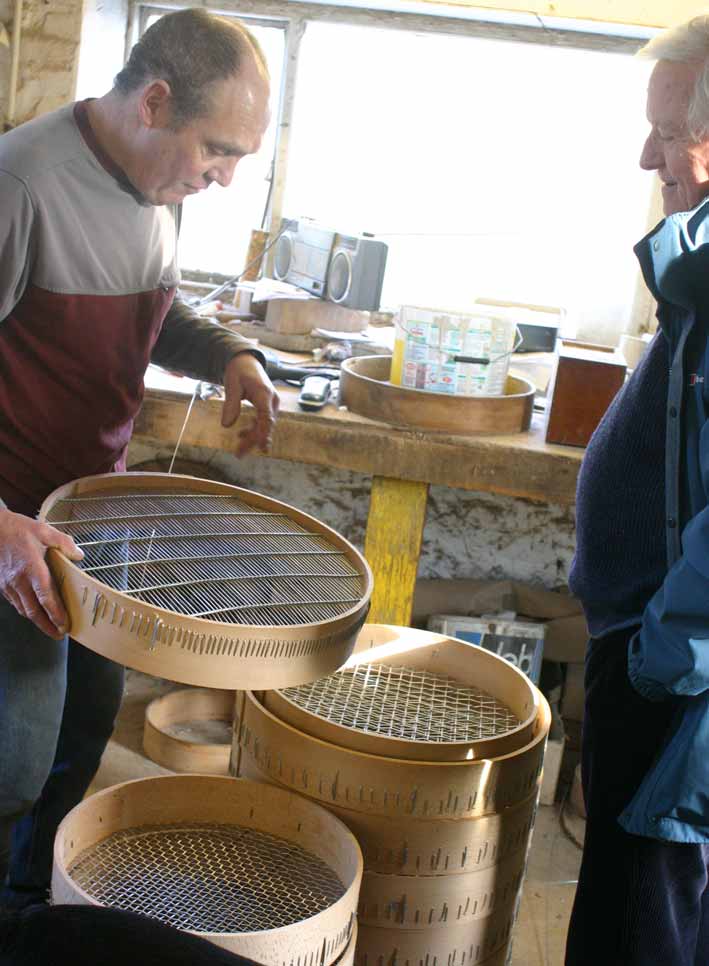
Hand-crafted riddles

Last fall I happened upon this audio slideshow featuring Mike Turnock, the last riddle maker in the UK. That's Mike in the picture below, and he made the riddles in the picture above. 


Mike Turnock with one of his riddles.


Since the slideshow link above was published to the internet, Mr. Turnock has found someone to pass the craft and business on to. The company has a web site HERE.

Old handcrafts appeal to me. When I watched that slideshow last fall, I wanted to make riddles to. I wanted to be the only handcrafted wooden riddle maker in the United States. There is an opportunity right there for some enterprising American.

But I'm crafting products every day in my small rural workshop. And I still intend to start up an American-made wooden clothespin company, like I've talked about here in the past.

But I still wanted to make a small compost sifter/riddle for myself. As much as I'd like to make a round riddle, I just didn't have the time to do that for one sifter. So I made the sifter shown below.


My homemade compost riddle

My riddle measures 16" square. The sides are 3" high. The strips of wood on the bottom that hold the 1/4" hardware cloth in place are 1/4" thick.

Note the four support wires

Mike Turnock's round riddles have support wires under the screen mesh. Those support wires make a lot of sense and I made sure to put similar support wires under my screen, as you can see in the picture above (click to see an enlarged view).


I used common pine for the wood. And I coated it with a liberal amount of homemade beeswax-turpentine-linseed oil paste. 


I used my new riddle for the first time the other day. I needed just a little sifted compost. It worked really fine. Maybe not as well as a round riddle, but good enough.


The Deliberate Agrarian Blogazine
April 2013

Dateline: 30 April 2013

Farewell to The Blogazine
(it's time for a change)

Oh no. Not again....

Dear Friends,

Well, here it is, the last day of the month, our regularly-scheduled meeting time for another issue of the Deliberate Agrarian blogazine, and I am only now just sitting down to the computer, with a few half-baked ideas in my head to write about. This is no way to run a blogazine, and I've come to the point where, to borrow an analogy from Richard Grossman, The Midland Agrarian, "I am going to be parking this weblog for a while, removing the battery, draining the oil, taking off the tires and putting her up on blocks."

But I'm not putting the whole blog up on blocks—just the monthly blogazine approach.

You long-time readers may recall that I started The Deliberate Agrarian back in 2005. Then, come April of 2009 (four years after starting the blog), I posted The Ruminations End, wherein I stated that I was no longer going to blog. But, for awhile, I would post a Deliberate Agrarian update letter on the last day of each month. 

I assumed The Deliberate Agrarian would fade away, but readership went up, and the monthly update letter soon turned into the monthly blogazine format. Those four years of blogazine "issues" are all archived at this link: The DA Blogazine Archives.

I am taking a new direction with this blog because my life has taken a new direction. Since getting out of prison back in January I just don't have the time I once had to put a monthly blogazine together. It is something of a paradox that I "retired" from a job and have less time to write. But you would understand perfectly if you knew what my job entailed.

To  make a long story short, for 13 years I had a job that didn't require much of me. I didn't actually work. Fact is, I'll never forget when I was interviewed for the job I was told that they did not want me doing any work. That's what the inmate employees were for. So I "supervised" inmates in a shop making office furniture. I handed out and collected tools at allotted times, and I handed out orders that needed to get done, and the inmates pretty much ran the shop. Oh, sure, I truly had some serious responsibilities, it being a maximum security prison and all, and I had to deal with numerous issues as they arose. But, for the most part, I had a lot of time each day (and sometimes entire days), when I had nothing to do.

Many people, when they have nothing to do, do nothing. They idle away the hours gossiping, or engaging in pointless discussions, or doing Suduku, or crossword puzzles, or playing solitaire, or reading trashy novels, all of which amounts to, as I said, doing nothing.

As a person who likes to write, or, more specifically, is inwardly driven to write, I can keep myself productively occupied for hours with nothing more than paper and a pen. And that's what I did with my free time for thirteen years. I didn't have access to the internet or a computer to write, so I did it the old fashioned way.

I would sit behind a desk in my shop, where I was available when needed, and where I could keep an eye on everything, and I would write. Most of the hundreds of blog and blogazine posts I have written here since 2005 were first written longhand in prison, as time presented itself, on folded pieces of copy paper. I kept the folded pieces of paper stuffed in my pockets. Some days I'd come home with a couple pages of writing. Other days I'd have a large wad of papers. I don't think a day went by that I did not write something.

Truth be told, I wrote most of all seven of my self-published Whizbang books in prison.

I did not realize going into the job that it would allow me so much time. But when I did realize that I had time to spare, I saw it as an opportunity to be productive in my own way, with the hopeful goal of building a home business that would pay the bills so I could get out of prison. And that's the way it eventually played out, thank God.

==========

Now, 3.5 months after breaking free of the drudgery of a government non-work job, and the guilt of collecting a check for not doing much of anything, I am joyfully busy doing real work, full time, at the home business and around my homestead. 

Real work is a beautiful thing. I can report that I feel stronger and more healthy after coming home. I am on the go every day, bouncing from task to task, from early morning until I "hit the wall" in the evening. Then I drop into bed, exhausted. And I sleep better than I have in years. And I'm working on getting my desk-job-softened hands back into callused shape.

So, you see, I don't have the time to blog like I did in the past. Now, instead of blogging once a month on the last day, I'm going back to blogging intermittently, when I feel inspired to share something here, like I did for the first four years, but probably less often than I did in those early years. My future blog posts here will probably also be short and contain less depth of thought and detail. They will be similar to the two essays I posted earlier this month. In case you missed them, here they are...

Birth of an Orchard
Part 1

Birth of an Orchard
Part 2


Subscribe By E-Mail

This blog now has a place where you can sign up to get new posts by e-mail. It's on the right side of the page, near the top. Go ahead and sign up, so you don't miss a blog post. Don't worry about me getting your e-mail and sending spam or anything like that. It's not going to happen.


My Newest Book 
Is Now Available For Purchase

This Planet Whizbang logo will be prominently featured on the front cover of the book.

If you are subscribed to the Planet Whizbang newsletter, you already know that The Planet Whizbang Idea Book For Gardeners is now available for pre-purchase. In fact, it may well be that you have already purchased a copy. 

If you go to the web site you can read the Introduction to the book, and learn what's in it by reading the Contents.

I've been surprised (and a little bit overwhelmed) by the volume of orders that have come in over the last couple of days since I sent out the newsletter. If you did order a book, I sincerely thank you! And I will be confirming your order with an e-mail, but it will be a few days before I get confirmations to you all. If you don't get a confirmation e-mail from me by this Sunday, don't hesitate to send me an e-mail query... hckimball@bci.net I don't want to mistakenly miss anyone's book order.

For those of you who missed the newsletter, I summed up my new book as follows:
You will enjoy the adventure of discovery that awaits you in this one-of-a-kind book. You will be a smarter, more clever, and better gardener as a result of reading this book. And you will also be greatly inspired.

The Planet Whizbang Idea Book For Gardeners is being launched without a lot of fanfare. I don't Twitter and I don't Facebook. I just don't have the time for that sort of thing. And I'm really not all that sophisticated when it comes to electronically hyping my books. I tend to rely more on word-of-mouth marketing—and time—to sell books. With that in mind, I would be grateful if those of you who are familiar with my past books (and liked them) would pass the word about this newest book (and the book's web site), via e-mails, blogs, twits, and face-bookings. 


Whizbang Solar Pyramids 
Make Great Coldframes!


These tomato seedlings are in an ideal solar pyramid environment on sunny days, and brought into the house when the temperature outdoors drops. (click to see an enlarged view)

Back in the June 2012 Blogazine issue I showed a remarkable picture of a Whizbang solar pyramid in my garden. That picture generated a lot of interest, as well it should. The solar pyramids are amazing cloche structures. I tell how to make and use them in my new book.

But it never occurred to me that the solar pyramids would make ideal cold frames for starting plants in the spring. That is, it never occurred to me until a few days ago. It is past practice for us to start tomato seedlings inside the house on the windowsill and, when sunny spring days come, we transport them outside into a garden cart with a sheet of clear plastic spring-clamped over it. The makeshift cart-as-a-greenhouse has worked for years, but it is a bother because the cart has to be continually repositioned to get full sun into it. Besides that, if it gets hot outside, the plastic has to be vented.

But I have discovered that if I simply put a solar cone on the lawn, in full sun, and put a flat of seedlings under it, the solar "appliance" is all set for the day—no need to continually move it to get sun, and it self ventilates, which is one of the amazing features of the pyramids. The plastic I use provides an environment of diffuse sunlight. It is ideal for getting young plants, in the ground, or in a flat, off to a great start.

When it cools down at night, it's no big deal to just pull the cover off and bring the flat of seedlings inside.


Howard Phillips Has Died


I feel compelled to mention the passing of Howard Phillips. I heard him speak once at a homeschool convention and I sensed that I was listening to somebody special. 

Mr. Phillips was was a wise man of rare integrity. Though not known as an agrarian, he believed and fought for several principles that have historically been embraced by agrarian-minded people. He was an advocate of smaller, decentralized government, and personal responsibility. He believed in the sanctity of life, and the value of strong traditional families 

Like anyone who stands for such things in post-Christian America, he was criticized. But from what I've been able to discern, he didn't compromise what he understood to be true and right for either convenience or personal advancement. I admire that in any man.

Howard Phillips's son, Doug, recently wrote a tribute to his father and I encourage you to read it at THIS LINK.

Dave Ramsey Gets A Plug


Not that Dave needs any promotion from me, but the guy has a way of very effectively communicating some fundamental economic wisdom to the masses, and I believe he has blessed my family in doing so.

I signed up two of my sons (and their girlfriends) to go through Dave Ramsey's Financial Peace University. It amounted to a 1.5 hour class once a week for nine weeks. Cost was a couple hundred bucks. It was worth every cent. My kids loved it. They want to go again.

I don't agree with everything Dave teaches, but I sure do agree with his advice on debt, which is to not go into debt. I've tried to drive that bit of rock-solid, contra-industrial wisdom home with my kids for years. But I'm not the master communicator that Dave Ramsey is. When Dad says it, and then Dave Ramsey says it (in his own special way), well then maybe it's important enough to take really seriously.

By the way, I see that Dave Ramsey has built a new house. I dare say, if I had the money to build a house like that, I sure wouldn't build a house like that! 

Gardening & Hope 
In The Springtime

I've blogged here for so long that I've forgotten what I wrote. When putting together the web site for my newest book, I came across the following 2008 post. I'm reposting it here because I like it, and it's fitting for this season of the year....

I have a section of good soil for my garden. I have gardening tools. I have seeds. I have compost. I have strength in my body, and the will to use it. And I have hope. It is springtime. 
Already I have removed the detritus of last year’s garden: straw-mulch, remnants of floating row cover fabric, trellis frames, and long-dead vegetative refuse. Then I tilled the slate clean. I am ready. I have hope, because it is springtime.
The freshly-turned earth in my garden is moist and soft and sensual. We have been apart too long. The separation of winter has made my heart grow fonder. It is good to once again be back with my garden. It is springtime, and my hope runs high.
Long lengths of sisal string, stretched taunt between stakes, mark my rows. Below a line, my hand slices through the soil, making a furrow, just so. As I work with my hands, the cool earth packs in dark crescents under my fingernails. Each fingertip has a smile, as does my face. It is springtime in my garden, and I have hope.
Freedom can be found in a garden. Great masses of modern men are shackled to the degrading work of our industrialized economy. We submit to the drudgery of efficiency, of specialized, repetitive, trivial tasks. We are, at the same time, active participants and victims of the exploitation. But when we work in our gardens, the chains fall off. We find escape. There is hope, and it is strongest in the springtime.
I have commenced to plant some seeds in my garden: lettuce, spinach, and parsley. To plant these properly, I must kneel in the soil. There are devices that allow one to plant while standing. But, no, I must kneel. And I will bow my head as I place the hard, lifeless specks in the furrow. Planting seeds in the garden is, after all, an act of faith. Faith and hope, seed-in-furrow, hand-in-hand, in the springtime.
The planting of seeds in my garden, by hand, on my knees, is a simple action of rebellion against the modern order. It is an act of wisdom and significance in the midst of a foolish and vacuous world. It is voluntary submission to an older, higher calling. There is hope in this doing, in this calling. And this hope is greatest in the springtime.
Like every gardener, through every age, from the beginning of time, I envision what will be as I plant seeds in my garden. I see the entire garden planted. The seeds have grown to lush and fruitful maturity. I see divinely-inspired beauty. I see the bounty of the harvest on my family’s dinner table. I see the goodness preserved and stored in our pantry. I see into the future, with hope, in the springtime.
Food, fresh food from the garden, is, of course, on my mind when I am planting. I imagine the satisfaction of eating what I have grown. The flavors of steamed summer squash, of cucumber slices in vinegar, of fresh peas and young potatoes, of just-picked, peak-ripe tomato slices mixed with cilantro, of cabbage salad, of cantaloupes, of green beans, of cold, juiced carrots in the fall, and more. My mouth waters at such thoughts. They fill me with hope in the springtime.
There are people who are repulsed by the idea of growing their own food. They consider it wasted time, or an outward expression of poverty. They seek a richer life in modern leisure and amusements. Blinded by the fog of industrial-cultural, they search far and wide, in vain, failing to see that the answer is directly under their feet. They too could be co-creators, they too could be partakers in the mystery, and the wonder, and the beauty. They too could know the hope that comes to a gardener in the springtime.
I do not yet know for certain, but I believe gardening is eternal. One day, after my lifeless body, a mere speck in the vastness of creation, is placed in the soil and covered over, after my soul is transplanted into the realm of He who, out of love, created the garden and all that is, then I will know. But one thing is sure now: Hope is eternal in the heart of this gardener... especially in the springtime.


Birth of an Orchard
Part 2
Layout & Planting

Dateline: 20 April 2013

On my way to plant apple trees. (click on any of the pictures to see enlarged views)

This installment of Birth of an Orchard will give you some perspective of the layout of my land and where the orchard will be located. I'll explain how I planted the trees, and fenced them.

It was a cold and raw day in April when I loaded my tractor wagon with trees and supplies for planting the apple orchard of my dreams. It had rained most of the previous two days. The wind was steady out of the west and more rain was in the forecast. It seemed like the ideal kind of day for getting apple trees planted.

For more than 20 years my family has lived on a 1.5 acre section of rural land, and I have long wanted to expand the size of our property. Last year we providentially acquired 16 acres right next to our home. In the picture above I am driving down the road, away from our 1.5 acre lot. Our house is up the hill, past the telephone pole you see in the distance. The wooded land you see along the side of the road is part of our 16 acres. I can't just drive through the woods to the field portion of the new land because there is a deep gully and stream running through the woods. I have to drive down the road...

That double-wide trailer came with the new land.


As I drive further down the road, there is a bend to the left and the double-wide trailer that came with the new property comes into view. Most people would have bought the house and got the land with it. We bought the land and got the house with it. That house is packed with all kinds of inventory and work tables for my Planet Whizbang mail-order business. Just past those pine trees in the picture above is an entrance to the field portion of our new land...

Entering the field.

As you can see, the ground is wet with standing water at the entrance to the field. The trees at the top of the hill define our eastern property line.

Heading up to the future orchard.

The apple orchard will be 2/3 of the way up the hill, about in the center of this picture. The T-post on the left side of the picture marks the beginning of a very wet spot in the field. Water comes up out of the ground there and flows down into a ditch behind the house, then into the stream. There are several field tiles under the ground that flow full bore into the ditch. It is a spring-fed area. A lot of water. It would be a good place to have a pond..... someday.


Part way up the field, looking back at where I entered the field (by the pine trees).
The above picture is looking west. There is a valley, and the rise of land in the distance is the other side of the valley

I've already dug the tree holes.

I had already dug the holes for the trees. I dug them by hand, using a shovel and a 17-lb digging bar. The holes are approximately 30" in diameter and 20" deep. I dug 16 holes but I didn't dig them all at once. My body isn't capable of that kind of feat. I dug them over the course of four days. The first day I could only dig three holes before I was physically spent.

 After digging those first three holes, I wondered how I would ever find the wherewithal to dig the other 13 . Then I remembered The Sermon I'll Never Forget, which is the story of Pastor Ralph West as a young Marine at Iwo Jima, marching, after a brutal beach assault, in the hot sun towards Mount Suribachi. And I realized that I would dig all those holes... one shovel of soil at a time. One shovel and one rock at a time.

The above picture also shows (to some degree) the layout of the apple trees. I did not put them in straight rows. I positioned them in concentric, semicircular rows around a knoll. The top row has 4 trees, spaced 30 ft. apart in a 90 ft. radius. The second row has 6 trees, spaced 30 ft. apart in a 120 ft. radius. The third row has 4 trees spaced 30 ft. apart in a 150 ft. radius. And the fourth row has two trees spaced 30 ft. apart in a 180 ft. radius. The 4th row came about after two holes in the third row filled with water (as you will shortly see). Perhaps next year I'll add two or three more trees to the fourth row. And that'll do it.

The radiused placement of the trees was determined by pounding a T-post at the top of the hill, making a ring of heavy wire to fit loosely over the post, and tying a length of baling twine to the ring. I stretched the twine out 90 ft. for marking tree placement in the first semicircular row, and added 30 ft. more of string for each of the other rows. It's an unconventional layout for sure. I like to think it's perfectly contra-industrial to not have straight rows.

As for that spacing of 30 ft., it is a bit further apart than the recommended spacing for trees on B.118 rootstock. But I want to create a spacious little orchard. When the trees are full grown many years from now, I don't think 30 ft. will look as far apart as it does now.

One tree hole 

There is an old saying that when it comes to planting fruit trees, you want a $10 hole for a $5 tree. I guess those prices are some indication of how old the saying is. My trees averaged out to $27 each. So I dug "54-dollar holes." The point being that a good-size hole is important. I think the theory is that the loosened soil in a large hole provides an ideal environment for the tree roots to get off to a good start. 

That's not good.
After a couple days of rain, two of the tree holes I had dug were full of water, as you can see in the picture above. The other 14 holes had no standing water in them at all. Fruit trees need well-drained soil. Two days of rain revealed to me that two of my tree locations were not the best (but 14 of them were very good). So I ended up digging 18 holes for my 16-tree orchard.

Leyland (my tractor) and 12A (my wagon) at the top of the orchard.
Before I commenced to plant trees I took a few pictures from the top of the orchard. They give you some more perspective on the lay of the land. The road that I was driving down in the first picture of this essay is on the other side of those woods.

Lots of rocks.
The picture above shows one of many rock piles that are along our field at the wood-line. This particular rock pile is at the top of the future orchard.


A view over the rock pile

Looking over the rock pile pictured above, into the woods (to the north), you can see some of the stream that runs down through the woods. The road is just beyond. I would like to someday put a large culvert pipe in the stream right at this point and bring in fill to make a driveway through the woods to our field. It would come out on the knoll at the top of the orchard. That would be a big expense, and the government probably has all kinds of regulations that would hinder the idea. But it would be a great place to build a house on the new land.

View to the southwest
For more perspective, this view from the top of my future apple orchard shows  the farm that my land was once part of. My property line is along the corn field. That  farm was the home of my high school pal, Art Dillon. It is a rare piece of property for these parts because the farm consists of land on both sides of the road for nearly a mile. Art's parents have died, and his older brother died, and Art himself died, and the place is now owned by an adopted brother. It was once a well-kept farm, with a nice herd of beef cattle and a small dairy. But the house and barns are now in disrepair and the land is rented to an industrial-scale farmer. I envision that an Amish or Mennonite family will one day buy the land and revive the farm. It would be a family farm again, and that would be nice.


Looking west.
For more perspective, this is a view from the future orchard, looking down at the double-wide house that came with the property. The elderly man who owned our property lived in the double wide. He grew up on the farm in the previous picture. His parents sold it to Art Dillon's family in the early 1970's.  The blue house across the road is where the man's son now lives. Once I figure out what I'm going to do with the excess of water down that way, I'll plant some rows of pine trees behind the doublewide. Picture those grown pines on the left all around behind the house. It will give my field a little  more privacy from people driving along the road.


My future apple orchard came in a relatively small bundle.

Now that you know something about the layout of my land, it's time to plant trees. The 16 bare-root trees came bundled together, with plastic wrapped around the roots to keep them moist. Tree roots should never get dry before planting.


Although the ground was plenty wet, the newly-planted trees needed to be well-watered at planting time. I filled a 55-gallon barrel with water and added a little liquid seaweed solution. That barrel is the same one we use as a maple sap collection tank when making backyard maple syrup. And it was also used when I made one of Steve Lonsky's amazing siphon-tube rain-barrel systems, as I explain in my soon-to-be-published Planet Whizbang Idea Book For Gardeners.


Planting the trees was a fairly slow process (since I was doing it alone) but I wasn't in any hurry. I backfilled each hole, putting the topsoil in the bottom, around the tree roots. I made a point of carefuly spreading the tree roots out, as the picture above shows (click to enlarge). The graft union at the base of the tree needs to be around 4" above the soil line and I was cognizant of that as I planted each tree.

The steady west wind eventually blew in a shower of little ice pellets, followed by steady rain. I kept working until the rain soaked through to my shoulders. I had 12 trees planted by then. I left Leland and 12A in the field and walked home through the woods.

Our stream in the springtime.
The picture above shows where I usually cross the stream. My home is in the distance.


I went to bed that night envisioning a herd of deer eating my just-planted trees down to stubs. I understand that deer love young apple trees and can be quite a pest. So I was up the next day, anxious to get the rest of the trees planted, then fenced.

The fencing I used is 2" x 4" welded wire and 5 ft. high. I bought 4 rolls for $49.99 each, and put a 12 ft ft. length of wire around each tree. To support the fence, I drove in two 7-ft. T-posts. The posts cost me $6.29 each. Total, with sales tax, for the fence and posts: $433.34.

I don't think a 12 ft. length of fencing will keep deer away once the tree "whips" start making branches. So next year I'll probably have to buy 4 more rolls of fencing and 32 more T-posts. 

If this orchard was much bigger I'd have to start an Indiegogo campaign to finance it. And I could send apples to those who donated... maybe ten years from now.

I also need to add in the stakes I put next to each little tree. After watching This knowledgeable chap from the UK explain how to plant apple trees, I felt like I needed to stake them (and I think the Cummins Nursery how-to information recommended the same thing). I used 1" galvanized electrical conduit for the stakes. Ten-foot lengths of the conduit cost $6.77 each and 8 lengths would give me the 16 stakes I needed. Total cost, with tax, $58.49 ($3.66 a stake). 

I also purchased 50 ft. of yellow poly rope ($7.00) to tie the trees to the stakes (using the little trick explained in the abovementioned video). 

And I bought a 50 lb. bag of organic phosphorus (0-3-0) fertilizer at the local fed store. Michael Phillips, my apple tree growing mentor, recommends that one pound of phosphorus fertilizer be added to each tree's planting hole. The 50 lb. bag was $26. The extra fertilizer will keep.

So now the trees are planted and protected. I need to pick up all the rocks I unearthed and add them to the piles along the woods, like those who worked the land before me have done for over 100 years.
.
==========

.

.
.
.