Why We Fight

Dateline: 12 January 2016 AD


Why We Fight is a powerfully compelling documentary that came out in 2005. It begins with Dwight D. Eisenhower, 34th President of the United States, giving his famous farewell address in which he warned Americans about the rise of the "military-industrial complex." Then the movie reveals just how incredibly powerful the military-industrial complex has become. 

This documentary has some excellent interviews in it, including interviews with Eisenhower's now-grown children. It presents a perspective about America's many military engagements that is contrary to mainstream government propaganda. 

Click Here to watch the whole movie, in 12 parts. 


My Search For
A Good Rubber Boot
(Part 2)

Dateline: 11 January 2016 AD

In my creek, with dry feet.
(boot selfie)

In my previous blog post I explained that rubber boots these days are not as durable as rubber boots used to be, and the reason for this appears to be that most rubber boots these days are made using a synthetic, thermoplastic, so-called rubber, as opposed to more durable natural rubber. Then I told you about two long-established companies in France that still make rubber boots using natural rubber.

I decided that I would get either a pair of the French Aigle rubber boots or LeChameau rubber boots. Both are available from online sellers. But the European sizing concerned me. I wanted to actually see the boots and try them on.

The Aigle boots appealed to me a bit more than the LeChameau, but they both seemed pretty much the same. I saw that the LeChameaus were sold by Orvis. I have never been to an Orvis store but I knew there was one in Rochester, NY, which is a couple hours west of me. Then I learned that there is an Orvis store in Manchester, Vermont.

Manchester is east of me a few more hours than Rochester. But Vermont is special to me. I hiked the Appalachian Trail there when I was a teenager, and went to the Sterling School (now Sterling College) for a year. 

Marlene and I had our 30th wedding anniversary coming up in late November, and I hadn't taken any vacation for all of 2015, so we decided to just drive to Vermont.

It was a short, multipurpose vacation. In addition to checking out the boots at Orvis, we visited the Window Quilt workshop, the Vermont Country Store , and King Arthur Flour. It was a good time

The Orvis store was something. We walked in and first looked at a table of men's plaid dress shirts. Marlene said "These are nice shirts." Then I turned over the price tag... $130. We recoiled from the table in unison.

Orvis has absolutely beautiful, high-quality clothing. It's the style of clothing I like. But it is shockingly expensive. If the shirts were $30 each (or even $40), I might have splurged and bought one. But I'm in the wrong socio-economic class to be buying clothing at Orvis. Boots, however, are different...

A little further into the store, a man asked if we were looking for something in particular. Well, as a matter of fact, we were hoping they had some LeChameau boots? His face lit up and he took us to the LeChameaus.


LeCahmeau, Vierzon

I tried on a couple pairs of the leather-lined Chasseur. Size 43 fit best. The Chasseur is very nice. Price: $400.

I did not buy the Chasseur. I couldn't justify it. The British Royals can (and do) wear leather lined LeChameau rubber boots, but they're filthy rich. I'm a commoner.

Having done my research, I knew the LeChameau Vierzon boot, with jersey lining, was only $200 a pair. The Vierzon doesn't have a long side zipper (a nice feature) like the Chasseur, but I can manage without that. I just want a natural rubber boot that will hold together and keep my feet dry for years to come.

Manchester Orvis did not have any Vierzons in stock, but the Orvis Man (Dale Robinson—a downright nice guy) was very helpful. He called the warehouse (in a southern state) and found that there was one size 43 in stock. He ordered the pair for me, and they showed up at my house a few days later.

Within minutes after their arrival, I had my LeChameau boots on and headed to my field to work on digging a ditch (more about this in a future blog post). 

My LeChameau boots are comfortable. They are not as heavy on my feet as the Bass Pro boots that prematurely failed me. They are not insulated, which means they are more of a spring and fall wet-weather boot, not a winter boot. 

On the downside, they don't look quite as manly as the camouflaged BassPro boots I had. But I didn't buy the boots  for their looks as much as I did for their durability and longevity.

I expect the boots will get a puncture or two in the years ahead, but that isn't a problem. Natural rubber can be patched easily and securely.

Is it good economy to spend $200 on a pair of rubber boots when I can get other rubber boots for $100 (or less) elsewhere? Well, if these boots last as long as I hope and expect they will, I'll consider them an economical purchase. 

Specifically, I'm hoping they will last at least 10 years. That would be 5 times longer than the $100 BassPro boots. And if that proves to be the case, even the $400 leather-lined Chasseurs would be a good value.

A couple of interesting sidenotes...

1. It turns out that the Vierzon boots are not made in France. They are made in Morocco. I think the high-class, leather-lined Chasseurs are still made in France. Also, if I understand correctly, some of the LeChameau footwear is now made in China.

2. Dale Robinson (the Orvis Man in Manchester) told me that the only real problem they've had with the natural rubber boots is that they do not hold up to chicken manure. Apparently, a chicken farmer bought a pair and continual exposure to high-ammonia chicken manure deteriorated the boots. I raise some chickens but I'm not concerned since I don't deal with heavy concentrations of high-ammonia chicken  manure. Still, it's a good thing to know.

So that's the story about my search for a good rubber boot. So far, I like my LeChameaus. If there are any new developments with the boots, I'll let you know.


Stained Glass at VT Orvis
(click for larger view)


My Search For
A Good Rubber Boot
(Part 1)

Dateline: 10 January 2016 AD

This one doesn't qualify.

I bought a pair of rubber boots a couple years ago at the local BassPro store. They looked like the boot above. I liked them a lot when I got them. They cost me around a hundred dollars. I don't wear rubber boots a lot but they are nice to have at certain times. I figured the boots would last me many years.

But two months ago I wore the boots to do some digging in a muddy part of my field, and my right foot got soaking wet. A closer inspection revealed that there was a 2" split in the back of the boot by my heal. The split wasn't due to any damage on my part. It just split open all by itself. The boots still looked practically new, but one was no good.

What do you do when you're digging a muddy ditch and your boot leaks? You work with a wet foot. And that's what I did. 

A little while later a friend showed up to return the cider press I had loaned him. He was wearing a pair of old green rubber boots. 

"How old are those boots you're wearing?" I asked

"I've had them over 20 years," he replied.

"Do they leak?'

"No. I've had to patch a couple of small holes but they don't leak."

Do you wear them much?

"Yes, I wear them a lot."

"Do you know what brand they are?

He looked but couldn't find any name.

Well now. It's just not right that an almost-new pair of $100 rubber boots comes apart like that boot of mine did. I went to the internet to do some research and found that my experience is not unusual—a lot of people are disappointed with the quality of rubber boots these days. Rubber boots are simply not holding up like they used to.

Further research on the subject brought me to the conclusion that the reason why the typical rubber boots being sold these days don't hold up like rubber boots used to is that they aren't made of rubber. They are, instead, made of injection-molded thermoplastic, a.k.a., synthetic rubber.

Now, I'm here to tell you there is a big difference in the durability of synthetic rubber as opposed to genuine latex rubber. I know this better than most people because I sell Kent C-25 chicken plucker fingers that are made with natural latex rubber. The fingers I sell are a lot more expensive than the synthetic rubber plucker fingers everyone else sells. But the fingers I sell last a very long time before they break. Here's an excerpt from an e-mail I recently received...

"My husband and a friend built a turkey plucker last year and our friend got a different finger than the Kent C-25 one we used on our Whizbang chicken plucker. The other brand of fingers are a year old and we plucked 20 turkeys last week, and 16 broke off. We have been using our Whizbang plucker with the Kent C-25 finger for over six years now and haven't lost one..... and we process about 400 chickens a year!"

That right there illustrates the difference between synthetic rubber and the real thing. And there isn't a doubt in my mind that it holds true for rubber boots as much as it does rubber plucker fingers. (By the way, my Whizbang plucker is now 17 years old, has plucked thousands of chickens, and not a single finger has broken... yet).

So, with a true appreciation for rubber boots that are made of real rubber (unlike my $100 BassPro boots) I searched the internet some more...

I thought traditional Wellington boots (commonly known by the name Hunter) from the UK would be what I wanted. But it turns out that Wellington boots are no longer made in the UK. They are made in China, and the traditional quality has apparently plummeted. My assumption is that they must not be made of natural rubber. 

Then I thought of LaCrosse. They have a reputation for making good rubber boots. They certainly look like good boots. But they say their boots are "made with more natural rubber than most other boots."  

Well, that marketing jargon tells me pretty much nothing. Most other boots are made with no natural rubber. LaCrosse is playing semantic games. That doesn't set well with me. If their boots had any respectable amount of natural rubber they would be saying so.

Then I found two long-time rubber boot makers in France. Aigle and LeChameau. Both companies have been in business for a a very long time. They say their boots are made with natural rubber, and their boots were highly rated by people who owned them.

This YouTube movie shows how Aigle boots are made. This YouTube movie shows how LeChameau boots are made. Those two videos show rubber boots being crafted, piece by piece, using real rubber. 

Even if you are not in the market for a new pair of rubber boots, I'm pretty sure you will enjoy watching those videos.

In my next blog post I will tell you which kind of boot I ended up getting, and where I traveled last November to get them. 

No, I didn't go to France. :-)


Growing Onion Sets
(An Ongoing Experiment)

Dateline: 9 January 2016 AD

Copra onions in my 2015 garden

Those who have read this blog for long know that I like to grow Copra onions. They do well in my soil and you will not find a better storage onion. I typically grow 300 to 400 Copra onions every year. 

In past years I have bought onion sets from Dixondale Farm is Texas. I have no complaints with their onion sets. But I have long thought that I should try growing my own onion sets from seed, and last year I finally got around to doing it. 

After pondering on the specifics of how to grow my own Copra onion sets, I came up with my own unique idea, and this blog post is an introduction to that idea....

I pretty much invented the concept of tri-growing onions in thin black plastic mulch over a garden bed, as seen in my "4-Day Carrots" series on YouTube. My success with tri-growing carrots in 3" diameter holes in black plastic  (started under shade discs) led me to try growing parsnips in a similar manner, and the results could not have been better (I'll blog about the parsnips soon). So I started thinking about what other crops I could adapt to the circular cutouts in plastic mulch, and onion sets came to mind.

I determined that mid-July would be the best time to start the onion sets. The idea being that I get them started in 2015, have them grow to a small size, pull them in the late fall, store them for the winter, and replant them in the spring. Specifically, I planted the onion seeds on July 20. 

The plastic mulch had been in place over the garden bed since May 6th when I made the cutouts and planted the onion seeds. The soil under the plastic was soft, moist and weed free. 

I planted 10 seeds in each 3" diameter cutout. I used a homemade template and dibble, as you can see in the following picture, to make 10 evenly spaced indents for 10 onion seeds.

(click pictures to see enlarged views)


In this next picture you can see the dibbled indents, and if you look close you can see a single onion seed in each one.


Then I filled the indents with fine vermiculite (picture below). I've come to the conclusion that vermiculite is the ideal seed covering for this sort of thing. Last year I bought a large bag of fine vermiculite from ULINE. Since I only use a little every year, the big bag will last me a very long time.


This next picture shows all the circular plantings in a section of garden bed. 500 onion seeds were planted in that small section of garden bed. The seeds came from Territorial Seed Company. A 2-gram packet cost me $6.75.  I only used about half the packet.


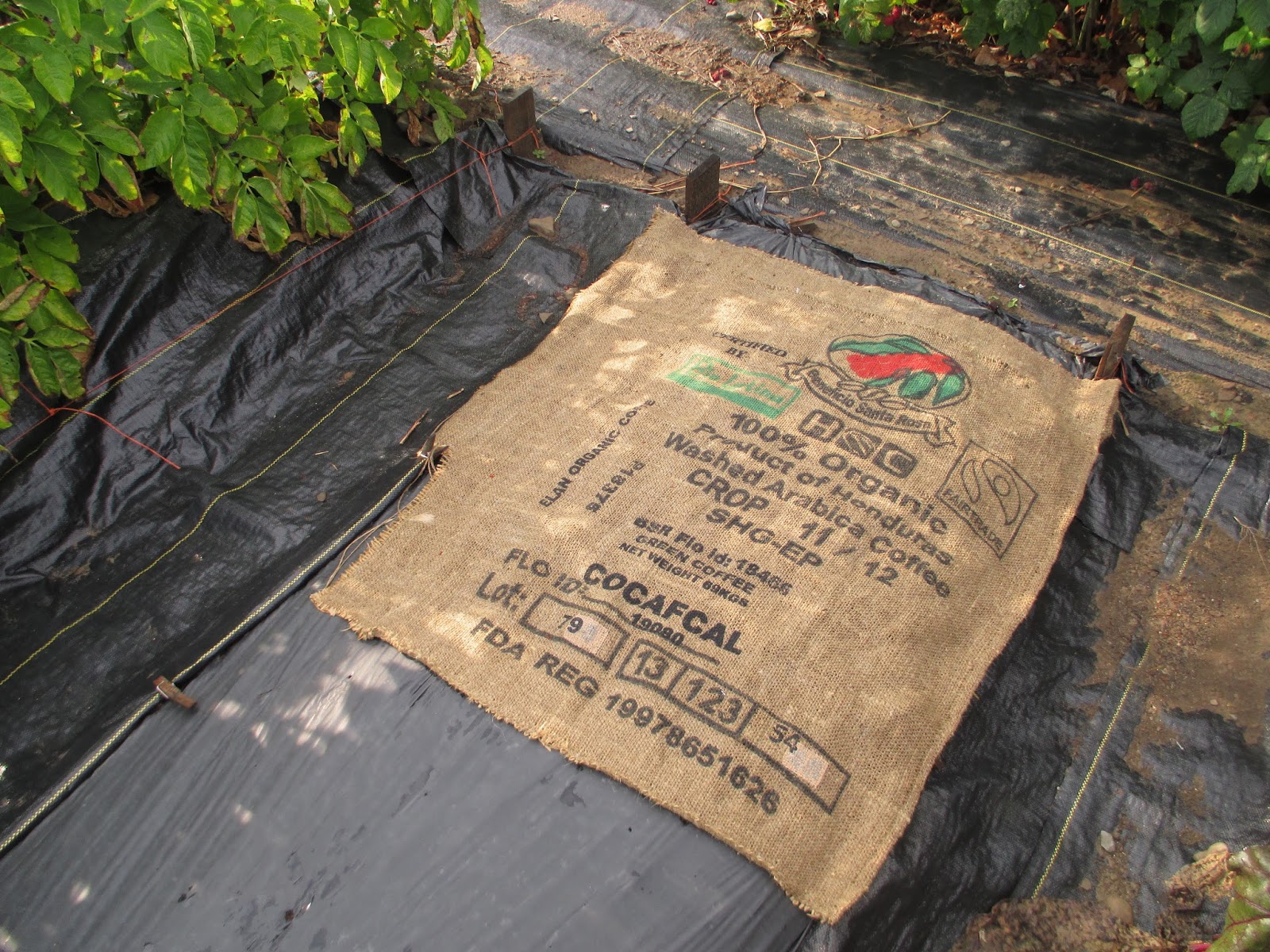
I covered the just-planted section of bed with a piece of coffee-bag burlap that Marlene picked up at the local thrift store for a dollar. The burlap protected the seeds from being displaced in a heavy rain, and it allowed me to water over the plantings without creating any disturbance.


Eight days later, some onion seedlings were emerging and I removed the burlap. On August 9th, most all of the onion seeds had germinated and were 2" to 3" high. They were inconsequential looking little filaments of green, but they were on their way.

I lost track of dates but this next picture shows the onion circles some time later. They grew very well. I did not water them once established. No thinning was needed, and there was no weed competition.


This next picture shows the onions a little further along, and the close-up shows how healthy and beautiful the young onions were.


In late November the onions were pretty big. Maybe they were too big. I really don't know (remember, this is my first time trying this).


This next picture shows what they looked like after I pulled them up...


I decided the best way to keep them through winter was to clamp them right in the garden. So I dug a shallow hole and layered all the onions on a bed of dry leaves...


Then I covered the onions with some straw...


Then I piled some soil on top and flagged the clamp...


There is snow on the ground here now. I'm hoping the onion sets will get through winter in good enough shape to plant early in the spring, and that that I'll get a great crop of storage onions next year. 

This is all an experiment. I'll modify it as needed until I have a system that works best for me. For example, I don't think I really want the sets to be so big in the fall. So I'll plant the seeds a week (or even two weeks) later than July 20th next time I do this. And if the clamp doesn't work as well as I think it should, I'll try another idea. 

That's a lesson in gardening for you. The point being, you experiment with different ideas and fine tune your own gardening systems. This sort of thing can take a lifetime to do.

I'll keep you updated on this idea through next year.

Stay tuned...

Some of the 2015 harvest


Technocracy...
The Next Economic System?

Dateline: 8 January 2016 AD


As you probably know, there was a lot of speculation about some sort of economic crash in the fall of 2015. Jonathan Cahn's Harbinger (based on his application of the shemitah to our day and age) got a lot of attention. I watched his video and listened to a couple interviews. It did not resonate with me. I made a conscious decision not to have anything to do with it on this blog. 

I've bought into the prognostications of financial pseudo-prophets in the past, and their predictions did not pan out. I'm wary of anyone who, under the cloak of Christianity, predicts a date for collapse. When they are wrong (and they have always been wrong as far as I know), they make Christians look like crazy Chicken Littles.

Don't get me wrong. I'm sure the financial system that we all labour under will eventually fail, just like my submersible well pump failed back in November. There were little indications that something wasn't right. Then, one day, the electric breaker tripped. I flipped it on and it tripped again. Upon closer inspection, the pump was just no good. Everything has a lifespan, including economic systems.

Little indications of impending economic failure are in the news every day. There is no fixing it. The system will just have to die, and then it will be replaced. This is widely understood in economic circles. It is the historical pattern. But it could be years before the system really goes.

When I listen to the analysis of various alternative economic commentators, none of them seems to know for sure what the next economic system will look like. Many are fond of returning to a gold-backed system of some sort. I happen to like that idea, but I have a feeling it isn't going to happen. 

Instead, I'm persuaded that there is a whole new economic system that is being prepared. The groundwork is pretty much already in place. This system would not be acceptable to people today, with our economy still holding together, but a large enough crisis will change people's minds. 

This new economic system is called technocracy. It is a revolutionary carbon-debit economic system that was developed in the 1920s. You can learn about it from This Online Article. 

An effort was made to establish an economic technocracy during America's Great Depression of the 1930's. But it failed. American's valued personal freedom and property rights too much back then (both must be given up for a technocratic system to work). Besides that, the technology for implementing such an economic system was not available back then. 

But with today's advanced computers the whole concept is entirely doable. And the American people are now far more dependent on government, which makes them far more vulnerable to the economic tyranny of technocracy.

All of this is explained in the book, Technocracy Rising: The Trojan Horse Of Global Transformation by Patrick Wood (who also authored the above-linked article). 

Patrick Wood has done a remarkable job of "connecting the dots" and showing that the world has been moving towards  economic and political technocracy for the past few decades. This is all happening in real time, by design. 

Here's what he writes in the book about the technocratic economic system that is in the works...

"Technocracy is so radically different from all current economic norms that it will stretch your mind to get a grasp of what it actually means and what it implies for a global society."

If you have any interest in the economy and where it is headed, I think Technocracy Rising will really open your eyes to probabilities that almost no one is talking about. The book was, without a doubt, the most interesting book I read in 2015.


A sign promoting the Depression era Technocracy movement. 


Old-Time
Agrarian Entertainment

Dateline: 7 January 2016 AD


If the above video clip is not one of the best videos on YouTube, I don't know what is. It was filmed in 1964 at the home of 82-year-old Bascom Lamar Lunsford of South Turkey Creek, North Carolina. 

The people in the film (young and old together) are making their own entertainment. They are having a very good time. This is a glimpse into a simple, down-to-earth way of life that is virtually gone. It's something special, for sure.

In the following  movie clip, we see the octogenarian, Mr. Lunsford doing a bit of dancing himself. Then he and his wife pay a visit to the home of Bill MacElreath.  With a cigarette in his mouth, the nearly-80-year-old MacElreath dances and plays banjo like nobody's business.


Personally, I'd like to know more about Mr. MacElreath's home as shown in the picture. Did he build that remarkable stone house himself? He looks like he was a working man in his day and probably did. I tried to find more information online and came up with this picture of MacElreath in front of his stone home (with a dead rattlesnake)...


In the following clip, we get some insights into Bascom Lamar Lunsford's early days. And we can hear one of the locals tell Bascom (on a narrow country road) how to get to Bill MacElreath's house.  


In the following video, David Hoffman tells the story of traveling from Long Island to North Carolina back in 1964 to film the "pure American culture" you see in the living room of Bascom Lamar Lunsford (in the first video above).


Opening Day

Dateline: 6 January 2016 AD


The Glenside Diner opened up for business at 6:00 this morning, as scheduled. I'm usually up well before 6:00 am but this morning I slept in. My mind was finally at ease and, frankly, my body was exhausted. The past couple of weeks of new-diner preparation have been kind of intense around here. 

It isn't just me. Marlene poured herself into this project too.  And James & Bekah were noticeably run down. Last night around 10:30 they left our house with a bunch of freshly-printed Glenside Diner breakfast and lunch menus. 

They're young. They can bounce back from exhaustion quickly. But Marlene and I don't bounce back like we once did. We need a few days to recover.

Just about everything around here was put on hold while we focused on helping to get the diner all ready for today's opening. As a result, our house is a mess, my shop is a mess, my work vehicle is a mess, and I'm behind with all sorts of projects. Fortunately, it's winter and my Planet Whizbang business is experiencing it's yearly slow time. There is no way I would have had time to help with the diner renovations if it were any other season of the year. So that worked out nicely.

Unless something breaks at the Glenside, I don't expect to be down there too much. I do plan to make a simple website for the diner, but that's no big deal. 

Marlene went down there today for lunch (she's a regular customer) and she messaged me that they were real busy. That's good news. 

And that's that.


How To
Become Prosperous
(1904)

Dateline: 5 January 2016, AD


I was recently looking through an old gardening magazine and found an ad for a new book with the title, Working With The Hands, by Booker T. Washington. I was familiar with Booker T. Washington's autobiography, Up From Slavery, but not Working With The Hands. The title intrigued me. I found a copy on Ebay and bought it.

Working With The Hands is a 246-page book that was published in 1904. It is the story of B.T. Washington's life work at the Tuskeegee Institute in Alabama. 

I thoroughly enjoyed the book and it's message. Booker T. Washington was, without a doubt, a deliberate agrarian. His objective was to help his race achieve self reliance and economic freedom by learning better farming practices, valuable trade skills and useful domestic skills. He encouraged freed slaves and the children of freed slaves to pursue land ownership, and he discouraged debt slavery. 

Working With The Hands is over a hundred years old, so much of the information is therefore dated, but there are timeless principles and concepts that can be applied to today, and to all races living in the throes of our crumbling post-industrial culture.

The following advice from Working With The Hands is found in the chapter titled, Helping The Mothers...


How To Become Prosperous

Keep no more than one dog. Stay away from court. Buy no snuff, whiskey and tobacco. Raise your own pork. Raise your own vegetables. Put away thirty cents for every dollar you spend.

Get a good supply of poultry. Set your hens.Keep your chickens until they bring a good price.

Go to town on Thursday instead of Saturday. Buy no more than you need. Stay in town no longer than necessary.


Was Math
Invented or Discovered?
(Fundamental Thoughts For The New Year)

Dateline: 3 January 2016


Martin Armstrong sent me an e-mail yesterday morning with a link to the YouTube video above. It's about some guys who printed the number pi on a length of paper to the millionth digit, then rolled it out on an airport runway.   From my perspective, the video is interesting, but not real interesting.

I realized many years ago (like, around 5th grade) that I'm missing the math gene. Nevertheless, I am powerfully intrigued by math and, in particular, the question of whether mathematics was invented or discovered.

Take, for example, the basic equation of 1 + 1 = 2. Did some real smart human, or group of humans, invent this concept long ago, along with other numbers and the equations of addition, subtraction, multiplication and division?  

And if some real smart humans did invent basic math, did they also at the same time invent all the related branches of mathematics, like algebra, geometry, calculus and trigonometry, which are built upon and integrate perfectly with the basics of addition, subtraction, multiplication and division?

Or, on the other hand, have smart men discovered the basics of mathematics and, in time, the deeper revelations. A case in point being Pythagoras of Samos, the greek mathematician, who lived some 500 years B.C. He typically gets credit for discovering or proving (the existence or truth of) the Pythagorean TheoremI don't think anyone asserts that Pythagoras invented his theorem.

When you discover or prove the existence of something, that something had to preexist. It was there all the time. It's kind of like the discovery of umami. Or it's like the discovery of Pluto in 1930. Or it's like the discovery of DNA's double helix in 1953. Or it's like the discovery of the tiny Microhyla nepenthicola frog in Borneo in 2010. Etcetera.

So, if math is something that preexists (as appears to be the case), where did it come from? Can something as complex, and vast, and reliable as mathematics happen all by itself? And is it just coincidence that consistent principles of math can be found throughout the natural world, as evidenced in the Fibonacci sequence? Maybe all of this evolved over millions of years by random chance and natural selection, eh? But wait, can mathematics evolve?

Well, from my perspective as a Christian, the question of where math came from (along with everything else than man has discovered, and continues to discover in our universe) is sufficiently answered for me in Genesis 1:1.... "In the beginning, God created the heaven and the earth." 

I happily accept this because it makes perfect sense to me. It explains everything about origins and the world I live in. It relieves me of all angst and confusion about such matters. 

And I am thankful that this incredibly intelligent and all-powerful God of all creation told me this in The Book that He, through the mind and hands of a selection of his created beings, over a period of around 1,500 years, put together for my benefit (and that of all mankind). 

Right there, in the first sentence and chapter of the Bible, the matter of creation is answered. Then, from there on, God's Book reveals much more important things that I need to know. Like why I was created, what my purpose in life is, and how to have a proper relationship with God here in this earthly realm—as well as in the otherworldly realm(s) that lie beyond.

Many people scoff, of course, at those, like myself, who believe in such a book, with it's transcendent explanations and insights. How can you believe that old book? 

I can believe it because I see the evidence of this Creator God in the creation all around me. And if this Creator God, who is sovereign over all his creation (as the potter is over his clay) wanted to write a book to me, and preserve the essence of its message over the centuries... well that would be a relatively simple thing for such a God to do, wouldn't you say?

By the way, as I understand it the Bible is the only book in the world that claims to be the Word of God. That right there is a whole lot more interesting and exciting to me than the number pi printed out to the millionth decimal point.

The amazing thing to me is that so many other people do not accept this fundamental explanation of the origin of all things. This dichotomy of understanding is due to the dynamics of human presuppositions.

I learned about fundamental presuppositions several years ago when I read Gary Demar's book, Thinking Straight in a Crooked World. What Gary wrote really resonated with me.

Presuppositions are bedrock beliefs upon which an individual worldview is built. Every person develops these fundamental presuppositions in childhood and holds tight to them throughout their life. Any information contrary to the presuppositional beliefs is immediately rejected by that person as false.

Now, here's the interesting thing about every person's fundamental presuppositional beliefs... they are assumed to be true without absolute proof

The most fundamental of fundamental presuppositions a person can have is the matter of the existence of God, or not. Those who presuppose there is no God, presuppose this by faith. They can not empirically prove there is no God, so they must believe there is no God by faith. Make no mistake about it, atheism is a faith-based belief system.

When your fundamental presupposition is atheism, you try to make sense of the world and the purpose of your life based on your atheistic faith. You accept or reject data about the world (including the created order) based on whether or not it fits your presupposition.

Someone who has embraced the fundamental presupposition that there is no Creator God can not and will not consider the possibility that math is the transcendent creation of such an all-powerful Creator. Instead, such people will come up with all manner of other imaginative possibilities or theories 

While researching this topic, I came across This E-Mail Exchange between a high school girl (Angela) and a scientist (Dr. Math). Angela asked Dr. Math if math was created or discovered. It is abundantly clear from the exchange that Dr. Math has an atheistic presupposition. He presents all kinds of  ideas and information that help to support his worldview. But, in the end, the girl doesn't buy it...

"Upon doing more research, I discovered that I must stand on the so-called "absolutist" side of the argument. I think that mathematics is universal and certain. Mathematics is discovered by the intuition of the mathematician, and then established in a proof."

Angela's fundamental presuppositions helped her arrive at her conclusion. She has a Creator-God presupposition, whether she realizes it or not. Absolutism is founded on unchanging truth. And the only absolute source of truth is transcendent truth, which is from God.

Can fundamental presuppositions change? Yes. But they don't change easily. I think it is always something of a small miracle when a firmly-held presupposition against the existence of God changes.

I think it behoves every person to consider and understand his or her most fundamental presuppositions. And if we do believe in the existence of an omnipotent, absolutist, Creator God, as explained in the first chapter of the Bible, I think it behoves us to read what else God has in The Book.

One of the things we'll find is God's opinion of people with fundamental atheistic presuppositions (like Dr. Math)... "The fool has said in his heart, there is no God." (Psalm 14)


###

The following video is a lot of fun to watch. It gets really good after the 3-minute mark. I had to laugh when the guy said math appears to be a lot less like science and more like... "the opposite of science."


The Diner Dream
Becomes A Reality

Dateline: 1 January 2015


Well, I’m finally back to blogging here after my nearly-two-month absence. I left to focus my writing efforts on my son and daughter-in-law’s GoFundMe campaign. If you have followed the campaign, and read the 27 Updates that I posted there since November 5th, you have pretty much continued to read this blog, though in a different format.

I wrote about my family. I reminisced about people I knew and events that happened in my life decades ago. I even wrote about the rutabagas I grew this year in my garden. Oh, and I posted some updates about Jimmy & Bekah’s Diner Dream, telling how the gifts that so many people gave were being used.


And if you have read the Updates, you know that I have not been idle in my Deliberate Agrarian blogging absence. I made a new Specials chalk board at the diner. I helped my son remodel the restroom. Then we launched into some renovations to the dining room, which are ongoing (we will be working there all day today and tomorrow). For those who haven’t read the GoFundMe updates, here are a few pictures (click on pictures to see enlarged views)…

The "specials" chalk board before.
The new "specials" chalk board.
The restroom was dark and stark before we made it
look like you see in this picture. We put in a new
sink, new lighting, new mirror, new ceiling, new
flooring, new exhaust fan, new baseboard and
wainscot paneling. We also rerouted the ugly
exposed copper water pipes into the wall.
This is a before view of one section of the dining room,
with the wallpaper border removed.
This is an after-view of the other half of the dining room.
Note the wide baseboard, beaded wainscot paneling, and
chair rail molding. There are now sills on the windows,
and the fresh coat of paint is refreshing, to say
the least. Marlene is making new valence curtains.
And speaking of rutabagas, here are some that I
harvested from my garden in November.

Reflections on the GoFundMe Campaign

The GoFundme campaign for Jimmy & Bekah's Diner Dream officially raised $4,005. Around $500 more came into the project in the form of checks and cash. I kicked off the campaign with a $500 donation. So, if I take that out of the equation, the campaign actually raised $4,000. 

The gifts ranged from a low of $5 to a high of $300 (from a person who gave twice). Readers of this blog gave approximately half of the money that came into the campaign.

From an analytical perspective, I was surprised by the response of blog readers. I expected to get a lot of smaller donations, like in the $20 (give or take) range. That's what I would typically give if a blogger I followed had a similar fund-raiser. But in the final analysis, we received some such donations, along with a few much larger ($50 and more) donations.

The other surprise was the $680 in donations that came from high school friends, some of whom I have not seen or heard from in 40 years (Class of '76). 

Not surprising were the gifts that came from family members ($530), and the gifts that came from friends of Jimmy and Bekah, including diner customer friends ($795).

The comments that came with the donations were very nice to read, ranging from the note (and $10 check) from Chuck and Carole, an older couple who reads this blog out in Kansas, to regular diner customer, Linda G., who wrote:

"This place is my home away from home, not just because of the good food, but your family makes me feel like family."

It is worth noting here that Linda G. was at Jimmy & Bekah's wedding back in May of this year, as were several other non-family customers of the diner. 

There is a "community aspect" to operating a small-town, rural diner. You get to know your regular customers pretty well. They become a part of your life, and you become a part of theirs.  It is something rare and special in this world of social disconnections. It is powerfully endearing. I expect to write more about it here in the future.

In nearly 16 years of Deliberate Agrarian blogging, I have never asked for help from readers of this blog for my family. This GoFundMe campaign was a first. I took some criticism for doing it, but I sure don't regret it. It has been a great experience. However, I don't forsee doing anything like this again.

With that in mind, I'd like to say thank you very much to everyone who reads this and donated to Jimmy & Bekah's Diner Dream. When I left blogging here back on November 5th, I wrote that this project was important to me... and you responded with your generous donations. Your donations truly made a big difference. Jimmy & Bekah were able to do some things to get ready for their new opening that they otherwise wouldn't have been able to do. 

The new Glenside Diner in Moravia, NY will be opening for business on January 6th. We have lots to do before then to get everything shipshape. And it's time for me to get to work down to the diner on this first day of the new year.....


Update...

If you are interested in reading the 27 GoFundMe updates I wrote, you can find them by going to the Diner Dream Campaign web page. The most recent Update is at the top of the campaign. At the bottom of the Update, you will see a link where you can click "Show More." When you do that, several previous Updates will show. You can keep clicking "Show More" and go all the way back to Update #1. The screen shot below shows where to click.