My Whizbang
Firewood-Cutting Holder

Dateline: 24 November 2012

(click picture to see an enlarged view)
  
We built our house 27 years ago with a wood stove as the only heat source. I bought a used Vermont Castings stove, put it in the living room, and that has done the job for all those years. It’s simple, efficient, and reliable.

The only drawback is that our 1.5 acres of land did not provide enough firewood  for us to be fuel self sufficient. So I’ve bought firewood from my neighbor every year.

But all of that changed this year. With the acquisition of 16 acres of land right next to our place, containing a woodlot of around 5 acres, we are now fuel self-reliant. It’s a downright good feeling.

Of course, I have to cut the wood, and haul it home, and split it. But that’s okay by me. I love to work in the woods and I’m a firewood cutter from way back (my parents heated their home with two wood stoves and we cut our own wood). 


My wife, Marlene, is my #1 helper. She helped me cut and haul firewood back when we were dating in high school, and here we are so many years later, out working in the woods together. I feel young again cutting firewood with Marlene. It’s a beautiful thing.

This essay is about my latest idea for easily cutting the long lengths of firewood that we haul out of the woods and bring back home. It’s easier to carry a length of small-diameter tree out of the woods and throw it into to the wagon than it is to carry numerous already-cut-to-firewood-length pieces. So I end up with various lengths of wood that need to be cut up at home.

Cutting so many smaller-diameter lengths on the ground is a pain. Putting all the lengths up on a sawbuck of some sort makes it easier, but that’s still a pain. So I got to thinking.... and came up with the device shown in these pictures.

The T-posts are 7' long (around 6' high once pounded in the ground) and wired together at the top to prevent spreading (I have lots of t-posts because I use them to make garden trellis supports in my garden). The posts in the picture are 16” apart, which is the length that I cut my firewood pieces to. The post  on the left is positioned 16” from the center of the 16” span. The pictures below tell the story pretty well.


I cut the outlying wood to 16" lengths until I'm left with what you see in this picture, which is short lengths of wood about 32" long.

And here you see the final cut has been made directly down the center.

This idea is still new and can be improved. I think the single t-post on the left needs to be out of there. That way I can center the long lengths in the 16” span. They will stack and balance themselves better that way.

I plan to lay a board or log on the ground, maybe 10 ft long, and mark off 16” increments, beginning in the center of the 16” t-post span. Then I’ll just start on each end of the stack and cut towards the center, visually eyeing up my saw with the 16” increments on the bottom board. And my last cut will be right down the center.

And that's all there is to it.


P.S. 
 .
I think this is an original "whizbang" idea on my part. But who knows, I might have seen it somewhere in the past, and subconsciously filed it away, and just think it's my own original idea. When you get to be my age, you can do that sort of thing pretty easily. So if anyone reading this has seen this idea elsewhere, please post or e-mail me about it and I'll give credit where credit is due. Thank you.

Oh, and by the way, for those who don't know, "whizbang" is a dictionary word that means, "conspicuous for speed, excellence, or startling effect."

UPDATE 
30 November 2012


"Here I was with a stack of small “logs” that I had from clearing a trail in my bush,  I was trying to stack them in a pile that wouldn’t be too bad for cutting and along you came with your post.  Spent an hour and knocked together a couple of jigs – it all worked great!  I just stacked all the pieces in the jig and my son-in-law came along and cut them.  I often mill a bit of wood, and we cut up the slabs for firewood, so these will work great for that job.  I might build a 3rd one to handle the longer stuff. Thanks for the inspiration!"
(from Rob M. in Canada) 


Andrew Jackson
Hated Paper Money
(and corporations and national banks)

Dateline: 17 November 2012
Special From The Deliberate Agrarian

Andrew Jackson (1767-1845) was the seventh president (1829-1837) of the United States.

Andrew Jackson is one of the most controversial of American presidents. He is reviled because of his brutal treatment of Indians. His response to the nullification crisis involving South Carolina may have cast the Union-must-be-preserved die for Lincoln’s later war against the South. And Jackson apparently had no reservations about the institution of slavery. Nevertheless, I can't help but think of Andrew Jackson as one of the most admirable of our presidents (right up there with Washington & Jefferson), based solely on the brave and selfless stand he took against paper money, conniving bankers, and large corporations.

Jackson the politician was not a go-along-to-get-along kind of man. When you understand something about his battle to revoke the charter of the Second Bank of the United States (a non-government institution akin to our modern Federal Reserve), his reasons for opposing the bank, the monumental task it was to to revoke the charter, and his subsequent victory, I dare say that you can’t help but admire the man. Jackson’s war against the bank is well worth understanding, and you can get a pretty good condensed version of the story from this ten minute YouTube video: The Money Masters & Andrew Jackson

.

Jackson & Paper Money
.
When it comes to the subject of paper money, Jackson believed the United States Constitution clearly says that only gold and silver coin (a.k.a., “specie”) should be the legal tender of America. 

Keep in mind that Andrew Jackson’s presidency was only about 50 years after the Constitution was signed. Jackson knew several of the “founding fathers.” He was well acquainted with their thinking and the reasons for putting Article 1, Section 10 into the Constitution, wherein it states:
“No State shall... make any Thing but gold and silver Coin a Tender in Payment of Debts...”

Why would they put that in the Constitution? It was because the Founders understood from personal experience that paper money was an abomination. It was an opportunity and an invitation for public and private schemers to defraud the hardworking people of the country.

Roger Sherman (the only man to sign the Declaration of Independence, the Articles of Confederation, and the Constitution) was largely responsible for making sure that gold and silver coin was constitutionally declared to be the legal tender of the new nation. Thomas Jefferson once said of Roger Sherman: “That is Mr. Sherman, of Connecticut, a man who never said a foolish thing in his life.” Perhaps Andrew Jackson knew Sherman. It is possible. But even if he did not, I’d bet he read Roger Sherman’s famous little book about the evils of paper money.

Sherman’s booklet, first published in 1752 titled, A Caveat Against Injustice: An Inquiry Into The Evils of a Fluctuating Medium of Exchange, is must reading for anyone who wants to understand an essential first principle of sound economics, and the thinking of the Founders. Here is but one point made by Sherman in his book:


But if what is us'd as a Medium of Exchange is fluctuating in its Value it is no better than unjust Weights and Measures, both which are condemn'd by the Laws of GOD and Man, and therefore the longest and most universal Custom could never make the Use of such a Medium either lawful or reasonable.

What does he mean by a fluctuating medium of exchange? Paper money, of course. The truth about the evil of paper money has not changed in the 260 years since Roger Sherman wrote his book. Nor has it changed in the thousands of years since God declared unjust weights and measures to be an evil (see Leviticus 19:35-36 and Proverbs 11:1). 


It is a shame and a pity that America has veered so far off the intended course when it comes to money. I dare say that our nation would have none of the financial distress that currently besets us if we had wisely stayed with gold and silver coin as our money.

Now, because America did not hold fast to specie as currency,  it is a virtual certainly that our economy faces collapse and ruination in the days ahead. That is hardly in question. But what kind of economy, based on what kind of money, will come after the collapse? Will gold and silver specie again be the currency of a wise nation, or will another foolish fiat-money scheme be proposed. It behooves us all to understand this issue properly.

There is however, a risk to being an advocate of gold and silver as currency. Most people will think you are something of a kook. Or, you might be labeled as a “terrorist”— an enemy of America. Yes, we have strayed that far from truth and honesty. But it is understandable... After all, to pull the wool off the fiat-money wolf is a serious challenge to the powers that be—the powers that so efficiently extract wealth from the sheep via fractional reserve banking and paper dollar manipulations.

Americans are now slaves to the whole industrialized, centralized, debt-based paper money system that dominates their lives. Sadly, the majority of Moderns don’t understand the roots of their dilemma and the immorality of the modern financial system. If they did, they would cry out for a leader like Andrew Jackson, who would resist and route out the self-serving and powerful money masters, in and out of government, who prey on the people of this country.

.


Jackson's Farewell Address

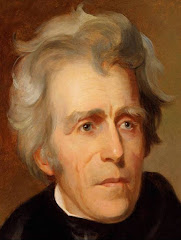
Andrew Jackson in 1845, the year he died. He lived only eight years after issuing his Presidential farewell address.

After serving two terms as President, Andrew Jackson was old, sick, and weary He retired to The Hermitage in Tennessee. But before leaving public office, he issued a farewell address to the people of America, much like George Washington did.

I think Jackson’s farewell address is as pertinent to the issues of our day as it was in 1837, especially when it comes to matters of money and government. It should be read and discussed by every person in America who cares about the future of our nation now and in the very difficult days that face us. Bearing that in mind, I present to you the following excerpts for your consideration and illumination (bold emphasis in the text is mine)...


"In reviewing the conflicts which have taken place between different interests in the United States and the policy pursued since the adoption of our present form of Government, we find nothing that has produced such deep-seated evil as the course of legislation in relation to the currency. The Constitution of the United States unquestionably intended to secure to the people a circulating medium of gold and silver. But the establishment of a national bank by Congress, with the privilege of issuing paper money receivable in the payment of the public dues, and the unfortunate course of legislation in the several States upon the same subject, drove from general circulation the constitutional currency and substituted one of paper in its place.
It was not easy for men engaged in the ordinary pursuits of business, whose attention had not been particularly drawn to the subject, to foresee all the consequences of a currency exclusively of paper, and we ought not on that account to be surprised at the facility with which laws were obtained to carry into effect the paper system. Honest and even enlightened men are sometimes misled by the specious and plausible statements of the designing. But experience has now proved the mischiefs and dangers of a paper currency, and it rests with you to determine whether the proper remedy shall be applied.
The paper system being founded on public confidence and having of itself no intrinsic value, it is liable to great and sudden fluctuations, thereby rendering property insecure and the wages of labor unsteady and uncertain. The corporations which create the paper money can not be relied upon to keep the circulating medium uniform in amount. In times of prosperity, when confidence is high, they are tempted by the prospect of gain or by the influence of those who hope to profit by it to extend their issues of paper beyond the bounds of discretion and the reasonable demands of business; and when these issues have been pushed on from day to day, until public confidence is at length shaken, then a reaction takes place, and they immediately withdraw the credits they have given, suddenly curtail their issues, and produce an unexpected and ruinous contraction of the circulating medium, which is felt by the whole community. The banks by this means save themselves, and the mischievous consequences of their imprudence or cupidity are visited upon the public. Nor does the evil stop here. These ebbs and flows in the currency and these indiscreet extensions of credit naturally engender a spirit of speculation injurious to the habits and character of the people. We have already seen its effects in the wild spirit of speculation in the public lands and various kinds of stock which within the last year or two seized upon such a multitude of our citizens and threatened to pervade all classes of society and to withdraw their attention from the sober pursuits of honest industry. It is not by encouraging this spirit that we shall best preserve public virtue and promote the true interests of our country; but if your currency continues as exclusively paper as it now is, it will foster this eager desire to amass wealth without labor; it will multiply the number of dependents on bank accommodations and bank favors; the temptation to obtain money at any sacrifice will become stronger and stronger, and inevitably lead to corruption, which will find its way into your public councils and destroy at no distant day the purity of your Government. Some of the evils which arise from this system of paper press with peculiar hardship upon the class of society least able to bear it. A portion of this currency frequently becomes depreciated or worthless,..... It is the duty of every government so to regulate its currency as to protect this numerous class, as far as practicable, from the impositions of avarice and fraud. It is more especially the duty of the United States, where the Government is emphatically the Government of the people, and where this respectable portion of our citizens are so proudly distinguished from the laboring classes of all other nations by their independent spirit, their love of liberty, their intelligence, and their high tone of moral character. Their industry in peace is the source of our wealth and their bravery in war has covered us with glory; and the Government of the United States will but ill discharge its duties if it leaves them a prey to such dishonest impositions. Yet it is evident that their interests can not be effectually protected unless silver and gold are restored to circulation.
These views alone of the paper currency are sufficient to call for immediate reform; but there is another consideration which should still more strongly press it upon your attention. 
Recent events have proved that the paper-money system of this country may be used as an engine to undermine your free institutions, and that those who desire to engross all power in the hands of the few and to govern by corruption or force are aware of its power and prepared to employ it. ....
...when the charter for the Bank of the United States was obtained from Congress it perfected the schemes of the paper system and gave to its advocates the position they have struggled to obtain from the commencement of the Federal Government to the present hour. The immense capital and peculiar privileges bestowed upon it enabled it to exercise despotic sway over the other banks in every part of the country. ....it asserted (and it undoubtedly possessed) the power to make money plenty or scarce at its pleasure, at any time and in any quarter of the Union, by controlling the issues of other banks and permitting an expansion or compelling a general contraction of the circulating medium, according to its own will. ...
The result of the ill-advised legislation which established this great monopoly was to concentrate the whole moneyed power of the Union, with its boundless means of corruption and its numerous dependents, under the direction and command of one acknowledged head, thus organizing this particular interest as one body and securing to it unity and concert of action throughout the United States, and enabling it to bring forward upon any occasion its entire and undivided strength to support or defeat any measure of the Government. In the hands of this formidable power, thus perfectly organized, was also placed unlimited dominion over the amount of the circulating medium, giving it the power to regulate the value of property and the fruits of labor in every quarter of the Union, and to bestow prosperity or bring ruin upon any city or section of the country as might best comport with its own interest or policy. 
We are not left to conjecture how the moneyed power, thus organized and with such a weapon in its hands, would be likely to use it. The distress and alarm which pervaded and agitated the whole country when the Bank of the United States waged war upon the people in order to compel them to submit to its demands can not yet be forgotten. The ruthless and unsparing temper with which whole cities and communities were oppressed, individuals impoverished and ruined, and a scene of cheerful prosperity suddenly changed into one of gloom and despondency ought to be indelibly impressed on the memory of the people of the United States. If such was its power in a time of peace, what would it not have been in a season of war, with an enemy at your doors? No nation but the freemen of the United States could have come out victorious from such a contest; yet, if you had not conquered, the Government would have passed from the hands of the many to the hands of the few, and this organized money power from its secret conclave would have dictated the choice of your highest officers and compelled you to make peace or war, as best suited their own wishes. The forms of your Government might for a time have remained, but its living spirit would have departed from it.....

...The mischief springs from the power which the moneyed interest derives from a paper currency which they are able to control, from the multitude of corporations with exclusive privileges which they have succeeded in obtaining in the different States, and which are employed altogether for their benefit; and unless you become more watchful in your States and check this spirit of monopoly and thirst for exclusive privileges you will in the end find that the most important powers of Government have been given or bartered away, and the control over your dearest interests has passed into the hands of these corporations.
====

The paper-money system and its natural associations--monopoly and exclusive privileges--have already struck their roots too deep in the soil, and it will require all your efforts to check its further growth and to eradicate the evil. The men who profit by the abuses and desire to perpetuate them will continue to besiege the halls of legislation in the General Government as well as in the States, and will seek by every artifice to mislead and deceive the public servants. It is to yourselves that you must look for safety and the means of guarding and perpetuating your free institutions. In your hands is rightfully placed the sovereignty of the country, and to you everyone placed in authority is ultimately responsible. It is always in your power to see that the wishes of the people are carried into faithful execution, and their will, when once made known, must sooner or later be obeyed; and while the people remain, as I trust they ever will, uncorrupted and incorruptible, and continue watchful and jealous of their rights, the Government is safe, and the cause of freedom will continue to triumph over all its enemies.
But it will require steady and persevering exertions on your part to rid yourselves of the iniquities and mischiefs of the paper system and to check the spirit of monopoly and other abuses which have sprung up with it, and of which it is the main support. So many interests are united to resist all reform on this subject that you must not hope the conflict will be a short one nor success easy. My humble efforts have not been spared during my administration of the Government to restore the constitutional currency of gold and silver, and something, I trust, has been done toward the accomplishment of this most desirable object; but enough yet remains to require all your energy and perseverance. The power, however, is in your hands, and the remedy must and will be applied if you determine upon it.

In closing, if you are interested in learning more about Andrew Jackson (the good, and the bad) I recommend a History Channel documentary that you can watch on YouTube in ten parts. Here is a link to the first part (It actually starts 2 minutes into the clip): Andrew Jackson Documentary

The Deliberate Agrarian Blogazine
October 2012

Dateline: 28 October 2012
(a few days early in case hurricane Sandy shuts down my internet)


Family Portrait: Marlene, Me, Jaxson & Leyland

My grandson, Jaxson Kimball, and his mother were here from Oklahoma for a short and sweet visit this past month. Jaxson’s Army soldier daddy was away, in “the field,” for a month (in Arkansas). Jaxson is now around seven months old and a very happy little guy.

.
My Grandfather Kimball 
is Honored


Dr. Herrick C. Kimball

I’ve written in the past (Here, Here, and Here) about my grandfather, Dr. Herrick C. Kimball, of Fort Fairfield, Maine, the man I am named after. Fort Fairfield is a small rural town next to the Canadian border, in the northern reaches of the state.

My grandfather established his medical practice in Fort Fairfield in 1927. He owned and operated the first hospital in Fort Fairfield in the 1940’s. I think it was in a clapboard building—nothing fancy. In the 1950’s he was involved in the building of a new brick-and-mortar hospital for the community. Here’s an excerpt from a recent article in the town’s newspaper:


Dr. Kimball's little hospital was replaced with what was to become Community General Hospital through a massive fundraising effort by the community. “He was the one that really initiated this. He was the largest fundraiser. At the time, the people in Fort Fairfield privately raised $230,000 to build what became Community General Hospital... [It] was a full service hospital, providing doctors, surgery, x-ray and all other common health care needs.

Community General Hospital, a hospital built by the community, was mothballed in the 1980’s. Locals have had to go to another town for their medical needs. But the community of Fort Fairfield is now building an new medical facility. It will be a primary health care clinic, owned by the town and leased to a health services provider. It will be called the Kimball Community Health Center, in honor of my grandfather. Here’s an article about it from the Bangor newspaper: Community Breaks Ground on Health Center

.
The Only Picture...

H.C.Kimball and H.C.Kimball

That is the only picture I have of my grandfather Kimball and me. It was taken in August of 1965. My grandfather does not look well and, in fact, he wasn’t well. He would die five months later, just shy of his 65th birthday.

I would like to know what book he was reading in that picture. I imagine it was a history book, and probably a Civil War history book. Perhaps it was Bruce Catton’s  Never Call Retreat, which was published in 1965. I own my grandfather’s copy of that book, and several others. 


I am attracted to the history of the Civil War, just as he was, though I am a Southern sympathizer. Perhaps he was too. Anyone who reads and understands the history of that time can’t help but be a Southern sympathizer, or so it seems to me.

=====

I recall as a small boy once going with my grandfather to Community General Hospital in Fort Fairfield. It would have been maybe 1963, when I was 5 years old. I was lavished with attention from all sorts of people who I didn’t know. I felt pretty special being Dr. Kimball’s grandson. And I feel pretty special now, 43 years after his death, to be the grandson of this man who, unfortunately, I have only small memories of, and was never allowed the chance to really know.

I hope that I can live to see my grandchildren grow up and get to know them, and they me, and that their memories will be good. I will be 61 when Jaxson is 8 years old, the age I was when my grandfather died. One thing for sure, I will make certain that there are lots of pictures of me and him and any other grandchildren that may come along...

.


.
How My Grandfather Kimball 
Saved My Life 
(and my tonsils)


I beg your indulgence as I tell another grandfather story......The picture above shows my right hand, and the handiwork of my grandfather Kimball’s hands. Here’s the story behind that semicircular scar...

I figure I must have been three years old (1961). I was playing along the rocky beach in front of my grandparent’s camp on the shore of Cross Lake in northern Maine. I picked up a sharp piece of broken glass. It sliced deeply into my palm and wrist. I think I remember the event—the astonishment I felt at seeing the bright red blood, and so much of it, then the panic. I don’t remember any more than that (I’m pretty good about forgetting unpleasant events in my life.) But my mother recollected about what happened to me a couple times over the years.

I was bleeding profusely and we were at the camp alone, with no car. My mother rushed me over to Roger Hall’s camp next door. Roger’s wife, Max, was there. She had a car and she drove us to Fort Fairfield—to Community General Hospital.

My mother told me the Halls had a brand new Thunderbird automobile and it was equipped with an alarm that went off if driven over a maximum speed limit. I have done a Google search and, sure enough, the 1961 Thunderbird had a “speed warning buzzer.” I don’t know what speed it buzzed at, but those cars had 300 horsepower V8 engines with four-barrel carburetors. They were made to go fast. My mother said the alarm sounded most of the way.

With normal driving speeds, I think Fort Fairfield is about an hour from the camp, but Max got us there in record time. I assume my grandfather was waiting (telephones were around back then). In any event, when we got back to “the Fort,” I was wheeled directly into the operating room, and my grandfather sewed me back together.

I’m sure it was a traumatic event for my mother, she being 25 years old at the time, and I being her baby. As for my grandfather, I’m sure it was all in a day’s work for him. But still, maybe there was some anxiety in tending to a serious cut on his little, firstborn grandson. Or maybe there was more anxiety in the waiting, and then relief once I was there and he knew better what he was dealing with.

The only other medically-related incident of personal significance I recall involving my grandfather Kimball was a discussion in his office with my mother about my tonsils (I was prone to yearly bouts with strep throat when I was younger, and I think that may have led to the discussion).

My mother seemed to think that it was best to have my tonsils removed. I wasn’t very old but I was old enough to have an opinion on the subject, which was that I didn’t want any surgery. I listened quietly and carefully to the words being exchanged, and I recall being very relieved when my grandfather told my mother that he thought it best to keep my tonsils in place. I think I remember him saying that they served a purpose.

My mother always spoke with great respect for “Dr. Kimball” (as she called him). More than once in my lifetime she told me that “Dr. Kimball was a good man.” When she said that, it was always in a reflective manner, with emphasis on the “good.”

That’s how I came to keep my tonsils, and I’m glad to have them.

.
A “Moron-Proof” Apple
.

Goldrush sounds good to me (Read About it Here)

I am thinking about planting apple trees on our new land next spring, and I’ve been reading a lot about how to properly grow apple trees. I have settled on the Budagovsky 118 rootstock, which makes a cold-hardy tree 80% to 95% full size. I’ll buy from Cummins Nursery in Trumansbugh, N.Y., which is not far from me. I will place my order soon. It will be for only six trees. I hope to plant six more the year after. Twelve trees is enough for me to take care of and should, in time, provide plenty of apples.

The fun part about contemplating the apple trees one will grow is choosing among the many varieties. One variety, Goldrush, caught my eye at the Cummings web site. The description says of it:

Fruit is conic-round, medium large, a deep uniform greenish yellow. Flesh is hard, very crisp and breaking, flavor intense and memorable. Both sugar and acid levels are high (soluble solids seldom below 17%), the balance slightly favoring tartness at harvest, then mellowing in storage. Length of storage almost without parallel, in excess of six months, good texture out of a household refrigerator as late as July or August. ....  Ed Fackler, fruit consultant in Indiana [says] “it’s one of the easiest things to grow in my life.” .... “This is just a moron-proof apple,” he said.

Moron-proof? That’s quite the sales pitch. I’ll definitely have one of those!

.
. 
.
Cider-Making Feedback
.

Pastor Beck and his homemade Whizbang cider press
 .
Early in this month I received a real nice e-mail from Toby Beck, pastor of Evergreen Bible Church in Vancouver, Washington. He was in the process of making a Whizbang Cider press, according to the plans I provide in my Whizbang Cider Plan Book. Pastor Beck told me that the story of finding my plan book and making a cider press made it into one of his Sunday sermons. He provided me with This Link to listen to the sermon online. 
 
Pastor Beck's comments about my book and the cider press are about one minute into the sermon. It was a lot of fun to hear his excitement about discovering and building the press, and his comments about me.

Then, just a few days ago, Pastor Beck wrote me again with an update. I asked if I could share his e-mail and pictures here and he graciously gave me permission to do so...

Greetings Herrick,
 
Toby Beck here again.  I’m the pastor in Vancouver, Washington who got inspired to build an apple grinder and cider press using your very helpful book.  I just had to let you know how much fun this has been; not just for me but for dozens of people.  Because I mentioned it in my sermon, many have been asking about the progress on the press.  A lot of guys are curious about the design and quiz me about how it works.  Others heard what I needed and supplied necessary parts. (Like a motor!)  A sheriff’s office detective said her colleagues would like to see the press.  Apparently they had been talking about it at work and she told me that in the midst of all the horrific stuff they have to deal with on a daily basis that it is medicinal to talk about something simple and good like cider. I mentioned it to a pastor friend at a conference and he’s all excited because their church participates in the local community cider pressing event but they don’t have a press yet.  He’s fired up to find someone in their church to build one.
 
And of course, my family has enjoyed watching it come together.  It was a great joy last weekend as we had our first pressing party.  My folks came to visit and we had a great time squeezing cider.  It was truly a harvest party!  And of course, I just had to include it in my sermon.  And it was great fun to offer everyone a taste of fresh cider at the end of the worship service.  We served out 6 gallons; it was a hit!
 
I figured you should know something of the joy and blessing that your investment/idea has sparked.  Have a blessed autumn,
 
Toby

.
Feedback like that is powerfully endearing to me. Thank you, Pastor Beck, for giving me (and now all my readers) a glimpse into the good fun and great memories that can be made when family and friends get together, and work together, towards a common goal, like turning apples into sweet cider.
.

Pastor and Mrs. Toby Beck, enjoying some of their homemade cider.

.
Long’s Horseradish

(photo link)

Marlene visited a high school friend earlier this month in Lancaster, PA. One of the things they did was visit the Lancaster Central Market, which is the oldest continuously operating farmer’s market in the country. That’s kinda neat.

At the market Marlene bought me a jar of Long’s horseradish and a jar of Long’s horseradish mustard. I’m always interested in value-added food products that are made by individuals or families and direct marketed, as opposed to food products made in factories and sold wholesale to supermarkets. Small-scale free enterprise appeals to me. I am, after all, a small-scale, home-based, free-enterprise, and down-to-earth entrepreneurship kind of guy.

So I looked up Long’s horseradish on the internet and discovered that it’s a 5th generation family business (started by the father of the current owner’s grandfather’s uncle). If a business has been around five generations, you have to think it has been, and continues to be, successful, which is to say, it makes sufficient money to justify the effort.


(photo link)

I don’t think it would occur to most people that grinding up horseradish roots, adding a little salt and vinegar, and packing it into a jar would be a successful home business. But the Long family has been doing this for some 70 years.

I believe there are lessons to be learned by budding agrarian entrepreneurs in the Long’s horseradish example. One lesson is that you don’t necessarily need a unique new product. The other lesson is that you don’t need to have a complicated manufacturing process. It looks to me like the Long’s horseradish-processing operation consists of an old grinder that they feed the roots into by hand. So it’s a low-investment, low-overhead business. Very nice.

I was talking to a man this month who asked me, “Can you really make money selling homemade garlic powder?” It wasn’t the first time someone has asked me that. My answer was that, yes, you can make money selling garlic powder if you put the necessary effort into it and invest the time it takes to become established. The fact is, you can make money selling any farm/food product if: 1) your product is good, 2) you keep your investment and overhead low, 3) you give it time.

We live in a culture where entrepreneurs want to see immediate and significant financial return on their business ventures. This rarely happens with any new value-added food product. But if you stay the course, you’ll build a customer base. I doubt that great grandfather Long was an instant business success with his horseradish sauce when he started out back in 1901.

By the way, what I’ve just written holds true for other home-crafted products. I’ve seen it with my wife’s handcrafted soaps. If you get truly good feedback from customers of your product (and they are repeat customers), then you probably have a winning product and just need to stick with it.

Another thing that I think is important when selling a value-added food product is to make it affordable. A jar of Long’s horseradish cost $3.00. That’s affordable.

The only thing about Long’s horseradish that disappoints me is that the Long family no longer grows their own horseradish roots. Grandfather long would, I suspect, not approve.

Also, I understand there are plans to start selling Long’s horseradish in supermarkets, on a national scale. I wonder if the supermarket jars will be as fresh as the jars you can get at the Central Market? It’s not likely. So the most distinctive quality of Long’s products would no longer apply. Were it sold in grocery stores, it would be just another supermarket horseradish—nothing special. And I doubt it would be hand-ground on that old grinder any more. Too bad.

But I have an idea....  The proprietors of Long’s horseradish products could make and sell their product inside certain select supermarkets one day a week, or one day a month. This would be a unique draw for the store and I think people would respond well to it. This would be a way to expand the business without compromising on the hallmark freshness of their product.


My Political Opinion
.

Turns out it was just another case of irrational exuberance

I rarely talk politics here, though in November of 2008, after the election of our current president, I wrote: Obama: America’s New Hope. We’ve come a long way since then, and what I wrote is what I still think.

Beyond that, I’d like to opine that I’m not for getting more people to vote, which seems to be a bigger focus these days than I ever remember. Way too many immature, ignorant, addled, utterly selfish, and easily manipulated people are voting. How can the remaining fragments of our democratic republic survive that?


It’s interesting to look back and see that after the last election, 78% of Americans thought Barak Obama would solve the economic crisis. That statistic proves my point about ignorant, addled and easily manipulated masses. 


None of these politicians are going to solve the serious problems of an economy built on debt, fiat money, and the necessity of perpetual growth. All any of them can do is delay the inevitable day of reckoning.

Which is a perfect lead-in to this next story....

.
Walter Prescott Webb
His Life and Impact
.


Professor Walter Prescott Webb

I just finished reading a biography of my favorite historian. Walter Prescott Webb: His Life and Impact was published in 1976. I was most interested in reading any insights into  professor Webb’s remarkable book, The Great Frontier wherein he presents his compelling “Boom Theory of Modern History” (which I have written about Here).

It so happens that his boom hypothesis developed out of a prior book, Divided We Stand: The Crisis of a Frontierless Democracy (1937), which I wrote about Here. Webb’s groundbreaking thesis came as a result of his “insatiable curiosity” and 15 years of study. Webb's  biographer sums up the boom theory and The Great Frontier as follows (bold emphasis is mine):

Published in 1952, the book was Webb’s fourth historical adventure, and one that he felt might ultimately prove to be his greatest. In what he called “the boom hypothesis,” he proposed that new lands discovered by Columbus and other explorers precipitated a boom in the Metropolis (Europe). Accompanying the boom came the rise of modern civilization, great wealth, and new institutions such as democracy, capitalism, individualism, and the acceleration of progress. By 1900, the new lands disappeared, the frontier closed, and new institutions were placed under stress. With depressing clarity of expression and a hint of prophecy, Webb analyzed contemporary questions and attempted to alert society to problems of today and tomorrow. He suggested that the frontier and its wealth had created an abnormal period of prosperity for western civilization. Since it had ended, society was faced with adjustment. Despite the fact that we continually search for new frontiers, Webb bluntly proclaimed that most of these frontiers were “fallacious.” In the fifties, such gloom-spreading was considered un-American and resulted in a half-serious effort for his dismissal. Webb himself realized that The Great Frontier could not be judged by standards of his times, but suggested that around 1990, the “thinking public” would reevaluate the boom hypothesis.

I find it amazing that professor Webb not only postulated a theory that explains exactly why we are having the problems and issues we are having today, but he understood that it would be another 40 years before it would start to resonate with  the “thinking public.” Webb saw a very broad and pertinent historical trends that no one else was seeing. 


Also, I learned from the biography that The Great Frontier was nominated for a Pulitzer Prize.

.
Wartime Farm
.

These three (Ruth, Alex and Peter) are accomplished time travelers, and a lot of fun to follow.


Mr. Kimball,
 
From reading your blog I know that you have enjoyed the "Tales from the Green Valley", "Victorian Farm", and "Edwardian Farm" series.  Well, there is a fourth in the series entitled "Wartime Farm" which profiles what life was like for farmers during WW2.  Go to youtube and type in "E1 Wartime Farm" and you'll find the episodes.  As half of my family is from England (grandfather served in the Navy during the war, grandmother worked in a factory during the day and put out fires from flare bombs at night, came over here early 1950s post war).  This series gets more into areas of life besides farming, but is interesting nonetheless.  What is particularly interesting is the near-draconian control that the government imposed on the populace in all areas of life.  Here they were combatting the Nazis and acting like Nazis themselves in some instances.  I understand the motives, but wonder (1) if the country would have survived with less intrusive controls and (2) how our country would react with such an approach?
 
Best Regards,
 
Tim from Ohio

I’ve watched Episode 1 and enjoyed it very much. For those who don't know (and I didn't know until I watched episode 1), the challenge for England during the war was to raise enough food to feed themselves. German ships were blockading imports, and the country was far from food self-sufficient.  They needed to double their production!

Thanks Tim! 
 .
A New 
Planet Whizbang Product
.

This might be a medical device..... but I developed it as a very useful gardening tool.

The growing season is now over here in Central New York State. Except for cabbages, chard, kale, and some fall-planted garlic, my garden is tilled and planted to  a green-manure cover crop. I appreciate the seasons—a time to plant, a time to harvest, a time to think and plan before planting again.

With that in mind, one of the most useful new gardening ideas of my 2012 growing season was using bucket irrigation and fertigation. It was an exceptionally dry summer here but my garden produced well, due to the bucket fertigation ideas I learned from Steve Solomon’s gardening books.

The simple, inexpensive, low-tech method of bucket irrigation and fertilization led me to develop a bucket irrigation hardware kit, a Planet Whizbang version of which I now make and sell.

You can learn all about bucket fertigation and irrigation (and read Steve Solomon’s wisdom on the subject) at my newest web site, www.BucketIrrigation.com


By the way, I typically sow a cover crop of rye on my garden in the fall. But when I went to the local feed store, they had no rye seed. There is a shortage! So I planted wheat. And it turns out there is a hay shortage this year too.
.
Old Farm Almanacs 
From Mummy Rags?


A farm almanac from my collection (photo link)

As many of you know, I collect old New England farm almanacs from the 1800’s. The paper used to print many of the older almanacs I have is of an unusual texture. I now know why. It was made from the recycled wrappings from Egyptian mummies.

This is a bizarre but evidently true story that I think you will find very interesting. It turns out that they used Egyptian mummies for other practical purposes too (things you would never guess). This article gives new meaning to the topic of natural resources.... Unwrapping the Connection Between Egyptian Mummies and Maine Papermaking.

 .
Tomato Espalier  Project
2012

Espaliered tomato after the frost (click for closer view)
Back in my June Blogazine I mentioned that I was going to try growing an espalier tomato. In last month's blogazine comments, Ray in Tennesee asked about how it worked. Well, the picture above gives an idea. I made an espalier 5-ft. wide with 5 horizontal wires and a top bar. I planted a single Tommy Toe tomato in the center. It grew to fill the space with no problem. I started to espalier the branches but the plant got ahead of me. Still, the horizontal supports served to hold it all. My conclusion: espalier tomatoes are worth experimenting with, and I will try them again, but I will make a support twice as wide (ten ft.) for a single Tommy Toe. Five feet is much too small for a single plant.