Rural Americans:
Cannon Fodder
For The New World Order

Dateline: 6 September 2013

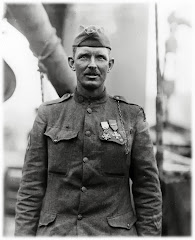
Sergeant Alvin C. York  (this farmboy knew how to shoot!)


"They say farmers are good warriors because they learn to shoot at an early age. Sociological profiles done for the United States Army found rural, conservative boys from farms had a natural propensity to take orders, were in good physical shape, and naturally were accustomed to the outdoor life of nights on the ground. I suppose it is no accident that Sergeant York was of rural stock. The Roman strategist Vegetius over sixteen centuries ago agreed. “I do not think,” he wrote, “that there has ever been any question that rural people are the best equipped for military service.”

At the heart of the rustic’s ability to fight both effectively and brutally is [his] combative attitude toward nature—the very hard-headed view of the unending struggle to grow food. In my own family my Swedish grandfather who was gassed in the Argonne—my namesake, Victor Hanson, Jr.—who was blown apart on Okinawa a few weeks before the war ended, a cousin, Holt, with a bullet in his brain at Normandy, my late father who flew on the big B-29 thirty-four times over Tokyo, were all good warriors—the latter especially a lethal man with either a .50-caliber machine gun or 20-mm cannon. I think now that their skills derived from the years on this farm. These pest-sprayers and -dusters understood that you must—no, want to—kill things that destroy to survive, must obliterate those who would eradicate civilization, must as part of nature itself use muscle and brain to slay the slayer. When the warriors of this family recognized the character of the satanic Nazi or imperial German or racist Japanese, I’m afraid that not one of them blinked when his finger was on the trigger, and so slew many of those blindly obedient to an evil cause before being wounded, poisoned, and shot down themselves."

—Victor Davis Hanson
“The Land Was Everything”


####

American Secretary of Agriculture, Tom Vilsack, has recently stated that 150 years ago, when the USDA was established, 90% of the people in this country were connected in some way to rural America. Today it is 16%. 

With most Americans now crammed into high-density population centers, separated from the culture and values of rural America, rural citizens have virtually no political clout. Rural Americans are now pretty much disenfranchised.   Those in power recognize that we have a problem—but the problem they see is not the same problem that rural Americans see.

Joel Salatin, small-farm advocate, and a voice of rural-agrarian sanity, has recently written of a meeting he attended where Tom Vilsack expressed the main concern that the centralized "powers that be" have about the loss of population in rural America. What Joel heard upset him very much. He posted about it at His Facebook Page. The quotes below come from his commentary:


“...although rural America only has 16 percent of the population, it gives 40 percent of the personnel to the military. Say what? You mean when it's all said and done, at the end of the day, the bottom line--you know all the cliches--the whole reason for increasing farms is to provide cannon fodder for American imperial might. He said rural kids grow up with a sense of wanting to give something back, and if we lose that value system, we'll lose our military might.

So folks, it all boils down to American military muscle. It's not about food, healing the land, stewarding precious soil and resources; it's all about making sure we keep a steady stream of youngsters going into the military. This puts an amazing twist on things. You see, I think we should have many more farmers, and have spent a lifetime trying to encourage, empower, and educate young people to go into farming. It never occurred to me that this agenda was the key to American military power.

Lest I be misread, I am not opposed to defending family. I am not opposed to fighting for sacred causes. I am violently opposed to non-sacred fighting and meddling in foreign countries, and building empires. The Romans already tried that and failed.

But to think that my agenda is key to building the American military--now that's a cause for pause. I will redouble my efforts to help folks remember why we need more farmers. It's not to provide cannon fodder for Wall Street imperialistic agendas. It's to grow food that nourishes, land that's aesthetically and aromatically sensually romantic, build soil, hydrate raped landscapes, and convert more solar energy into biomass than nature would in a static state. I can think of many, many righteous and noble reasons to have more farms. Why couldn't he have mentioned any of these? Any?

No, the reason for more farms is to make sure we get people signing up at the recruitment office. That's the way he sees me as a farmer. Not a food producer. When the president and his cabinet have their private conflabs, they don't see farmers as food producers, as stewards of the landscape, as resource leveragers. No, they view us as insurance for military muscle, for American empire building and soldier hubris. Is this
outrageous? Do I have a right to be angry? Like me, this raw and bold show of the government's farming agenda should make us all feel betrayed, belittled, and our great nation besmirched."


Joel Salatin

—America—
The Herod Nation?

Dateline: 4 September 2013


A week from today will be the 12th anniversary of the 9/11 attack. I suppose every adult in the country remembers where they were when they heard the news that day. I was inside a New York State prison. The whole place went into lockdown. No one in, no one out. Inmates were quickly sent back to their cells. The Muslim inmates were all smiles. They were high-fiving each other.

I managed to get a call out to my wife. She was at her mother's house, watching the television. She said it was terrible. I remember telling her it was The Fourth Turning— America would never be the same.

Since that day, we have seen the rise of the American police state. Further consolidation of power in the federal government has come. Individual freedoms in this country have disappeared at an alarming rate. Our economy has experienced an economic depression. Our national debt is is at unprecedented (and unpayable) levels. We have initiated wars against nations on the other side of the globe, and killed their people, and Americans have been killed in the process. 

What went wrong? How did all of this come to be?

Well, I guess it depends on who you ask. If you ask me, I think a good insight into what happened can be found in  Proverbs 16:7...


When a man's ways please the Lord, He makes even his enemies to be at peace with him.


I think the same principle applies to nations, and I can't help but think that America has not pleased the Lord for a very long time.

Pick a sin. Any sin. And America has embraced it in a startling way, especially in recent years. The statistics are alarming. Abortion. Divorce and broken families. Children born out of wedlock. Pornography. Homosexuality and redefining what a family is. Greed and the love of money. Unjust weights and measures (fiat money). Materialism. America has embraced all manner of sins that displease the Lord. And, worse yet, we use our money and our international influence to promote these sins throughout the world.

Does anyone remember the Mayflower Compact? I'll bet it isn't even in the government school books any more. But it is, nevertheless, considered one of the important founding documents of this nation. Here it is...


IN THE NAME OF GOD, AMEN. We, whose names are underwritten, the Loyal Subjects of our dread Sovereign Lord King James, by the Grace of God, of Great Britain, France, and Ireland, King, Defender of the Faith, &c. Having undertaken for the Glory of God, and Advancement of the Christian Faith, and the Honour of our King and Country, a Voyage to plant the first Colony in the northern Parts of Virginia; Do by these Presents, solemnly and mutually, in the Presence of God and one another, covenant and combine ourselves together into a civil Body Politick, for our better Ordering and Preservation, and Furtherance of the Ends aforesaid: And by Virtue hereof do enact, constitute, and frame, such just and equal Laws, Ordinances, Acts, Constitutions, and Officers, from time to time, as shall be thought most meet and convenient for the general Good of the Colony; unto which we promise all due Submission and Obedience. IN WITNESS whereof we have hereunto subscribed our names at Cape-Cod the eleventh of November, in the Reign of our Sovereign Lord King James, of England, France, and Ireland, the eighteenth, and of Scotland the fifty-fourth, Anno Domini; 1620.


Did you see that part about coming to this country and establishing a colony "for the gory of God and advancement of the Christian Faith?"  Do you think those men's ways pleased the Lord? They acknowledged God. They trusted God. They feared God. And they establish a form of government, in accord with their beliefs.

But things have changed, to say the least. Our government is now secular. That means it does not acknowledge God. It does not fear God. It does not honor God. The God of the Pilgrims and the other founders of this nation is no longer tolerated by our governmental system. 

The secular thinking is that by not tolerating any Christian influence in government (including government schools), then there will be no religious influence. Neutrality is the desired goal. But that's a laugh. There is no such thing as neutrality.

When a person rejects Christianity, that doesn't for a second mean that they have no faith. It simply means that person has put their faith in someone or some thing else. The same goes for governments that have rejected God. What effectively happens when a government rejects God is that the government assumes the role of God. It recognizes no higher authority. And it takes the glory due to God unto itself.

There is, of course, precedent for this sort of thing. Take, for example, Herod Agrippa.

I happened to be reading the book of Acts (in the Bible) the other day and my eyes locked on chapter 12, verse 21-23:


And upon a set day Herod, arrayed in royal apparel, sat upon his throne, and made an oration unto them. And the people gave a shout, saying, It is the voice of a god, and not of a man. And immediately the angel of the Lord smote him, because he gave not God the glory: and he was eaten of worms, and gave up the ghost.


When Herod, the Roman-appointed ruler of the region, gave a speech to the people, they looked to him as their God. Herod gave not God the glory. So God smote him with worms. Then he died. 

It's more normal for someone to die first , and then the worms come. But not with Herod Agrippa. First the worms came. Then he died. That must not have been a pleasant sight.

What struck me about that story is that it is a compelling metaphor of America in these early years of the 21st century. 

We as a nation have done just about everything a nation can do to displease God. And so our enemies have invaded us—enemies within and enemies without. And we find our nation beset with all manner of social and economic "worms" that are effectively working to bring America down.

Yes, America has faced challenges in its past, and we have surmounted them. But this nation has never before been so alienated from God as we are today.

The question that is now before us is if America will be brought down to it's knees in repentance, and discover God's mercy, or down to it's death like Herod Agrippa.


Dried Red Tomatoes

Dateline: 3 September 2013


I'm drying tomatoes. I like to dry tomatoes because it's so doggone easy to do, and they're so good.

If you go on YouTube and check out the videos about dehydrating tomatoes, you'll find people who parboil and peel the skins off tomatoes before drying them. And there are people who remove all the seeds before drying them. That's too much work! 

I just wash, slice and dry. The tomatoes above are some of the Tommy Toe tomatoes I grew on a string trellis, as explained at This Web Site. The Tommy Toes are the size of a ping pong ball, and they grow in copious clusters. I sliced them into quarters and cut away the little bit of toughness at the base of each stem.

They dry for 10 hours, or so, at 130 to 140 degrees before they're sufficiently hardened. Then they go into canning jars with a tight lid.

The dried tomatoes can go into winter soups, but mostly we will consume them just as they are, right out of the jar, like a snack, in the winter months. 

I eat them like a lozenge,  letting them soften and dissolve in my mouth before chewing and swallowing the pulp. They're full of nutrition, especially if you leave the skin and seeds on them. 


Introducing
The
Agrarian Foundation
Archives

Dateline: 2 September 20123


Something amazing has happened! Yesterday I blogged here about The Agrarian Foundation and the Christian-agrarian writings of David E. Rockett. I said I had permission to republish his essays but I would have to take the time to type them out. Then, Chad Butler, a longtime reader of this blog, sent me an e-mail with links to the Agrarian Foundation's web site at the "Internet Archive Wayback Machine." 

And there they were. All I had to do was copy and paste. I decided the writings needed their own home and I have spent the last couple of hours creating The Agrarian Foundation Article Archive.

Thanks Chad! 

Thanks David Rockett! 

Check it out everyone!

The Agrarian Foundation Article Archive


.

The Prima Facie
Credibility of
Covenantal Agrarianism

Dateline: 1 September 2013


There was once an organization known as The Agrarian Foundation, headed by David E. Rockett. The Agrarian Foundation had a newsletter and a web site. The web site (now long gone) had some excellent articles by Mr. Rockett about Christian-agrarianism. The articles were helpful to me as I was looking for deeper understandings about Christian-agrarianism.

I contacted Mr. Rockett by e-mail awhile back and asked if I could republish his agrarian articles at this blog. He gave me permission to do so and gave me the e-mail of a man who could send me the articles. I didn't have any success getting the articles from the man, and I let the idea go.

But when I left my wage-slave job back in January, I cleaned out my 13-year accumulation of assorted magazines, papers, and books. Buried in a drawer full of papers I found a copy of The Prima Facie Credibility of Covenental Agrarianism, by David E. Rockett. It was written in 1999. I had printed the 8-page article from The Agrarian Foundation web site in March of 2009.

Now that I have the article in hand, I can type it out and get it online. But it will have to wait until I have more time later this winter. For now I will just present the following excerpt from the essay.

But before I give you the excerpt I need to explain the word, "Prima Facie." It is Latin and it means: Evident without proof or reasoning; obvious.

In the introduction to the article, Mr. Rockett writes...


"Here, I simply hope to lay some foundational pilings, or pillars which establish a prima facie credibility of Covenental, or distinctively Christian, Agrarianism."

Later in the article, under the discussion of "Covenant Community," Mr. Rocket writes:


"The Modern Church has rejected cultural antithesis. It cowers, paralyzed under the modern fear of being 'marginalised' or feeling 'isolated' from the world. It has opted for a total absence of covenantal identity. There is no social or cultural antithesis between the sons of God and the children of the devil. The social fear of isolation and being marginalised has led the modern Church to barter a rich and distinctive Covenant life—for conformity, assimilation in the social poverty of Modernism.
This brings us to a subject seldom considered in Christian social theory. Within the covenant community, we are told to 'work with our hands,' and 'owe no man anything but to love one another.' What should we think about the multitudinous dependencies inherent in modern society? Should the Bride of Christ embrace a social structure which yokes Her to, and ensnares Her children with, a dependence upon unbelievers for the basic sustenance of life? Why? The modern city and suburb, with its radical division of labor, relegates our families to a host of dependencies upon giant municipalities and corporations. Some Christian economists have taught us to call this progress. We might ask 'Progress for whom, and by what definition?'
Let's be more clear concerning our dependencies. Few modern Christians ever contemplate their all but complete helplessness to provide their most basic sustenance of life—shelter, food, water and clothing. We have become contented in our dependence upon government municipalities and giant corporations (agribusiness and grocery chains) for our food, water and shelter. What would your family do if the electricity stayed off for several weeks and no trucks came to restock the food at the giant grocery outlet? Christian man and pagan man are all too similar—both are Modern Proletariats. Rather than rise to some modicum of self-reliance to meet his family's needs, both have become wage laborers. The property he owns is largely unproductive—frivolous and useless in meeting any part of his essential needs of food, shelter and clothing. These are provided via exchange of money with strangers with whom he has no relationship other than economic. This has not always been the case. Indeed, it has gradually arisen over the last 130 years of Industrialism—especially in the last 50 years!
The story of the modern Proletariat is completely ignored today. Modern man would rather gush on about his progress, techno-toys and all his 'cool stuff.' But take a moment to contrast the small independent farmer and his community of 1948, 1848, 1748, and 1648... to his suburban counterpart of 1998. The Husbandman-Farmer produced a large portion of his food and water from his own skill and productive property, year after year. Modern suburbanites have no productive landed property—or the skill and ability to provide for themselves if they did.
The Husbandman-Farmer lived in a community of landed freeholders much like himself, who not only worked with him from time to time, but supplied most of what he lacked by trade, barter and sale. Note here that an Agrarian economy or market is socially diversified by 1) some modicum of self-reliance and self-sufficiency, 2) local barter and trade, 3) regional commerce and exchange.
Modern proletariats are completely swallowed by The Money Economy. His 'neighbors' are as equally helpless and dependent to meet their needs as he is. Rather than see him as a helpful asset committed to their well being, he is more likely viewed as an economic competitor. Nor should there be much more than a superficial relationship in modern neighborhoods. Most suburbanites are temporary transients. Their corporate employers, or career opportunities are likely to relocate them in 3-5 years. So they have little enduring attachment to Place or community. The Mall and the Stadium—economics and sports—are the only forms of 'community' in Modernism's nomadic status-quo. Without Covenant, there is no chance for real community. Life becomes largely reduced to economics, and that an all but exclusive monetary preoccupation.
Covenantal Agrarianism, contrary to some misunderstandings, however, does not champion an isolated sort of rugged individualism, where a man meets all his needs all by himself. Rather, Covenantal Agrarianism champions the historic ideal of a freeman, or yeoman property owner, who has the ability to meet many of his basic needs, and carefully limits his dependencies. Though he might purchase some non-essentials, his essentials are provided by local interdependencies."

#####

Here is the link to another article by David E. Rockett: 

(click for enlarged view)


—John Maynard Keynes—
Economics From A
Homosexual Worldview

Dateline: 31 August 2013


I was listening to Why Economic Recovery is Impossible at Generations With Vision radio back on August 20th. The show is an excellent interview with Christian-economist, Dennis Peacocke about his recently-published book, On The Destiny of Nations: Resolving Our Economic Crisis. I bought the book, I read it, and I have mixed feelings about it, which I'll write about here in a future blog post. For now, I want to focus on John Maynard Keynes, who is credited with being the architect of our current global economic system.

From that radio interview I learned of a prior Generations radio interview with Dennis Peacocke titled, Doing Business God's Way, which I also listened to. At one point in that interview Dennis Peacocke says that John Maynard Keynes was a "flaming homosexual." After making it clear that he is not homophobic (he's theophobic), Mr. Peacocke said:


"The issue with Keynesian economics is that the homosexual community, in general, is not interested in generational transfer. That is, the accumulation of capital across family lines. And biblical economics is all driven by generational transfer. That is how God expects us to pass on skills to our children, who are then able to build off what we have created. The Keynesian economic model is debt-driven, and it basically assumes that a current generation has the right, if not the responsibility, to consume whatever level of assets it wants, even if it has to borrow from the future—borrow from children and grandchildren, born and unborn, in order to support that consumption level."


Biblical economics is driven by "generational transfer." That, in itself, really piqued my interest, and needs to be better understood, but I was downright intrigued by that "flaming homosexual" comment. 

What exactly is a flaming homosexual? Well, I would suppose it to be an openly "gay" person who is a promiscuous sodomizer, and whose conscience is seared.

With that in mind, I checked the Wikipedia page for John Maynard Keynes, and it appears that he truly was  a flaming homosexual. 

Now, it matters not a whit to me what Keynes did in his private life, but I was powerfully intrigued by the idea of how his homosexual worldview related to his now-dominant economic theory. Dennis Peacocke alluded to the connection between Keynes's moral depravity and his economics in the radio interview. Indeed, that was his reason for mentioning the homosexuality of Keynes in the first place.

My curiosity led me to do a Google search of "homosexual worldview." I found my way to Gospel Analysis of The Gay Worldview, by Dustin Conner. I found it to be an interesting read. Here's a pertinent snippet:


"The gay worldview largely reflects a post-modern mindset when it comes to knowledge. Knowledge is gained primarily through desires and inclinations that feel normal to each individual."


Well, that's interesting. My biblical worldview tells me that the fear of the Lord is the beginning of knowledge (Proverbs 1:7). But I'm well aware that I'm countercultural in that respect. Then the Gay Worldview essay states:


"In a gay worldview, the individuals ethic is defined not by a transcendent universal code to be adhered to by all, but is instead defined by the preference of an individual or a specific community."


So, in other words, in the homosexual worldview, there is no higher moral authority than preference or feelings.  If it feels good, if it pleases me, then it is morally good. Instead of God giving mankind standards of righteousness to live by and to order civilization, the homosexual worldview believes that humans can make up their own standards of right and wrong. 

That was the worldview of John Maynard Keynes, and that is exactly what he did when he applied his worldview to economics.

In one of those aforementioned radio interviews, Dennis Peacocke makes the statement that there are fundamental God-created, economic laws (akin to physical laws, like gravity) that can not be broken. He then pointed out that we don't break God's laws...they break us. The point being, when men and societies stray from the transcendental truths of God's word, there will be a price to pay. Thus, economically speaking, our civilization will pay a heavy price for following the economic theory of John Maynard Keynes. 

After I received Dennis Peacocke's book and got to reading it, I found more discussion about Keynes:


"I am citing [the homosexuality of Keynes], not out of moral concerns in this discussion, but rather out of the obvious effects his orientation had on his view of economic theory. He clearly cared very little for future generations, based on the debt levels he was willing to create for them by borrowing from the current generations, hoping to create added employment through government spending or higher levels of consumption to stimulate the economy. The point of these effects relative to his sexual orientation was that his parental concerns or views regarding children were non-existent in his conversations, and his books featured strong attacks on the "traditional life-styles" as he called them, of traditional society and traditional family morals."

The Bible makes it clear that actions have consequences. Actions are based on beliefs. Beliefs are built on fundamental presuppositions about the world we live in, about our origins, about what is true, about reality, which is to say that beliefs come out of a person's worldview. I find it fascinating that an economic theory, based on the perverted worldview of one man could be so universally accepted.

But the more important thing to be considering is what kind of economic system should prevail when the Keynesian economy finally collapses.


My (Regrettable) First
Mail-Order Venture

Dateline: 30 August 2013

Marlene and I (in the blue coats) with some high school friends, in the winter of 1976, We were about to go skiing at Greek Peak in Cortland, New York. None of us were any good at skiing, but that just made it all the more fun. Those blue coats figure into this tale.

I think I can now safely say that I have a successful mail-order business. My definition of successful is that the business makes enough money to pay the bills (without me or my wife working another job) and provides some beyond that. It is a business that I can run from home, and that is something I've desired for a very long time... Thirty-nine years to be specific.

The fact is, I've wanted a mail-order business since I was 16 years old. I bought books back then about how to start and run a successful mail order business. I studied mail-order ads in magazines. I put a lot of thought and vision into the idea. My problem was that I couldn't think of anything that I could sell with my limited resources.

Then I came up with an idea. 

It was an idea shaped by the times I lived in. Mother Earth News magazine was in it's heyday. A lot of people were looking to be more self-reliant. They were embracing the whole concept of working with their hands, of learning new skills and crafts, of making things themselves.

One of the things Marlene did back then was sew. Her mother had taught her to sew. She was in 4H and had sewn her own clothes for 4H projects. She enjoyed sewing. 

Back in those days, enough of America's population either sewed or was interested in sewing that a mail-order company by the name of Frostline became very successful selling sewing-project kits. The kits contained pre-cut fabric, thread, buttons, zippers, and such, along with instructions. Folks could buy Frostline kits to sew their own camping gear, like backpacks and tents and sleeping bags. Frostline also sold kits for making goose-down coats. The company had big ads in magazines and was very successful. I'm sure that many of you reading this remember the Frostline company. Here's a Frostline kit for a goose-down vest:


(Click here for information about the Frostline company)

Marlene bought Frostline kits to make matching goose-down coats for she and I, and we are wearing them in the picture at the top of this page. She also made me a sleeping bag as a gift when I was in school in Vermont. Even I sewed together a Frostline kit. It was a pair of gaiters that I could wear when snowshoeing.

I don't know what has become of those Frostline coats Marlene made. We wore them for many winters. But the sleeping bag, I know where that is. In the winter months, I use it like a blanket (the zipper has long been broken) under the bedcovers. It is over 30 years old but still very warm, and I couldn't imagine a winter without it.

All of this is background to the mail-order idea I devised...

I was enamored with the natural insulating properties of my Frostline goose-down coat. It was light in weight, puffy and oh so warm. Goose-down was very popular back in those days. And, for Marlene and I, so was going to estate auctions. We went to auctions a lot. I bought a fine old treadle sewing machine at an auction. It worked perfectly (I sewed my Frostline gaiters on it). We bought a lot of stuff at auctions, and one day at an auction I paid a couple bucks for a big, old, feather tick mattress. 

I brought the mattress home and opened it up and it was full of small feathers.... and down. Down was expensive to buy but for a couple bucks I had bought a mattress full of it (along with small feathers). That's when I got the mail order idea.

I can't remember the exact year. I think it was sometime between 1979 and 1982. If I took the time to sort through my stacks of old Mother Earth News magazines, I could find the single classified add I placed, and I could tell you exactly what it said. Nearly as I can remember, it went something like this:

Down & Feathers—ten cents a pound. FREE sample. Full Details. 
$2 with SASE. 

My mailing address was tacked on the end, and shortly after the magazine issue came out, envelopes with $2 in them started arriving in my rural mailbox.

For $2 I sent people a two-page printout that explained how I bought the old feather tick at an auction, that it was full of beautiful down and feathers, and that they could do the same thing. I included a small "baggie" with a sample of down & feathers from my old feather tick. 

I thought I was pretty clever, collecting my $2 and sending back the information and sample. But a couple customers were not pleased. I got a letter from a woman who was very angry. She said my ad was deceptive and she demanded her money back. Then another angry letter came in the mail.

My conscience was pricked. I had convinced myself that selling the "information" was was worth a couple bucks, but I came to realize that I was ripping people off. I sent everybody's money back with an apology.

It was a learning experience. Nobody besides Marlene (and my mother) has ever known about it. It has been the only serious skeleton in my closet. Now that I've confessed it here in public, I feel a lot better. Now, if I decide to run for high political office someday, I don't have to worry about some researcher digging up this sordid tale from my past. 🙂

Feather Ticks For Sale


(photo link)
The down and feathers pictured above came out of an old feather tick. They are fluffy, and soft. If you would like to buy an old feather tick for the feathers, they often come up for sale at Ebay and on Etsy.


Buy A Deliberate Agrarian Book,
(on sale)
And Support
An Agrarian Documentary

Dateline: 28 August 2013


Vulnerability comes with centralization and complexity, and our current global economic system has never been so centralized and complex. Thus it is that Western civilization has never been more vulnerable to collapse. Any honest look at the macro economic situation that America is facing leads to only one conclusion... life as we have known it is going to change dramatically in the years ahead. The handwriting is on the wall.

People who have a lot of money, and live their lives totally dependent on their financial wherewithal to buy their necessities of life, will face great hardship. At the other end of the spectrum, people who are totally dependent on government pensions, social security, or any other form of government handout, will also face great hardship. People who are totally dependent on supermarkets and restaurants to feed themselves and their families, will face great hardship.  People who are in debt will face great hardship. There will be great hardship all around as the modern socio-economic support system that most modern people have grown to depend on, fails them.

This coming collapse will be the end of the world for so many modern people who live totally dependent on the industrial system.

But there will also be many people who, seeing the handwriting on the wall, endeavor to change their lifestyle, lessen their dependencies and become more self reliant. They will eliminate all debt. They will reduce their needs and wants, eschewing materialism and simplifying their lifestyle. They will move out of the urban areas, to a section of land where they can grow some of their own food, harvest water as needed, and cut firewood to heat their homes in the winter. They will invest in  tools of self-reliance and home production.  They will establish family economies involving everyone in the work of meeting the needs of their family. They will establish home businesses to support their way of life. They will focus on strengthening family relationships, and relationships with those in their community. They will humble themselves before God and repent of the vanity of modern life and the foolishness of modern culture. They will embrace God's grace, and His mercy, and love His law, and live accordingly. I call this way of life, "Christian agrarianism." I did not invent the term by any means, but I have adopted it and promoted it.

In the spring of 2005 I started this blog with the primary focus of sharing and promoting my Christian-agrarian beliefs. Few people back then were familiar with the word "agrarian," let alone "Christian-agrarian." I have encouraged fellow Christians who've come to these writings to reexamine the mainstream industrial worldview and their conformity to it. It is a secular, man-centered, proud, science-worshiping world view. It is not a worldview acceptable to God, and the way of life built on that worldview is not appropriate for God's people. It is also, as I've already noted, not sustainable.

My earliest writings at this blog contained foundational Christian-agrarian precepts. They provided  groundwork to build on. They charted a course out of industrial dependency. They cast a vision for a lifestyle that is more in line with what God intended for His people to live.

One year after starting this blog, I took many of my early essays off the internet and compiled them into a book titled, Writings of A Deliberate Agrarian. In the book, I define Christian-agrarianism, and I promote this counter-cultural way of life.

If you are a Christian, if you are new to this blog, if my writings here resonate with you, and if you don't yet have a copy of the book, now is the time to get yourself a copy. Now is the time because I'm selling it at a special, significantly-reduced price, for a limited time, and for a special reason.

For the next week (until September 7) you can purchase a copy of Writings of a Deliberate Agrarian, using the order button below, for only $8, postage-paid. I normally sell the book for $12.95.

For every copy of the book sold between now and September 7th, I will donate $5 to support production of the independent documentary film, Beyond Off-Grid.

Back on July 2nd I blogged (HERE) about the Christian-agrarian, Beyond Off-Grid documentary project.  Then, today, as I was working in my shop, I listened to the August 16 edition of Scott Terry's Christian Farm and Homestead radio program, where he speaks with Jason Matyas to get an update on the film. 

I really like the message that is being communicated through this film. I have donated to the project. I hope you will donate directly to the project too. But here is an opportunity to donate in an indirect way, and get something tangible in return. I'd like to sell at least 40 books, and send at least $200 to the project. 


Will you help support this idea?

(Add To Cart Button Has Been Removed)

####

Update
September 7, 9:00 pm
This Fundraiser Has Ended
Number of books sold
87 copies
(That's $435 to support the documentary project)

####

Online Reader Reviews of 
"Writings of a Deliberate Agrarian"


We're Making Clothespins!

Dateline: 27 August 2013

My son and I are focused heavily on getting our first production run of clothespins made. My son is enthused about making clothespins. That pleases me. It is tedious work and he wants to get through them fast, but I keep stressing that making clothespins is a marathon, not a sprint, especially when making a lot of them, as we are doing.

The process of making clothespins involves some basic woodworking power tools but I would not classify this as a basic woodworking project. Everything has to be done just-so. The pictures that follow were taken by me last year when I was prototyping my clothespin design. I have changed the overall design slightly from what these pictures show, but the process is pretty much the same. These pictures give you an idea of what we've been doing under the "clothespin-making tent" outside my workshop.


(click pictures to see enlarged views)

The wood is ash. Boards are planed down to 3/8" thick. Each board is crosscut into pieces 3.5" long. I call these pieces clothespin "flitches."


Each clothespin flitch is machined just-so before the clothespin halves are cut. In this picture you can see the three "grip grooves" that have been cut with the table saw.


Various other cuts are made in the flitches using a router mounted in a router table.


Here you can see the machined flitches


The flitches are clamped to a "flitch sled" for ripping on the table saw, as shown here.


The mouth end of the flitches is ripped down with the blade at a slight angle. Then the flitches are flipped 180° and the handle end is ripped at an angle. The second ripping cut is shown here.


The final cutting step is to rip the clothespin halves out of the machined flitches, and that's what is happening in this picture.


After the halves are cut out, they are put in plastic bags and tumbled for a period of time. This tumbling action serves to "sand" the sharp edges smooth. Then, pieces of terrycloth, dampened with linseed oil and turpentine are added to the bags and the halves are tumbled some more. After the second tumbling, the pin halves look like you see here. After air-drying, they will be assembled with stainless steel springs.


Our first production run of clothespins will be offered for sale on this blog. First come, first served, until they're gone. I still don't know what the price will be. That depends on our total yield and the labor we've invested in making them. I'm looking forward to showing you the finished product.


How About A
Wood Oven Pizza Biz?

Dateline: 25 August 2013

The Forno Bravo Primavera 60 (photo link)

Marlene and I visited the Ithaca Farmer's Market in Ithaca, New York yesterday. We try to get there at least once every summer. It's a great place to just sit and watch the happy mob of diverse humanity. And it's a good place to eat. Our primary objective was to get a pizza cooked in a portable wood oven.

The thin-crust pizza for $7.50 was good, but it would have been better with more toppings, though I don't think thin-crust pizza is structurally suited for holding a lot of toppings.

It happens that we were at the market for "business" purposes as much as pleasure. We are thinking that a mobile wood-fired pizza business might be ideal for our youngest son, James, to pursue. He likes the idea, and was supposed to come with us to the market, but he had to work. He works at a local diner in town.

James isn't much interested in going to college, and I'm okay with that. Why go if you're not interested? Besides that, the whole paradigm of higher education is changing. Kids are going to college, incurring enormous debt to get a degree, and a lot of them can't find a job afterwards. Many end up working in a restaurant.

I'd rather help my son start an entrepreneurial business than help to pay for an education that is a waste of time and resources. So we're looking for an entrepreneurial idea that suits James' personal inclinations.

I like this business idea because I like pizza, and so does most everyone else. I like the idea because it can involve a whole family working together to contribute to the success of the business. I like the idea because it is focused on serving local people and contributing to local community. I like the idea because it can utilize locally-raised foods in season. I like the idea because it doesn't involve a significant "brick-and-mortar" investment.

The Fire Within is a company that trains and equips people to run their own mobile pizza business. But the 3-day training is expensive, and the mobile ovens are very expensive. I would finance both of those things if I thought James would take the business seriously. But he is 18 years old (almost 19) and, though he is a responsible kid, I'm not ready to put my hard-earned and limited resources into a business idea that I'm not absolutely certain will be taken very seriously and pursued with passion and commitment.

So, for now, we will pursue this idea one step at a time. The 2nd step (after discussing it and doing some initial research) may be to buy a small wood-fired pizza oven, like the Forno Bravo oven pictured above. That oven is only a one-pizza oven (but it cooks in less than 2 minutes). It weighs 450 pounds and costs nearly $3,000, delivered. That's a lotta money to cook a pizza!

But I wouldn't buy it to cook pizza as much as to see if James can learn and master the craft of making pizza (I'm sure he can), and (more importantly) to see if he will develop a passion and greater vision for the mobile, wood-fired pizza idea.  He has a family and a lot of friends who could help critique his pizza-making efforts, and help him if he does make it a business.

Beyond that, at 450 pounds, I see no reason why that oven could not be configured onto a small trailer and made into a mobile catering oven for small events (look at this little mobile oven).

We will take this idea one step at a time, and if the passion and vision doesn't develop, well, then we have a practical outdoor oven that we can use. It wouldn't be a total loss.

Does anyone reading this have any experience with wood-fired pizza ovens, or with a mobile wood-fired pizza business?


Obama &
The Wisdom Of
Martha Washington

Dateline: 24 August 2013

Martha Washington, as she looked when she married George

I am doing well at maintaining my mainstream media fast. Oh, I may glimpse a headline when I do a Google search, but, for a season, I'm refusing to submit myself to the media manipulators. I can report that it is a liberating experience.

Were it not for my son telling me last night, I would have completely missed the news that the president of the United States of America was in "the neighborhood." 

He was in Auburn, New York, a small city about 20 minutes from my home. He stayed at the Holiday Inn, which is sort of right in front of the state prison where I used to work.

From what my son told me, it is a big deal. Security is, of course, tight. The airspace over the city was shut down. Roads were blocked off. And people are swarming into the area hoping to see the president. 

Silly people.

You will never see me among the masses fawning for a glimpse of any president or politician, or any movie star, or any singer, or any sports star, or any of so many other just-people who have achieved mainstream "superstar" popularity. If the presidential circus happened to drive by my place out here in the countryside, I'm sure I would watch the show go by, and even give a friendly wave, but I don't have the time or the inclination to get any more excited than that.

You are probably wondering, from the title of this blog post, what exactly Obama has to do with Martha Washington? The answer is, exactly nothing. My intention with this post was to share a quote (and the interesting picture above) with you, only to be interrupted by the news that Obama was in town. 

I happen to admire George Washington (I do not admire Obama). I admire Washington because of his Christian character, his love of farming, and his exemplary manliness. And I have long suspected that Martha Washington was an admirable person too. She is, however, something of a mystery. But I recently read a quote from Martha Washington that I think is really good, and it provides a glimpse into her character. Here it is...


"I am still determined to be cheerful and happy in whatever situation I may be; for I have also learned from experience that the greater part of our happiness or misery depends on our dispositions and not our circumstances. We carry the seeds of the one or the other about with us in our minds, wherever we go."

It would appear from that snippet of a letter that Martha Washington had to deal with some difficult situations in her life. And she chose to deal with them as a Christian should. Her quote is an echo of the apostle Paul, in Philippians 4:11-12...


"...I have learned, in whatsoever state I am, therein to be content."

####

The picture of Martha Washington at the top of the page is from the cover of Martha Washington: An American Life. It was forensically derived from a painting of her in old age that her family said was a very good likeness. You can read about the picture and the younger Martha at This Link.

####

Update: 25 August 2013

The Midland Agrarian has added some good thoughts and quotes about mainstream-media fasting at this post: Info Fasting