My Non-Agrarian Day Job

Dateline: 5 January 2007


My place of employment
(photo link)


If you go to my Blogger Profile you will see that I’ve described my occupation as “part time agrarian with full time aspirations.” That is accurate but somewhat evasive. Those who have read this blog much know I’ve mentioned that I work in a furniture factory. That is accurate too, but not complete. Today, after nearly two years of blogging, I’m going to tell you the truth about my very non-agrarian day job.

For the past six and a half years I have worked in a furniture factory that is inside a class A, maximum security New York State prison. Each day I drive 20 minutes from my pleasant rural homestead into the city and walk into another world—a world so incredibly contrary to what I have ever known.

After showing my identification to a prison guard inside the front entrance, I make my way past six checkpoints where I pass through ten iron gates or doors that are opened for me by a guard who is watching from inside a heavily secured room. Ten minutes or so later, I have walked to the back of the facility where the three story factory I work in is located. The factory, all prison buildings, all 1,800 inmates, and several hundred employees, are surrounded by a thick, 40-foot concrete wall. Guards with rifles are positioned in towers around the perimeter of the wall. The prison is among the oldest in the country and, to my knowledge, no one has ever escaped, but many have tried.

The factory I work in makes license plates and office furniture of various kinds. The furniture is sold to state agencies and schools. I am a supervisor in a shop that makes desks and bookcases. My employees are convicted felons—murderers, rapists, child molesters, and their ilk. They are men who have done some of the most heinous crimes imaginable, and some of those crimes are beyond imagination. Many of the men will never get out of prison, and it is a good thing that they don’t. Some will do their time and be allowed back into society, which is not always a good thing.

I give my employees tools like hammers, chisels, screwdrivers, and even utility knives. I make sure they are doing their job properly and that we fill the orders we have. My employee workforce is constantly changing as men are moved to other prisons or get into trouble and lose their job. The man who is in charge of placing inmates into my shop assures me that I am getting the “top of the bottom of the barrel” when it comes to workers. My employees work six hours a day and get paid anywhere from sixteen cents to 45 cents an hour.

Prior to doing this work, I spent 20 years in the building trades. Ten of those years I worked for area contractors. Then I worked ten years for myself. I loved the work but it was all-consuming, especially being self employed. I had little time for family.

Then came the “time of humbling.” The Lord took me through a period of significant financial loss and self-doubt. It was the lowest point of my life. I was fighting depression. I didn’t know what to do with myself. I worked some but my drive was gone. It was a bad time. I cried out to the Lord for some sort of job, but I had no idea what. I couldn’t even bring myself to go look for a job. Then the phone rang.

A man I knew, a friend from the past, asked me if I would like to work as an assistant teacher in the building trades program at the local vocational school. The job only paid $12,000 a year. It was not something I could really support my family on, but I felt the Lord had opened a door and that I needed to take the job. So I did. I’ve written about it here.

Around that same time, another friend asked if I would like to work at the prison. This same friend had asked the same question of me a few times in previous years and I always said no. I couldn’t imagine such a thing. But this time I said, “When do I start?”

He told me to fill out a form (which he got for me) and send it into some state agency with $25. I did that but didn’t really think anything would come of it. As the school year was winding down, I was faced with the task of finding some sort of job. I certainly could not afford to take the summer off. The finances were very, very tight.

Then, two weeks before the end of school, the phone rang again. The prison called to arrange an interview. It was many months after I filed out the paperwork. I had pretty much forgotten about it. My friend gave me some advice: “Wear a tie and whatever they ask you, tell them you can do it.” He assured me that I certainly could do the job.

That’s how I got the job, and I realize now that it was something of a miracle because I had no political connections. With a week remaining in the school year, I resigned from the teacher position and went to work at the prison. I didn’t care what I was getting into. All I cared about at the time was that I would be making more money and better supporting my family.

The first few days of my new job, Marlene and the boys wanted to know what it was like.

I told them it was like going to hell.

The analogy is still appropriate. I almost never talk about my job at home. It’s not something I want to discuss. And I don’t ever expect to discuss it here at this blog after this.

Contrary to what you may have heard, state prison is not a “country club.” It is a place of big muscles, bad scars, and cheap tattoos. It is a Darwinian society where anger, intimidation, and brutality are the norm. It is a place of extreme perversion--a place where the most perverse and obscene things are, in fact, routinely discussed and laughed about. It is a place where no one really cares. If you are sick or hurt or scared, no one really cares. No one really cares if you live or die. The state has lawful responsibilities to care for inmates and endeavors to do so, but no one really cares.

State prison is a place where sicknesses like AIDS and hepatitis are common. Many inmates have mental problems and are medicated. More exotic ailments like flesh eating bacteria have been known to show up. It is a place that is sterile in its starkness, yet filthy.

I have yet to find one single coworker who shares my Christian convictions. I am so out of place that it is amazing. I am the complete oddball. Christianity is routinely mocked and laughed at. Discussions about matters of faith and worldview sometimes happen (I steer them that way when I can) but no one wants to take Jesus Christ or a Biblical worldview seriously. Christians are part of the problem in their eyes. Homeschoolers are akin to terrorists. It is a tough place in so many ways.

The majority of inmates are black. Many are Latino. Quite a few are Muslim. Some profess to be Christians. It is not unusual to see inmates reading a Bible. But I do not see the fruit of the spirit in most professing Christian inmates I’ve met in prison. In some, I have.

I can not, as an employee, be friends with any one inmate. I can not bring them food, or books or anything. I must treat them all the same, and that is what I do. I treat inmates with a measure of respect (unless they give me reason not to) and I am firm, fair, & consistent in my dealings with them. This is more than they get from many other employee. They all know I am a Christian and that I will not harass them. Unfortunately, though, prison is a place where kindness is mistaken for weakness

I am, by nature, not a confrontational person. But I have had to learn to deal with inmates who take advantage of my good nature. If you do not learn this in prison, you will have a very hard time.

I once had an employee who was not doing the work I wanted him to be doing. He was much larger than I and was very intimidating to look at. I walked over to him to confront him and found myself looking up into his scowling face. I could not help but notice that one of his nostrils was way bigger than the other. All I could think at the moment was that it looked like a rat hole I have seen in the ground around the outside of our chicken coop. A rat hole into his head. Writers notice things like that and make such associations. Some of the people I work with know I am a writer and they have told me I should write a book about prison. That will never happen.

But if it did, I’d include inmate ideas about how to make money…

One inmate told me how to make an easy and legal $75,000. He explained that all I had to do was rob a drug dealer or a bookie. Then take the bag of money out on some deserted road and throw it in a muddy ditch. A month or so later, get your girlfriend to “find” it and turn it into the police. If no one claims it (and drug dealers or bookies won’t do that) she gets to keep the money. The IRS will take 25% and the rest is all yours. Perfectly legal. Interestingly, this particular inmate was in jail for life for murdering two drug dealers.

Yes, I sure could write a book about prison. But it will never happen. That’s because prison is full of everything that I don’t like. The place affects your mind and your soul in a very negative way

Every day I go to work I get a dose of spiritual poison. I walk out the door and get into my car and drive home and I do not look at the world the same, I do not look at people the same. Paranoia, suspicion and other self-defensive mechanisms have been working in me all day. I’ve been exposed to the worst language and ideas around. I am in the grip of a general malaise of bad feelings. It is not a good thing.

But, fortunately, I have an antidote for the poison. It is my Christian faith, my family, and the down-to-earth rural life we live. My day-job is centered around the worst things in life, but when I am not at work, my life centers around the best things in life. It is a dichotomy of the most extreme kind.

Once, when speaking to fellow Christian agrarian Franklin Sanders (who has done jail time in the past), he asked me what I did for a living. I told him I worked in a maximum security prison. He got a good laugh out of that. And then he commented that such work probably gives me a passion for writing about the things I write about. I believe he is absolutely correct in that observation.

Some people, after reading this story, will wonder why I work at such a job. Why stay there if it is dangerous and hostile and evil and poisons your soul? Why stay there if I do not like it?

Well, I stay because I feel like that is exactly where God wants me for now. Hardly a day goes by that I don’t thank Him for the job which provides for my family while also giving me personal time to focus on my family and my writing projects. But at the same time, I ask Him to please take me out of there.

All I can think is that I am there for a reason that has not yet been made clear to me. Perhaps I am there for a time when I will witness something very wrong and will have to testify in an investigation. Fortunatly, that has not happened (I am actually separated from much of the worst of prison culture). But if it does happen, I will tell the truth. People who tell the truth, who break the code of silence and shroud of lies, are not looked upon well. Perhaps I am there to be tortured and die in a riot one day. Perhaps I am being far too dramatic and morbid in my imaginings. Perhaps I’m there to simply support my family until I get enough years in to retire. I don’t know.

What I do know is that when God makes it clear to me that I should leave, I will leave. I will shake the dust of that place off my feet and never look back.


The Best Place to Buy Plucker Fingers

Dateline: January 2007

 My 15-year-old son, Robert, told me he wants to make money selling something on the internet. I suggested that he could start by selling rubber plucker fingers to people who want to build their own Whizbang mechanical chicken plucker.

He was receptive to the idea. So we opened a checking account, a PayPal account, bought a pad of invoices, and ordered several thousand brand-spanking-new, Kent C-25 medium-durometer-hardness rubber plucker fingers.

Robert invested a few hundred dollars of his own hard-earned money and I gave him a loan for the balance. I will also be guiding him through the process, making sure he gets his orders properly processed and mailed out quickly. This will be an educational experience as much as a business enterprise.

Photobucket - Video and Image Hosting

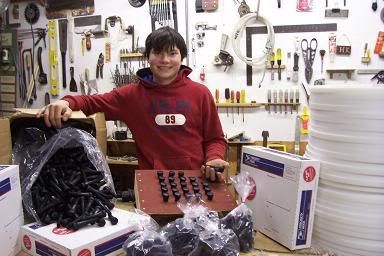
The above photo shows Robert in my shop with some of his plucker finger inventory. The fingers come from the factory in boxes like shown on the left side of the picture. Robert has a “counting thing” he made. It is a board with 25 holes in it. When the holes are filled, he transfers the fingers to a plastic bag (also seen in the photo). Such a system insures that 25 fingers go in every bag, every time.

You can also see several Priority Mail boxes in the photo. Those boxes are already packed with 125 fingers and ready to ship. 125 fingers are needed to make a Whizbang Plucker.

Photobucket - Video and Image Hosting

The above photo is a close-up of the Kent C-25 fingers.

===================

UPDATE: July 2010
In the last three and a half years since I wrote this post, Robert has sold well over a hundred thousand fingers. The little enterprise really took off and he has done well at it. Robert's plucker finger business has now  merged with Planet Whizbang, our family business. Please go to  THIS LINK to purchase plucker fingers.

====================

P.S. If you have not yet read the following poultry-related essays, I invite you to do so:

My Whizbang Plucker Story

My Chicken Plucker Parts Business

The Next Best Thing To A Whizbang Chicken Plucker

Frequently Asked Questions About The Whizbang Plucker

Introducing My Deluxe Homemade Chicken Scalder

Backyard Poultry Processing With My 11-year-Old Son

How To Butcher A Chicken

Talkin’ Bout My Chicken Tractors

Talkin' Bout My Chicken Tractor (Part 2)

Getting Started With Turkeys

Turkeys in Tractors & Comfrey For Feed

FREE Chicken Feed

Poignant Reflections of an Aged Agrarian


Kept The Faith

This day is, in my life, a day to record. I have signed away to a
younger man most of those acres where for many years I have
spent my time and my strength in the labors of a farmer.

There are not so many of us left anymore who know what the
feeling is like to love that land where you have plowed and
harrowed, sowed and reaped, built fences and put up the hay and
herded the cattle.

Now, as the one-time owner of that land, I bid goodbye as to an old and very dear friend. A man and his acres are, after all, not of different kingdoms. The man, the bird, the tree, the clump of grass all have the same Maker, and take their sustenance from the same prodigious earth.

By being human, I trust I have added something to this landscape of hills and valleys, but I could have done nothing without those other forms of life. Now I feel the loss of ties which are formed through labor and association.

Memories are all the harvest that is left.... memories, plus the faith that other hands will do as well or better than mine have done to keep those acres fair to look upon. In a certain way, this land will always belong to me.


The above was found on a single, yellowed-with-age, hand-typed
page that was among my mother’s old family papers (which have
recently come into my possession). No author is given. It could
have been written by my grandfather Percy Philbrick of Fort
Fairfield, Maine. It could have been written by any number of old
farmers across America who, due to advanced age, poor health, or
insufficient finances had to sell their beloved farms.

I wonder, where were the children of this old farmer and those like
him? I’ll tell you. They left the land for “greener pastures”—for
careers in the cities and suburbs. Millions of them left the farm.
They broke their connection to soil and family tradition to pursue
an industrialized version of “the good life.”

In so doing, they and their children would never know a section of
land, a place, like the old farmer who penned the words
above did.

That is a tragedy.

My Great, Great Grandmother's Diary

I have established another blog to tell the story of my great, great grandmother's diary. It is called, Diary of an 1892 Farmer's Wife.

I invite you to stop by and learn about the life of a common farmer's wife in Aroostook county, Maine one hundred and fifteen years ago.


2006/2007
Looking Back & Looking Ahead

Gee but it’s great to be back here after my three week Christmas vacation (from blogging)! The time off has led me to reflect a bit about blogging and some other things…

Why I Blog
I blog because I love to write about Faith, Family, & Livin’ The Good Life. I’ve been writing about these things here for almost two years. My intention from the beginning was to share something of my life with you, introduce and celebrate Christian Agrarianism, help to define what it is, and, hopefully, inspire others as they seek to live richer, fuller, more meaningful lives within this earthly realm. But is not necessarily the main reason I blog…

The Main Reason I Blog
This public record of beliefs and family activities is a record that I am in the process of printing (complete with your comments), hole-punching, and putting into a three ring binder. Actually, one big binder is already full and I’m filling another. It amounts to a lot of acid-free paper and ink but that’s okay. I consider it an investment of the most important kind—an investment in my family. Here’s what I mean…

My three sons only read this blog on occasion. One day they will have more of an interest in the things I’ve written. They will have more of an interest because they are featured in many of the stories and they will want to remember the things we have done here as a family. We are establishing family traditions, developing a unique family culture, making childhood memories--and they are good memories. But these things are, I think, taken for granted by my boys. That’s because they don’t have the perspective of age and life experience.

Such perspective will come in time, perhaps when my sons are grown and have children of their own. It may be when I am dead and gone. Whatever the case, one day, they will seek out and read “dad’s old blog writings,” and they will value them more than they do now at their youthful ages.

Even better, I will be able to “speak” to my grandchildren through the notebooks. I will be able to pass on some wisdom and, God willing, it will serve to make a difference in their lives. This is a small part of the multi-generational vision I have for my family.

Rediscovering a Multigenerational Vision

We live in a time when people think primarily of themselves in the here and now, and give little consideration to future generations of their family. Such self-centerdness is to be expected from foolish, ungodly people, but not from Christians.

Nevertheless, it has been my observation that modern evangelical Christianity is very shortsighted and self absorbed. I think that’s because so many Christians have been led to think they are the Terminal Generation: that they are going to be raptured out of the world in their lifetime.

I read Hal Lindsay’s “Late Great Planet Earth” when I was a teenager, and I listened to Bible “experts” explain how current events were foretold in prophecy. That everything was falling into place. That the Antichrist was waiting in the wings. That the tribulation was about to begin. That the rapture would soon happen. And I believed them. For thirty years I believed them. But they were wrong. I’m still here. I never expected to be here at 48 years of age.

Rapture-centric Christianity leads people to think differently; to make decisions in their lives that they otherwise would not. I know this because I’ve experienced it, and I’ve seen this way of thinking played out in the lives of other Christians.

Why save money for the future if we’re not going to be here? Why plan and leave an inheritance to our children and grandchildren if they aren’t going to be here? Why respect God’s creation if we’re not going to be here? Why get involved in the important issues of our day if we can’t change the course of history because we are in the “end times?” Why have a family vision beyond getting our children saved if Christians will soon be leaving this sorry earth?

As a Christian I believe that Jesus will return because He said he would. I look forward to it. I hope it will be soon. But I no longer listen to the prognosticators who read the headlines and tell how the events fit into Bible prophecy. I do not make my plans and live my life as if I will be leaving at any moment... I have determined that I will, instead, occupy with a long term vision for my life and family….

My Christian Agrarian Family Vision
Way back in May of last year I wrote of My Agrarian Family Vision. With this new year now upon us, I reread that essay and am more convinced than ever that it is correct for my family.

Fact is, I believe the vision outlined in that blog is correct for the church at large. That is not to say that I think everyone should live the life a farmer or homesteader. Clearly, God directs the lives of individuals and families in different ways to serve His purposes.

But the point of my vision, of what I believe in this regard, is that strong, healthy, God-centered families are essential to building the Kingdom of Jesus Christ. What’s more, I believe that strong, healthy, God-centered families are best nurtured and sustained within the agrarian paradigm (framework). Agrarianism is the Biblical and historical norm. Modern, industrialized life is a historical aberration, and like rapture centric theology, it rarely bears good fruit.

Furthermore, contrary to the modern, industrialized, mass-media approach to evangelization, I believe the most effective Christian outreach is achieved by Christian families, and small independent churches composed of Christian families, living simply and being salt and light to the community they live in. There is plenty of room within this way of life for missionary outreach and other ministry endeavors, as God leads.

Such a vision for life is not very “exciting” to the modern mindset. Modern Christianity likes to think up bigger, more clever, more organized, and more carefully crafted evangelistic outreaches for winning souls to Christ. Such industrialized methods work because they have the numbers to prove it. But I’m not convinced. It looks to me like much of the modern Christian “experience” is shallow and self-centered. It is also heavily syncretized with worldly attitudes and customs.

The Christian agrarian approach to life and Christian ministry is slower, less measurable, more personal, more intertwined with the daily life and work of the family. It results in a faith that I think it is deeper, more humble, and more firmly rooted. I may be wrong, but I think this is closer to the way that God intends for His people to live and interact and influence the world around us.

The average modern Christian can not accept this because of his industrial mindset. And he does not think multigenerationally. He wants big, measurable results, now and if he doesn’t get those things, he thinks something is wrong with his approach. Well, yes, there is.

The way I see it God has always worked through families, over generations, to achieve His purposes. Those families have typically lived simple agrarian lives. From such families, God has sometimes called out individuals to do great things for his kingdom. It is something to think about.

Looking Back on 2006
Last year was a blessed year here on our little homestead. Not everything went as well as we would have liked. There were struggles and disappointments, but that’s nothing new.

Back in April we thought we would buy the big old Grange Hall in Moravia. I even put a purchase offer in for the property and it was accepted. I wrote about it here and in subsequent blogs. But the deal fell through. It fell through because I had justified to myself that it would be okay to go into debt for this thing; I felt it would help me to achieve my family vision for more land and a a more viable family economy.

There is, however, something deep within me that abhors debt. I fear being a slave to the lender. I’m not saying all debt is wrong. I’m not passing judgement on anyone who borrows money. I’m saying that I am persuaded that God gave me a family vision and that He will provide in His time. My job is to trust Him and glorify Him by focusing on being a father to my children, working diligently with my mind and my hands, and being a wise steward with the resources He has entrusted to me.

Sometimes that is hard for me. I am a motivated person. If I set my mind to something I am inclined to drive towards it with singleminded determination, forgetting the more important things like faith and family along the way. My challenge is to maintain the balance. To stay centered. To be patient. To wait on the Lord. He has corrected me before. He has humbled me. He has taught me that He is in charge, not me. He doesn’t get with my program. On the contrary, I must move according to His word, His will, his leading. I don’t want to learn any more hard lessons. So I work and wait and trust, and there is great peace in that.

With the proper focus in mind, I have to say that my favorite blogs of last year were Backyard Poultry Processing With my 11-Year-Old Son and The Charging Woodchuck. Another family-centered blog of last year that is particularly dear to me is What My Grandmother Did For Me.


Home Business Adventures
Viable home businesses are integral to my agrarian family vision. I have a full time job in a factory but Marlene and I are working on several fronts to build home businesses that we can involve our children in or, at least, use to inspire them to pursue their own home businesses. .

Marlene has her farm market bread business which my son James has been very involved in. Just yesterday he told me he can’t wait until June so he can do the farmer’s market and make some money. Marlene also has her soap business which grew in 2006.

I published an unusual book last year in April. You can read my reasons for publishing Writings of a Deliberate Agrarian here. I’ve tried to find a distributor for the book but have had no success. The book has not sold very well. But it has sold some and readers have contacted me to tell me that they were blessed by the essays.

The only negative comment I’ve had is that I’m not very nice to “Moderns.” Well, it’s true. I’m guilty. What can I say? Sometimes the truth hurts.

Writings of a Deliberate Agrarian will be an obscure, underground, “subversive” and, to some people, offensive, little book. So be it. I believe the Lord has, and will continue to direct the book into the hands of those He wants to read it, and I am content with that.

One of my other businesses is growing garlic and making garlic powder. I blogged about how I plant my garlic last year. I blogged about selling my garlic powder at the farmer’s market too. And I blogged about the simplegarlic bulb dryer I invented.

A writer for “Farmshow” magazine found out about my garlic dryer and garlic powder business and an article should appear in a future issue of the publication. Isn’t that neat! Oh, by the way, I am now sold out of Herrick’s Homegrown stiffneck garlic powder. My thanks to all of you who purchased some.

My chicken plucker parts business is yet another home enterprise we have here and the Lord has greatly blessed the sale of these parts in the past year. My son Robert and I are currently working to get a big supply of the “featherplates” built ahead. And son James is helping to assemble parts for the idler arm hardware kits. I love to fire the woodstove up in my shop on a cold winter day and have my sons help in a very tangible way to make this business a success. Thank you to everyone who purchased parts to build your own Whizbang Chicken Plucker last year!


Looking Ahead to 2007
2007 will find me continuing to focus on faith, family and living the Christian agrarian “good life” while pursuing my agrarian family vision. I will soon launch into another book project. This year’s book will tell how to build a very useful “Whizbang Workhorse” garden cart. Lord willing, it will be in print by spring. My own Whizbang garden cart has been put through the paces for four years now. It is among the most versatile and useful homesteading tools I own.

Last year I developed a Whizbang apple crusher. This year I plan to develop a cider press to compliment the crusher. Then, perhaps next winter, I will publish plans telling others how to make their own crusher and juice press. I am thinking long-term with the books. The garden cart book has been on my mind for the past few years but only now am I determined to get it together and published.

My 15 year old son Robert expressed an interest in having an internet mail order business of his own. I suggested an idea. He liked it. I will be telling you more about this new business shortly.

I have set a goal for myself this year to learn how to make my own web site. I see this as necessary to building a sustainable home businesses; to establishing a viable family economy. Software and books are on the way now. It is way past time for me to buckle down and do this!

Another little goal for the year is to learn how to make hand-cut dovetails. I got a Lonnie Bird video on the subject for Christmas. In keeping with my “Yeoman Furniture” blog of last year, I want to make a big, old-style blanket chest with hand-cut dovetails. Stay tuned.

There is also, of course, work to be done in the garden and on the house in 2007-- two things that are always ongoing and time consuming. In the midst of it all, I want to take more walks with my sons--like we did last month, day before Christmas, as shown in the photos that follow. It is not often that we here in Central New York enjoy such beautiful weather in late December!

Here is wishing you and yours a new year filled with the best things life has to offer: things like spiritual renewal and a closer walk with the Lord, family closeness, creativity, hard work, joy in your work, rest from your labors, creativity, wisdom, discernment, and the peace that comes with knowing that God is in charge and you are not.

Yours truly,

Herrick Kimball


Photobucket - Video and Image Hosting


Photobucket - Video and Image Hosting

Photobucket - Video and Image Hosting

Christmas Break...

Dear Friends & Fellow Agrarians,

Every so often, I need to take a break from blogging. It isn't that I get tired of writing here. On the contrary, if I had the time, I would write here even more!

But, for a few weeks, I need to focus on some other projects.

Let's meet back here on New Year's Day, 2007. It's only about three weeks away.

Have a Merry Christmas.

Herrick Kimball

ACRES of Hope America: A Christian Agrarian Ministry

A couple blogs back, I wrote about The Elder Agrarian: C.F. Marley. It was Mr. Marley who introduced me to the National Catholic Rural Life Conference, an organization devoted to encouraging rural family life and sustainable stewardship of the land. I asked the question: ”Can someone tell me of a comparable Protestant organization?” Well, someone did.

When I got home from work this afternoon there was a phone message for me from Barry Morgan who told me about a ministry called Acres of Hope America. Please go to the web site now and see what it is about. You will notice the site is under construction. That’s because Acres of Hope America is a fledgling ministry. But it is, I believe, a ministry with a God-inspired calling.

I say that because this evening I spoke with Mr. Morgan. He and his wife, Lynne, have, after much prayer, started the Acres of Hope America ministry, and Barry is currently working at it full time. My impression of Mr. Morgan is that he is a sincere and capable man with a Christian agrarian vision for localized rural renewal, that he has a lot of practical ideas to help make such renewal a reality, and, most importantly, I sense that the Lord is going to bless this unique ministry.

Fact is, after talking to Mr. Morgan, I’m downright excited about this non-denominational but solidly Christian-agrarian ministry, and I hope to be giving you more details about it in the future.

Starting a National Christian Agrarian Association

Every so often someone will bring up the idea of starting something akin to a National Christian Agrarian Association. It is a well-intentioned idea that I’ve given much consideration to and I’d like take this opportunity to publicly state my thoughts on the matter.

Let me say that the idea of a large Christian-agrarian gathering was discussed at one time and I was asked if I would be willing to be a speaker. And, as I’ve mentioned, I have also heard of the idea of starting some sort of official Christian agrarian organization.

I am not against such a gathering, or such an organization, but I would not support them. My reason for saying that is that I see the Christian agrarian movement as a movement of the Lord in individual hearts. I believe He is leading individual families back to agrarian life and culture. I am not convinced that it would serve any truly constructive purpose to establish a large-scale Christian-agrarian club or fraternity-like organization. Would it draw media attention to the movement and expand our ranks? Well, I’m sure it would, but I’m not convinced that is a proper thing for any of us to be doing

Personally, I do not want to travel the country and speak, as has been suggested to me that I could do. I want to stay home, to be with my family, to work around my little homestead. I want to, God willing, buy some land someday and establish family-centered agrarian enterprises. Yes, traveling and speaking and such would help me spread the Christian agrarian message, and sell more of my books, and that would help me to earn enough to buy the land, etc., etc. But I don’t want to compromise, or significantly alter the agrarian life I enjoy in order achieve my family vision. It smacks of hypocrisy and any Christian agrarian worth his salt would see right through it.

Beyond building a membership and establishing some sort of political voice, I wonder what the practical purpose of a National Christian Agrarian Association would be? Would it be to encourage and inspire others in their Christian agrarian journey? If so, I see that being achieved right now (right here, even!) in an agrarian, decentralist, manner by individuals and families who are, from the comfort of their homesteads and farms, blogging, writing books, publishing periodicals, making movies, recording interviews, and teaching classes. They are doing this as the Lord leads them and they are having an impact.

And if we need hats or t-shirts or bumper stickers to identify our Christian agrarian inclinations, some home-based Christian family enterprise can provide those too!

As for effecting political change, that can be done by home-based internet activists too. The grassroots internet-based resistance to NAIS is an example of that.

No, I do not see the need for any manmade Christian Agrarian Organization. Let’s live simply while prayerfully focusing on the work of home, church, community, family enterprise, and local ministry, all the while watching as the Lord orchestrates this Christian Agrarian movement for His good purposes.

~~~~~~~~~~

P.S. My thinking on this matter does not extend to small scale, Christian-agrarian ministries which would serve to establish sustainable, localized, rural renewal and help support rural family life. Ministries like ACRES of Hope America which I'll tell you about in my next blog entry.


Flee to the Fields

Dateline: 7 December 2006


I see that Rick Saenz has already written about the book, Flee to the Fields: The Founding Fathers of the Catholic Land Movement over at his blog, Dry Creek Chronicles. So I suggest you go there and read what he has to say.

For my part, I will provide you with a few excerpts from the new introduction of the recently reprinted version of the book....

“The industrial regime, as Hilaire Belloc noted in the original preface to this book, has but one goal, and that is the accumulation of material wealth. To the orthodox Catholic, this all-consuming desire wrought terrible social consequences. Industrialism centralized production and thereby created a monopolistic economy under which millions of people had been forced (or seduced) from farm and village, to take up a barrack-like existence in burgeoning cities. The loss of property subsequently reduced most Englishmen to a state of economic servility, in which they were wholly dependent on industry for survival. Likewise, this impoverished proletariat could be easily manipulated through elaborate social programs enacted by a government that was firmly under the control of the new industrial ruling class. But perhaps the most troubling consequence of industrialization was that it created conditions under which a healthy religious culture could no longer flourish. For, by severing human beings from family, community, and nature, industrialization had effectively dissolved the primordial bonds that made religion tangible, and hence believable.”


~~~~~

“In countering industrialism, the Catholic Land Movement did not attempt to create an agrarian utopia, nor was it a Luddite rejection of technology. Rather, it was a prudent approach to economic life that was based on small-scale agriculture, craft-making, and retailing.”


~~~~~

Thus, by relying on the household, family, community, and nature’s bounty to provide as many basic needs as possible, people could free themselves from economic dependence and the political control of the plutocrats, and thereby regain a modicum of human dignity and freedom.”


~~~~~

“It was this desire to sustain an agrarian Christian culture against that of industrialism, rather than a desire to return all of society to some mythical agrarian past, that was the essential social vision of the leaders of the Catholic Land Movement.”


~~~~~

“By reclaiming the household as the center of economic life, and by relying on thrift, physical labor, and frugality, all Christians are capable of battling the corrosive effects of industrialization. In pursuing such a philosophy the long-term goal of a more humane and decentralized economy can be realized. For it is only when economics again becomes subservient to religious mores that the virtuous life is possible.”


~~~~~

I have yet to really dig into this book. When I do, perhaps I will post some more quotes. If you would like a copy of the book, check out www.ihspress.com


C. F. Marley:
The Elder Agrarian

Dateline: 6 December 2006

C.F. Marley

A few months ago I got a phone call from a guy by the name of C. F. Marley in Nokomis, Illinois. Mr. Marley had heard about my Whizbang Chicken Plucker and wanted to know more. It so happens that C.F. is an agricultural writer. That in itself was kind of interesting to me, but I soon discovered many more interesting things about Mr. Marley.

We had not spoken long when C.F. informed me that he was a Christian agrarian. That was something of a surprise because there are not many of us around. He told me he is a Catholic Christian agrarian, and that he had been one for a long time. I found out later that C.F. Marley is 85 years old.

When C.F. asked me if I had ever heard of a book by the name, The New Agrarian Mind: The Movement Toward Decentralist Thought in Twentieth-Century America, by Allan Carlson, I was even more surprised. I told him it was in my bookcase and I consider it an excellent book.

I sent C.F. a copy of my Whizbang Plucker plan book and my Chicken Scalder book, and I included a copy of my Christian-agrarian memoir/manifesto, Writings of a Deliberate Agrarian. In return, C.F. sent me some information about the National Catholic Rural Life Conference. It turns out that, years ago, he edited NCRLC publications and was a board member.

I discovered the NCRLC is an organization that supports and encourages rural family life and sustainable stewardship of the land. Their work is, of course, centered around the Catholic Christian worldview.

The NCRLC web site says its mission to “support and empower rural people is made more necessary by globalization and world environmental issues.” It is clearly a Christian agrarian organization, and it has been around since 1923!

Now, I have to say that it looks to me like the NCRLC has a handle on something very important. I suppose I shouldn’t say that, being a Protestant, but it’s true, so I did say it. Can someone tell me of a comparable Protestant organization? We Protestants are often so heavenly-minded (or so we like to think) that we are no earthly good. I suppose I shouldn’t say that either. But if the shoe fits….

Anyway, Mr. Marley wrote me and said that a rural Iowan priest, Luigi Ligutti, “is the man who pulled me into this whole thing.” I knew Ligutti’s name from Allan Carlson’s book. There is a whole chapter devoted to him and what he did to advance the agrarian movement starting back in the 1930s.

But, to tell you the truth, I barely read that particular chapter. After all, I’m a Protestant. I don’t believe in transubstantiation. What could I possibly learn by reading Catholic thoughts about agrarianism? Really, that’s what I thought. And by thinking that, I shut myself off from a lot of very good agrarian writings that I’m just starting to discover.

This doesn’t mean I’m going to become Catholic. It simply means that, believe it or not, some of those Catholic writers have a very good insight into the social problems that arose out of the Industrial Revolution. Problems that have only gotten worse. Problems that Christian agrarianism, Protestant and Catholic, can provide solutions for. Now there I go again, saying things that, as a firmly-grounded Protestant, I probably shouldn’t.

C.F. photocopied and sent me a couple pages from Ligutti’s 1940 book, Rural Roads to Security: America's Third Struggle for Freedom. He recommended that I read the book, and I will.

Being a Christian agrarian and agricultural writer, C.F. saw and objected to the changes that were coming into traditional family farming back in the 1950s. It started with the introduction of factory broiler and egg systems. Then factory hog production. Marley warned that factory farming (the industrialization of agriculture) would lead to the ruin of small family farms and rural culture. That would, I suppose, make him something of a prophet.

C.F. also relayed to me that he had serious concerns about the shift towards regional government, something he learned about in the mid 1960s. A consortium made up of people from the largest corporations in America, operating under the name, “Committee For Economic Development,” called for merging local governments out of existence and substituting regional government run by “specialists.”

I became aware of the plan and threat of regionalism back in the 1980s when I joined an organization called, The Committee to Restore the Constitution. Regionalism is nothing short of the industrialism of government and it has largely come to fruition. C.F. rightly saw the scheme as a threat to Constitutionally mandated checks and balances and separation of powers.

With that thought in mind, C.F. Marley, who is a decorated veteran of World War II, went into battle again, this time in the political arena. He ran for state office in 1970. His platform: 1) Guarantee autonomy for municipal townships and county governments. 2) Guarantee local control of property taxes. 3) Allow people of the state a direct vote in lawmaking (referendum). But Marley was a voice crying in the wilderness and not your typical political candidate. “People would not listen,” he says.

I guess not much has changed in that regard. As we “slouch towards Gomorrah” few people care about the erosion of the wise Republican form of government our forefathers gave us. As long as the television and GameBoy work, the cupboard is stocked with junk food, and there is “gas in their Ford,” most American families are comfortably amused and sedated.

I thank God there are people like C.F. Marley, who are not content to be passive while things like truth and individual liberty are trashed by those conniving interests who see such things as stumbling blocks to their selfish pursuits. It was people like C.F. Marley who made this country great, and it’s people like him who will preserve it, if it is to be preserved. Christian, patriot, populist, constitutionalist, agrarian, family man (seven children), and still writing with interest and passion at 85 years old, I feel inspired and honored to have met this elder agrarian.


A Reflective Ramble About Salvation & Prayer

Dateline: 5 December 2006

Billy Graham, in 1970

When I was a kid my family rarely attended church. So when I ended up at Boy Scout camp one Sunday morning, I was presented with a dilemma... Should I go to the Protestant service or the Catholic service? I didn’t know the difference.

A couple of my friends asked me if I was Catholic or Protestant. When I told them I didn’t know, they said, “You’re Catholic. Come with us.” So I followed them, and discovered that I was not Catholic.

Not long after that, I was watching a Billy Graham crusade on television. I listened to Billy Graham explain that, because of Adam’s sin, all men were sinners. He was talking to me. I knew I was a sinner and it became clear to me that, because of my sin, and because God is holy, I was separated from Him. That being the case, I was destined for hell.

Billy Graham explained that God provided a miraculous solution to the problem of sin by sending His son Jesus to Earth. He said that being good didn’t get a person to heaven, because none of us can meet God’s standards. By ourselves, by our own efforts, we don’t have a chance. But Jesus willingly gave His life when he was crucified on the cross and, in so doing, he took the penalty for our sins. Jesus paid the price.

Mr. Graham explained that in order to be saved, I needed to admit I was a sinner and accept Jesus into my heart by praying a prayer, and that’s what I did. I think I was 13 years old.

Now, thirty-five years later, having grown considerably in my Christian faith, I wonder if I chose Jesus or did He choose me?

Clearly, what seemed so obvious, and simple, and true to me back then does not come across the same to so many other people. That being the case, I've come to believe that God, through His Holy Spirit, supernaturally opens individual hearts to the reality of who He is and what He has done, and in so doing, enables them to find the salvation He offers only through the shed blood of His beloved son.

I have had plenty of discussions with friends through the years who do not share my Christian faith. They reject it outright, or embrace a worldly view of Christianity—a Christianity in which Christ is not the focus. God is not holy to them. They do not respect His law. They do not know Jesus as their Lord. They may mentally believe in Him, but they do not follow Him.

No matter how well I point out the error of their pagan belief system, they cling to it. Theirs is a religion of doubt and unbelief. How can they not see the obvious? Because God has not revealed it to them. And why not? I don’t know why not. But I do have an idea why not.

In recent months I have been convicted more than ever that the most powerfully effective way to “lead someone to Christ” is through prayer on their behalf. In fact, it has occurred to me that it might be only through the prayers of other Christians that any unsaved person comes to a saving knowledge of Christ. Now that premise may not hold theological water, but it’s what I’ve been thinking, and it is something I have been keeping in mind as I pray for others.

I’ve also felt led, for the past few years, to pray more for people I don’t know. Specifically, for my future daughter-in-laws, whoever and wherever they are, that God would work in their hearts and draw them to Him, that He would prepare them to be godly wives and mothers to my grandchildren. And I pray regularly for those yet-to-be-seen (but so greatly looked forward to) grandchildren. On occasion, I’ll pray for the next generation too.

All of which leads me to wonder….. Who prayed for me? How have I come to a life-transforming knowledge of, and a close relationship with, Jesus Christ while others in my family have not? How have I come to avoid so many of the heartaches of rebellion and sinful life choices while others I know have not? How is it that I went to a secular college and actually grew in my faith while other “Christian” kids around me turned away from Christ? It is a mystery. But I keep thinking that someone must have prayed for me, from an early age, perhaps before I was born, and those prayers are what made all the difference.

My grandmother Kimball and my maternal grandmother, Gertrude Philbrick, were women of faith. Did they pray for me? I’m sure they must have.

My Grandmother Kimball once gave me a small, worn, Gideon pocket Bible that belonged to her mother. I have only a brief recollection of my great grandmother, Kate Towle. But I have her little Gideon Bible and inside the cover, under where she wrote her name, is a blank line to fill in “when you received Christ as your savior.” In the shaky handwriting of an older person she wrote: “Many years ago.” Perhaps my great grandmother prayed for me. 

There may have been others. Of course, my mother was praying for me later in life, after she experienced a spiritual renewal (she watched the Billy Graham crusades back in the day too). Perhaps there were more distant relatives or neighbors I never really knew who prayed for me, or even just someone who looked at me as a little boy somewhere and said a prayer for me. 

Have you ever done that—Prayed for a little unknown child's salvation? Have you prayed that spirits of sonship and adoption would work in the childs life to lead him or her to Christ, because God put it on your mind to do so?

If not, you really should. It may be among the most important things you ever do in your life. And that makes me think of something else….

As Christians we know that prayer is important, that we are called to prayer, that prayer changes things. But most modern Christians do not pray as they should, like they could, like they otherwise would, if they didn’t live a fast-paced, busy, busy, busy lifestyle. I am among them.

I could blame it on the Industrial Revolution. In fact, I will do just that… The Industrial Revolution changed it all—even down to the prayer life of God’s people

But that is no excuse.

I believe the agrarians of yore were more inclined to prayer because they lived and worked closer to the natural world, closer to creation, a creation that reveals the Creator in so many ways. 

Even something so simple, yet so remarkably beautiful as a summer sunset, is a metaphor for Christ. The sun setting in a red sky: the sun is Jesus. The red sky signify’s his blood shed for sin. The darkness to follow signifys death. But then, in the morning, the Son rises bright. No wonder I feel like praising God when I stand in my garden and watch a summer sunset.The message of redemption and resurrection is "preached" by creation every day.

Well, today’s blog has ended up being a ramble. Believe it or not, I intended to tell you about a book I am reading titled, Flee to The Fields. It is about the Catholic Land Movement. I guess we can talk about that next time.


The Most Challenging
“It’s a Wonderful Life”
Trivia Quiz in The World

Dateline: December 2006
Updated: December 2011


In my previous blog entry I talked about the classic movie It’s a Wonderful Life. The movie is so endearing, and so many people have watched it so many times (people like me) that we have started to take note of the smallest details. Such details are trivial, but they are fun to notice and know.

With that in mind, I once saw a trivia quiz for It’s a Wonderful Life and it was supposed to be difficult but I found it way too easy. That made me think that I should put together my own “hardcore” trivia quiz for the movie, and that’s what I’ve done. I think it might be the hardest “It’s a Wonderful Life” Trivia Quiz in The World.

The answers to the following 57 questions (it’s a long trivia quiz too) are found in the movie. I do not ask questions like: Why is Mr. Potter in a wheelchair? (Answer: Because Lionell Barrymore, the actor who played him, was wheelchair bound in real life). And I won’t ask you: What actress who later starred in The Waltons television show had a small part in the movie? (Answer: Ellen Corby--a.k.a., Grandma Walton). So you need look no further than the movie itself for your answers.

This quiz is my gift to you.

Best wishes,

Herrick Kimball

~~~~~~~~~~

1. The movie takes place in a fictional town by the name of Bedford Falls. What state is Bedford Falls in?

2. An angle named Clarence is given the job of being George Bailey’s guardian angle. What is Clarence’s last name?

3. In one part of the movie Clarence is asked how old he is. After thinking about it, he says: “Two hundred and ninety three…. Next May.” What kind of work did Clarence do on earth before he became an angel?

4. Clarence is said by one of his heavenly superiors to have the I.Q. of what animal?

5. In the first scene of the movie we find a young George Bailey in 1919 snow sliding down a hill with his friends. What are the boys sliding on?

6. How old was George when the snow sliding scene takes place?

7. How old was George’s kid brother, Harry, in 1919?

8. George loses the hearing in one ear as a result of jumping in the ice cold water to save Harry. Which ear does he lose his hearing in?

9. Mr. Potter is the “richest and meanest man in the county.” What is Mr. Potter’s first name and middle initial?

10. As a boy, George has an after school job at Old Man Gower’s drug store. Mr. Gower receives a telegram telling him that his son has died. What was his son’s name?

11. How did Mr. Gower’s son die?

12. Drunk and grief-stricken over the death of his son, Mr. Gower mistakenly dispenses poison capsules and tells George to deliver them. George returns later without having delivered the capsules because he knew they were poison. Mr. Gower is initially angry at George for not delivering the capsules. How many times does Mr. Gower slap George?

13. What was George Bailey’s father’s first name?

14. What was the last name of Ernie, the cab driver?

15. What is the Bailey family’s housekeeper’s first name?

16. What year did George’s kid brother, Harry, graduate from high school?

17. George decides to go to the high school party, where he and Mary dance. What is Mary’s last name?

18. What is Mary’s older brother’s name?

29. What was the first and middle initial of Mary’s father?

20. What kind of dance contest did they have at the high school party?

21. What was the prize for winning the contest?

22. After the dance, where George and Mary fall into the swimming pool under the dance floor (by the way, that scene was filmed at an actual school with a swimming pool under the floor) George and Mary walk home. What is the name of the song they sing together?

23. George and Mary are wearing dry clothing they got from the high school locker room. George has a football uniform on. What number is on the front of the uniform?

24. Mary’s robe has four letters on the back. What are they?

25. At one point in the walking home scene, George says: “What is it you want Mary? What do you want? Do you want the moon? Just say the word and I’ll throw a lasso around it and pull it down. Hey, that’s a pretty good idea. I’ll give you the moon Mary.” Mary replies: “I’ll take it. Then what?” To which George says: “Well then you could swallow it and it will all dissolve, see, and the moonbeams would shoot out ____ ___________ and _____ _________ and the ______ ____ _______."(fill in the seven words)

26. After George accidentally steps on Mary’s robe and it comes off, she hides in what kind of bush?

27. How old is Uncle Billy when his brother dies?

28. Besides Uncle Billy and George, there are two other employees of Bailey Brother’s Savings & Loan (I think they are Uncle Billy’s children). What is the first name of the man?

29. What is the first name of the woman employee?

30. George’s brother Harry comes back from college with a wife. Her first name is Ruth. What is her maiden name?

31. Ruth’s father has offered Harry a job. What business is her father in?

32. During the bank run scene, Miss Davis (played by the future Grandma Walton) asks George if she can have how much money?

33. George and Mary spend their honeymoon night in the old Granville house (at 320 Sycamore). They are serenaded by Bert the cop and Ernie the cab driver. After the song is over, one of them kisses the other on the forehead. Who kisses who?

34. After helping move the Martini family into their new home in Bailey Park, George and Mary present the family with three things. What are they?

35. Potter tells George he has frittered his life away playing nursemaid to a lot of “garlic eaters” and offers him a job with a three year contract making how much per year?

36. What notable thing did Mary’s brother do in World War II?

37. What did Mr. Potter do during World War II?

38. Why didn’t George go into the military during World War II?

39. Who was wounded in North Africa and got the Silver Star?

40. What is Violet’s last name?

41. How much money does Uncle Billy lose?

42. What is the name of the bartender at Martini’s Bar?

43. George and Mary have four children. ZuZu is the youngest. What are the names of the other three children?

44. ZuZu’s petals come from a flower she won at school. What kind of flower was it?

45. Where does George first pray for guidance from God after Potter turns down his plea for a loan?

46. What is the last name of the man who punches George in the face and knocks him to the floor after he prays the prayer?

47. At exactly what time on Christmas Eve does George “think seriously of throwing away God’s greatest gift?”

48. Where would Uncle Billy have ended up if George had never been born?

49. Uncle Billy’s wife is deceased. What was her first name?

50. Who does Clarence call to for help when Bert the cop tries to handcuff him?

51. What was the bank examiner’s name?

52. Where did the bank examiner want to spend Christmas?

53. At the end of the movie, all of George’s friends come to the Bailey home to help George with donations of money. What Christmas song do they sing?

54. When Violet shows up at the Bailey home, she returns the money George had given her to go to New York City. She tells George she changed her mind. The movie then shows George silently mouthing two words. What are the words?

55. On top of the pile of money his friends have given him, George finds Clarence’s book. Inside the book Clarence has written: “Dear George, Remember no man is a failure who has friends. What was the title of Clarence’s book

56. There is one scene in the movie where a dog is barking. And if you look closely, you can see part of the dog, but only for a split second. Where does this scene take place?

57. How old was Uncle Billy when he and George’s father started the Savings & Loan?

===============
UPDATE 2011— It was my original intention to provide another blog entry with answers to these questions but I don't know if I will ever get to it. Looking down through these questions now, I realize I have forgotten some answers. I'll be watching for them when my family watches the movie again this year.
================