Backyard Sugarin’
Part 1
Why We Do It

Dateline: 7 April 2008

Yours truly collecting maple sap

Chapter One of my book, "Writings of a Deliberate Agrarian," is titled, The Breakfast of Agrarians (Click here to read chapter One). When you read that short story, you will discover that my family makes our own maple syrup. We do this on a very small scale in our backyard using a relatively simple procedure. Our yearly production of the heavenly-flavored maple sweetness is around five gallons a year. But this year we ended up with a harvest of eight gallons. It was a good year for making "maple."

In this series of essays I will introduce you to the idea of Backyard Sugarin’. Then, in the next four essays, I’ll tell you about how we tap trees, collect sap, boil it down, and finish it off. I’ll also provide lots of pictures along the way.

Some people question why I make maple syrup at all. They see it as a lot of work for a relatively small amount of finished product.

“Wouldn’t it be easier to just buy maple syrup?” That’s the kind of question I get from people who have never done Backyard Sugaring. Folks who have made their own maple syrup don’t ask that question.

And then there is the matter of cost. When my coworkers hear that I’m actually taking a few hours off from work to help make a few gallons of maple syrup, they question the economy of it: “Boy, that’s going to be some expensive maple syrup when you figure your time off into the equation!”

Well, it so happens that making maple syrup with my family isn’t about saving money, and it isn’t about doing what’s easy. It’s all about working together as a family, doing something that is productive and enjoyable, which doesn’t cost much money to do. It’s all about getting outside in the fresh spring air, walking through the woods, feeding a wood fire, and standing over a boiling pan of tree sap, while breathing in the maple steam. In the end, we end up with sweet memories and sweet syrup.

So that’s why we make maple syrup.

People who have done their own Backyard Sugarin’ (even if not as a family tradition) don’t question the economics and work involved. They know there is an intangible something that is very special and downright satisfying about making maple syrup. Rink Mann, in his book, Backyard Sugarin' puts it this way:


”I’ve got to say that there is something magical about sugarin’, and if you talk with people who make maple syrup, either in a big commercial evaporator or out in the backyard, you’ll find out there’s a lot of agreement on that fact.

Maybe it’s the time of year—the warm sun climbing higher into the sky, warming the back after a long winter, turning the snow to piles of white corn, turning the brooks from trickles to torrents, starting the maple sap flowing—a sort of hint of the Spring and Summer lying ahead. Maybe it’s the drip drip of sap falling into the buckets, the telltale aroma of boiling sap, or the hissing sound of sap in a rolling boil. Maybe it’s the magic of converting sweet water, as the Indians used to call it, to delicious golden syrup. But whatever it is, it’s there.


My first experience with making maple syrup came, like so many other first experiences, after high school when I headed off to further my education in Vermont. While there, I spent part of a spring day helping collect sap from buckets hanging on trees, and I spent some time watching the boiling operation in the sugar house. I experienced my first drink of warm maple syrup, right out of the evaporator. One drink, and I was hooked.

It would be a few years before I had land of my own with a few maple trees, and a few more years after that before I finally got around to getting my own sugaring operation going. Part of the delay was that I didn’t really think I had enough trees to justify making syrup, and the sugaring equipment was expensive.

Only after I read the book, Backyard Sugarin’, by Rink Mann did I realize that I didn’t need a lot of trees and I didn’t need all the fancy maple-syrup-making equipment. That book opened my eyes to the whole concept of really-small-scale backyard maple production. It is a very good book that I recommend wholeheartedly. Mr. Mann has this to say of Backyard Sugarin’ in his Introduction:


”The real challenge in backyard sugarin’ is to find ingenious ways to collect and boil down sap without spending any money, and I must say I found a whole breed of like-minded people. Backyard sugarin’ builds interesting friendships, a kind of fraternity, I suppose, born of a mutually parsimonious nature.”

I like to think, too, that most backyard sugarers must have a little of the moonshiner’s blood in them. And there are a surprising number of similarities between boiling maple sap and distilling out the old mountain dew. In both cases you’re separating water from something else. In the case of sugarin’ you want what’s left in the pan after the boiling, while with moonshining it’s what comes off that counts. In both cases, too, you try to set up operations in a nice secluded spot, where you won’t get laughed at for your mechanical eccentricities (in the case of sugarin’) or arrested (in the case of moonshining).


The title of this series of how-to essays is the same as Mr. Mann’s book because his whole philosophy of small-scale, home-scale, on-the-cheap syrup making is summed up nicely in the book’s title; Backyard Sugarin’. His informative little book was the inspiration I needed to make my own maple syrup. Perhaps this series of essays will be the inspiration you need to start making your own maple syrup.

To be continued....
Click Here to go to Backyard Sugarin' (Part 2): Tapping Trees


CLICK HERE to check out the Wood family's "Sap to Syrup" DVD


Peak Grain

I stayed for dinner after church today and, in conversation, the topic of wheat came up. If you didn’t know already, wheat prices have more than doubled from what they were a year ago. My pastor follows the grain market pretty closely. He told me the U.S. grain reserve is gone. There is no reserve. There used to be a surplus reserve of grain in this country. But it’s gone.

If that is true, it is an ominous development.

I decided to look into the subject with a Google search. I discovered a prophetic article written a year and a half ago that talked about the very low reserve of wheat and other grains. The article stated that prices were going to rise. But that will be just the beginning.

It behooves you to read the article. It is not long. It is not difficult to understand. Remember, it was written eighteen months ago. It was written before the price of wheat jumped so dramatically. It was written before your average Joe had a clue any of this was going to happen. Some people can see the handwriting on the wall. We need to take heed. Here is a link to the article:

Grain Drain: Get Ready For Peak Grain

And here is another similar article, written at the same time:

How Long Can The World Feed Itself?

Of Small Houses & Cheap Alternative Housing Options

A friend of mine recently told me that in his town the building code does not allow anyone to build a home that is less than 900 square feet. That got me to thinking about how I really hate it when the government makes such stupid and oppressive laws—especially local governments in areas that are mostly rural.

When Marlene and I built our house—the one we live in now—back in 1985 it measured 16 feet by 24 feet with two floors (no basement). That amounts to 768 square feet. We have since added on to the house so it now amounts to 1,650 square feet. The house is still relatively small, especially with three boys (all in one bedroom). We would love a larger house someday, but what we have is sufficient. Our house is a home. We are content and thankful for what we have.

I can tell you that small houses have their advantages. For one thing, they are cheaper to build. As I explain in my book, Writings of a Deliberate Agrarian, Marlene and I borrowed $10,000 from her father to build our house, and we did the work ourselves. The house is not fancy but it is built very well. There was never a bank loan and the house is now paid for. I’m thankful for that too.

Another advantage to a small house is that it costs comparatively less to heat in the winter, as I have mentioned here a few times in the past. Maintenance costs are also comparatively less. After 23 years, I’m going to need a new roof on the original structure and it won’t break the bank to get that done. Of course, it helps that I’ll be doing the actual roofing work myself.

Looking back, if I had it to do all over again, and I had the same limited financial resources, I’d build a small house just like I did. Perhaps I would incorporate more salvaged materials. I did that with some windows and a staircase, but could have done it to a greater degree. I have an uncle in Ohio who built his house and several outbuildings using almost all salvaged materials, including a slate roof. His house has been featured in Fine Homebuilding magazine.

Or maybe, in retrospect, I would do it just a little bit differently. I now think it would have been wiser to find a good section of land and buy that first. Forty acres would have been nice, with some woods, and some field. The one and a half acres I bought back then, and live on now, is hardly big enough to hold us with all of our homestead projects. What's funny though is that I've gotten e-mails from people who lament that they have only 8 or 10 acres to homestead on.

In any event, with my 40 acres in place, I would have lived in some sort of “alternative” housing to start, while saving to build a more permanent and conventional house. The best alternative housing would be low-cost and not incur any additional property taxes.

One such form of alternative housing would be some sort of camper/trailer. I’ve heard old pull-behind campers can be had surprisingly cheap. And I know people who have lived in them, on their land, for a long time.

Another option is a yurt which is the traditional home of Mongolian herdsmen. I once watched a very unusual documentary movie titled The Story of The Weeping Camel. The best part of the film was seeing the yurt the the Gobi desert herding family lived in. It was roomy and strong and warm in the cold weather. Since yurts are portable structures, I don’t think they would be taxable.

I have long had a hankering to live in a yurt. In fact, I have this idea that someday, when/if I can finally afford to buy a section of woods and field, I will talk The Lovely Marlene into living on our land in a yurt. I have not told her about this yet. She is less adventurous than I when it comes to things like this. Such ideas of mine must be presented with care and wisdom on my part. Hopefully, I’ll be able to persuade her of the many advantages of yurt living and she will agree to try it for one year. And then maybe she would want to live in our yurt for one more year. I don't know which will be harder...saving to purchase the land (debt free) or getting Marlene to try yurt living. Well, one step at a time. :-]

Another possible alternative for housing could be a big, walled tent, like is used on African expeditions. If you think tent living would not be comfortable, check out the pictures at Mary Jane’s Farm Bed & Breakfast. I have written about Mary Jane's Farm HERE. The tent idea would not be much fun in the winter where there is cold and snow. But it would work comfortably for half a year here in upstate New York.

Have you ever been inside a common box trailer that truckers use to haul goods all over the countryside? There is a surprising amount of room in one of those things. I think they measure around 8 foot wide and are something like 60 foot long. Evidentally, the undercarriage wears out and will not pass inspection. Find such a trailer box, with wheels, buy it cheap, park it on your land, and you can set up house in that thing.

My pastor once told me of a nifty tax-free housing idea he had. If your land has a pond on it, build a small floating house on top of empty 55-gallon drums. It would be a house “boat.” The tax assessor around here doesn’t raise your property taxes if you park a boat on your property.

I once knew an old Italian fellow who told me of how, as a young man, he had plans to build a small home for his family out of the lumber in used packing crates. He got the crates free from the factory where he worked. Every day, on his way home (to an apartment) he dropped the crates off at the little section of land he had bought. On weekends, he would take the crates apart and neatly stack the wood under cover. Then World War II came and he went into the military. His plans were put on hold. When he came home from the war, his life had changed course. He never built the house. And he regretted it.

I have a friend who got married last year. He and his wife have been renting a house, and paying utilities. He is very discouraged because it costs so much (especially for fuel through the winter) and they can’t save any money. I could suggest to him that they live in a nice wall tent or a cheap camper for the summer months. Then they could save a lot of money. But I know my idea would not be well thought of.

With the economy the way it is, and people loosing their homes, they need places to live. Most are probably moving into apartments. Marlene and I lived in a two-room apartment for a couple of years when we were first married. I’ll take a wall tent, or an old camper, or even the back of an old tractor trailer box, on a little piece of rural land, over an apartment in town any day, thank you. But a yurt would be preferable.

There are ways to live cheaply, especially in rural areas, where you can get away with “camping out” when you are just starting out, or even starting out all over again. But to live so cheaply requires that you take a socioeconomic step (or two) down from the typical modern lifestyle. It’s a humbling situation that few people are willing to place themselves in. But I think it is easier to do if you see it as a means to an end, not necessarily an end in itself.

Whatever the case, even a shack in the woods can be a beloved home, especially if it is inhabited by a family that loves each other and is thankful to God for the blessings they have. That is what I believe.

=================================
I’m wondering... do you have an example from your own experience of living in some form of cheap, alternative housing (under 900 square feet)? Or do you know of others who have done this. If so, I invite you to tell about it here.

Some Random Thoughts For April 2008

I have a lot of little things on my mind that I’d like to share with you.....

Scott’s Emulsion
As a follow-up to my last blog essay I’d like to tell you about Scott Nearing’s “Emulsion,” which can be found in the book, “Simple Food For The Good Life,” by Helen nearing.
SCOTT’S EMULSION

1 tablespoon honey
2 tablespoons peanut butter

Stir vigorously together into a smooth emulsion in your own bowl. (This is where the guest and eater has to do the work, not the cook.) Then fill your bowl with wheat berries (or kasha or millet). Again give all a good old stir and consume unlimited quantities.


An Organic Apple
For what it’s worth, I bought one organic “Gala” apple at the grocery store one morning this week before going to work. It cost me $1.25.

2008 Whizbang Garden Cart Contest Entry #1
80-year-old John Hudson down in Alabama made himself a Whizbang Garden Cart. It’s a sharp looking unit. Check it out HERE

A Simple, Sustainable Fuel Source
The most recent issue of Small Farm Today magazine has an editorial by publisher, Ron Macher, in which he states:
“One acre of mature forest will supply one cord of firewood per year (cull trees), and the supply will never run out. It is renewable and sustainable.”
As I’ve mentioned in this blog before, I heat my house each winter with a basic woodstove and 10 face cords of wood (which I bought from my neighbor for $450 last fall). I’ve heated my home with with wood in that same stove for 23 years.

In my dreams....someday....I hope and pray I will have a woodlot of my own to husband and harvest sustainably.

Deliberate Agrarian Review
My thanks to Small Farm Today magazine for reviewing my book, Writings of a Deliberative Agrarian. This is what the review says:
”This is a story of the best of rural life as it once was—and as it can be again. It is a wholesome Christian book for those families who want to experience life at its best. I found it an excellent read... It belongs on your bookshelf.”


2.2 Million Less Tomato Plants
According to an article in “Lancaster Farming” newspaper,
“The Mid-Atlantic region’s largest producer of mature green tomatoes is getting out of the business and switching tomato acreage to field corn.”
The reason for the change is the shrinking migrant work force. According to the farmer,
”Let me tell you, there is no local labor that is going to go out and harvest those tomatoes in 90-degree temperatures except our immigrant labor.”
The article reports that it has been years since the former tomato farmer (he planted 2.2 million tomato plants last year) “...has seen local students visit his farm for work. The farm pays a high wage, about $16.59 per hour...”

McDonald’s French Fry Grease
Marlene and I recently attended a wedding reception and sat next to a woman who manages a McDonalds. I asked her how often they change the oil used to make the French fries. The answer.... every 21 days.

That’s THREE WEEKS!

One of my best friends from high school died of colon cancer at 44 years of age. He loved McDonald’s French fries. In high school, when we went out to eat at McDonald’s, he always ordered two large fries with his burger. When he was diagnosed with cancer, awaiting surgery in the hospital, I went to visit him. We had lost touch over the years. I asked if he still ate a lot of McDonald’s French fries. He said he did. He loved McDonalds French fries.

I never eat McDonald’s French fries.

My first Vegetarian Friend
After High School I went to school in Vermont for a year. There I met a fellow named Randall Blank from Philadelphia. We became pretty good friends. Randall was a vegetarian. The only vegetarian I had ever known of before Randall was the guy who ran a natural foods store I sometimes went to. He was pale and frail and sickly looking. But Randall was robust and healthy.

The amazing thing about my friend Randall was that he had never eaten meat in his life. His parents had raised him and his brother from the beginning as vegetarians. He also would not eat milk or eggs or cheese. He wouldn’t even eat jello. For breakfast he poured orange juice on a bowl of Cheerios. We went to McDonalds once with a group of other students. He ate French fries.

Incidentally, Randall and his brother once hitch-hiked to Maine to visit Scott & Helen Nearing.

Randall’s Legacy to Me
One day, my friend Randall, the vegetarian, stopped by the little library in the town where our school was, and they were throwing out 30 years worth of old Organic Gardening & Farming magazine. He brought them back to his dorm room and called me over to see his find.

I happened to love that magazine, and I practically salivated over the sight of so many old issues, going back to the 1940s. I offered him money. He wasn’t interested. I offered him more money. He wasn’t interested. I asked him if there was anything I could trade him for those magazines. There was nothing. So that’s the way it was.

But, near the end of the year, Randall gave me all the back issues. No charge. It was a gift. I was so grateful. I still have all those great old issues. That magazine is now nothing like it once was. It was a wonderful publication in its day.

Thank you again, Randall!

No More Squash
I wrote awhile back about My Squash Planting Secret. That essay got a lot of attention. Sad to say, we ate our last two Sweet Dumpling squashes on March 29th. They were tasty.

So we were able to eat our own homegrown squash for five months after they were harvested. Squash is easy to grow. Squash is easy to store. Squash is nutritious. Squash is good.

Men Talking
Yesterday, as I was going into my workplace, I stood with several other men in a secure enclosure. A heavy steel door automatically closed and locked behind us. We waited, without talking, for a man inside a room with bulletproof glass to work the controls that would open the door before us. We were about to walk into the main yard of a maximum security state prison. Here is the conversation that took place:

Man #1: “Well, here we are again.”

(momentary silence)

Man #2: “Another day in paradise.”

(momentary silence)

Man #3: “Another day closer to retirement.”

Man #4: “Another day closer to death.”

Everyone laughs.

Except me.

And the door opens.

Advice From Jack
I grew up watching Jack LaLanne on television. He inspired me to do exercises with common household items like a chair, a broom, and a couple cans of beans. He had a white dog named Happy. Jack LaLanne was an inspiration to me.

I recently told my kids about Jack LaLanne. He is still alive. He is in his 90s. He is still healthy. We went to his web site.

In 1956, at age 42, Jack set a world record of 1,033 pushups in 23 minutes on “You Asked for It, a TV Show with Art Baker. In 1979, at age 65, Jack towed 65 boats filled with 6,500-pounds of Lousiana Pacific wood pulp while handcuffed and shackled in Lake Ashinoko, near Tokyo, Japan. He did all kinds of stuff like that.

As you might guess, Jack was and is a "health food" advocate. Guess what he ate a lot of. Yep, that's right... Scott Nearing's Horse Chow!

Naw. I'm kidding. You knew I was kidding, didn't you? Well, actually Jack might have eaten Horse Chow. I really don't know. In any event, I want to tell you one of Jack LaLanne's famous Words of Wisdom:
"If it tastes good, spit it out.
Now that's funny. Here's another classic bit of advice from Jack. This is his "Posture Improver" (and it works):
Pretend to try and crack a walnut between your buttocks


It's past my bed time..........


Scott Nearing's
"Horse Chow"
(Part 4...The Conclusion)

Dateline: 1 April 2008

Scott in his later years.

I have been writing about Scott and Helen Nearing, authors of the 1954 classic, Living The Good Life. Though the Nearings and I part company when it comes to fundamental religious beliefs, we share common understandings about the foolishness, failures, and dangers of our modern, industrialized culture.

One of those areas of understanding revolves around the subject of food. The Nearings believed that most modern foods were unhealthy and unnecessary for living the “good” life. In fact, to the Nearings, living the good life meant escaping the modern bondage to the high-priced, chemical-laden, and adulterated foods of the industrial cornucopia.

Helen and Scott embarked upon a pre-industrial diet consisting of fresh fruits and vegetables, most of which were grown in their own garden. They also ate whole grains, nuts, and beans. For sweeters, they used honey, molasses, and maple syrup—never white sugar. They drank water and homemade herbal teas—never alcoholic, carbonated, or caffeinated beverages.

I should also point out that the Nearings were vegetarians, which isn’t necessarily pre-industrial. But I think it is safe to say that most pre and non-industrialized cultures did not and do not eat a lot of meat. Personally, I like meat, and have no problem eating it. But I am not a big meat eater and I now limit my intake primarily to meat I’ve grown and processed myself (chicken and turkey) and meat that has been raised by people I know and trust.

During their 20-year odyssey in Vermont’s Green Mountains, the Nearings report that they had no refrigerator or freezer. They relied on a root cellar to keep produce through the cold months. They also had an unheated greenhouse to grow some greens through the winter. They canned some foods (applesauce in particular). Their “Good Life” book goes into more specific details about their diet. The thing I want to point out is that they ate basic, unprocessed, and usually organic, food.

It was this diet, along with the steady exercise of homestead work, and stress-free living, that is the most likely reason why Helen and Scott enjoyed such long, productive, and disease-free lives. I find that the most inspiring aspect of the Nearing’s example. And, as I recently reread their book, I felt convicted to give more attention to eating more wholesome foods.

Compared to many, my diet is already pretty basic and healthy. As already noted, my intake of meat is under control. I do not eat a lot of processed or sugar-laden food. I haven’t drank a whole glass of carbonated beverage in years (a sip is enough to remind me why). I’ve never been an alcohol drinker (though I have been known to indulge in a rare glass of hard cider). I can do without coffee. I can pass up doughnuts and pastries. Candy does not beckon me (I do, however, have a weakness for peanut butter cups). Nevertheless, I know I can do better about eating foods that are better for me. Thus, I find myself drawn to the whole idea of a Spartan diet.

And so it was that I recently came to read Helen Nearing’s 1980 book Simple Food For The Good Life. I checked it out from the library because I’m trying to cut down on book buying. But I might go buy a copy because I like the book.

Helen’s book is something like a cook book, but she is the first to admit that she didn’t like to cook. She felt she had better things to do than slave over the stove for hours baking and making meals that would get eaten in ten minutes. My wife, Marlene, can relate to that. So the “recipes” in the book are more down-to-earth and simple than probably any other recipe book you've ever seen.

My primary objective in getting the book was to find out about Scott Nearing’s Horse Chow. I had read somewhere that “horse chow” was a favorite food of the Nearings. I wanted to know more.

Well, horse chow is the second recipe in the book (right after popcorn, which the Nearingss purchased wholesale in 50-pound bags). Here is what the book says:


HORSE CHOW

In the early 1930s, before health foods and granola became household words, I made up a dish we called Horse Chow. At that time raw oats were not being eaten by humans. This is the simplest granola of all and perhaps one of the earliest. It was dreamed up in the Austrian Tyrol, where we holed up one winter in a village far from supplies and with a very slim larder of hit-or-miss articles, but with great appetites.

4 cups rolled oats (old-fashioned, not the quick-cook kind)
1/2 cup raisins
Juice of 1 lemon
Dash of sea salt
Olive oil or vegetable oil to moisten

Mix all together. We eat it in wooden bowls with wooden spoons.


After reading that recipe for Horse Chow I decided to give it a try. Cooking is not one of my strengths, but no cooking is needed. Just mixing. I know how to mix stuff. I have mixed concrete in a wheelbarrow many times.

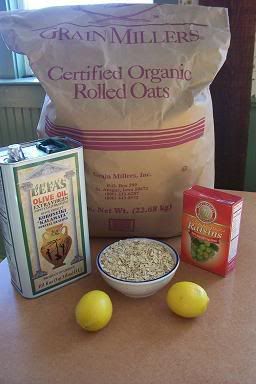
When I made my own Horse Chow, I didn’t follow the Nearing's directions exactly because I’m a typical man in that regard. I now realize (after typing out the recipe above) that I left out the sea salt. It still mixed together just fine. Here is a picture of the ingredients:


Photobucket


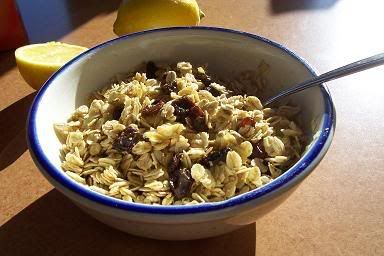
I made my horse chow by putting some raw rolled oats in a bowl. Then I squeezed in 1/2 of a lemon, and mixed. Then I poured in some good-quality olive oil, and mixed. Then I added the raisins, and mixed. Here’s a close-up picture of the finished chow:


Photobucket


You’re probably wondering how it tasted. Well, it needed salt. Just kidding. The Horse Chow was different. It was chewy. But it wasn’t bad. The sweet raisins and the tart lemon made for a nice contrast of flavor. One thing is for sure—Horse Chow fills you up!

I have been eating quite a bit of Horse Chow over the past 10 days. One Saturday I ate nothing but Horse Chow for the whole day. I’ve mixed Horse Chow at work for lunch. I’ve found that I like it better with some apple pieces. It’s also good mixed with yogurt.

You’re probably also wondering how I feel after eating so much of this raw chow. Well, I feel pretty good. I think I’ve even lost some weight since I’ve started eating horse chow. I also run faster and jump higher.

In the past, when I was hungry, I’d snack on bread or crackers (carbs) with something on them (peanut butter, jam, cheese, sardines—you name it). But now I mix up some horse chow. It’s quick and easy.

Did you notice that BIG bag of rolled oats in the above picture? I’ll be eating horse chow for a long time to come. If you stop by for a visit some day, I may feed you horse chow. That’s one of the things the Nearings fed their many visitors.

In my next essays (a twelve-part series!) I will tell you all about recipe number four in Helen’s cook book.....”Scott’s Emulsion”. It’s a two-ingredient recipe. And “Scott’s Emulsion” is really tasty when mixed with boiled wheat berries. ;-)


==================================
CLICK HERE to go to Part 1 of this "Horse Chow" series.


Scott Nearing’s
“Horse Chow”
(Part 3)

Dateline: 28 March 2008

Scott & Helen building a stone wall.

My last two blog esays have been about Scott and Helen Nearing, their 1954 book, Living The Good Life, and what remarkable people they were. Each of my essay’s has been titled Scott Nearing’s “Horse Chow”. But I have yet to tell you about the “horse chow” which, I hasten to add, is not for horses. In this essay I might actually get to telling you about Scott’s horse chow.

As noted previously, one of the reasons the Nearings left urban life with its many trappings and conveniences was to maintain and improve their health. Scott was 49 years old when they made their break for the Vermont wilderness. Helen was 20 years his junior.

The Nearings saw very clearly that the typical modern lifestyle was inherently unhealthy. For the urbanized masses, work was becoming more sedentary and separated from fresh air and sunshine. Furthermore, the corporate-industrial system was spraying food with synthetic chemicals in the growing, and adulterating the food with chemicals again in the preserving and processing. In their “Good Life” book, the Nearings write:


Among the vested interests that have come to the fore in the modern world there are those who deliberately devitalize, drug, and poison the population for profit. Perhaps it may seem absurd, in this day and age, to write about deliberate poisoning. Most people associate the poisoning of food with family feuds in the Middle Ages, with primitive warfare, or with an occasional bit of spite-work perpetuated in a fit of anger or jealousy. Research shows the words are more applicable today than they were in the days of the Borgias.

Poison, says the dictionary, is “any substance which by reason of an inherent deleterious property tends to destroy life or impair health when taken into the system”. Any food product which tends to destroy life or to impair health therefore may be listed as a poison.

Among the many poisonous foods that are commonly consumed, the Nearings list: white flour, white sugar, polished rice, oleomargarine, canned foods, puddings, cakes, and anything with artificial colors, preservatives, and flavorings. Alcoholic, caffeinated, and carbonated beverages also fall into the poisonous category. Here are a couple more pertinent quotes from the book:


Food processing, poisoning, and drugging is undermining the health of the American people as well as yielding large profits to the individuals and corporations engaged in processing, poisoning, and drugging.
We are equally convinced that the immense sums spent by the food processors, drug manufacturers, and pharmaceutical houses for advertising, propaganda, lobbying, and other types of “public relations” are having a deleterious effect on the well being of the American and other Western peoples.


Helen and Scott wrote those words 56 years ago. They stated that Millions of people in the United States [are] more or less helpless victims of the food industry. It was true then. It is even truer today.

With those things in mind, the Nearings decided they would no longer be victims. They determined to not consume the poisonous food of the industrial providers. They would modify their diet to eat whole, fresh, fruits, vegetables, grains, and nuts. And, being vegetarians, they never ate “the cooked carcasses of beasts, birds, or fish.”

All of which means that they didn’t eat the overwhelming majority of foods found in any modern supermarket. Such foods were seen as part of the “corporate market economy.” And living the good life was a declaration of separation and independence from such an economy.

Beyond the matter of health, those readymade and poisoned foods were seen as completely superfluous. They quote Mark Twain: Civilization is a limitless multiplication of unnecessary necessaries. Then the Nearings add their own insight: A market economy seeks to ballyhoo and bamboozle consumers into buying things they neither need nor want.” It was true then. It is even truer now.

All of this leads us to the question: How did they survive without all the “good” modern foods?

Well, they actually managed to survive quite well. Scott lived to be 100 years old, and Helen to 91. Both were healthy and active to the end. It is reported that they did not go to doctors, did not have any sicknesses, and were on no medications.

Helen writes in her final book ("Loving and Leaving The Good Life") that, with age, Scott grew physically weaker. When he could no longer carry in their firewood, he decided it was time to go. He simply stopped eating and starved himself to death, at home, while Helen cared for him through the “final episode.” It was suicide by starvation, which, frankly, I find shocking. Helen died in an auto accident while driving herself to town several years later.

The point is, these two people were remarkably healthy and physically productive, and for far longer than the average modern man or woman. They attributed much of this vitality and longevity to their diet. They attributed it to Scott’s “horse chow” mix.

Oh, but look.... time has run out once again. I’ll have to tell you about Scott Nearing’s Horse Chow in my next essay.

Stay tuned.....
==============

CLICK HERE to read the fourth and final essay in this horse chow series.

=====================
CLICK HERE to go back to the first essay in this "Horse Chow" series.


Scott Nearing’s
"Horse Chow"
(Part 2)

Dateline: 26 March 2008

Scott & Helen Nearing

In my previous essay I introduced you to the classic back-to-the land book, Living The Good Life by Helen and Scott Nearing. And I gave you some background information (things you won’t find in the book) about the Nearings. I concluded by recommending the book even though I am not in accord with the Nearing’s non-Christian beliefs.

Truth be told, I admire Scott and Helen for their gumption, idealism, focus, and determination. They recognized the foolishness and depravity inherent in the industrialized lifestyle and decided not to participate. They didn’t just talk the talk, they walked the walk. That is admirable. If more modern-day Christians in America walked the walk instead of just talking the talk, we would be a far more effective witness for Jesus Christ. That’s my opinion.

Personally, I have endeavored to live a countercultural Christian lifestyle, especially over the last nine years. It is a way of life called Christian-agrarianism. As most of you who read this blog probably know, I even wrote my own “good life” book a couple years ago (Writings of a Deliberate Agrarian is the title).

In the beginning of my book I make it clear that I am no expert on the Christian-agrarian “good life.” I am more like a hungry beggar who has found a source of good bread, and I want to tell others all about it.

I get letters from readers of my book, and that is always a nice thing. But some people write seeking greater wisdom and depth of understanding from me about Christian-agrarianism. More than a few even want to come and visit me. I feel inadequate about answering many, if not most, of the specific questions posed to me, and I am pretty sure people would be disappointed if they visited me. I am not the eloquent and dogmatic counterculture “radical” that Scott Nearing was. I am not prepared to debate my position with any and all comers, as Scott Nearing delighted in doing when he was in his prime. I am no Christian-agrarian paragon.

I’m just a beggar who has found bread. And I’ve tasted the bread. And it is good.

I have found that when Christianity is embraced and deliberately lived within the agrarian framework, it bears good fruit. It bears better fruit than life lived within the industrialized, worldly, framework that dominates in this day and age. And I believe it bears better fruit than agrarianism blended with the Nearing’s brand of Buddhism, or any other antichrist belief system. In fact, I'll go so far as to say that I believe Chirstianity is best lived within the agrarian paradigm. I think that is what God intended from the start. And good fruit is what a truly good life should be all about.

When I refer to "good fruit" I am referring (for starters) to the "fruit of the Spirit" mentioned in Galatians 5:22. "But the fruit of the Spirit is love, joy, peace, longsuffering, gentleness, goodness, faith, meekness, temperance..." Qualities like that do not find fertile ground to grow and mature in the industrial world and the industrialized lifestyle, as they do within the agrarian lifestyle.

I think Michael Bunker said it well: "Agrarianism is the only proper seedbed of a Christian life and worldview. The whole Bible teaches it, and every story and parable re-affirms it."

The rightness and "goodness" of Christian agrarianism seems so plainly obvious to me. And I often wonder, how do I explain something that is obvious? How do I justify something that is obvious? I do it by simply testifying to the obvious with stories from my own life, and pertinent essays. This blog archive has plenty of such testimonies, as does my book. But I have digressed. This is supposed to be about the Nearings.

Yes, I like the Nearings for many reasons. They rejected consumerism and materialism by living very simply. They embraced the virtues of hard physical work and a wholesome diet of organic food. They grew 80-percent of their own food. They cut their own firewood. They built their home and outbuildings with their own hands using native stone. They were good neighbors, and gracious hosts to as many as 2,000 strangers who made their way to the Nearing’s homestead each year. When people showed up, Scott and Helen put them to work, and fed them, and they shared their vision of the “good life” with them. That is remarkable.

The Nearings eschewed the whole modern idea of working a regular job in order to earn a living. They chose instead to make a subsistence income by working on their land. That is what they said in their book. But in recent years, after their death, it has come to light that the couple had the luxury of inheritances to help support themselves. Does this revelation about their “good life” discredit their lifelong experiment? I think it does. But only to a degree.

The fact remains that they still lived deliberately and simply, and separate from the industrialized modern culture. Most people who are blessed with the advantage of “old money” would never choose to live as the Nearings did. It’s quite possible that their choice of lifestyle is even more remarkable knowing that they may have had the money to live far “better.”

In any event, it was my intention to tell you about Scott Nearing’s unusual food concoction called “horse chow” in this essay (it's not for horses) and, once again, I have rambled on without doing so. I will get to it next time (maybe). For now, I’d like to leave you with an excerpt from an interview that Helen Nearing gave in 1994. Scott had died eleven years earlier at 100 years of age. She was 90 years old and would die in an auto accident a year later.

The interviewer mentioned that many people are attached or addicted to “feeling part of the culture, watching big events on television, going to the popular movies. Have you ever regretted not being a part of those events—missing that shared context?”

Helen responded:

"I have a sense of not being part of it but I haven’t missed it. The titillation that’s generated on the screen or boombox is absolutely unnecessary to me. Hell on earth for Scott and me would have been the perpetual noise of radio or television. And you get them perforce. You can do nothing about it once you turn on these machines. There these voices are, there these ideas are, there these people are. I feel no kinship with them and I gladly turn their noise off. And gladly live without the noise."


CLICK HERE to read essay #3 in this four-part "Horse Chow" series.


Scott Nearing’s
"Horse Chow"
(Part 1)

Dateline: 25 March 2008

Scott & Helen Nearing in the early years

Scott & Helen Nearing were icons of the 1970s back-to-the-land movement. They fled the rat race of New York City in 1932, during the deepest part of the Great Depression, and moved to a run-down 65 acre farmstead in the rural wilderness of Vermont’s Green Mountains.

Twenty years later, they wrote and self-published the book that would make them famous: Living The Good Life: How to Live Sanely and Simply in a Troubled World. The book was a chronicle of Helen and Scott’s countercultural quest. Since then, “Living The Good Life” has been through more than 30 printings and sold more than 300,000 copies. In the Preface of the book, the Nearings write:


At the outset we thought of the venture as a personal search for a simple, satisfying life on the land, to be devoted to mutual aid and harmlessness, with an ample margin of leisure in which to do personally constructive and creative work.


The Preface further states:


When we moved to Vermont we left a society gripped by depression and unemployment, falling a prey to fascism, and on the verge of another world-wide military free-for-all, and entered a pre-industrial, rural community.


What exactly motivated the Nearings to make their life-changing move? Surely the depression was a factor. But there was much more to it. The book hints of the deeper reasons when it says that because of their “pacifism, vegetarianism, and collectivism," they were denied "their part in public education.” Knowing something more of Scott Nearing’s background brings a clearer understanding....

He was born in 1883 to a well-to-do family in Pennsylvania. At 23 years of age he was an assistant professor at the Wharton School of Economics. Nine years later they fired him for his vocal opposition to child labor. One wonders how opposing child labor in factories and mines would get a man fired from his job as a professor. Well, evidently, he directed his venom at the Philadelphia industrialists who were benefiting from the use of child labor. These moneyed interests exercised their plutocratic powers and Nearing was out.

In 1917 Scott Nearing railed against the war, which he recognized as a capitalist tool to enrich the plutocracy. He wrote an anti-war pamphlet and was promptly indicted by the federal government for instigating draft dodging. At his trial he addressed the jury with an eloquent final statement, declaring that it was his right and duty as an American to voice his conscience. They deliberated for 30 hours and acquitted him.

Scott Nearing ran for Congress as a Socialist. He did surprisingly well but lost. He joined the Communist Party and, after disagreeing with them, they kicked him out. Unable to get a job in education, Scott turned to speaking. For nearly ten years he made speeches and debated such luminaries as Clarrence Darrow. Then came the Great Depression.

Again, from the Preface of “Living The Good Life”....


Under the circumstances, where could outcasts from a dying social order live frugally and decently, and at the same time have sufficient leisure and energy to assist in the speedy liquidation of the disintegrating society and to help replace it with a more workable social system?


That rhetorical question resonated with me when I first read it 32 years ago. Even though I was not a Communist or a Socialist, and even though I thought Capitalism was a good thing, and even though I thought foreign wars were probably necessary, and that vegetarians were oddballs, and even though the word “plutocracy” was nowhere in my personal lexicon, I knew something was seriously wrong with modern culture; that it was self-destructive. I intuitively understood that living simply was living better.

As a teenager, I was fascinated by the Nearings and their book. I still am. Here is another excerpt from the Preface:


We left the city with three objectives in mind. The first was economic. We sought to make a depression-free living, as independent as possible of the commodity and labor markets, which could not be interfered with by employers, whether businessmen, politicians or educational administrators. Our second aim was hygienic. We wanted to maintain and improve our health. We knew that the pressures of city life were exacting, and we sought a simple basis of well-being where contact with the earth, and home-grown organic food, would play a large part. Our third objective was social and ethical. We desired to liberate and disassociate ourselves, as much as possible, from the cruder forms of exploitation: the plunder of the planet, the slavery of man and beast; the slaughter of men in war, and of animals for food.

We were against the accumulation of profit and unearned income by non-producers, and we wanted to make our living with our own hands, yet with time and leisure for avocational pursuits. We wanted to replace regimentation and coercion with respect for life. Instead of exploitation, we wanted a use economy. Simplicity should take the place of multiplicity, complexity, and confusion. Instead of the hectic mad rush of busyness we intended a quiet pace, with time to wonder, ponder and observe. We hoped to replace worry, fear and hate with serenity, purpose and at-one-ness.


It was an idealistic, utopian vision the Nearings had, and, to a degree, they achieved what they set out to do. Today, the Nearing's simple, agrarian-based “good life” still beckons to many. They see that our industrialized culture is bereft of substance and meaning. To such people, Living The Good Life is a worthwhile read. It contains practical advice and inspiring examples. I recommend it. However, this book should be read with discernment. It is a chew-the-meat-and-spit-out-the-bones kind of book.

Bearing that in mind, I would be sorely remiss if I did not state that I feel the Nearings missed the mark in their quest. I can not fathom a “good life” without my Christian faith at the center of it all. I can not imagine the “good life” without children and grandchildren to share and enjoy it with. Both of these things are conspicuously missing from the Nearing’s example.

Though not specifically discussed in their book, one need not look far to discover that the Nearings were not Christians. Helen’s thinking was heavily influenced by Buddhist beliefs. One assumes that Scott’s was also. Their lifestyle has Buddhist overtones. Though they acknowledged and loved the natural world, they held pantheistic beliefs about origins. They embraced the Hindu theology of reincarnation. This explains their vegetarianism and never owning any animals. Curiously, Helen made it a point not to even say the word, “God.”

Helen was also an avid dowser, a practice known as divination in the Bible, and strictly forbidden by scripture. When she and Scott decided to leave Vermont (because it was getting too developed and crowded) they turned their sights to coastal Maine. To find the best place for their new homestead, Helen dowsed with a pendulum over a map of the state. They moved where the pendulum told them to move.

In the final analysis, I’m convinced that “the good life,” as the Nearings knew it and lived it, was not "the best life." They left out the most important things. They failed to see and understand God's grace, and His mercy, and they neglected to give Him all the glory for all the goodness they had ever known.

All of which brings me to my own definition of The Good Life:

When a simplified lifestyle, separated-from-the-craziness-of-an-ungodly-world system, is lived within the God-ordained agrarian paradigm, and is pursued with a Biblical worldview, in humility and love, for the purpose of raising godly families (unto future generations), while blessing those around you, and strengthening the body of Christ, and influencing others to pursue righteousness, then God is glorified, and that is, in my opinion, as good as it gets.

=============================

P.S. You may be wondering why I titled this essay Scott Nearing’s Horse Chow. Well, it was my original intention to write about the unique food concoction the Nearings ate. They called it "horse chow," but it was not for horses. We’ll talk about horse chow next....

CLICK HERE to go to part two of this series.

Old Farm Almanacs For March

My pet project this year is my newest blog Old Farm Almanacs. Here is a sampling of postings I've made there for this month of March:

Farmers Are Lords of Creation: 1864
A Christian-agrarian statement from 144 years ago!

Questioning Progress: 1867
"We tunnel the mountains, net the continents with railways, and stretch our telegraph wires under the ocean, but are we any better men and women, any truer worshippers of God..."

Feeding Horses: 1875
"Here is a table for horse feed given by a Conecticut clergyman, after careful estimates and experiments..."

March & Mars, The God of War: 1851
Here's an anti-war statement like you've never seen before.

Dealing With Udder Inflamation: 1865
Learn how farmers managed without antibiotics

Take Your Work by the Forelock: 1859
It's March. Get to work!

Get Ready For Spring Work: 1867
There is plenty to do on the farm come March.

Questioning Creation in 1878
Dr. Tyndall is amazed with creation, but confused about origins. It is Darwin's legacy.

Picking Rocks: 1882
March is a great time to get the rocks out of your fields.

Economical Habits & Christian Virtue: 1865
Here's a fine little sermon from a "secular" publication of the day.

The Woodlot in March: 1856
"Hark! ‘tis the woodsman’s axe...."

Riches & Happiness: 1845
"Riches take away more happiness than they bestow...."

Wisdom For Raising Children: 1850
The advice is timeless.

Selections From March "Farmer's Calendar" Essays
"Keep up courage, winter is nearly gone...."

More Selections From March "Farmer's Calendar" Essays
"There is no other month like this. Cold, sleet, rain, snow, and sunshine. But we must make the best of it...."

Boy Shoots Raccoon in His Underwear

Today at lunch Marlene told me about a conversation she had with her friend who lives not too far from us. Her friend related that a neighbor woman had been chased by a rabid raccoon in her yard. The neighbor called someone to come shoot the animal, but they couldn’t find it.

Then, a little while later, the critter showed up at Marlene’s friend’s house. The friend’s teenage son ran outside and shot the raccoon in his underwear.

That’s quite a story. I couldn’t help but ask the obvious.... How did the raccoon end up wearing the boy’s underwear?

Seriously, though, I like that story because the boy responded and did exactly what God designed men (young and old) to do, which is to protect their families against dangers. And instead of taking the time to get dressed, this kid runs outside in his underwear to get the job done! Yeah. I like that a lot.

Of course, you can do stuff like that when you live out in the country. Running outside in your underwear and shooting dangerous animals is really not out of the ordinary.

Now, if you lived in the suburbs, that’s a different story. You can’t shoot things in your yard in suburbia. The neighbors will call the police. And if you’re out there in your skivvies, it just compounds the problem.

This story is actually somewhat coincidental because this afternoon, I walked out of my work shop, toward my house and, on the way, I passed a raccoon. He was about 20 feet off to my left side. I almost didn’t even notice him. He was quietly ambling along, with his rear end hiked up in the air, like raccoons do, and not paying any attention to me.

Well, when I see a raccoon walking through my yard in daylight, I shoot it. More likely, one of my kids will shoot it. First, they would probably argue about which one of them was going to shoot the raccoon. But I happened to be home alone today when this incident happened. Oh, and I should make it clear, I was fully clothed.

Once I was in the house, I hastily went to the gun cabinet and chose my son Robert’s single shot, break-action, 20-gauge shotgun—the one I bought him for Christmas a couple years ago—the one he uses to hunt rabbits and squirrels. I had a choice of bird shot or deer slugs. I grabbed two slugs, put one in the chamber and hurried outside. I left our dog, Annie, in the house. The last thing I needed was my dog to tussle with a rabid coon.

When I got outside, the raccoon was nowhere in sight. I wandered around and finally spotted it on the other side of my shop. I closed in as it walked past my compost pile. I walked closer. The coon acted like he didn’t see me. I was off to its side and a little behind as he made his way along one side of my chicken tractor. Then he stopped, and so did I. We were maybe 10 feet apart.

The raccoon slowly turned his head around and looked at me with his beady black eyes. The way he turned his head and looked at me reminded me of a scene I once saw in Jurassic Park, where the big dinosaur realizes there is a human nearby, and turns his head slowly to look at the person, just before pouncing.

Well, I didn’t wait to see what the coon was going to do next. I blasted that thing and killed it dead, right there next to the chicken tractor. That’s what I did.

Deer slugs work real well on raccoons (I only used one, by the way).

For those readers who live in a foreign country where there are no raccoons, or if you’re a city person who has maybe never seen a dead raccoon, here’s a picture of the little beast:

Photobucket

So then I had to dispose of the dead, rabid coon. I can’t leave it outside where Annie would get it. She would chew on it and drag it off to someplace and bury it. Then dig it up a few months later and drag it onto the lawn, by the door to our house (where everyone who visits us would see it) and commence to eat it.

Fortunately, I have a special place. It’s the place where we toss all our dead raccoons. And all the long-dead and half-rotted carcasses Annie hauls in from who-knows-where. It’s an Annie-proof place. Here it is:

Photobucket

That is what’s left of a big, hollow basswood tree that blew down in a storm a few years ago. It is located across from our house in the neighbor’s hedgerow. All the dead animals go in that stump. That’s a real handy stump there.

Introducing a Young Agrarian Blogger...

Matthew Potter is 18 years old. He lives with his family in a farm house on 1.5 acres of land in Michigan. His father is an electrical engineer. His mother is a "one woman army." His brother is a talented pianist. Matthew is a Christian with agrarian interests. And he has just posted his first blog entry.

I encourage you to check out Matthew's introductory blog essay and welcome him to the world of Christian-agrarian blogging....

Matthew's First Post at PotterVilla Academy

Gold At $1,000

[Dateline: 13 March 2008]

You've probably heard the big news. Today, for the first time ever, the value of one ounce of gold squeaked past $1,000.

If you have ever seen a one-ounce gold coin you know it is not very big. A one-ounce American Gold Eagle bullion coin is roughly the size of a half dollar coin. Tonight they are selling on Ebay for around $1,200. A 1/10 ounce American Eagle is roughly the size of a dime, and they are selling for around $120.00.

What would compel people to spend so much for those little pieces of metal?

The answer is FEAR. The reality of the seriousness of inflation, and uncertainty about the future, is beginning to really register with the masses. They want to preserve their assets. Precious metals, gold and silver in particular, typically hold their value in an inflationary period.

Here's the interesting thing about today's high price... it really isn't the highest price per ounce that gold has ever been.

Back in the 1980's, the price of an ounce of gold got up to over $800. I read recently that if you figure in the rate of inflation since then, the price of gold today would have to be over $2,000 to equal that previous high.

Do you think it will get that high? I would be very surprised if it didn't.

Tonight on the radio I heard a BBC radio news report in which the reporter said something pretty close to this: "The American Federal Reserve says it will not rest until it finds an appropriate salve for the current monetary problems."

That's kind of funny. I don't think the Federal Reserve has an "appropriate salve" for what's we're experiencing.

Now that gold has broken the $1,000 barrier, some people believe that will trigger a mass flight to gold. Gold could become the next "bubble."

Well, maybe. I sure don't know. But I think even the most optimistic of American investor-lemmings are beginning to see the handwriting on the wall. Things are not going to be getting any better with the American economy any time soon. Should we all buy precious metals? Well, maybe. But I have a feeling that most Americans don't have the money to spend on such things.

If you are interested in purchasing gold or silver, contact Franklin Sanders at The Moneychanger. I believe he is someone you can trust completely.

But, more importantly, if I were to offer any advice for the uncertain days ahead it would be exactly what I wrote two months ago in this essay: An Agrarian-Style Economic Self Defense Plan.